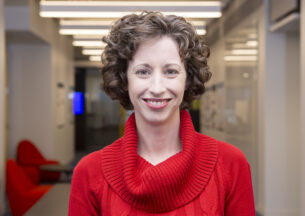
Rebecca Willett is a Professor of Statistics and Computer Science at the University of Chicago and Faculty Director of AI at the Data Science Institute. She holds the Worah Family Professorship and is a member of the Wallman Society of Fellows. Her research focuses on machine learning, signal processing, and scientific computing, with applications in astronomy, climate science, and biochemistry. She has held visiting roles at institutions including UCLA and INRIA. Key roles include Deputy Directorships at the NSF-Simons Institute for Theory and Mathematics in Biology and the SkAI Institute. Education: PhD in Electrical and Computer Engineering from Rice University (2005), followed by faculty roles at Duke University (2005–2013) and the University of Wisconsin-Madison (2013–2018). Awards include the 2024 SIAM Data Science Career Award, NSF CAREER Award (2007), and AFOSR Young Investigator Award (2010). Research interests span inverse problems, optimization theory, and interdisciplinary applications. Her work bridges high-dimensional statistics and imaging science. Recent articles emphasize neural network theory, climate data assimilation, and biophysical modeling. Awards include SIAM Fellowship, IEEE Fellowship, and teaching excellence awards. She leads initiatives in AI ethics, broadening participation in STEM, and serves on key committees like the National Academies' CATS. Labs/Groups: Machine Learning Group at UChicago, CERES Center for Unstoppable Computing. Grants include NSF, DOE, and collaborations with Argonne National Laboratory.
Florian Schäfer is an Assistant Professor at the School of Computational Science and Engineering at Georgia Tech. His research spans numerical computation, statistical inference, and competitive games, with applications in materials science, turbulence modeling, computer graphics, and computational geometry. He will join the Courant Institute at NYU in September 2025. PhD in Applied and Computational Mathematics, Caltech Bachelor’s and Master’s in Mathematics, University of Bonn His work focuses on information geometric mechanics to design structure-preserving numerical methods for continuum mechanics. This includes: State-of-the-art solvers for elliptic PDEs via Gaussian elimination and conditional independence Efficient multi-agent optimization algorithms Information geometric regularization for compressible fluid dynamics Enabling the first compressible fluid simulation exceeding 100 trillion grid cells His recent research trends integrate: Machine learning for materials science (e.g., active learning, Bayesian approaches) Stochastic modeling of microstructures and phase-field problems Neural operators for super-resolution fluid dynamics Generative models for polycrystalline material datasets Optimal transport and diffusion models for conditional density transformations High-performance computing at extreme scales Florian collaborates with researchers including Houman Owhadi, Jessie Liu, Spencer Bryngelson, Tamer Zaki, and Ali Mani. He actively presents at conferences like SIAM and UCLA seminars, and is recruiting PhD students for work at the Courant Institute starting 2025.
Matthew B. Blaschko is a Professor in the Department of Electrical Engineering at KU Leuven, Belgium. He serves as director of the KU Leuven ELLIS unit and is a fellow in the ELLIS Health program. He is a Core PI in the Flanders AI Research Program, working as a workpackage lead for Decision Support Systems and Medical Imaging. Blaschko is also a member of the KU Leuven Institute for Artificial Intelligence and one of the leaders of the working group on Machine Learning and Data Science. Professor Blaschko received his B.S. from Columbia University, M.S. from the University of Massachusetts Amherst, and Dr. rer. nat. from Technische Universität Berlin (awarded for work at Max Planck Institutes Tübingen). He was a Newton International Fellow at the University of Oxford and received his Habilitation (HDR) from École Normale Supérieure de Cachan. Prior to joining KU Leuven, he was a Permanent Research Scientist in the INRIA Saclay Research Center and a Faculty Member at Ecole Centrale Paris. His research focuses on machine learning techniques applied to visual data, with particular emphasis on calibration in deep learning, medical image analysis, and federated learning. Blaschko's work bridges theoretical foundations with practical applications, as evidenced by technology developed in his research being incorporated into MONA, software for ophthalmic image analysis. His research group has made significant contributions to the fields of model calibration, uncertainty estimation, and medical imaging analysis, with recent publications showing strong trends toward improving reliability of AI systems in medical contexts and advancing theoretical understanding of calibration metrics. Professor Blaschko has been recognized with several awards including the Université Paris-Saclay STIC Doctoral School Best Scientific Contribution Award, Best Paper Award at CVPR 2008, Main Award at DAGM 2008, and Best Student Paper Award at ECCV 2008. Professor Blaschko has supervised numerous PhD and Master's students, with current and former students including Deniz Soysal, Claire Marchal, Dongli Xu, Sebastian Gruber, Jiameng Li, Marco Mezzina, and many others working on diverse topics from Alzheimer's disease analysis to surgical phase recognition. His research has been supported by various funding sources including the Flanders AI Research Program. He has co-organized several influential workshops including the "Another Brick in the AI Wall: Building Practical Solutions from Theoretical Foundations" at CVPR 2025, Commands 4 Autonomous Vehicles workshop at ECCV 2020, and the Learning from Limited Labeled Data workshop series at NIPS 2017 and ICLR 2019. His laboratory focuses on machine learning for medical image analysis, with applications in ophthalmology, neurology, and surgical robotics. The group maintains active collaborations with medical institutions and participates in international challenges such as the KNee OsteoArthritis Prediction (KNOAP2020) challenge.
Sebastian Schemm is a Heisenberg Fellow at the Department of Applied Mathematics and Theoretical Physics (DAMTP), University of Cambridge, a position regarded as equivalent to a non-permanent Associate Professor. He leads research within the Atmosphere-Ocean Dynamics group and previously held an ERC Starting Grant-funded Assistant Professorship (without tenure track) at ETH Zurich. Education and Career Path PhD (2013) and MSc (2010), ETH Zurich, Switzerland Postdoctoral researcher, University of Bergen, Norway (2014–2017) Postdoctoral researcher, Laboratoire de Météorologie Dynamique, ENS Paris (2017–2018) Assistant Professor (ERC Starting Grant), ETH Zurich (2020–2024) Heisenberg Fellow, DAMTP, University of Cambridge (2025–present) Research Focus Schemm’s work centres on atmospheric and climate dynamics, spanning turbulence to planetary scales. Core themes include the physics of extratropical cyclone life cycles, jet-stream and storm-track dynamics, Rossby waves and teleconnection patterns, high-resolution atmospheric modelling, and the integration of machine-learning techniques for parameter estimation, data assimilation, and kilometre-scale global simulations. He also contributes to large-scale initiatives such as ECMWF’s WeatherGenerator. Scientific Awards and Editorial Service DFG Heisenberg Fellowship (2025) ERC Starting Grant (2020–2024) European Meteorological Society Young Researcher Medal (2019) Co-Editor, Weather and Climate Dynamics (EGU) Co-Editor, Quarterly Journal of the Royal Meteorological Society PhD Supervision & Funding He currently supervises PhD students at both Cambridge and ETH Zurich, with funding streams including the Cambridge CREATES Doctoral Training Partnership and Swiss/EU grants. Ongoing students explore reinforcement-learning parameterisations, jet-stream–storm-track relationships, mid-latitude eddy energetics, machine-learning ensemble forecasting, and Bayesian parameter estimation in LES. Active Projects EU Horizon project WeatherGenerator (led by ECMWF) PASC HiRAD-Gen : High-Resolution Atmospheric Downscaling Using Generative Models
Assoc Prof Ng Teng Yong is an Associate Professor at the School of Mechanical & Aerospace Engineering (NTU), specializing in numerical modeling and simulation. With a background as Research Manager at A*STAR Institute of High Performance Computing, his work spans materials science, nanotechnology, and aerospace engineering. Current focus on graphene-based desalination membranes Expertise in molecular dynamics simulations Investigates nanoscale fluid mechanics and structural dynamics Recent publications highlight advancements in energy-efficient electrodialysis, smart robotics, and nonlinear vibration analysis. His interdisciplinary approach integrates computational methods with experimental validation in additive manufacturing and soft material mechanics.
Dr. Carolyn Conner Seepersad is a Woodruff Professor in the George W. Woodruff School of Mechanical Engineering at Georgia Institute of Technology. She leads the Digital Design and Manufacturing research group and previously founded the Center for Additive Manufacturing and Design Innovation at The University of Texas at Austin. Her research focuses on additive manufacturing, materials design, and process innovation. She holds editorial roles, including Editor-in-Chief of the ASME Journal of Mechanical Design, and has received numerous awards for research and teaching. Education: PhD, Mechanical Engineering, Georgia Tech, 2004 MS, Mechanical Engineering, Georgia Tech, 2001 BA, Philosophy, Politics, and Economics, Oxford University, 1998 BS, Mechanical Engineering, West Virginia University, 1996 Her research interests span design for additive manufacturing, simulation-based materials and structures, and metamaterials. She emphasizes manufacturing-aware design and sustainability. Key contributions include lattice structure optimization, negative stiffness composites, and process-aware manufacturing techniques. Her publications reflect advancements in additive manufacturing processes, materials characterization, and design methodologies. Awards include the ASME Design Automation Award and recognition as a University of Texas System Academy of Distinguished Teachers. Seepersad has advised on grants such as the LEAP-HI GOALI project and contributed to initiatives like the Solid Freeform Fabrication Symposium. Her work bridges academia and industry, emphasizing practical applications and innovation. Labs/Teams: Leads the Digital Design and Manufacturing group at Georgia Tech, previously directed the UT Austin Additive Manufacturing Center.
Jonathan A. Kelner is a Professor of Applied Mathematics in the Department of Mathematics at the Massachusetts Institute of Technology (MIT) and a member of the MIT Computer Science and Artificial Intelligence Laboratory (CSAIL). His research focuses on applying techniques from pure mathematics to solve fundamental problems in algorithms and complexity theory, with the goal of developing practical algorithms for real-world questions. Dr. Kelner received his undergraduate degree from Harvard University and his Ph.D. in Computer Science from MIT in 2006. Before joining the MIT faculty, he spent a year as a member of the Institute for Advanced Study. His educational background has provided a strong foundation for his interdisciplinary research spanning mathematics and computer science. His research interests include combinatorial optimization, mathematical programming, spectral graph theory, distributed computing, machine learning, computational geometry and topology, computational biology, signal processing, and random matrix theory. Kelner's work demonstrates how deep theoretical insights can lead to practical algorithmic improvements, particularly in graph algorithms and optimization problems. His approach often involves connecting seemingly disparate areas of mathematics to create novel algorithmic techniques. Analysis of his recent publications reveals a strong focus on spectral graph theory, optimization algorithms, and the Sum-of-Squares method. His work frequently addresses fundamental questions in theoretical computer science with practical implications for algorithm design. A notable trend in his research is the development of nearly-linear-time algorithms for various graph problems, which represents significant improvements over previous approaches. NSF CAREER Award Alfred P. Sloan Research Fellowship NEC Award for Research in Computers and Communication Sprowls Doctoral Dissertation Award Best Student Paper Award at STOC 2004 Best Paper Award at STOC 2011 Kokusai Denshin Denwa Junior Faculty Chair 2008 Harold E. Edgerton Faculty Achievement Award 2011 School of Science Award for Excellence in Undergraduate Education 2012 Professor Kelner has been actively involved in mentoring students and has received recognition for his teaching excellence, including the School of Science Award for Excellence in Undergraduate Education in 2012. His research has been supported by prestigious grants including the NSF CAREER Award. He has collaborated extensively with researchers across multiple institutions, often working with other leading figures in theoretical computer science to produce groundbreaking results in algorithm design. At MIT, Kelner is part of both the Mathematics Department and CSAIL, positioning him at the intersection of theoretical mathematics and practical computer science. This dual affiliation reflects the interdisciplinary nature of his work, which bridges pure mathematical theory with concrete algorithmic applications.
Vladimir Spokoiny is a Professor at the Departments of Mathematics and Economics of the Humboldt University of Berlin and Head of the Research Group "Stochastic Algorithms and Nonparametric Statistics" at the Weierstrass Institute for Applied Analysis and Stochastics (WIAS) in Berlin, Germany. His research spans multiple areas of statistics, machine learning, and financial mathematics, with significant contributions to nonparametric statistics, high-dimensional data analysis, and statistical methods in finance. Spokoiny received his M.Sc. in applied mathematics from the Moscow Institute of Railway Engineering in 1981 and his Ph.D. in mathematics from Lomonosov Moscow State University in 1988. He completed his Habilitation at Humboldt University in 1996. His academic career includes positions at the All-Union Institute of Railway Transport in Moscow, the Institute for Information Transmission Problems in Moscow, and the Institute for Applied Analysis and Statistics in Berlin before joining the Weierstrass Institute and Humboldt University where he has been a professor since 2002. Spokoiny's research focuses on adaptive nonparametric smoothing and hypothesis testing, high dimensional data analysis, statistical methods in finance, image analysis with applications to medicine, classification, and nonlinear time series. His work often addresses the challenges of nonstationarity in time series data and develops innovative methods for volatility estimation and risk management. He has made significant contributions to the development of adaptive weights smoothing procedures, which have applications in image processing, community detection, and manifold learning. His recent work has expanded into high-dimensional statistics, Bayesian inference, and optimization methods for machine learning, with publications demonstrating novel approaches to Gaussian approximation, Laplace methods, and statistical inference in non-Euclidean spaces. Spokoiny has supervised numerous PhD students including Oliver Reiss, Danilo Mercurio, Ying Chen, Elmar Diederichs, and Mstislav Elagin, whose research has focused on mathematical finance, time series analysis, and statistical methods. He serves as an Associate Editor for The Annals of Statistics (since 2004) and Statistics and Decisions (since 2002), and has previously served on the editorial board of the Journal of Statistical Planning and Inference. His professional activities include reviewing for major statistical journals including Annals of Statistics, Bernoulli, Econometrica, and Journal of American Statistical Association, as well as reviewing grant proposals for the National Science Foundation (USA), German Research Foundation, and Netherlands Organisation for Scientific Research. Spokoiny is a member of several professional societies including the International Statistical Institute, American Statistical Association, Institute of Mathematical Statistics, and Bernoulli Society. He is fluent in Russian (mother tongue), English, and German, and has good knowledge of French. His research group at WIAS focuses on developing novel statistical methodologies with applications across various scientific domains, particularly emphasizing adaptivity and robustness in complex data environments. The group's work has significant implications for financial risk management, medical imaging, and machine learning applications, with recent publications addressing fundamental questions in high-dimensional statistics and nonparametric inference.
Ivan C. Christov is an Associate Professor of Mechanical Engineering at Purdue University's School of Mechanical Engineering in West Lafayette, Indiana. His research focuses on fluid dynamics, non-Newtonian fluid mechanics, and multiphase processes, with applications in biomedical engineering, micro/nanotechnology, and advanced materials. He leads the Transport: Modeling, Numerics & Theory laboratory. Education: Ph.D., Northwestern University, 2011 M.S., Northwestern University, 2008 M.S., Texas A&M University, 2007 S.B., Massachusetts Institute of Technology, 2005 Research Interests: Soft hydraulics, computational science, scientific machine learning, nonlinear waves, and fluid-structure interactions. His work spans theoretical modeling, numerical simulation, and experimental validation in complex fluid systems. Publications: Recent work includes studies on flow-rate pressure-drop relations in deformable microchannels, physics-informed neural networks for particle dynamics, and fluid-structure interaction in cerebral aneurysms. Themes include microfluidics, elastohydrodynamics, and rheological characterization of soft materials. Awards: Fulbright U.S. Scholar (2022) Outstanding Engineering Instructor (multiple recognitions) Richard P. Feynman Distinguished Postdoctoral Fellowship (2013) Labs/Teams: Directs the Transport laboratory at Purdue, focusing on interdisciplinary research in fluid mechanics and computational methods. Collaborates on biomedical fluid dynamics and advanced materials characterization.
David Melcher is Professor of Psychology and Program Head in Psychology at New York University Abu Dhabi (NYUAD), where he also serves as a Global Network Professor. He is affiliated with the Division of Science and leads the Perception and Active Cognition Lab, focusing on the integration of perception, attention, memory, and action within a cognitive neuroscience framework. PhD in Psychology and Cognitive Science, Rutgers University (2001) Former researcher and professor in Italy and the UK Current leadership: Program Head, Psychology, NYUAD David Melcher's research centers on cognitive neuroscience , particularly how perception, attention, working memory, eye movements, and self-motion interact to shape cognition and behavior. His lab emphasizes active cognition —the idea that perception is not passive but dynamically shaped by action, context, and goals. He investigates how temporal dynamics in neural processing organize perceptual experiences and guide decision-making. His work spans both healthy and clinical populations, exploring individual differences in spatial and temporal processing across the lifespan. The 15 most recent publications reflect a consistent focus on temporal organization in cognition , perception-action coupling , and neural mechanisms of attention and memory . Keywords across these works include cognitive neuroscience, perception, and neuroimaging, with subfields ranging from eye movement research and neural synchrony to computational modeling and clinical neuropsychology. Collectively, they demonstrate a trajectory toward integrative models of brain function that bridge behavioral, neuroimaging, and computational approaches. Among his notable recognitions is the Distinguished Scientific Award for Early Career Contribution to Psychology from the American Psychological Association (2011), highlighting the early impact of his work in cognitive neuroscience. Distinguished Scientific Award for Early Career Contribution to Psychology, APA (2011) David Melcher has advised numerous students through capstone projects in psychology and computer science, fostering interdisciplinary research at the intersection of cognitive science and technology. His research has been generously supported by major funding agencies including the European Research Council , the US National Institutes of Health , the Italian Ministry of Research and Education , and the Chinese Ministry of Foreign Expert Affairs . He also contributes to the academic community as a member of the editorial boards of Journal of Vision , Psychonomic Bulletin & Review , Perception , and iPerception . He leads the Perception and Active Cognition Lab at NYUAD, which employs a multidisciplinary approach combining behavioral experiments, neuroimaging (fMRI, EEG, MEG), eye-tracking, computational modeling, and clinical assessments. The lab’s research aims to understand how the brain constructs stable percepts from dynamic sensory input, particularly during active engagement with the environment.
Professor Carl Edward Rasmussen is affiliated with the University of Cambridge , where he focuses on Machine Learning , Probabilistic Inference , Decision Making , and Reasoning Under Uncertainty . His work bridges theoretical advancements with practical applications in robotics, control systems, and computational biology. Academic Affiliation: University of Cambridge Academic Role: Professor His research emphasizes scalable Gaussian process methods, Bayesian system identification, and reinforcement learning. Recent projects include transfer learning for antibacterial discovery , graph neural processes for molecular functions , and efficient variational inference techniques . Key themes in his publications highlight uncertainty quantification , model generalization , and nonparametric approaches . Notable Scientific Contributions Advancements in sparse Gaussian process hyperparameter estimation Framework for Bayesian system identification in dynamic systems Hybrid models combining transformers and Gaussian processes
Quoc Thong Le Gia is an Associate Professor in the School of Mathematics & Statistics at the University of New South Wales (UNSW), Sydney. He holds a PhD in Mathematics from Texas A&M University (2003), an MS in Mathematics from Texas A&M University (2000), and a BSc in Mathematics and Computer Science from UNSW (1998). His research focuses on Numerical Analysis , Approximation Theory , Partial Differential Equations , and Stochastic Processes , with particular expertise in problems on spherical domains. His work bridges theoretical mathematics with practical applications in computational science, data science, and machine learning. Le Gia's recent publications demonstrate a strong focus on numerical methods for PDEs on spheres, stochastic analysis, and machine learning applications. His work shows consistent progression from theoretical foundations to practical implementations, with increasing interdisciplinary applications in recent years. L. F. Guseman Prize in Mathematics, Texas A&M University (2003) As a dedicated academic mentor, Le Gia has supervised numerous PhD, Master's, and Honours students across computational mathematics and data science topics. He has secured significant research funding through ARC Discovery Projects including DP220101811 (2022-2024) and DP180100506 (2018-2020). Professionally, he serves as External Associate Editor for Frontiers in Applied Mathematics and Statistics , Secretary for ANZIAM's Computational Mathematics Group, and Co-chair of Mathematics of Computation and Optimisation (AustMS Special Interest Group).
Scientia Professor Nasser Khalili is the Head of the School of Civil and Environmental Engineering at the University of New South Wales (UNSW). He also serves as the Director of the ARC Research Hub for Resilient and Intelligent Infrastructure Systems (RIIS), President of the Australian Association for Computational Mechanics (AACM), and a core member of the International Technical Committee on Unsaturated Soil (TC106). His research focuses on geotechnical engineering, computational mechanics, porous media behavior, and sustainable infrastructure systems. Key areas of expertise include unsaturated soils, hydraulic fracturing modeling, and advanced material characterization for asphalt mixtures. Professor Khalili's work integrates computational methods with experimental analysis to address challenges in infrastructure resilience and environmental sustainability. He has pioneered studies on pore pressure dynamics, fracture mechanics in porous media, and the application of waste materials in construction. His leadership roles in national and international committees reflect his influence in advancing geotechnical and computational engineering practices. His scientific contributions include over 150 peer-reviewed articles, with recent work emphasizing machine learning applications in civil engineering and innovative solutions for sustainable asphalt mixes. Awards include Fellowship of the Academy, recognizing his significant impact on the field.
Mohammad Modarres is the Nicole J. Kim Eminent Professor at the University of Maryland within the A.J. Clark School of Engineering. He serves as Director of the Center for Risk and Reliability (CRR) and is a Professor of Nuclear Engineering in the Department of Mechanical Engineering. Dr. Modarres co-founded the world's first degree-granting graduate curriculum in reliability engineering at the University of Maryland and has established himself as an international expert in reliability and risk analysis. Dr. Modarres received his educational credentials from prestigious institutions: B.S. in Mechanical Engineering from Tehran Polytechnic M.S. in Mechanical Engineering from MIT M.S. and Ph.D. in Nuclear Engineering from MIT Dr. Modarres' research spans multiple critical areas in engineering risk and reliability. His primary interests include probabilistic risk assessment, uncertainty analysis, probabilistic physics of failure, and probabilistic fracture mechanics. His work encompasses both experimental investigations and sophisticated probabilistic model development. He has made significant contributions to materials degradation science, prognosis and health management systems, and nuclear safety analysis. His research bridges theoretical developments with practical applications in complex engineering systems, particularly in nuclear power and aerospace sectors. Analysis of Dr. Modarres' recent publications reveals a strong trend toward integrating advanced data science techniques with traditional reliability engineering. His work increasingly incorporates machine learning, deep learning, and entropy-based approaches to solve complex problems in prognostics and health management. There's a clear focus on multi-unit systems, particularly in nuclear power applications, and a growing emphasis on data-driven methodologies for remaining useful life estimation and failure prediction. His research maintains a strong foundation in probabilistic methods while embracing cutting-edge computational approaches. Dr. Modarres has received numerous prestigious honors and awards throughout his distinguished career: Nicole Y. Kim Eminent Professorship in Engineering Minta Martin Professorship in A.J. Clark School of Engineering University of Maryland Distinguished Scholar-Teacher (2019) Tommy Thompson Award for outstanding lifetime contributions to nuclear safety (American Nuclear Society) Fellow, American Nuclear Society Fellow, Institute of Electrical and Electronics Engineers (IEEE) Life Fellow of IEEE 1996 Maryland Inventor of the Year Award (in Information Sciences) FDA Commissioner Special Citation for Contributions to Risk Assessment Methods (2004) 2008 International Research Leadership Award (Society for Reliability Engineering, Quality and Operations Management) Honorary Doctorate from Universidad Da Vinci de Guatemala As the founding director of the Center for Risk and Reliability, Dr. Modarres has built a world-renowned program that has awarded over 500 Ph.D. and master's degrees. His research has been supported by significant grants from government agencies and industry partners, particularly in nuclear safety, aerospace reliability, and critical infrastructure protection. He has mentored numerous students who have gone on to become leaders in reliability engineering across various industries. His center collaborates extensively with the International Atomic Energy Agency (IAEA) and other international organizations on risk assessment methodologies. The Center for Risk and Reliability (CRR), which Dr. Modarres directs, serves as a hub for multidisciplinary research in risk and reliability engineering. The center has recently renovated its facilities to enhance collaboration among researchers from different engineering disciplines. CRR maintains strong partnerships with industry leaders including Amazon Lab126 (as evidenced by their collaboration on device durability research) and has been instrumental in advancing probabilistic risk assessment tools used in nuclear power plant safety analysis. The center hosts regular seminars, workshops, and international conferences, positioning itself at the forefront of risk and reliability research globally.
Gary King is the Albert J. Weatherhead III University Professor at Harvard University and Director of the Institute for Quantitative Social Science. He is based in the Department of Government within Harvard's Faculty of Arts and Sciences. One of only 22 University Professors at Harvard, this represents the institution's most distinguished faculty position. King received his B.A. from SUNY New Paltz in 1980 and his Ph.D. from the University of Wisconsin-Madison in 1984. His academic journey has led him to become one of the most influential scholars in political methodology and quantitative social science. Professor King's research spans numerous areas of methodological innovation in the social sciences. His work focuses on developing and applying empirical methods across various domains. Key research interests include: Ecological Inference - developing methods to infer individual behavior from group-level data Automated Text Analysis - creating techniques for extracting knowledge from massive text collections Causal Inference - methods for detecting and reducing model dependence in causal effect estimation Missing Data and Measurement Error - statistical approaches to handle incomplete or imperfect data Survey Research - developing methods for more accurate cross-cultural survey comparisons Unifying Statistical Analysis - integrating diverse methodological approaches into coherent frameworks King's recent publications demonstrate a continued focus on methodological innovation with practical applications. His work spans political science, public health, and data science, with particular emphasis on privacy-preserving data analysis, maternal health metrics, survey methodology, and media effects. A notable trend is the increasing interdisciplinary nature of his research, bridging political methodology with public health, computer science, and demography. His work on census data privacy, maternal mortality disparities, and media influence represents cutting-edge applications of social science methodology to critical societal issues. His scientific achievements have been recognized with numerous prestigious awards: Fellow of the National Academy of Sciences (2010) Fellow of the American Statistical Association (2009) Fellow of the American Academy of Arts and Sciences (1998) Guggenheim Foundation Fellow (1994-1995) Career Achievement Award (2010) Warren Miller Prize (2008) Multiple awards for research software and methodology King has mentored numerous students and postdocs, many of whom now hold faculty positions at leading universities. His research has been supported by major funding agencies including the National Science Foundation, Centers for Disease Control and Prevention, World Health Organization, and National Institute of Aging. He has collaborated with over seventy scholars on research publications and served on numerous editorial boards and professional organization councils. His work on the Mexican universal health insurance program represents one of the largest randomized health policy experiments to date, demonstrating his commitment to rigorous evaluation of real-world policy interventions. As Director of the Institute for Quantitative Social Science, King leads a vibrant research community focused on methodological innovation. His work has practical applications in diverse areas including legislative redistricting (used by the U.S. Supreme Court), health policy evaluation (including the largest randomized health policy experiment to date in Mexico), Chinese censorship analysis (revealing government fabrication of 450 million social media comments annually), and automated text analysis (through Crimson Hexagon, a company he co-founded).