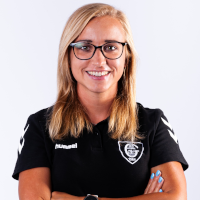
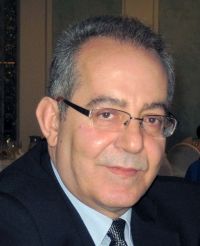
Lasse Hansen is a PhD student at the Institute of Biomechanics and Orthopaedics, part of the German Sport University Cologne. His research focuses on musculoskeletal biomechanics, particularly knee osteoarthritis and muscle physiology, with emphasis on gait analysis, joint loading mechanisms, and exoskeleton applications. He has actively contributed to interdisciplinary projects involving esports physiology and gender-specific biomechanical responses. Key professional activities include guest lecturing on kinematics/kinetics and sports physiotherapy at the university level. He conducted a research visit at the University of New South Wales (2018), fostering international collaboration. His work integrates clinical biomechanics with experimental protocols, such as studying unloader braces for osteoarthritis and exoskeleton efficacy in cognitively demanding tasks. Hansen's publications span biomechanical journals and international conferences, addressing topics like muscle synergy alterations in osteoarthritis patients and fatigue metrics in esports athletes. He collaborates across disciplines, bridging sports science, rehabilitation engineering, and digital health innovations.
Srđan Marković is a researcher at the Faculty of Physical Education and Sports Management at Singidunum University. He holds a PhD in Sports Science from the University of Belgrade (2015) and has been actively involved in academic work since 2000. Bachelor's and Doctoral studies completed at the University of Belgrade's Faculty of Sport and Physical Education (2008 and 2015). Current affiliation: Singidunum University, Faculty of Physical Education and Sports Management. His research focuses on sports performance analysis, biomechanics, and training methodologies. Key areas include: Endurance running pacing strategies Muscle power output and athletic performance Football training optimization using technology Motor skill development across sports Recent publications reveal trends in: Ultra-marathon pacing patterns (2025) Agility test reliability analysis (2025) Comparative school sports systems (2024) Post-COVID athlete fitness impacts (2024)
Mariola Gepfert is a Researcher and Teaching Doctor at the Department of Sports Theory and Practice at the Academy of Physical Education in Katowice. She specializes in strength and conditioning coaching, particularly within women's football leagues. Her work focuses on enhancing athlete performance through methods like contrast training and post-activation potentiation. She has been involved in the women's top football league for three seasons and contributed to the Polish Championship victory in 2022/2023. Her research explores physiological responses to training techniques and athlete motor potential analysis. Key Research Areas: Power output training, eccentric movements, and biomechanics. Sports Achievements: Champions League qualifiers (2023) and Polish Championship success. Her publications span topics in International Journal of Environmental Research and Public Health and Journal of Human Kinetics, emphasizing practical applications of training methodologies.
Antonios Travlos is a Professor at the Department of Sports Organization & Management, University of Peloponnese, Greece. He holds academic affiliations with the Faculty of Human Movement Sciences and Quality of Life. His professional journey includes roles in sport management education, leadership studies, and applied sport psychology. He has served as a researcher and educator across multiple institutions, including the Nursing Department and Physiotherapy Department at the University of Peloponnese, and Deree College - The American College of Greece. Education: Ph.D. in Physical Education and Sport Studies, University of Alberta (1988-1993) M.A. in Physical Education and Sport Studies, McGill University (1986-1988) B.A. in Physical Education, National Academy of Physical Education, Athens (1977-1981) Research Interests: Leadership practices in digital-age education Psychological and physiological factors in sports performance Impact of pandemics (e.g., COVID-19) on physical activity and public health Migration patterns and athletic success Anti-bullying interventions and moral disengagement mechanisms Cognitive-behavioral outcomes of exercise Recent Research Trends: His work bridges sport science with interdisciplinary topics such as ICT integration in education, post-infection physical activity recovery, and historical studies of Spartan athletics. Key themes include data-driven insights into athlete performance, policy implications for school leadership, and cross-cultural analyses of global sports talent systems. Advising & Grants: No specific grants or advising data listed in the provided texts. His teaching spans undergraduate and graduate courses in sport psychology, statistics, and organizational behavior, reflecting his dual focus on academic rigor and practical application. Labs/Teams: No dedicated labs or teams explicitly mentioned, though collaborations with international researchers (e.g., Bourdas, Souglis) are evident in co-authored publications.
Dr. Robin Hardin is a Professor in the Sport Management program at the University of Tennessee's Department of Kinesiology, Recreation, & Sport Studies. He holds a PhD in Communication and has over 20 years of academic and professional experience. His research focuses on intercollegiate athletics governance, holistic student-athlete care, sport communication, and adaptive sport programs. Dr. Hardin has authored over 100 publications and served as editor of the Sport Management Education Journal . He also contributes as an official statistics staff member for Tennessee football and basketball. Education: PhD in Communication (UT Knoxville), MS in Human Performance/Sport Studies and Communications (UT Knoxville), BS in Communications/Political Science (East Tennessee State University). Research emphasizes administrator career mobility, governance structures, and ethical issues in collegiate sports. His work addresses challenges faced by female administrators, mental health support systems, and diversity in athletic programs. Dr. Hardin has mentored 14 doctoral and over 100 master’s students. Notable contributions include studies on NCAA policies, gender equity in athletics, and the role of sport chaplains. His recent articles explore psychological safety in athletic teams, licensure differences in mental health professionals, and fantasy sport consumer behavior.
Javier Pujadas Martí serves as an Associate Professor in the Sport Science and Sport Management Department at the Faculty of Psychology, Education and Sports Sciences, Ramon Llull University. He leads the Research Group on Sports and Society (GRIES) and maintains an active research profile with 22 publications and 15 projects since 1992, including significant recent work on Olympic Games opposition movements and urban sports policy. Doctorate in Sports Science Extensive research on Catalan sports systems Specialization in social movements related to mega-sport events His research focuses on the intersection of sports, society, and urban development, with particular expertise in analyzing social opposition to major sporting events like the Pirineus-Barcelona 2030 Winter Olympics candidacy and the Louis Vuitton America's Cup. His work combines historical analysis of Spanish sports systems with contemporary studies of physical activity's societal impact, examining how sports policy evolves through political transitions including the Francoist period to modern democratic governance. Recent publications reveal a strong trend toward analyzing visual discourse and protest movements surrounding mega-events, alongside longitudinal studies of physical activity patterns across the lifespan. His work spans social sciences, political science, and urban studies with emphasis on Barcelona and Catalonia's unique sports landscape. Principal Investigator for GRIES research group (AGAUR funded) Lead on multiple projects analyzing Olympic candidacy opposition European Commission-funded PROMISE project for women in basketball Professor Pujadas Martí directs several significant research initiatives including the TATVELL calisthenics neighborhood project in Trinitat Vella and the PROMISE project advancing women's basketball. His work frequently involves interdisciplinary collaboration with researchers across Catalan institutions, focusing on practical applications of sports research for community development and social inclusion.
Stefanie Klatt is a Professor in the Department of Cognition in Team Sports at the German Sport University Cologne. Her research focuses on integrating cognitive factors into the analysis and optimization of training and movement processes in sports games. Current academic leader in team sports cognition Active editorial contributor to sports science journals International collaborations with institutions like University of Brighton Her research spans Sports Science , Cognitive Psychology , and Motion Analysis , particularly examining attention mechanisms, decision-making dynamics, and cognitive-motor integration in high-pressure sports scenarios. Recent work explores stress responses in referees and novel training interventions for athletes. Key publication trends include team sports cognition , performance optimization , and health promotion initiatives. Awards include the DOSB Science Prize (2016) and Honorary Research Fellowship at University of Brighton (2020). DOSB Science Prize 2016 DVS Publication Prize 2015 Karl Hofmann Research Prize 2015 Honorary Research Fellow, University of Brighton 2020 Excellence in Research Award 2023 She supervises junior researchers like PhD student Benjamin Noël and leads third-party funded projects on referee training, movement analysis, and public health interventions through insurance partnerships.
Associate Professor Alen Miletić is affiliated with the Faculty of Kinesiology at the University of Split, Croatia. His primary research focus lies in Dance Education , Biomechanics , and Sports Kinesiology , particularly examining motor learning, service-learning pedagogy, and musculoskeletal pain in dancers and athletes. Education: BSc in Natural Sciences and Educational Studies (Faculty of Natural Sciences and Mathematics, Split, 1993), PhD in Kinesiology (Faculty of Kinesiology, Split, 2012) Roles: Coordinator for Dance Sports Trainer Program, Lecturer for Dance courses, and Researcher in motor skill acquisition Miletić’s recent research explores service-learning models in physical education, motivational climates in dance learning, and musculoskeletal pain patterns in female athletes. His work bridges pedagogical methods with physiological and psychological factors affecting dancers and athletes. His publications span teaching styles , talent identification (e.g., relative age effects), and dance-specific biomechanics . While no specific awards are listed, his contributions to dance education and sports science are evident through extensive publications and curriculum development for undergraduate programs.
Aleksandar Gadžić (born January 6, 1971, in Jajce, Bosnia and Herzegovina) serves as a faculty member at the Faculty of Physical Education and Sports Management of University Singidunum. His career spans multiple institutions, including the Faculty of Physical Education in Novi Sad and the Faculty of Sports and Physical Education in Niš. PhD in Physical Education and Sports (Niš, 2011) Master's in Physical Education and Sports (Niš, 2008) BSc in Physical Education (Novi Sad, 1996) Diploma in Electrical Engineering (Šipovo, 1989) His research focuses on motor abilities assessment , physical fitness in children and athletes , and sports training methodologies . Recent work examines obesity prevalence in preschoolers, dynamic stretching effects on basketball performance, and pandemic impacts on athlete health metrics. Publications demonstrate expertise in anthropomotorics , gender-based fitness differences , and functional movement screening . He has contributed to journals like Sport Mont , Facta Universitatis , and Biomedical Human Kinetics , with conference presentations on ACL recovery assessment and sports tourism development. As a textbook author, he has published works on shaping exercises and physical education methodology . His collaborations span institutions including University of Niš, University of Novi Sad, and Serbian military research programs.
Adria Miro Alba is a researcher affiliated with the Research and Innovation Group on Sport and Society at the University of Ramon Llull. His work focuses on sports science, particularly in basketball performance analysis, muscle physiology, and therapeutic hypnosis applications. Research Interests : Sports analytics, vibration therapy in strength training, psychological interventions for athletes, and biomechanical demands in youth sports. Projects : Inclusion of mechanical vibration and instability in contemporary strength training methods (2024-2025), and development of the BASKETRHYTHM tool for basketball rhythm analysis (2025). Collaborations : Works with multidisciplinary teams in sports science, including researchers from biomechanics, psychology, and performance physiology. Recent Publications : Key themes include vibration-enhanced core training, hypnosis-based performance optimization, and data-driven analysis of basketball game dynamics. His work frequently employs statistical methods like ANOVA and Friedman tests.
Professor Özcan Saygın is a distinguished academic at Muğla Sıtkı Koçman University's Faculty of Sports Sciences, Department of Coaching Education, where he serves in the Department of Movement and Training Sciences. With over two decades of academic experience, he has established himself as a leading researcher in sports science and exercise physiology. His educational background includes a Bachelor's degree in Physical Education and Sports from Selçuk University (1990-1994), a Master's degree in Physical Education and Sports from Muğla Sıtkı Koçman University (1996-1999), and a Ph.D. in Physical Education and Sports from Marmara University (2001-2003). Professor Saygın's research primarily focuses on exercise physiology, motor learning, physical fitness assessment, and sports performance analysis . His work spans multiple domains including cognitive functions in athletes, the impact of different exercise modalities on physical parameters across various age groups, and biomechanical aspects of sports performance. His research often employs interdisciplinary approaches, bridging sports science with psychology, physiology, and gerontology. His recent publications demonstrate a strong emphasis on age-specific exercise interventions , with significant work on elderly populations (walking football studies), adolescent athletes, and specialized training for different sports disciplines. He has conducted extensive research on football/soccer performance analysis , motor coordination , and physiological responses to exercise . His work frequently examines the relationship between anthropometric features, physical fitness parameters, and sports performance across different age groups and competitive levels. Professor Saygın has been actively involved in numerous research projects examining physical activity levels, body composition, and fitness parameters across diverse populations, from children to elderly individuals. His work has significant implications for sports training methodologies, physical education programs, and exercise prescription for different demographic groups. His research team at Muğla Sıtkı Koçman University's Faculty of Sports Sciences conducts studies in specialized laboratories focusing on motor performance, physiological testing, and sports biomechanics. The team frequently collaborates with researchers from other Turkish universities and international institutions, contributing to the growing body of knowledge in sports science.