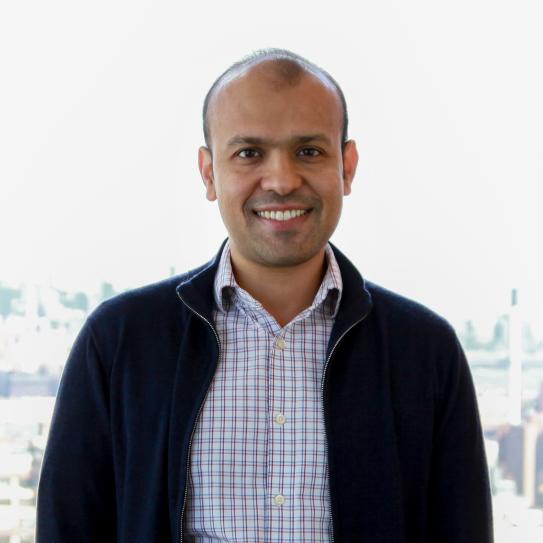
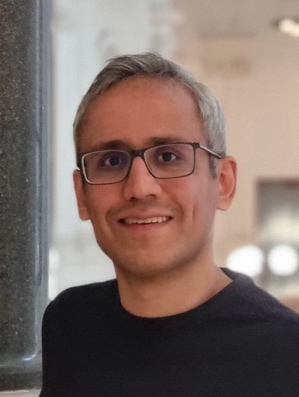
Siddharth Garg is the Institute Associate Professor of Electrical and Computer Engineering at NYU Tandon School of Engineering, leading the EnSuRe Research Group. He holds a Ph.D. from Carnegie Mellon University (2009) and a B.Tech. from IIT Madras. His research focuses on secure and energy-efficient computing systems, integrating machine learning, cybersecurity, and hardware design. He previously held roles as Assistant Professor at NYU Tandon (2014-2020) and the University of Waterloo (2010-2014). Key affiliations include NYU Center for Cybersecurity (CCS), NYU Wireless, and the Center for Advanced Technology in Telecommunications. His work has been recognized with prestigious awards like the NSF CAREER Award (2015) and inclusion in Popular Science’s 'Brilliant 10' (2016). Notable research includes private inference optimization, secure hardware IP protection, and adversarial machine learning defenses. Publications highlight advancements in zero-knowledge proofs, AI-driven chip design, and mitigating backdoor attacks in neural networks. His grants include funding from NYU Wireless and NSF initiatives like the Chips4All project. The EnSuRe group emphasizes bridging software and hardware design gaps using AI and fostering cybersecurity education.
Prof. Tansu Alpcan is a Professor and Reader in the Department of Electrical and Electronic Engineering at The University of Melbourne, Australia. He holds a PhD from the University of Illinois at Urbana-Champaign (UIUC) and has held academic positions at Technical University Berlin and Deutsche Telekom Laboratories. His research focuses on AI/ML applications in engineering, game theory, cybersecurity, Industry 4.0, quantum machine learning, smart grids, and communication networks. Education: PhD in Electrical and Computer Engineering (UIUC, 2006); MSc (UIUC, 2003); BEng (Bogazici University, 1999). Research interests include adversarial machine learning, cybersecurity games, quantum computing, and renewable energy systems. Authored over 200 papers and two books, including Network Security: A Decision and Game Theoretic Approach (Cambridge, 2011). Recipient of IEEE Senior Membership (2012) and multiple best paper awards. He leads the WILAB and has secured grants such as the ARC Training Centre in Optimisation Technologies. Current projects include quantum machine learning, adversarial reinforcement learning, and smart grid modeling. Supervised 17 PhD and 3 Master’s students.
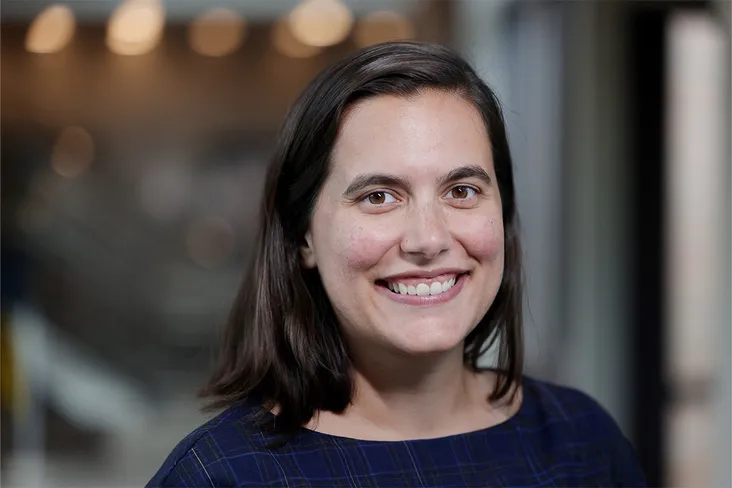
Bernadette Bucher is an Assistant Professor in the Robotics Department (primary) and Computer Science and Engineering Department at the University of Michigan. Her research focuses on embodied AI, vision-language grounding, and mobile manipulation, with an emphasis on interpretable visual representations and uncertainty estimation for robotics tasks. She previously worked at Boston Dynamics AI Institute, NVIDIA Research, and Lockheed Martin Corporation. Her academic background includes a PhD in Computer Science from the University of Pennsylvania (GRASP Lab) under advisors Kostas Daniilidis and Nikolai Matni, alongside MA degrees in Mathematics and Economics from the University of Alabama (2014). Research interests include robotics, computer vision, and machine learning intersections, particularly autonomous mobile manipulation. Her work emphasizes uncertainty-aware systems and deployable learning-based methods. Notable achievements include the Best Paper in Cognitive Robotics at ICRA 2024. Her research spans projects like EVORA for off-road autonomy and ASHiTA for hierarchical task analysis. She has contributed to open-source projects like RoboNet and actively publishes in top conferences (CVPR, CoRL, ICRA). Key projects: EVORA, ASHiTA, Vision-Language Frontier Maps (VLFM) Grants and funding: Honda Research Institute (Curious Minded Machines project) Labs/Teams: Active participation in robotics labs at University of Michigan and prior collaborations with industry partners
Dr. Gunel Jahangirova is a Lecturer in Computer Science within the Department of Informatics, Faculty of Natural, Mathematical & Engineering Sciences at King's College London. Her research focuses on software testing, software engineering for AI, and search-based software engineering. She earned her PhD through a joint program at Fondazione Bruno Kessler (Italy) and University College London (UK), followed by postdoctoral work on the ERC-funded 'Precrime' project at Università della Svizzera italiana (Switzerland). Software Testing AI Engineering Search-Based Optimization Deep Learning Verification Her recent publications explore fault localization in neural networks, ethical testing of autonomous systems, and environmental impacts of AI code development. Current projects include ITEA GENIUS and ITEA GreenCode , focusing on AI testing and sustainable software practices.
Haoyi Xiong is an active academic researcher in artificial intelligence, machine learning, and data science, with extensive publications in top-tier journals and conferences including IEEE TPAMI, NeurIPS, ICML, KDD, and AAAI. His work spans explainable AI, graph neural networks, diffusion models, remote sensing, and large language models. Research Interests: Explainable AI (XAI) and model interpretability Graph Neural Networks and contrastive learning Diffusion models and generative AI Medical and remote sensing image analysis Large language models and autonomous agents Learning to rank and web search His recent publications (2023–2025) show a strong trend toward self-supervised learning , model robustness , and integration of LLMs with structured data and knowledge graphs . He frequently collaborates with researchers from major tech and academic institutions. Scientific Awards: No explicit awards mentioned in the provided text. Advising and Grants: While no direct mention of students or grants, his role as a senior author on numerous papers suggests he advises graduate students and likely leads funded research projects in machine learning and AI. His work on frameworks like COLTR , GS2P , and MUSCLE indicates leadership in developing scalable AI systems. Labs and Teams: Though not explicitly stated, his frequent collaboration with Jiang Bian, Dejing Dou, and Dawei Yin suggests affiliation with a well-established AI research lab or industry-academia partnership focused on data mining, intelligent systems, and large-scale learning.
Nuno Miguel Fonseca Ferreira is a Full Professor at the Instituto Superior de Engenharia de Coimbra (ISEC), part of the Polytechnic of Coimbra, where he currently serves as President of the Scientific Council. His academic career spans over 25 years at ISEC, progressing from Assistant to Professor Coordenador Principal. He has held significant leadership positions including Vice-President of ISEC (2001-2005), Pro-President of the Polytechnic of Coimbra (2009-2010), President of ISEC (2010-2013), and Vice-President of the Polytechnic of Coimbra (2013-2017), where he was responsible for internationalization initiatives. His educational background includes a degree in Electrical Engineering from the University of Porto (1996), a Doctorate in Electrical Engineering from the University of Trás-os-Montes and Alto Douro (2006), and a Habilitation Title (Aggregation) from the same institution (2020). His research focuses on Robotic Systems, with specialization in cooperative robotic systems as evidenced by his Habilitation work. Professor Ferreira's research spans multiple domains of robotics and intelligent systems, with particular emphasis on multi-robot coordination, environmental applications, and medical robotics. His work bridges theoretical control systems with practical applications across diverse fields including forestry, healthcare, manufacturing, and education. He has developed innovative approaches to robotic manipulation, sensor integration, and human-robot interaction, often incorporating advanced techniques from artificial intelligence and machine learning. His recent publications demonstrate a strong trend toward practical applications of robotics in real-world environments, particularly in forestry maintenance, industrial automation, and medical applications. The research shows progression from theoretical control systems to applied robotics in challenging environments, with increasing integration of computer vision, deep learning, and collaborative systems. His work spans both fundamental robotics research and immediate industrial applications, reflecting a balance between academic inquiry and practical implementation. Professor Ferreira has supervised two doctoral theses and participated in numerous research projects with substantial funding. His leadership extends to coordinating 15 of the 33 national and international R&D projects he has participated in, demonstrating significant grant acquisition and management capabilities. His international collaborations through Erasmus+ and other European programs highlight his role in fostering global research partnerships. He is an integrated member of GECAD (Research Group in Engineering and Intelligent Computing for Innovation and Advanced Development), a Portuguese R&D unit classified as Excellent by the Portuguese Science and Technology Foundation. Additionally, he is a member of LASI (Associated Laboratory for Intelligent Systems), the Portuguese laboratory associated with Artificial Intelligence, connecting him to a broader national research ecosystem.
Daniele Caviglia serves as Full Professor in the Department of Naval, Electrical, Electronic and Telecommunications Engineering at the University of Genoa, Italy. He holds the position of Coordinator for the Master's Degree in Electronic Engineering and teaches advanced courses including Radio Frequency Electronics, Electronic Devices, and Electronic Systems for Telecommunication across both Bachelor's and Master's programs. His research program focuses on ultra-low-power electronics for biomedical and environmental applications, with three primary thrusts: (1) nW-scale circuit design for bio-signal processing and neural interfaces, (2) advanced beamforming techniques in medical ultrasound imaging, and (3) energy harvesting systems for autonomous environmental monitoring. His group has pioneered inverter-based OTAs achieving sub-10nW operation and developed novel genetic algorithm-optimized apodization methods for plane-wave ultrasound imaging. Recent publications (2024-2025) reveal strong thematic continuity with increasing emphasis on practical implementations - particularly sea wave energy harvesters for environmental buoys and satellite microwave link systems for rainfall monitoring in urban settings. The work consistently bridges fundamental circuit innovation with real-world medical and environmental applications, maintaining high impact in IEEE and Elsevier journals.
Thomas W. Malone is the Patrick J. McGovern Professor of Management at the MIT Sloan School of Management. He holds joint appointments as Professor of Information Technology and Professor of Work and Organizational Studies. As founding director of the MIT Center for Collective Intelligence, he leads pioneering research on how people and computers can connect intelligently. Previously, he founded the MIT Center for Coordination Science and co-directed the MIT Initiative on 'Inventing the Organizations of the 21st Century'. His teaching focuses on organizational design, IT, and leadership. His research examines how new organizations leverage information technology, with groundbreaking predictions about electronic business in 1987. Major works include the influential books The Future of Work (2004) and Superminds (2018). Research areas span: Collective Intelligence: Designing systems combining human and machine intelligence Organizational Structure: Decentralization, coordination, and future work models Climate Solutions: Crowdsourcing through Climate CoLab AI Implications: Human-AI collaboration in business strategy His publications demonstrate consistent focus on collective problem-solving, with recent emphasis on AI-workforce integration, remote team intelligence, and computational group metrics. Key research projects include the Collective Intelligence Design Lab, Minglr, Climate CoLab, and Measuring Collective Intelligence. Honors include an honorary doctorate from the University of Zurich . He co-founded four software companies and holds 11 patents in collaboration systems and organizational modeling. He directs the MIT Center for Collective Intelligence, leading interdisciplinary teams on global challenges. Current initiatives explore AI-enhanced prediction markets, collective intelligence genomes, and hybrid human-machine systems for organizational design.
Julien Diogo serves as Adjunct Professor at Polytechnic Institute of Viseu's School of Education of Viseu since 2020, teaching Market Analysis, Consumer Behavior, Strategic Communication, and Innovation/Creativity courses. He concurrently holds Visiting Professor positions at ISAG (Higher Institute of Administration and Management) since 2018 for Executive MBA programs and was Professor of Organizational Communication at ISCA-UA (2022-2023). His academic roles extend to Visiting Facilitator positions at Brazil's Personal Branding Academy and ISLA's Postgraduate Program in Innovation. His educational background includes: PhD in Communication Sciences (in progress, 2023-2026) at University of Coimbra Specialization in Teacher and Trainer Training (2022-2023) from Employment and Training Institute of Braga Marketing Specialist title (2019) from Polytechnic Institute of Viseu Master's in Communication and Marketing (2010-2012) from Polytechnic Institute of Viseu (Final Grade: 17/20) Bachelor's in Social Communication (2005-2008) from Polytechnic Institute of Viseu (Grade: 17/20) Diogo's research integrates neuromarketing with consumer behavior analysis, focusing on emotional responses in digital environments, Generation Z consumption patterns, and neuroscience applications in place branding. His work examines how cognitive processes influence purchasing decisions through physiological measurements and behavioral experiments, particularly investigating caffeine's neuropharmacological effects on consumer arousal and shop window design's attentional impact. He bridges theoretical neuroscience with practical marketing strategy development. His publication trajectory reveals increasing focus on digital-emotional consumer interfaces, with recent work analyzing pandemic-era behavior shifts and Gen Z's narrative processing. Key thematic clusters include neuromarketing validation in retail architecture, emotional sustainability in e-marketplaces, and neuroscientific foundations of territorial branding, demonstrating consistent application of cognitive neuroscience to contemporary marketing challenges. Scientific recognition includes: 2008 Academic Merit Award for Best Social Communication Student (Polytechnic Institute of Viseu) 2021 Nomination for Global Teacher Prize Portugal Diogo actively supervises master's research including thesis on territorial brand communication (2024), language informality in digital contexts (2024), and Apple's Lovemarks strategy for Generation Z (2024). He contributes to research projects like INOV C+ Intelligent Innovation Ecosystem (2024-present) and co-orientated neuromarketing studies on advertising reception decoding (2020). His academic service includes peer review for IGI Global and International Journal of Marketing. Through his dual leadership as CCO of ICN Agency (neuromarketing consultancy), co-director of PsicoSoma (publishing/training), and expertMind (LMS platform), Diogo maintains robust industry-academia integration, developing neuromarketing frameworks applied across retail, urban planning, and digital experience design contexts.
Professor Ross King is a faculty member at the University of Cambridge, affiliated with the Department of Chemical Engineering and Biotechnology. His research focuses on the automation of scientific discovery, machine learning applications in biology and chemistry, and DNA computing. Developed the first autonomous 'Robot Scientist' systems (Adam, Eve, Genesis) capable of hypothesis generation, experimental design, and execution using AI Pioneer in DNA computing, demonstrating the first physical Nondeterministic Universal Turing Machine (NUTM) 35+ years of expertise in machine learning, particularly relational learning for complex biological/chemical data Organizer of the international 'Nobel Turing Grand Challenge' for AI scientists His work in computational biology spans eukaryotic cell modeling, cancer signaling pathways, and AI-driven drug discovery for neglected tropical diseases like malaria and Chagas disease. The Genesis system aims to automate 10,000 simultaneous closed-loop experiments using micro-chemostats to model cellular complexity. The DNA computing research demonstrates exponential theoretical advantages over classical and quantum computing architectures for NP-complete problems, utilizing Thue string rewriting systems and polymerase chain reaction techniques. This work has significant implications for computer science, physics, and practical computing resource utilization. King's machine learning contributions include active learning strategies for compound selection in drug design and meta-learning approaches to optimize ML applications in bioinformatics and chemoinformatics.
Christian Hilbes is a Lecturer at the School of Engineering of Zurich University of Applied Sciences (ZHAW). He serves as Deputy Head of the Institute for Applied Mathematics and Physics (IAMP) and co-leads the research focus on Safety-Critical Systems. Active projects include leadership roles in Autonomous Predictive Interlock Systems , Personnel Safety Systems , and Triggering Conditions for Autonomous Cars . He specializes in STPA (Systems-Theoretic Process Analysis) , UML-based modeling , and Dynamic Flowgraph Modeling for safety-critical applications. Email: christian.hilbes@zhaw.ch His research integrates safety analysis with emerging technologies like autonomous systems and nuclear facilities, contributing to publications at MIT STAMP Workshops and in journals like Nuclear Engineering and Design . He actively collaborates on European Spallation Source (ESS) safety frameworks and develops domain-specific languages for STPA.
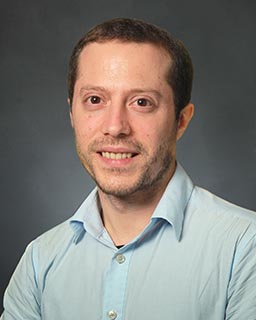
Nicola Capodieci is an Associate Professor at the Department of Physical, Computer and Mathematical Sciences at the University of Modena and Reggio Emilia, specializing in Information Processing Systems (IINF-05/A). He actively teaches multiple courses including Object-Oriented Programming, Web Technologies, and General Computer Science across Computer Science and Mathematics degree programs. His research interests focus on GPU acceleration for embedded systems, autonomous vehicles, and real-time computing. Dr. Capodieci's work addresses critical challenges in heterogeneous computing platforms, particularly for automotive applications and smart city infrastructure. His research bridges theoretical computer science with practical applications in autonomous driving and urban mobility systems. Analysis of his recent publications reveals a strong focus on optimizing GPU performance for latency-sensitive applications, particularly in autonomous vehicles. His work spans path planning algorithms, memory interference management, and real-time scheduling on heterogeneous platforms. A significant portion of his research addresses practical implementation challenges in embedded systems where computational resources are constrained but timing predictability is critical. Dr. Capodieci's teaching portfolio demonstrates expertise in both foundational programming concepts and advanced topics in web technologies. His courses emphasize practical implementation skills while covering theoretical foundations of object-oriented programming, web development frameworks, and computational thinking.
Kostas Papakonstantinou is an Associate Professor in the Department of Civil Engineering at Penn State University, affiliated with the College of Engineering. His research bridges Artificial Intelligence (AI) with Civil Engineering, focusing on uncertainty quantification and decision-making under uncertainty. Research Areas: Uncertainty Quantification Stochastic Control Deep Reinforcement Learning Bayesian Analysis Nonlinear Filtering Computational Mechanics Infrastructure Management Rare Events Quantification His work emphasizes AI-driven solutions for structural life-cycle management, infrastructure systems, and autonomous operations. Funded by the NSF and USDOT, his projects include AI-enabled fiscally constrained life-cycle asset management and Deep reinforcement learning for multi-asset infrastructure management . Scientific Awards: NSF CAREER Award: Optimal engineering decision-making under uncertainties for enhanced structural life-cycle He teaches graduate courses on Uncertainty and Reliability in Civil Engineering (CE 566) and Computational Analysis of Randomness in Engineering (CE 597) .
Morteza Haghir Chehreghani is a Professor of Artificial Intelligence and Machine Learning at the Data Science and AI Division of Chalmers University of Technology , Sweden. He leads the Machine Learning and Decision Making Lab and is affiliated with WASP , CHAIR , and ELLIS . Education : PhD in Computer Science (2014) from ETH Zurich under Prof. Dr. Joachim M. Buhmann Prior Roles : Staff Research Scientist at Naver Labs Europe (2014-2018) Research spans Interactive Machine Learning , Sequential Decision Making , Federated Learning , Efficient Deep Learning , and Graph-Based Learning . Key application areas include Transport , Autonomous Systems , Energy , Drug Discovery , and Computational Biology . Selected Publications (2020-2025) demonstrate expertise in Reinforcement Learning for drug design, Minimax Distance Measures for clustering, and Graph Neural Networks for trajectory analysis. Current work focuses on Combinatorial Bandits and Human-in-the-loop AI . Teaching includes graduate courses like Advanced Topics in Machine Learning (DAT441/DIT41), Algorithms for Machine Learning (TDA233/DIT382), and PhD-level Advanced Reinforcement Learning . He has also taught Statistical Methods for Data Science and Theoretical Foundations of ML . Patents include systems for Autonomous Vehicle Motion Control , K-NN Search via Minimax Distances , and Trip Prediction Algorithms . Collaborative projects involve Nature Communications (2022) and multiple ICML / CVPR publications.
Vera Pantelic is an Adjunct Assistant Professor in the Department of Computing and Software at McMaster University. Her research focuses on software engineering practices for model-based development in automotive systems, particularly centralized Electrical/Electronic (E/E) architectures, Simulink modeling, and supervisory control of probabilistic discrete event systems. Education: Not explicitly mentioned in the text. Her scholarly activity includes extensive contributions to conferences and journals in automotive software engineering, model transformation, and real-time systems. Her work addresses challenges in modularity, documentation, and compliance within automotive embedded systems. Her recent publications emphasize advancements in centralized E/E architectures, model-driven testing, and assurance cases for automotive safety. She collaborates on topics integrating software engineering principles with automotive domain requirements. Scientific Awards: No specific awards mentioned in the text. She serves as an advisor in software engineering, though specific student names are not listed. Her projects involve simulation-based testing, model refactoring, and compliance frameworks, supported by industry partnerships and academic grants. Her work contributes to labs and teams focused on automotive software reliability and model-driven engineering. No explicit lab or team affiliations are detailed in the provided text.