Steven D. Zohn is the Laura H. Carnell Professor at Temple University’s Boyer College of Music and Dance. He holds a PhD and MA in musicology from Cornell University and an AB in music from Vassar College. As a leading Telemann scholar, his research spans intersections of style and genre, print culture, reception history, domestic music-making, historical performance practices, and music as intellectual property. PhD, Musicology, Cornell University MA, Musicology, Cornell University AB, Music, Vassar College Zohn’s research emphasizes Telemann’s instrumental works, sacred vocal music, and cultural contexts, as well as Bach family studies and Enlightenment-era salon culture. His publications include influential books like Music for a Mixed Taste and Telemann Studies , alongside critical editions and articles in Journal of the American Musicological Society and Oxford Handbooks Online . In 2022, he received the Georg Philipp Telemann Award from Magdeburg for his contributions to Telemann research. Other accolades include the Noah Greenberg Award and the William H. Scheide Prize. He co-edits the Bach Perspectives series and serves on editorial boards, including Telemann’s Musikalische Werke . Zohn also performs on historical flutes with ensembles like Night Music and Philadelphia Bach Collegium, with recordings on Acis, Avie, and Chandos labels. His courses explore domestic musicking, Bach’s cantatas, and unaccompanied instrumental works.
Deidre Shauna Lynch is a distinguished Professor of Literature at Harvard University, holding the titles of Harvard College Professor and Ernest Bernbaum Professor of Literature. Her primary affiliation is with the Department of English within the Faculty of Arts and Sciences (FAS). She is deeply committed to supporting first-generation Harvard students, drawing from her own background as a first-generation college graduate. Dr. Lynch earned her B.A. (Hons.) from the University of British Columbia in 1983 and both A.M. and Ph.D. degrees from Stanford University in 1992. Her research focuses on 18th-century and Romantic-period British literature and culture, with particular emphasis on the theory and history of the novel, Gothic literature, Enlightenment studies, book history, and affect theory. She also explores the institutional history of English studies, examining how literary education and canon formation shape cultural narratives. Her work consistently engages with the material and cultural dimensions of literature. Recent articles highlight themes like fragmented reading practices, the role of women in literary genius discourses, and the interplay between texts and historical contexts. She has contributed to major projects such as the Norton Anthology of English Literature and edited annotated editions of Jane Austen’s works. Her awards reflect her teaching excellence and scholarly impact at Harvard. Scientific Awards: Harvard College Professor Ernest Bernbaum Professor of Literature In advising, Lynch prioritizes mentorship across undergraduate and graduate levels, emphasizing inclusivity and access to literary knowledge. She has not listed specific grants in the provided text, but her editorial leadership and institutional roles suggest significant contributions to academic infrastructure. Her research often intersects with historical archives, print culture, and the social dimensions of reading, though no lab affiliations are explicitly mentioned.
Jennifer Takhar is an Associate Professor at SKEMA Business School in Lille, France, specializing in Marketing. Previously, she held positions at Institut Supérieur de Gestion (2018–2024) and has been a Research Associate at Celsa Sorbonne Université since 2006. She earned her Doctorate in Social Sciences from Sorbonne Université in 2008. Her research focuses on intersections between biotechnology markets and consumer behavior, particularly in menopause advocacy, transhumanist consumption, and FemTech industries. Key areas include digital health movements, embodied health activism, and qualitative marketing methodologies. She has published in top journals like Social Science & Medicine , Marketing Theory , and Journal of Marketing Management . Dr. Takhar’s work addresses urgent issues such as equitable menopause care, the impact of social media on health perceptions, and the commodification of reproductive technologies. Recent projects include editing All Change! Marketing and Consuming the Menopause Transition (Routledge, 2025) and exploring transhumanist visions in biotechnology markets. She serves on the editorial boards of Journal of Marketing Management and Journal of Customer Behavior . Her interdisciplinary approach bridges marketing theory with critical cultural studies, addressing ethical and societal impacts of technological advancements in healthcare.
Francesca Cupelloni is a Researcher in Italian Linguistics (LIFI-01/A) at the Department of Modern Literature and Culture , Sapienza University of Rome. Qualified as an Associate Professor in 2023, she graduated in History of the Italian Language (2017) and earned her PhD (2020) at Sapienza, supervised by Luca Serianni . She has held scholarships at Scuola Normale Superiore, Pisa, and been a visiting scholar at the University of Lausanne (2019). Her research focuses on Italian language history (early centuries), lexicography , and gastronomic vocabulary , particularly 14th-15th-century Florentine and Middle Latin/vernacular gastronomic terms. She contributes to projects like the digital Autographs of Italian Writers ( www.autografi.net ), editing Lorenzo de' Medici's autograph letters with linguistic commentary, and collaborated on the PRIN 2017 AtLiTeG project. Recent publications include articles in VoSLIG. Historical Vocabulary of the Italian Gastronomy Language (2024), studies on Antonio Pucci's Danteisms, Leopardi's lexical borrowings, and historical syntax in Lorenzo de' Medici's epistles. She serves on the scientific committees of journals Interpres and Dante , and collaborates with the Germanisms section of the Lessico Etimologico Italiano (LEI) .
Rebecca Fortnum is a Professor of Fine Art at Central Saint Martins (University of the Arts London), where she currently serves as Acting Dean of C School. She has previously held academic leadership roles including Associate Dean of Research at Central Saint Martins and Head of the School of Fine Art at The Glasgow School of Art. Her career spans both academic and artistic domains, with professorships at Royal College of Art and Middlesex University. Academic Leadership Artistic Research Feminist Scholarship Contemporary Painting As an artist, Fortnum explores the intersection between theory and practice through painting, drawing, and printmaking. Her work focuses on gendered representations in historical sculpture, particularly through the lens of Michael Fried's 'absorption' theory. She investigates how visual artists can reanimate archival material through creative practices, with a strong commitment to feminist inquiry and decolonial approaches in art education. Her recent projects include the Henry Moore Institute Senior Research Fellowship (2021-22) and Merton College Visiting Research Fellowship (2018-19). She has received major awards from the Pollock-Krasner Foundation, British Council, and Arts Council of England. Fortnum's editorial work includes On Not Knowing: How Artists Think (2013) and A Companion to Contemporary Drawing (2020). Key Awards: Pollock-Krasner Foundation Award British Council Award Arts Council of England Award Abbey Scholarship at British School in Rome Notable Publications: A Mind Weighted with Unpublished Matter (2020) On Not Knowing: How Artists Think (2013) A Companion to Contemporary Drawing (2020) Contemporary British Women Artists: In Their Own Words (2007) Fortnum supervises graduate research projects focusing on diverse topics including embodied cognition in art, Africana archival studies, and textile materiality. She has co-convened major international conferences on art pedagogy and mentored numerous emerging artists through her roles as co-founder of Cubitt Artists (1991) and Gasworks Gallery (1994-99).
Donna M. Di Grazia is the David J. Baldwin Professor of Music at Pomona College, where she has taught since 1998. She is also the conductor of the Pomona College Choir and Glee Club, contributing to both performance and academic spheres of musicology. Her expertise spans 19th-century music , 17th-century English sacred music , and choral conducting , with a focus on cultural and historical contexts. Education: B.A. and M.A. from the University of California, Davis; Ph.D. in musicology from Washington University in St. Louis. Her research investigates the intersection of choral music-making and community-building , alongside 16th-17th-century English sacred music and 19th-century cultural studies . Publications include a monograph on Nineteenth-Century Choral Music and articles analyzing Berlioz, Liszt, and early English choral traditions. Recent projects highlight her scholarly rigor in musical repertoires and historical documentation . She has received multiple grants, including from the National Endowment for the Humanities and Pomona College. Scientific Awards: Wig Distinguished Professor Award (2003, 2017) Faculty Alumni Service Award (2023) NEH Sabbatical Research Grants (2003, 2007) As a conductor and performer, she has collaborated with renowned artists like Leonard Slatkin and Robert Shaw, and performed with Grammy-nominated ensembles. Her teaching includes courses on Beethoven's sphere of influence , historical musicology , and choral literature .
Christian Genetelli is a Full Professor at the Department of Italian , University of Fribourg , with a focus on modern Italian literature from the 18th to 21st centuries. His expertise spans philology , literary criticism , and epistolary studies , particularly on Giacomo Leopardi , Eugenio Montale , and Vittorio Sereni . He has held visiting positions at the University of Geneva and University of Bern , and serves as an Italian language commissioner for the Cantonal Lyceum of Bellinzona . His research emphasizes textual variants , manuscript history , and poetic language . Recent conference presentations (2025) explore Leopardi's epistolary networks , Montale's poetic occasions , and contemporary Italian poetry . He co-edited L'epistolario leopardiano tra filologia ed ermeneutica (2024) and authored critical monographs on Leopardi's Canti and Montale's Ossi di seppia . Scientific contributions include membership in the National Leopardi Studies Committee and an Italian Ministry of Foreign Affairs scholarship for research in Bologna. His 147 publications 2025 conference on Leopardi's authorial indices 2024 book chapter on Marco Santagata's Leopardi highlight his sustained engagement with Italian literary traditions.
Dr. Charalambos Dendrinos is a Senior Lecturer in Byzantine Literature and Greek Palaeography at Royal Holloway, University of London, and Director of the Hellenic Institute. He specializes in critical editions of Byzantine manuscripts, focusing on Emperor Manuel II Palaeologus and the Palaeologan period. His research bridges Byzantine literature, theology, and textual transmission. Educated at the American College of Greece (BA, 1990) and Royal Holloway (MA/PhD under Julian Chrysostomides, 1991–96), he has collaborated with institutions like the British Library and the Benaki Museum. Teaching includes modules on Byzantine hagiography, perceptions of holiness across cultures, and medieval Greek textual analysis. He supervises MPhil/PhD students on Hellenic themes from antiquity to modernity. Projects include the Porphyrogenitus Project’s lexicon of Greek manuscript abbreviations and the digitization of Greek manuscripts at the Benaki Museum and Lambeth Palace Library. Key activities include curating the Hellenic Institute, organizing academic conferences, and appearing as a Byzantine scribe in a BBC documentary on the Archimedes Palimpsest. His upcoming works include critical editions of Manuel II Palaeologus’s theological treatises and a festschrift honoring Nikos Moschonas.
Ian Woodfield is a Professor in the School of Arts, English and Languages at Queen's University Belfast, specializing in Musicology & Composition. He holds a prominent role in the field of classical music history with a particular focus on Mozart's operas and their reception. His research explores topics such as the autograph scores of Mozart's operas, 18th-century musical contexts, and the social history of music in Anglo-Indian societies. Woodfield has conducted significant research on Mozart's comic operas, including Così fan tutte and Don Giovanni , analyzing their structure, libretto-score interactions, and historical performance practices. His projects include studies of early manuscript copies and sources, such as the Prague Conservatory Don Giovanni score and the genesis of Così fan tutte at the King's Theatre in 1789. Key Projects: R1152MUS : The sources of Figaro (2009-2012) R1876MUS : A Study of the Early Manuscript Copies of Mozart's Don Giovanni (2007) R1809SON : A Study of the Early Manuscript Copies of Mozart's Don Giovanni (2006-2008) His publications and invited lectures span over three decades, focusing on topics such as Mozart's reception in London, the role of women amateur musicians in Anglo-Indian society, and the methodology of page-break analysis in operatic manuscripts. Woodfield has advised three supervised works, though specific student names are not listed. His research has been recognized through international collaborations and presentations at institutions like the Internationale Stiftung Mozarteum in Salzburg and King's College London.
Laura Pani is Full Professor of Latin Palaeography at the University of Udine's Department of Humanities and Cultural Heritage, where she has served since 1994. She coordinates modules on Palaeography, Codicology, and Diplomatics, previously for the Faculty of Humanities (now split into multiple degree programs). Her research focuses on Carolingian manuscript studies Medieval book production during epidemics Latin diplomatics Manuscript transmission across the Eastern Alps Lately, she has explored 20th-century manuscript distribution networks and paleographic education in Italy. Her 2022 paper on Lothar's manuscripts and 2021 work on lay scribes remain particularly influential. Prof. Pani contributes to the Chartae Latinae Antiquiores series and maintains active involvement in manuscript conservation and education initiatives.
Alicja Bielak is an Assistant Professor at the Institute of Philosophy and Sociology at the Polish Academy of Sciences (IFIS PAN), where she has been employed since 2020. She is affiliated with the Centre for the History of Renaissance Knowledge and conducts research within the ERC Project "From East to West, and Back Again. Student Travel and Transcultural Knowledge Production in Renaissance Europe" (PI: Valentina Lepri). Prior to this position, she was a lecturer at the Artes Liberales Faculty, University of Warsaw from 2018 to 2021. Dr. Bielak completed her literary studies degree in 2015 and earned her PhD in cultural and religious studies from the University of Warsaw in 2019. Her academic background reflects a deep engagement with early modern European intellectual traditions, particularly focusing on the intersections of literature, religion, and visual arts in the Polish-Lithuanian context. Her research specializes in early modern literature with particular emphasis on book history, emblematics, Reformation studies, and knowledge transfer in Renaissance Europe. Dr. Bielak's work explores cultural exchanges between Poland and Western Europe, examining how ideas, artistic forms, and religious concepts traveled across borders. She has made significant contributions to understanding emblem studies in religious contexts, the transmission of knowledge through student mobility, and the literary production of Polish Renaissance figures like Daniel Naborowski and Marcin Hińcza. Her methodology combines literary analysis, religious history, and art historical approaches to provide comprehensive insights into early modern European culture. Dr. Bielak's recent publications demonstrate a consistent focus on emblem studies, Reformation history, and early modern book culture. Her work examines Polish-Lithuanian Commonwealth's intellectual history with particular attention to religious dissent, meditative practices, and the visual representation of ideas. She has published extensively on the function of emblems in religious and secular contexts, the role of student travel in knowledge production, and the literary output of key Polish Renaissance figures. START Scholarship from the Foundation for Polish Science (2022) Herzog August Bibliothek Fellowship in Wolfenbüttel (2021) LECTIO Institute Fellowship at Katholieke Universiteit Leuven (2022/2023) As a researcher, Dr. Bielak leads multiple projects including the NPRH project "Daniel Naborowski – Poet, Physician, and Diplomat at the Court of the Radziwiłł Family" since 2022. She is also a member of the Board of Directors of the Society for Emblem Studies and serves on the editorial board of "Emblematica: Essays in Word and Image," contributing significantly to the international scholarly community in emblem studies. Dr. Bielak is actively involved with the Centre for the History of Renaissance Knowledge at IFIS PAN, where she collaborates with international scholars investigating the movement of ideas across Renaissance Europe. Her research bridges literary analysis, religious history, and art history to provide comprehensive understanding of how knowledge was created, transmitted, and transformed during this pivotal period in European history.
Elisabeth (Li) Gerhalter is a senior scholar and lecturer at the University of Vienna’s Department of History, where she has curated the Sammlung Frauennachlässe (Women’s Personal Papers Collection) since 2000 and directs it academically. Since 2006 she also manages the research blog Salon 21 . Her work spans women’s and gender history, ego-document research, diary studies, and the politics of archiving. Education: Dr. phil. in History, University of Vienna 2017 (summa cum laude) Mag. phil. in History, Sociology & Gender Studies, University of Vienna 2004 Doctoral and international summer schools in Paris and Drosendorf Research & Teaching: Her research focuses on 19th- & 20th-century women’s and gender history, autobiographical writing, diary cultures, and feminist archival practices. She currently teaches courses on women’s/gender history, ego-document analysis and archival excursions at both the Institute of History and the Institute of European Ethnology, University of Vienna. Publications & Trends: Recent articles (2024-25) interrogate intersectional gaps in legacy collections, map women’s archive holdings across Central Europe, and integrate citizen-science collection trips. Earlier work analysed adolescent wartime diaries, material memory cultures in girls’ schools, and the 1919 suffrage moment as recorded by Viennese women. Awards & Memberships: Käthe Leichter Prize 2022 for outstanding achievements in women’s and gender studies Founding member, European Ego-Documents Archives & Collections Network (EDAC) Chair, frida – Austrian association of women’s information & documentation centres Grants & Projects: She has led or co-led projects on feminist archival policies, public history approaches to diary collections, and edition projects such as the illustrated diary of Rudolfine Gandlmayr (forthcoming 2025). Since 2021 she is principal investigator of the FWF-funded project “(Un-)Systematic Knowledge. Ordering and Finding in Women’s and Gender History Archives” at the University of Vienna. Labs & Teams: She heads the Sammlung Frauennachlässe team (currently Sophie Hopfner) and is active in several university and trans-European collection networks, including “Die Sammlungen an der Universität Wien” and the interdisciplinary Research Focus on Women’s and Gender History.
Dr. Kai Drewes serves as Head of the Infrastructure Group and leads the Digital History / Scientific Collections division at the Leibniz Institute for Research on Society and Space (IRS) in Erkner, Germany. With a doctorate in modern history completed in 2011, he specializes in contemporary history with emphasis on DDR architectural and planning history, archival science, and digital heritage preservation. His research interests focus on DDR history , particularly urban planning, architectural documentation, and the socio-spatial transformation of East Germany. He examines architectural history through material culture including prefabricated housing systems (WBS 70), CAD development in socialist states, and architectural drawings. His digital history work explores cartographic analysis, migration patterns, and the digitization of physical collections. Additional expertise includes cultural heritage preservation of endangered archives and institutional collection building strategies. Analysis of his 15 most recent publications reveals consistent focus on material evidence of socialist-era planning, with increasing attention to digital methodologies since 2020. His work bridges architectural history, archival science, and spatial social research, demonstrating interdisciplinary approaches to understanding DDR's built environment through primary sources ranging from architectural models to migration cartograms. Research Prize of the Foundation for Personal History (2014) for dissertation on Jewish nobility granting in 19th-century Europe As division head since 2013 (Digital History / Scientific Collections since 2022), Drewes directs IRS's archival infrastructure while serving as deputy spokesperson for the Federation of German-speaking Architectural Collections (since 2019) and previously leading the Leibniz Association's Archives Working Group (2020-2024). His projects include 'Geschichte und Rezeption der Bauakademie der DDR' examining institutional history through interviews, and ongoing curation of the IRS's scientific collections containing unique DDR planning documents rescued from destruction.
Dr Alison Slater is Reader and Director of Programmes at Manchester Metropolitan University's School of Art and Design, where she also serves as Head of the Department of Art and Performance. With a career at Manchester Met since 2008 as an Associate Lecturer and permanent staff since 2013, she has established herself as a leading researcher in dress history and material culture. Her educational background includes a PhD from Manchester Met (2011, AHRC-funded), an MA in Textiles from Manchester Met (2006), and a BA (Hons) in Textile/Surface Design from Bolton Institute of H.E. (now University of Bolton). Prior to Manchester Met, she worked at the University of Bolton and University of Salford. Slater's research focuses on encounters with dress, particularly working-class and everyday dress, using oral history and material culture approaches. She explores the relationships between objects and identity, history and memory, especially experiences outside traditional historical records. Her work examines how immaterial ideas like relationships, emotions, and memories impact our encounters with material things and persist beyond people's lives and the objects themselves. Recent research investigates 'bequeathed identities'—what objects left behind after death reveal about their former owners' identities. Her publications trend shows a consistent focus on material culture and memory, with recent work expanding into collaborative projects and edited volumes that bring together diverse perspectives on dress narratives. The 2023 co-edited volume 'Memories of Dress: Recollections of Material Identities' represents a significant contribution that synthesizes approaches from dress history, fashion studies, and material culture. As an academic leader, Slater has supervised numerous PhD students to completion and currently oversees several in-progress doctoral projects. Her research has been supported by significant grants, including the AHRC-funded 'Life on the Outskirts' project (2017-2018) where she served as Co-Investigator. She has established valuable collaborations with institutions like Castlefield Gallery and the Helen Storey Foundation. Slater maintains active professional engagement as an external examiner for Liverpool John Moores University and as a member of the AHRC Peer Review College, demonstrating her standing within the academic community.
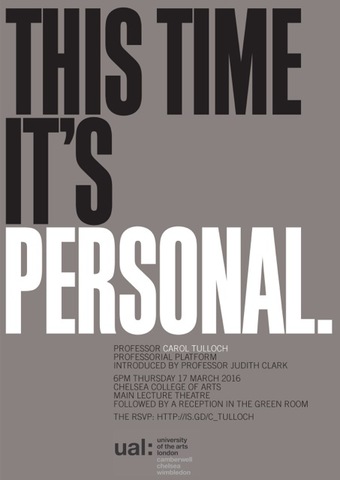
Carol Tulloch is a Professor of Dress, Diaspora, and Transnationalism at the University of the Arts London (UAL), based in the School of Design at Chelsea, Camberwell, and Wimbledon (CCW) Colleges of Arts. She holds an Honorary Senior Research Fellow position at the Victoria and Albert Museum and sits on the boards of Autograph and the Museum of London. Her research focuses on style narratives, cultural heritage, and diasporic identity, particularly within the African diaspora. Tulloch has curated major exhibitions like Black British Style (V&A, 2004) and Rock Against Racism (Autograph, 2015), and authored influential books including The Birth of Cool (2016) and The Persistence of Taste (2018). Her academic work bridges art, fashion, and cultural studies, emphasizing auto/biographical approaches and everyday practices. Tulloch has supervised PhD students exploring topics such as Afrofuturism, diasporic identity, and Nepali migrant creativity. She has received grants from the British Academy and AHRC for projects like Dress and the African Diaspora (2006–2007). Her curatorial and scholarly contributions address anti-racism, transnational art, and the intersection of personal archives with collective memory. Tulloch’s work is featured in venues like Tate Liverpool and the Open Arts Journal, and she has participated in BBC Radio 4’s Art of Now .