Yang Yuxiang is an Assistant Professor at the University of Hong Kong's School of Computing and Data Science. His research focuses on software security, adversarial machine learning, and AI safety, with a particular emphasis on formal methods and large language models. He holds a PhD from Hong Kong. Research interests include: Automated program repair using LLMs Cybersecurity in open-source ecosystems Adversarial attacks on vision-language models Formal verification of theorem provers Ethical implications of AI systems Recent publications explore cutting-edge topics such as causality-aware safety testing for autonomous systems , smart contract vulnerability detection , and large model safety at scale . His work bridges theoretical foundations with practical applications in secure software development and AI ethics.
Manuel Rosa Zurera is a Full Professor at the Universidad de Alcalá, specializing in Signal Theory and Communications. He leads the AES3 research group focused on Acoustic and Electromagnetic Smart Sensor Networks and Signal Processing. His research emphasizes machine learning applications in audio analysis, biomedical signal processing, and passive radar systems. Dr. Rosa holds a PhD from Universidad de Alcalá (1999), supervised by Francisco López Ferreras. Research Interests : Dr. Rosa’s work spans acoustic signal localization, UAV detection, emotion recognition via speech analysis, and evolutionary studies of hominin auditory systems. His innovations include robust detection algorithms for passive radar, energy-efficient anger detection systems, and age/gender classification from speech using neural networks. He has pioneered acoustic sensor networks for urban security and biomedical diagnostics. Key Contributions : Over 150 peer-reviewed articles since 1999 demonstrate his expertise in signal processing for aerospace flutter analysis, real-time violence detection in smart cities, and 3D reconstruction of Neanderthal auditory capacities. His work bridges theoretical signal processing with practical applications in healthcare, surveillance, and evolutionary anthropology. Labs/Teams : Directs the AES3 group and collaborates on EU-funded projects like DVB-T radar systems and acoustic drone detection initiatives. Active in designing microphone arrays for hearing aids and wireless sensor networks.
Stephan Werner is a researcher at the Department of Electrical Engineering and Information Technology, Technische Universität Ilmenau, leading the Electronic Media Technology Group as acting head. His work focuses on auditory perception, spatial audio processing, and binaural synthesis for augmented/virtual reality applications. Research Interests Werner's research explores spatial audio, room acoustics, and perceptual modeling. Key areas include audiovisual coherence in AR, reverberation time estimation, and auditory adaptation in immersive environments. His projects address applications in education, intergenerational communication, and human-robot interaction. Publication Trends Recent work spans acoustic modeling for AR/VR, perceptual analysis of room divergence, and privacy-preserving mixed reality systems. Collaborative efforts with institutions like IEEE and Audio Engineering Society highlight technical and societal implications of audio technology. Laboratory As head of the Electronic Media Technology Group, he leads interdisciplinary research in auditory illusions, spatial audio quality, and immersive media production, often collaborating with international conferences and technical committees.
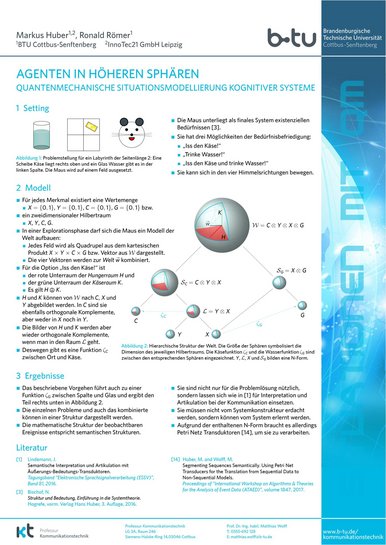
Prof. Dr.-Ing. habil. Matthias Wolff is a Full Professor of Communications Engineering at Brandenburg University of Technology Cottbus-Senftenberg, Germany. He leads the Cognitive Systems research group and serves as Speaker of the Lusatia Center for Artificial Intelligence and the WiR!-alliance Co-Innovation Platform Industrial Automation. His teaching focuses on systems theory, communications engineering, speech/language technology, and cognitive systems. Born in Görlitz, Germany Educated at Technische Universität Dresden (Dipl.-Ing. 1997, Dr.-Ing. 2004, Habilitation 2011) Head of Examination Board for Electrical Engineering (university program) Research Focus: His work spans text and semantics processing , behavior control of cognitive machines , and quantum-inspired AI methods , with interdisciplinary collaboration in scientific software development and acoustic pattern recognition. Current Projects: Includes research on cognitive material diagnostics in cooperation with Fraunhofer IKTS, focusing on AI applications in communication systems and cognitive engineering. Contact: Located in Building 3A, Room 246 | Phone: +49 (0)355 69 2128 | Email: matthias.wolff@b-tu.de
Heather Brand is an Assistant Professor of Photography at Allegheny College, where she also served as Gallery Director. She holds an MFA in Visual Studies from the State University of New York at Buffalo (2011) and a BSc in Studio Art/Photography/Painting with a minor in Art History from SUNY Brockport (2008). Education Master of Fine Art, Visual Studies, SUNY Buffalo (2011) Bachelors of Science, Studio Art/Photography/Painting, SUNY Brockport (2008) Her research examines how photography and installation art interrogate human attempts to control and categorize natural and domestic spaces. She focuses on sites like museums, botanical gardens, and historical monuments, using techniques such as digital mediation, scale shifts, and audio-visual integration to reveal the friction between artificial containment and perceived authenticity. Collaborative projects, such as Human Geography v.1.1 and v.2.1 with Byron Rich, demonstrate her interest in visualizing conversations through photographic processes. Her work has been exhibited at venues including the University at Buffalo, CEPA Gallery, and the Tower Fine Arts Gallery. Professional experience includes teaching roles at Allegheny College and the University at Buffalo. She has served as juror for the MATTA competition and participated in residencies like Ars Bioarctica in Finland.
Dr. Marcus Handte is a Senior Researcher at the University of Duisburg-Essen, focusing on networked embedded systems, context-aware computing, and sustainable mobility. His academic journey includes a Habilitation in Computer Science (2013) and a PhD in Natural Sciences (2009) from Universität Stuttgart, alongside a Master's degree from Georgia Institute of Technology (2002). Research Interests Context-aware applications Localization and location-based systems Sustainable mobility solutions Internet of Things (IoT) Smart city infrastructure Privacy-preserving technologies His recent work involves developing platforms for multimodal mobility analysis (MOBYDEX), wireless EV charging systems (TALAKO, FAIR), and innovative approaches to indoor localization. Publications span journals like Machine Vision and Applications and conferences in pervasive computing. Scientific Recognition Best Poster Award at ACM KMIS 2023 Dr. Handte has contributed to projects such as ATMo2, INNAMORUHR, and GAMBAS, and maintains active collaborations across institutions. His expertise in adaptive middleware and distributed systems continues to shape research in smart mobility and ambient intelligence.
Zhangming Zhu is a Professor at Xidian University in the School of Microelectronics . He specializes in Microelectronics and Circuit Design , with a focus on Analog-to-Digital Converters (ADCs) , CMOS Technology , and Low-Power Electronics . His work addresses challenges in high-speed, high-precision, and energy-efficient circuit design. Research Interests: His publications highlight expertise in ADCs, PLLs, energy harvesting, biomedical sensors, and RF systems. Recent Publications: 2025 papers include a 12-bit 1.5-GS/s ADC , a 5-18-GHz Quadrature Receiver , and 20-bit SAR ADC with thermal error suppression. Collaborations: Frequently co-authors with Shubin Liu, Yi Shen, Ruixue Ding, and others. Applications: Work spans consumer electronics, IoT, biomedical devices, and energy-efficient systems.
Adam Perer is an Associate Professor at Carnegie Mellon University, where he is a member of the Human-Computer Interaction Institute within the School of Computer Science. He serves as Co-Director of the Data Interaction Group and holds leadership positions as Area Papers Chair at IEEE VIS and Visualization Subcommittee Papers Chair at ACM CHI. Previously, he worked as a Research Scientist at IBM Research. Ph.D. in Computer Science from the University of Maryland, College Park Perer's research integrates data visualization and machine learning techniques to create visual interactive systems that help users make sense of big data. His work focuses on human-centered data science, extracting insights from clinical data to support data-driven medicine, and facilitating human-AI collaboration. He investigates how people engage with and make decisions using data, designing new interfaces to interact with complex information while assisting impactful domains drowning in data. His recent publications reveal a strong trend toward healthcare applications of AI and visualization, particularly in clinical decision support and overdose prevention. There's also a significant focus on explainable AI (XAI), with multiple papers examining how imperfect explanations affect human-AI collaboration and decision-making in critical contexts like healthcare. His work consistently bridges visualization theory with practical applications in high-stakes domains. Best Paper Honorable Mention for 'Dead or Alive: Continuous Data Profiling for Interactive Data Science' (VIS 2023) Best Paper for 'Neo: Generalizing Confusion Matrix Visualization' (CHI 2022) Most Reproducible Paper Award for 'SQLShare' (SIGMOD 2016) Perer actively mentors students across all levels, with PhD students focusing on human-AI collaboration in healthcare settings, visualization techniques, and clinical decision support systems. His lab receives funding for projects related to human-centered AI, data visualization in healthcare, and explainable machine learning systems. The Data Interaction Group, which he co-directs, focuses on empowering everyone to analyze and communicate data through interactive systems. His research has been supported by collaborations with medical institutions and appears in premier venues for visualization, human-computer interaction, and medical informatics. Current projects include Eye into AI (improving XAI interpretability), Predicting and Visualizing Overdose Risk, and AI applications in intensive care units.
David Temperley is a Professor of Music Theory at the Eastman School of Music (University of Rochester), where he has been teaching since 2000, progressing from Assistant Professor to Associate Professor and finally to Professor in 2015. His academic career also includes visiting positions at the University of Pennsylvania, Ohio State University, Columbia University, and New York University. He holds a Ph.D. in Music Theory from Columbia University (1996), an M.A. in Composition from Columbia University (1992), and a B.A. in History from Swarthmore College (1985). Dr. Temperley's research spans multiple areas at the intersection of music theory, cognition, and computational modeling. His work focuses on: Music cognition and perception Computational models of musical structure Analysis of popular music, particularly rock Relationships between music and language Rhythm and meter in various musical traditions Corpus-based approaches to music analysis His research demonstrates a consistent interest in applying quantitative and computational methods to understand musical structures and processes. He has pioneered corpus studies in music theory, examining large collections of musical works to identify patterns and principles that might not be evident from individual case studies. His work often bridges theoretical music analysis with empirical cognitive science approaches. Dr. Temperley has received several prestigious awards including the Society for Music Theory Emerging Scholar Award (2003), the University of Rochester Bridging Fellowship (2009), and the University of Rochester Provost's Multidisciplinary Award (2012). These awards recognize his innovative interdisciplinary approach that connects music theory with cognitive science and computational modeling. As an educator, Dr. Temperley has taught a wide range of courses in music theory, analysis, counterpoint, and music cognition at both graduate and undergraduate levels. His teaching reflects his research interests, emphasizing both traditional theoretical approaches and contemporary empirical methods. He has supervised numerous graduate students in their research, particularly in areas combining music theory with cognitive science. Dr. Temperley is also an active composer with numerous performances of his works, including chamber music for various instrument combinations and piano compositions. His compositional work informs his theoretical research and vice versa, creating a productive dialogue between creative practice and scholarly inquiry.
James W. Lewis is a Professor and Vice-Chair for Education at the West Virginia University School of Medicine, holding dual appointments in the Department of Neuroscience and the Rockefeller Neuroscience Institute. His research focuses on understanding how the human brain processes auditory information, particularly in relation to multisensory integration and natural sound recognition. PhD, California Institute of Technology Dr. Lewis's research explores the neural mechanisms underlying auditory object perception, with particular interest in how the brain categorizes and processes different types of natural sounds. His work employs functional magnetic resonance imaging (fMRI) to investigate cortical networks responsible for recognizing sounds produced by humans, animals, mechanical devices, and environmental sources. He has made significant contributions to understanding the fourfold cortical dissociation for representing different categories of action sounds, demonstrating how distinct brain regions process human, animal, mechanical, and environmental sounds. His recent publications reveal a consistent focus on auditory neuroscience with increasing attention to clinical applications in autism spectrum disorder and medical education innovation. A notable trend is his exploration of how high-level perceptual attributes like concreteness, effectuality, and spatial scale influence cortical processing of natural sounds, advancing models of grounded cognition for acoustic knowledge representation. Dr. Lewis leads a research program utilizing 3 Tesla functional magnetic resonance imaging at the Center for Advanced Imaging at WVU. His lab employs a full-scale simulation-MRI scanner to train children for neuroimaging studies, particularly those with autism spectrum disorder. The team investigates how the brain processes auditory information in both typical development and neurodevelopmental conditions, with findings having implications for biologically inspired hearing aid algorithms.
Anthony D. Bergstrom is an Assistant Teaching Professor of Computer Science at Purdue University's College of Science. He holds a PhD, MS, and BS in Computer Science from the University of Illinois at Urbana-Champaign and Rose-Hulman Institute of Technology. His research focuses on Human-Computer Interaction, Social Computing, and Education Technology, with notable work on visualizing social feedback and improving educational experiences. Bergstrom combines industry experience in software development and user experience with academic research, emphasizing practical applications of technology in education and communication. His work includes studies on conversation analysis, anonymous feedback systems, and multimedia chat architectures, often collaborating with institutions like D2L and Shopify. Despite no listed awards or grants in the provided texts, his contributions span over a decade of peer-reviewed publications in venues like HICSS, CHI, and IEEE journals. Education Background: PhD in Computer Science, University of Illinois at Urbana-Champaign (2011) MS in Computer Science, University of Illinois at Urbana-Champaign (2006) BS in Computer Science and Mathematics, Rose-Hulman Institute of Technology (2004) Research Interests: Designing visual systems to enhance social interactions and communication User-centric approaches to feedback mechanisms in educational and collaborative settings Applications of multimedia and data analysis in improving user experiences Key Publications: Focus on social signal visualization, conversation dynamics, and educational technology Notable work includes 'Distorting Social Feedback in Visualizations of Conversation' (2012) and 'Social Mirrors as Social Signals' (2009) Advising and Grants: No listed advisees or funded grants in provided materials Labs/Teams: Former member of the Social Spaces group during graduate studies at UIUC Current affiliation with Purdue's Department of Computer Science
Professor Palle Dahlstedt is affiliated with the University of Gothenburg's Interaction Design department. His work bridges music technology, live coding, and interdisciplinary performance. He specializes in gestural interactions, algorithmic creativity, and systems for collaborative improvisation. Key projects include the Bucket System, OtoKin, and research on live coding frameworks. Research interests focus on creative technologies in music and performance, with emphasis on real-time systems, human-computer interaction, and artistic collaboration. Dahlstedt has published extensively in venues like NIME, ICLC, and Evolutionary Intelligence, addressing topics ranging from hybrid piano design to generative storytelling. Notable contributions include the Biosphere Code Manifesto (2015), exploring algorithms in environmental contexts, and the Electroacoustic Modular Ecosystem (2020). His work often involves cross-disciplinary collaborations with dancers, musicians, and technologists. Performance highlights include jury-selected NIME performances (2015) and collaborations with artists like Gino Robair and Tim Perkis. Dahlstedt actively participates in international festivals and conferences, advancing the field of computational creativity and artistic research.
Kim Baraka is an Assistant Professor at the Faculty of Science, Vrije Universiteit Amsterdam, affiliated with the Artificial Intelligence department, Network Institute, and Social AI division. His research focuses on Human-Robot Interaction, Reinforcement Learning, and socially intelligent systems. He co-developed frameworks like SHARPIE for Human-AI collaboration and explores ethical aspects of AI teamwork. Baraka teaches courses on Human-interactive Agent Learning, Robotics, and Socially Intelligent Robotics. He actively contributes to conferences like HRI and ROMAN, publishing on topics ranging from robot curriculum learning to empathetic AI design. Ancillary roles include director of Bara-kadance and board member of Stichting Triplets. Research interests include: Human-AI co-creativity and collaboration Robot learning through human demonstrations Emotional expression in embodied AI Ethical frameworks for human-agent teams Recent work highlights multimodal interaction (e.g., audio-visual speech recognition), prosody-based teaching signals, and proxemics-aware navigation. His 2025 publications emphasize iterative algorithm design for fairness in human-agent teams and systematic reviews of collaborative AI creativity. This research bridges technical advancements with socially responsible AI deployment.
Dr. Katalin Eva Balint is an Associate Professor in Communication Science at Vrije Universiteit Amsterdam since 2018. She holds a PhD in Psychology from Pécs University (2012), a Master's in Film Studies from Eötvös Loránd University, and a Psychology Master's from University of ELTE Budapest. Her research focuses on media psychology, narrative engagement, and empathy in audiovisual narratives. She has held academic positions at Utrecht University (postdoc 2012-2014), University of Augsburg (2014-2016), and Tilburg University (2017-2018). Key research areas include the psychological effects of narrative complexity, formal features in cinema, and prosocial behavior elicitation through media. She leads projects funded by NWO (Aspasia Grant 2021) and the German Science Foundation (2017). She is affiliated with the Network Institute and Communication Choices, Content and Consequences (CCCC) research groups. Teaching includes courses on media psychology and storytelling at VU Amsterdam. She actively reviews for journals like Frontiers in Psychiatry and Patient Education and Counseling . Ancillary activities include directing Your Story Counselling in Amsterdam.
Prof. Timo Gerkmann is a Professor at the University of Hamburg's Department of Informatics, leading the Signal Processing Research Group. His research focuses on statistical signal processing and machine learning for speech and audio applications, including communication devices, hearing aids, audiovisual media, and human-machine interfaces. He previously held roles at Technicolor Research & Innovation, KTH Royal Institute of Technology, and Siemens Corporate Research. His work emphasizes generative models, diffusion-based approaches, and acoustic signal enhancement. He currently serves as Senior Area Editor of the IEEE/ACM Transactions on Audio, Speech, and Language Processing. Research Interests: Statistical Signal Processing for Speech and Audio Machine Learning Applications in Acoustic Environments Diffusion Models for Audio Restoration Audio-Visual Speech Enhancement Human-Machine Interaction Systems Acoustic Scene Analysis Publications Highlight Trends: Recent works focus on diffusion models for speech enhancement, generative approaches to dereverberation, and audiovisual multimodal analysis. He has pioneered frameworks like ReverbFX datasets and FlowDec codecs, emphasizing perceptual quality and unsupervised domain adaptation. Advising & Grants: While no specific students or grants are listed, his research group actively publishes in top venues, indicating sustained academic contributions. His work bridges theoretical signal processing with applied systems engineering. Labs/Teams: Leads the Signal Processing (SP) Research Group at UHH, specializing in cutting-edge audio technologies and human-centric signal processing solutions.