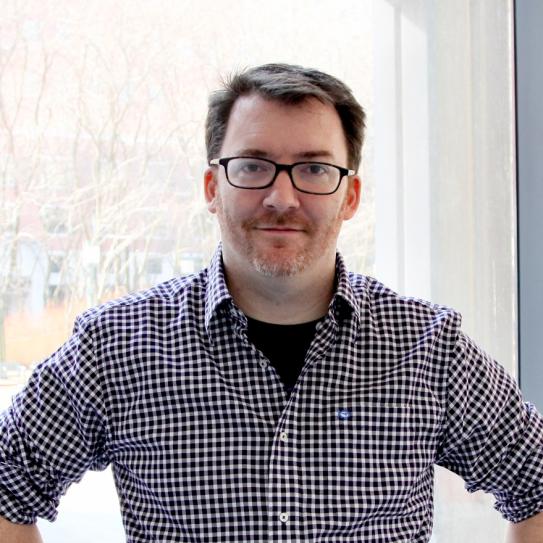
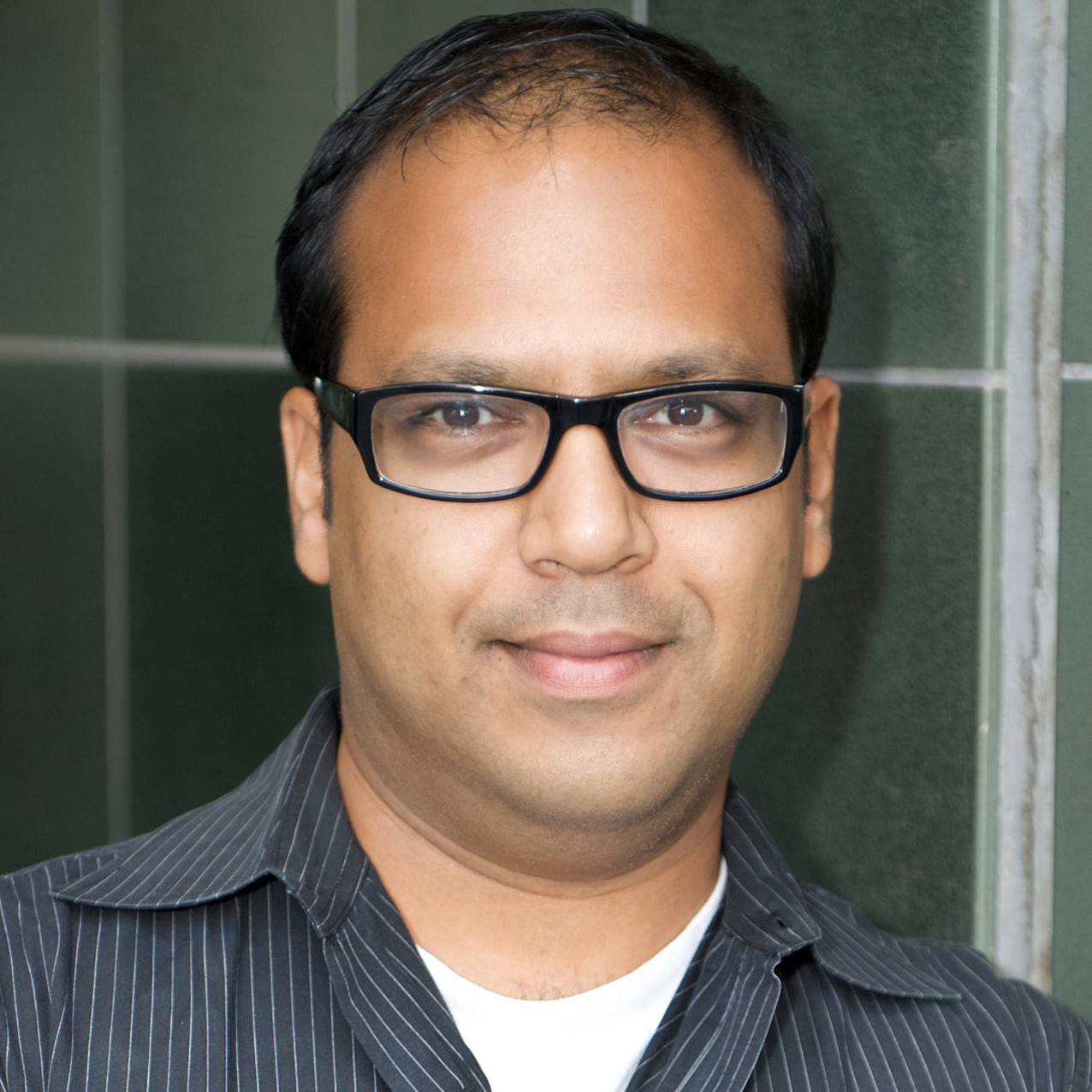
R. Luke DuBois is an Associate Professor and Co-Chair of the Technology, Culture and Society Department at the NYU Tandon School of Engineering, where he also directs the Integrated Design & Media program and the Brooklyn Experimental Media Center. He holds a DMA in music composition from Columbia University and is a renowned artist, composer, and performer whose work explores intersections between technology, sound, and visual media. His research focuses on digital media, human-computer interaction, and emerging technologies applied to artistic expression and accessibility. Key roles include directing the SONYC initiative (addressing urban noise pollution via AI) and leading the NYU Ability Project (advancing disability studies through technology). He has collaborated with institutions like the Smithsonian and artists such as Maya Lin, and his work has been exhibited globally, including at the Sundance Film Festival and the Aspen Institute. DuBois co-developed the Jitter software suite for real-time data manipulation and performs in avant-garde groups like Bioluminescence and Fair Use. His artistic practice combines time-lapse phonography, interactive installations, and interdisciplinary projects that critique cultural ephemera while advancing accessibility in STEM and the arts. Recent contributions include browser-based tools for accessible music notation (SoundCells) and sonification techniques for calculus education. He serves on the Board of the ISSUE Project Room and has been featured in major publications like the New York Times and TED Conference talks.
Dr. Lucie Kruse is a researcher at the Department of Informatics, University of Hamburg, specializing in Human-Computer Interaction (HCI) and Virtual Reality (VR). Her work focuses on immersive user interfaces for cognitive and physical training, particularly for older adults and those with dementia. She has been an active member of the University of Hamburg's HCI group since 2018 and served on the Ethics Commission since 2023. Her research interests include: Virtual Reality Exergames Serious Games Assistive Technologies Accessibility in VR Mental Health Applications Her publications from 2021-2025 demonstrate expertise in designing VR systems for healthcare, analyzing age-related interaction patterns, and developing inclusive interfaces. She has received multiple awards including the 2024 Honorable Mention for Best Poster at ACM SUI and the 2023 Honorable Mention at ACM CHI. Scientific Awards: Honorable Mention for Best Poster Award at ACM SUI (2024) Runner-Up Prize at Metaverse for the Good (2024) Honorable Mention at ACM CHI'23 Interactive Demo (2023) Honorable Mention at ACM VRST (2021) She has supervised multiple theses on topics like AI agents for mental health, accessibility of chatbots for seniors, and VR exergame design. Her work spans collaborations with institutions like HITLab NZ and Western Sydney University's MARCS Institute.
Koray Tahiroglu is a University Lecturer at Aalto University's School of Arts, Design and Architecture, specializing in Sound and Music Computing. His work bridges artificial intelligence, digital musical instruments, and embodied interaction, with a focus on deep learning applications in audio synthesis and human-AI creative collaboration. His research explores New Interfaces for Musical Expression (NIME), sonic interaction, and physical computing. He collaborates with SOPI Research Group and Google Brain Team (Magenta) on AI-driven artistic innovation. Recent Publications : 2024 studies on dance-sound cross-correlation and intra-action frameworks; 2023 work on AI-terity and deep learning syllabi; 2022 explorations of GAN synthesis, musical expectations, and lifeworld sonification. Scientific Awards : Co-Creative Artificial Intelligence of Music (2022) 2010 grant for scientific publications and artistic activities 2017 Honorable Mention for mobile cultural heritage research Tahiroglu contributes to digital art education and leads projects at Media Lab Helsinki, advancing sonic interaction and generative audio systems.
David Palmer is an Affiliate Associate Professor in the Department of Astronomy and Astrophysics. He is affiliated with Los Alamos National Laboratory (LANL). His research focuses on speech recognition, natural language processing, and multilingual systems, with particular emphasis on information extraction from audio and speech data. His work bridges computational linguistics and machine learning, addressing challenges in automated systems for audio comprehension and cross-language processing. Key research interests include robust information extraction from speech transcriptions, error detection in speech recognition, and multilingual processing for operational users. He has contributed to advancements in speaker identification, text preprocessing techniques, and domain adaptation in speech processing systems. His publications span over two decades, reflecting a consistent focus on improving automated systems for handling audio and text data in dynamic environments. While no specific awards or grants are listed, his extensive publication record highlights sustained contributions to the fields of speech technology and computational linguistics. His work at LANL likely involves collaborative research in applied computational sciences, though specific lab affiliations or teams are not explicitly mentioned.
Robert J.K. Jacob is a Professor of Computer Science at Tufts University, affiliated with the School of Engineering's Department of Computer Science. His research focuses on Human-Computer Interaction (HCI), particularly implicit brain-computer interfaces (BCI) using fNIRS and EEG technologies. He has held visiting positions at University College London, Université Paris-Sud, and MIT Media Lab. Education: Ph.D. in Computer Science from Johns Hopkins University. Research Interests : Jacob's work explores novel interaction techniques, adaptive interfaces, and BCI applications. Current projects emphasize real-time fNIRS-based systems for effortless user input, cognitive workload assessment, and neuroadaptive technologies. His lab investigates how brain signals can enhance user interfaces in domains like music learning, gaming, and urban design. Recent Trends in Articles : Recent publications highlight advancements in BCI design, neuroadaptive systems, and interdisciplinary applications of fNIRS. Work spans theoretical frameworks (e.g., NeuroCHI ethics) to practical tools like the Tufts fNIRS dataset. Key themes include improving BCI calibration, exploring AI's role in urban environments, and integrating affective computing into artistic interfaces. Awards : ACM Fellow (2016) ACM CHI Academy Membership (2007) Best Paper Award at CHI 2016 Advising & Grants : Supervised 15+ Ph.D. alumni in HCI and BCI. Served as Vice-President of ACM SIGCHI and co-chair of UIST/CHI conferences. Active in editorial roles for Human-Computer Interaction and ACM Transactions on Computer-Human Interaction . Labs & Teams : Directs the Tufts HCI Lab in the Joyce Cummings Center. Collaborates with interdisciplinary teams on projects like the Marble Track Audio Manipulator and Reality-Based Interaction Framework.
Lee M. Miller is a Professor and Vice Chair of Academic Affairs in the Department of Neurobiology, Physiology and Behavior at the University of California, Davis, affiliated with the Center for Mind and Brain. His research focuses on neuroengineering, computational neuroscience, and neural mechanisms underlying attention, speech processing, and multisensory integration. Research interests include the development of neural prosthetics, decoding of neuromuscular signals for prosthetic control, and understanding how auditory and visual systems interact during speech perception and attentional processes. His work bridges clinical applications (e.g., cochlear implants) with fundamental neuroscience, leveraging tools like electrophysiological recordings, EEG/MEG, and advanced signal processing techniques. Recent publications highlight innovations in electromyographic speech neuroprosthetics, the topology of neuromuscular signals, and the neural basis of speech-in-noise processing. Miller’s studies emphasize translational potential, such as improving speech synthesis from brain signals and designing haptic feedback systems for motor coordination. His contributions have advanced understanding of neural mechanisms in sensory integration, auditory attention, and the impact of cognitive factors on perception. Miller maintains a lab dedicated to these interdisciplinary efforts, with a focus on both basic science and clinical applications.
Maneesh Agrawala is the Forest Baskett Professor of Computer Science and Director of the Brown Institute for Media Innovation at Stanford University. He is also a consulting AI Scientist at Roblox. His research lies at the intersection of computer graphics, human-computer interaction (HCI), and visualization, with a focus on cognitive design principles for improving audio/visual media. He leads a vibrant research group and has advised numerous PhD students and postdocs. His research interests include: Computer Graphics Human-Computer Interaction Visualization and Visual Communication Cognitive Design Principles Generative AI and Diffusion Models Interactive Video and Sketch-based Interfaces Data and Information Visualization His recent publications (2023–2025) reflect a strong trend toward leveraging generative models—particularly diffusion models—for video and image synthesis, editing, and personalization. Key themes include controllable generation (e.g., SparseCtrl, ControlNet), sketch-to-image translation, relightable texturing, and tools that enhance visual storytelling and data communication. His work integrates cognitive science with computational tools to build systems that support human creativity and understanding. His scientific honors include: MacArthur Foundation Fellowship (2009) Alfred P. Sloan Foundation Fellowship (2007) NSF CAREER Award (2007) SIGGRAPH Significant New Researcher Award (2008) Allen Distinguished Investigator Award (2014) Induction into the SIGCHI Academy (2021) ACM Fellow (2022) Okawa Foundation Research Grant (2006) A dedicated mentor, Agrawala has advised a large cohort of students and postdocs, many of whom have gone on to influential positions in academia and industry. His lab develops tools for video editing (e.g., AnimateDiff, ControlNet), sketch-based design, and visualization (e.g., EmphasisChecker), often bridging theory with practical applications in media and education. He continues to be a leading figure in visual computing and interactive systems.
Professor Bruce N. Walker holds a joint appointment in the School of Psychology and School of Interactive Computing at Georgia Institute of Technology, within the College of Sciences. His research focuses on human-centered technology design, emphasizing accessibility, auditory displays, and human-AI interaction. He leads the Sonification Lab, pioneering multimodal interfaces and inclusive technology solutions. He earned his Ph.D. in Human Factors and Human-Computer Interaction from Rice University in 2001. Research Interests: Trust in technology, accessible interfaces, sonification, AI-human collaboration, and HCI in non-traditional environments. Current projects include the AccessCORPS VIP initiative to enhance course accessibility and studies on automated vehicle interaction. Awards: Best Paper Award at AudioMostly 2014 for auditory weather reports research. Active in professional organizations like the International Community for Auditory Display and Human Factors and Ergonomics Society. Teaching: Courses include Research Methods for Human Factors, Sensation and Perception, and HCI Foundations. Supervises interdisciplinary teams in the Sonification Lab R&D Studio and AccessCORPS VIP. Labs/Teams: Sonification Lab (multimodal data exploration) and AccessCORPS (disability-inclusive course design). Collaborates on international projects like the Mwangaza initiative for learners with vision impairment in Kenya.
Dr. John McGowan is a Lecturer at the School of Computing Engineering and the Built Environment , Edinburgh Napier University. His work bridges Music Therapy , Interaction Design , and Assistive Technologies for autistic individuals. Research Focus: Development of the CymaSense application—a real-time 3D audio-visual tool for augmenting music therapy sessions. This research explores how interactive cymatics (sound visualization) can improve communication and social interaction for people on the autism spectrum. Research Trends: His publications emphasize multi-sensory environments , therapeutic software systems , and user-centered design for neurodiverse populations. Recent work addresses stress triggers in autistic adults using augmented reality and mobile technologies . Supervision: Co-supervised PhD projects on topics including auditory selective attention in mixed reality and adaptive sound design for video games . Grants: Secured funding from Edinburgh Napier University and Arts & Humanities Research Council ( Audio Mostly 2023 conference ). £5,000 grant (AHRC) for embodied music interaction research Labs: Affiliated with the Centre for Interaction Design , contributing to interdisciplinary projects in health technology and creative arts .
Maxwell Tfirn is a Lecturer and Director of Creative Studies at Christopher Newport University , Department of Music, Theatre and Dance, where he teaches Music Composition, Sound Synthesis, and Music Technology. His research focuses on real-time recursive compositions and data sonification for scientific analysis. PhD in Composition and Computer Technologies - University of Virginia M.A. in Music Composition - Wesleyan University His work bridges music composition with bacterial behavior studies through NSF-funded research on Data Sonification of Bacterial Chemotaxis . Notable performances include works at ICMC, SEAMUS, and Subtropics Music Festival. Collaborations with ensembles like Jack Quartet and Loadbang highlight his impact in contemporary music circles. Key Trends in Publications: Articles span real-time algorithmic compositions, sensor-based live performance tools, and interdisciplinary sonification projects merging microbiology with auditory analysis. Subfields include neural network integration, audiovisual data mapping, and glitch-based performance aesthetics. Scientific Awards: Best Use of Sound (Academic) - ICAD (2023) Research Collaborations: National Science Foundation grant exploring bacterial chemotaxis sonification. Mentorship roles include advising students at Christopher Newport University and contributing to experimental music festivals globally.
Anthony Hornof is a Professor in the Department of Computer Science at the University of Oregon, part of the College of Arts and Sciences. He has been a faculty member since 1999 and was granted tenure in 2005. His research is centered on human-computer interaction, with strong emphases on cognitive modeling, eye tracking, and assistive technology. He leads an active research laboratory and has secured substantial funding from the National Science Foundation and the Office of Naval Research. University: University of Oregon School: College of Arts and Sciences Department: Department of Computer Science Position: Professor Email: hornof@uoregon.edu, hornof@cs.uoregon.edu Office: 356 Deschutes Hall Phone: (541) 346-1372 Education: B.A. in Computer Science, Columbia University, 1988 M.S. in Computer Science and Engineering, University of Michigan, 1996 Ph.D. in Computer Science and Engineering, University of Michigan, 1999 Research Interests: Dr. Hornof's research lies at the intersection of human cognition and computing. He is particularly interested in understanding and modeling the perceptual, cognitive, and motor processes involved in human-computer interaction. His work uses eye tracking both as an evaluation tool for cognitive models and as a real-time input method for creative expression and accessibility. A major focus is assistive technology, especially developing tools like EyeDraw that enable children with severe motor impairments to create art using only eye movements. He also explores eye-controlled musical compositions, bridging technology and artistic expression. His research is grounded in participatory design, involving end-users directly in the development process. Publication Trends: His recent publications demonstrate a consistent focus on modeling human behavior in complex interactive tasks. Key themes include visual search strategies, dual-task performance, cognitive modeling using eye-tracking data, and accessibility. His work spans top venues in HCI (CHI, TOCHI), cognitive science (CogSci, ICCM), and specialized conferences like ETRA and NIME. There is a strong methodological thread involving data calibration, model validation, and the development of predictive tools for interface design. Scientific Awards: Best Paper Award (Top 1%) at CHI 2014 (two papers) Honorable Mention Paper (Top 5%) at CHI 2010 Siegel-Wolf Award for Best Applied Paper at ICCM 2010 Advising and Grants: Dr. Hornof actively seeks to mentor exceptional undergraduate students, graduate students, and postdoctoral researchers in his lab. He emphasizes rigorous and creative scientific research. He has been awarded over $2.9 million in single-investigator research grants from prestigious agencies including the National Science Foundation (NSF) and the Office of Naval Research (ONR). Notably, he served as an NSF Program Director from 2012 to 2014, contributing to funding decisions for approximately $65 million in research. Labs and Teams: He leads the Human-Computer Interaction Laboratory at the University of Oregon, where interdisciplinary research is conducted on cognitive modeling, eye tracking, and assistive technologies. His team has developed software such as VizFix for visualizing eye-tracking data and has ported the Eyegaze system to Macintosh. The lab fosters collaborations with new media artists and musicians, and engages in participatory design with children who have disabilities.
Tom Mitchell is a Professor of Audio and Music Interaction at the University of the West of England (UWE), Bristol . As leader of the Creative Technologies Laboratory , his research focuses on interactive technologies for creative expression, blending computer science, music, and artificial intelligence. He is the principal investigator for the UKRI Future Leaders Fellowship project "Sensing Music Interactions from the Outside-In" and co-investigator for the Bridge , a £3M creative technology facility. His research spans digital musical instrument design , GPU-accelerated audio processing , and sonification of scientific data . Recent work includes accessibility improvements in virtual environments, AI-driven DMI development, and interdisciplinary collaborations like the MiMU Gloves with Imogen Heap. He also contributes to robotics teleoperation through auditory feedback systems. Selected publications highlight trends in GPU acceleration for audio , generative AI in musical contexts , and human-robot collaboration via sonification. As a software developer , he specializes in C++ and the Juce library , with applications in live performance systems and scientific visualization projects like Soma and danceroom Spectroscopy . UKRI Future Leaders Fellow Active in AHRC and WECA-funded projects Best paper nominations at EvoMUSART and International Faust Conference Mitchell collaborates with institutions including the Bristol Robotics Laboratory , Computer Science Research Centre , and Pervasive Media Studio . His work bridges academic research with commercial applications through ventures like May Productions and x-io Technologies.
Ian Pitt is a Lecturer in Usability Engineering and Interactive Media at University College Cork (UCC). He leads the Interaction Design, E-Learning and Speech (IDEAS) Research Group, focusing on multimodal human-computer interaction, auditory interfaces, and accessibility solutions for visually impaired users. Pitt holds a D.Phil from the University of York, followed by research fellowships at Otto-von-Guericke University in Germany before joining UCC in 1997. His research interests include speech-based interfaces, e-learning systems, and accessibility technologies for blind users. Key projects include the EU-funded ENABLE Network (2011–2014) and prototype development for UniWink. He has secured significant grants, including €72,009 from IRCSET for voice analysis research and €19,478 from the EU for ICT-supported learning initiatives. Pitt has advised numerous PhD students, including Flaithri Neff (2011), Emma-Kate Crowley (2014), and current candidates Aine Kearns and Patrick Egan. His publications span journals like International Journal of Game-Based Learning and conferences such as ICCHP and ACM SIGACCESS. He has contributed to committees for conferences like CHI and the Irish HCI conference. Teaching modules include Usability Engineering, Human-Computer Interaction, and Digital Media Development. His work emphasizes inclusive design principles, with projects addressing navigation systems for blind students and adaptive e-learning frameworks. Recent research trends focus on ICT-delivered aphasia rehabilitation, emotional BCI interfaces, and multimodal learning systems. Collaborations include international partners through EU grants, reflecting his global impact in accessibility and educational technology.
Tetsunori Kobayashi is a Professor in the School of Fundamental Science and Engineering at Waseda University, Japan, where he has served since 1997. He is renowned for pioneering research in human–robot interaction, spoken language processing, and multimodal conversational systems, leading to over 230 refereed papers and an h-index of 35 (Google Scholar). Education: 1980 B.Eng. in Electrical Engineering, Waseda University 1982 M.Eng. and 1985 Dr.Eng. from Graduate School of Science and Engineering, Waseda University Research Interests: His work spans intelligent robotics , perceptual information processing , pattern recognition , image and audio processing , and conversational AI . He develops algorithms for real-time dialogue systems, multi-party conversation facilitation robots, and non-autoregressive speech recognition leveraging CTC and pre-trained language models. Recent Publication Trends: Since 2020 his group has advanced non-autoregressive end-to-end ASR (Mask-CTC, Intermpl, BECTRA), noise-robust attention , multi-look-ahead conversational ASR , and neural speaker diarization . They integrate BERT-style pre-training with CTC losses to accelerate inference while maintaining accuracy. Parallel work explores vision-and-language topics such as scene-graph generation, video semantic indexing, and personalized summarization for spoken news delivery. Scientific Awards: IEICE Fellow 2023 – for multi-modal multi-party conversation research IPSJ Fellow 2016 – for pioneering robot conversation studies JST Award for Academic Start-ups 2024 Best Paper Awards from IEICE, IEEE BTAS, ACM SIGGRAPH VRCAI, and several IPSJ workshop prizes Advising & Grants: He has mentored dozens of PhD and Master’s students who now lead in academia and industry. Major funded projects include JST CREST on conversational robotics, NEDO and JST-support for AI-based speech interfaces, and industry collaborations with NHK, OKI, and NEC. Labs & Teams: Kobayashi heads the Perceptual Computing Laboratory at Waseda, conducting interdisciplinary research with domestic and international partners such as MIT, ATR, and NHK Science & Technology Labs.
Professor Margaretta Jolly is a Professor of Cultural Studies (Media and Film) at the University of Sussex, affiliated with the School of Media, Arts and Humanities. She has been at Sussex since 2007, leading research initiatives such as the Sisterhood and After: Women's Liberation Oral History Project and the Business of Women's Words collaboration with the British Library. Her academic roles include Director of Research (Knowledge Exchange and Impact) for her School until 2025. Her research focuses on life writing, oral history, and audio/visual storytelling, particularly in women's history and gender studies. She also studies cultural industries, emphasizing ethical and heritage enterprises. Notable projects include curating the BBC Connected Histories archives and directing the Centre for Life History and Life Writing Research at Sussex. Key research trends from her articles highlight feminist publishing strategies, philanthropy in social movements, and intersections of oral history with national identity. Her work bridges theoretical frameworks like Donna Haraway’s Chthulucene with practical applications in conservation diaries and cyborg theory. Awarded the University of Sussex Research Impact Award (2024), her contributions extend to academic leadership and knowledge exchange. She has advised on grants for projects blending archival work with contemporary activism, such as the Media Collaboration Network . Her interdisciplinary approach unites cultural studies with historical and technological analyses.