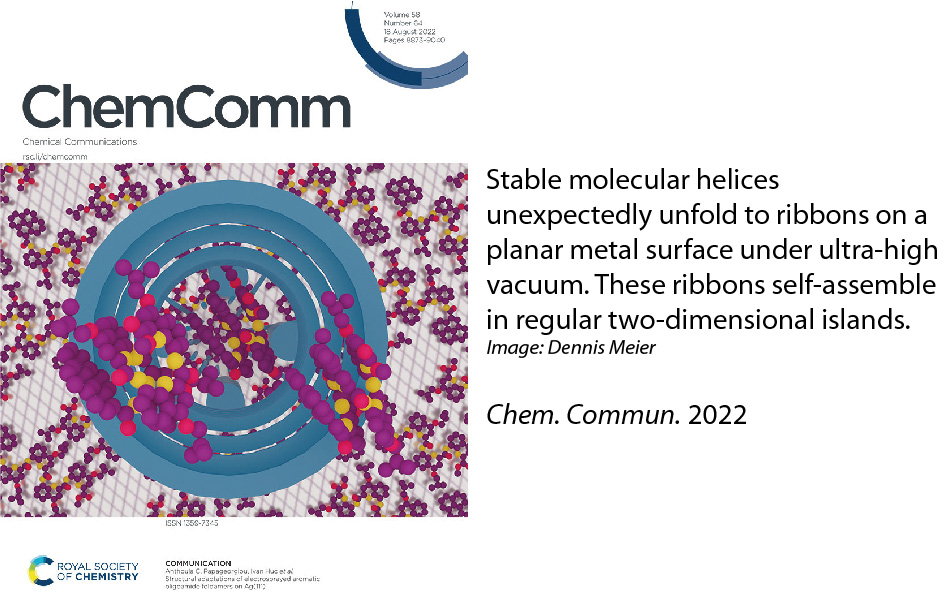
Anthoula Papageorgiou leads the Papageorgiou Group at Technical University of Munich's Physics Department (Surface and Interface Physics, E20). Her work focuses on surface processes and properties of molecular and supramolecular systems, using advanced microscopy and spectroscopic techniques. She has pioneered studies on porphyrins, carbenes, and 2D coordination networks. Education: BSc Physics (2000, Queen Mary & Westfield College), MSc Processes & Advanced Materials Technology (2004, Aristotle University), PhD Physical Chemistry (2007, UCL), Habilitation in Experimental Physics (2019, TUM) Research interests include surface-confined chemistry, nanoscale templating, and form-function relationships in surface nanostructures. Her group employs scanning tunneling microscopy (STM), X-ray photoelectron spectroscopy, and electrospray ion beam deposition. Key projects involve modular assembly of functional materials and understanding surface reaction mechanisms. Recent articles highlight discoveries like molecular raffle wheels, NHC-porphyrin interactions, and graphene nanoribbon synthesis. Funded projects include DFG priority programme COORNETs. Collaborations span theory (condensed matter physics), molecular synthesis, and surface science. The group actively mentors students from bachelor to doctoral levels.
Erich A. Müller is a Professor of Thermodynamics at Imperial College London's Department of Chemical Engineering, within the Faculty of Engineering. His research focuses on molecular simulation of complex fluids, adsorption phenomena, and phase equilibria, leveraging high-performance computing and machine learning. He holds a PhD from Cornell University and previously served as Head of the Department and Director of Academic Programs at Universidad Simón Bolívar in Venezuela. His affiliations include the Centre for Process Systems Engineering, Industrial Biotechnology Hub, and Institute for Molecular Science and Engineering. Research interests span thermodynamic modeling, carbon-based materials (e.g., graphene, carbon nanotubes), and applications in water purification, polymer-mineral interactions, and energy systems. Müller's work emphasizes computational methods like Molecular Dynamics and coarse-grained modeling frameworks such as SAFT-VR/γ Mie. His interdisciplinary approach addresses challenges in nanoconfined systems, interfacial phenomena, and sustainable technologies. Publications highlight contributions to adsorption mechanisms in porous materials, self-assembly of liquid crystals, and fluid phase behavior under extreme conditions. Notable projects include molecular-level analysis of CO₂ separation using nanoporous carbons and computational studies of polymer-calcite composites for enhanced oil recovery. He also explores pedagogical innovations, questioning traditional reliance on 'steam tables' in thermodynamics education. His research has been visualized through award-winning molecular dynamics videos (e.g., Gold Palm at 2009 RidgeDance Film Festival), demonstrating dynamic phenomena like water clustering in carbon nanotubes. Collaborations span academia and industry, addressing real-world applications in energy storage, environmental engineering, and materials science.
Frances Ross serves as the TDK Professor in the Department of Materials Science and Engineering at the Massachusetts Institute of Technology, where she leads cutting-edge research in nanoscale materials characterization and growth mechanisms. Education: Ph.D. in Materials Science, University of Cambridge B.A. in Physics, University of Cambridge Her research pioneers in situ transmission electron microscopy and scanning tunneling microscopy to observe real-time crystal growth during epitaxy, electrochemical deposition, and catalysis. This work drives innovations in microelectronics and energy storage through atomic-level understanding of nanomaterial self-assembly, with recent focus on developing next-generation microscopy instrumentation for liquid-phase studies. Her publication portfolio demonstrates convergence of materials science with computing hardware, exemplified by nanosecond-scale programmable resistors for analog deep learning. This reflects broader trends in designing energy-efficient neuromorphic devices using novel nanomaterials. Award highlights: Joseph F. Keithley Award (2024) Gerhard Ertl Lecture Award (2019) Hatsujiro Hashimoto Medal (2018) IBM Outstanding Accomplishment Award (2017) She maintains fellowships in six major scientific societies including the American Physical Society and Materials Research Society. Professor Ross actively mentors graduate researchers including Serin and Shu Fen, with her lab supported by grants focused on advanced microscopy development. Her team operates within MIT.nano facilities, collaborating across materials science and electrical engineering disciplines to pioneer new characterization methodologies. The Microscopy@MIT laboratory under her direction specializes in real-time observation of nanomaterial synthesis, maintaining strong partnerships with semiconductor industry leaders and national laboratories for applied research in energy storage solutions.
Alan McGaughey is a Professor in the Department of Mechanical Engineering at Carnegie Mellon University's College of Engineering. He leads the Nanoscale Transport Phenomena Laboratory, where his research bridges mechanical engineering, materials science, physics, and chemistry to study atomic-level transport of mass, momentum, and energy. His work emphasizes phonon, photon, electron, and fluid particle dynamics using advanced simulation techniques. Bachelor of Engineering, McMaster University (1998) Master of Applied Science, University of Toronto (2000) Ph.D., University of Michigan (2004) Post-doctoral training, University of Florida Alan McGaughey's research interests center on nanoscale thermal transport , with applications in energy technologies , materials for energy efficiency , and multiscale modeling . His lab develops molecular- and meso-scale simulation methods, including molecular dynamics, lattice dynamics, density functional theory, and Boltzmann transport equation modeling. Key research areas include thermal transport in nanostructures and interfaces, hybrid organic-inorganic materials, electrocaloric cooling, and liquid-vapor phase change. The team also applies machine learning to accelerate materials discovery and property prediction. The recent publications (2023–2025) reflect a strong focus on thermal conductivity prediction in diverse systems—from polymers and 2D materials to disordered crystals and thin films. The work integrates first-principles simulations , uncertainty quantification , and machine learning to uncover fundamental mechanisms of phonon transport and interfacial heat transfer. A recurring theme is the role of structural disorder —static, dynamic, or rotational—in modulating thermal properties. Air Force Office of Scientific Research Young Investigator Program (2009) Benjamin Richard Teare Teaching Award (2014) National Academy of Engineering’s Frontiers of Engineering Education Symposium (2015) Professor of the Year by MechE seniors (2012, 2015, 2017) 2019 & 2024 College of Engineering Faculty Awards 2021 Viskanta Fellowship, Purdue University McGaughey has advised numerous Ph.D. and Master’s students, many of whom have gone on to impactful research careers. His group has secured funding from agencies such as the Department of Defense and the Department of Energy, including Scott Institute seed grants for energy research. He collaborates extensively with experimentalists, including Jonathan Malen, Reeja Jayan, Chris Wilmer, and others, ensuring strong theory-experiment integration. He is also involved in educational innovation and was named faculty chair-elect for the College of Engineering. The Nanoscale Transport Phenomena Laboratory is a vibrant research group that combines computational modeling with interdisciplinary collaboration to advance fundamental understanding and enable next-generation thermal materials and devices.
Dr. Ehsan Aleem Ahmad is a post-doctoral researcher in the Department of Chemistry at Imperial College London, affiliated with the Computational Materials Science Group, Materials Chemistry, NanoHAC group, and the Thomas Young Centre. His research focuses on computational simulations for optimizing and discovering functional materials, including density functional theory (DFT) studies of strongly correlated materials, electrochemical catalyst characterization, and solar energy conversion. He holds an academic rank of Researcher within the Faculty of Natural Sciences. Dr. Ahmad's research interests span materials engineering, interdisciplinary engineering, and condensed matter physics, with a strong emphasis on computational modeling of materials properties and their applications in energy and corrosion science. His work integrates experimental and computational approaches to understand surface phenomena, catalytic mechanisms, and material degradation processes. His recent publications highlight advancements in photoelectrochemical materials, corrosion protection mechanisms, and DFT-driven catalyst design. Notable contributions include studies on Mo-doped BiVO₄ for solar water splitting, iron carbonate corrosion scales, and LaMnO₃ catalytic stability in alkaline fuel cells. These studies underscore his expertise in bridging theoretical predictions with practical material applications. No scientific awards have been explicitly mentioned. His research is supported through affiliations with Imperial College's advanced computational and experimental facilities. Dr. Ahmad's work contributes to interdisciplinary collaborations within the Faculty of Natural Sciences and international research networks in materials science.
Catherine Brinson is the Sharon C. and Harold L. Yoh III Distinguished Professor in the Thomas Lord Department of Mechanical Engineering and Materials Science at Duke University. She holds the Pratt School of Engineering affiliation and has served in academic leadership roles, including Department Chair and Associate Dean at Northwestern University. Her research focuses on advanced materials, with an emphasis on polymer-based nanostructured systems, interfacial mechanics, and integrating data science into materials discovery. Brinson earned her B.S. from Virginia Tech (1985), and M.S. and Ph.D. from Caltech (1986, 1990). Her work bridges experimental and computational methods, leveraging atomic force microscopy (AFM) and machine learning to study material behavior at nanoscale to bulk levels. Key projects include developing FAIR (Findable, Accessible, Interoperable, Reusable) data frameworks for materials research and optimizing 3D-printed metamaterials. She has pioneered methods like Dynamic Scanning Indentation (DSI) for polymer characterization and contributed to the MaterialsMine initiative for data-driven material design. Brinson's awards include the A.C. Eringen Medal (2022), AAAS Fellowship (2020), and Nadai Medal (2014). Her lab’s innovations span from smart textiles to computational modeling of nanocomposites. Collaborative efforts in materials informatics, such as the MaRDA initiative, underscore her commitment to interdisciplinary and open-science practices. Her grants include NSF CAREER Awards and industry collaborations. The Brinson Lab at Duke trains researchers in materials science, data science, and advanced characterization techniques, emphasizing FAIR data principles and AI integration.
Miaofang Chi is a Professor in the Thomas Lord Department of Mechanical Engineering and Materials Science at Duke University. She holds a Ph.D. from the University of California, Davis (2008). Her research focuses on designing advanced materials using novel electron microscopy techniques to study atomic-scale behavior in energy-related applications, including solid-state batteries, catalysis, and sustainable materials. Key areas of interest include nanomaterials synthesis, electrochemical energy storage, and materials characterization. Education: Ph.D. in Materials Science, University of California, Davis, 2008 Courses Taught: ME 758S (Curricular Practical Training), ME 555 (Advanced Topics in Mechanical Engineering) Dr. Chi's work bridges materials science and energy technology, emphasizing the development of high-performance materials for batteries, catalytic systems, and microelectronics. Her research employs cutting-edge electron microscopy to study material behavior at the atomic level, contributing to advancements in energy sustainability and nanotechnology. Publications span over 200 peer-reviewed articles, with recent focus on solid-state battery characterization, nanocatalyst design, and interfacial stability in energy materials. Her lab (Chi Lab) is recognized for innovative contributions to materials discovery and analysis.
Jörg Meyer is an Associate Professor at the Leiden Institute of Chemistry (LIC), Leiden University, The Netherlands, since 2020. His research focuses on energy dissipation at the atomic scale , particularly in chemical reactions on surfaces, leveraging computational modeling techniques from quantum mechanics to force-field levels. Education : PhD in Physics (2012, summa cum laude) and Diploma in Physics (2006, with distinction) from German institutions. Teaching : Co-organizer of workshops and courses on Density Functional Theory and Machine Learning in Computational Chemistry. His work has significant implications for heterogeneous catalysis, electrocatalysis, and astrochemistry , with a publication record of 51 papers and an H-index of 21. Recent projects funded by TKI-HTSM PPP grants (2020–2022) and recognized by the Teacher of the Year Award (2020). Supervised 11 PhD students and 8 postdoctoral fellows since 2015. Scientific Awards : NWO-CW Vidi Grant (2015) Young Investigator Competition Wins at Gordon Research Conferences (2011, 2013) DAAD Travel Grants (2011, 2013) Research Trends : His recent articles highlight applications of Density Functional Theory , Electronic Friction Models , and Vibrational Dynamics in systems like H2/Cu(111), N2/Ru(0001), and CO/Rh(100). Collaborative efforts span institutions in Germany, Austria, and the Netherlands.
Max J. Hülsey is a Rudolf Mößbauer Tenure Track Assistant Professor at the Technical University of Munich (TUM), appointed in 2024. He is affiliated with the School of Natural Science and leads research in the Focus Group "Catalytic Interfaces for Sustainable Chemical Energy Carriers" at the TUM Institute for Advanced Study. Hülsey's educational background includes: Biochemistry and Chemistry studies at Heidelberg University PhD in Chemical Engineering from the National University of Singapore Postdoctoral research at MIT in Chemistry and Chemical Engineering departments Hülsey's research focuses on the intersection of heterogeneous thermochemical and electrochemical catalysis. His work specifically investigates the impact of polarization on reactions without nominal charge transfer and the importance of non-Faradaic reactions on net electrochemical conversion processes. He aims to leverage fundamental insights to develop more sustainable methods for producing and interconverting chemical feedstocks and materials. His approach combines advanced spectroscopic techniques with catalytic reaction engineering to understand and optimize catalytic processes at the molecular level. Analysis of Hülsey's publication record reveals a strong focus on single-atom catalysis, electrochemical promotion of reactions, and sustainable energy conversion processes. His work spans fundamental mechanistic studies to applied catalytic systems, with particular emphasis on understanding reaction pathways at catalytic interfaces. The research demonstrates a consistent trajectory toward developing more efficient and sustainable catalytic processes for energy applications. Hülsey has received several prestigious awards recognizing his contributions to catalysis research: 2024: Nanyang Assistant Professorship (declined) 2021: Schmidt Science Fellowship 2020: Young Scientist Travel Support Prize 2017: SINGA Scholarship 2015: Germany Scholarship As a new faculty member at TUM, Hülsey is establishing his independent research group focused on catalytic interfaces for sustainable energy applications. His work bridges fundamental understanding of catalytic mechanisms with practical applications in sustainable chemical production. While specific grant information isn't detailed in the provided text, his fellowship appointments and publication record suggest strong support for his research program. Hülsey leads research within the "Catalytic Interfaces for Sustainable Chemical Energy Carriers" focus group at the TUM Institute for Advanced Study. This interdisciplinary team brings together expertise in catalysis, materials science, and energy systems to develop innovative solutions for sustainable energy conversion and storage.
Peter Sloan is a Senior Lecturer in the Department of Physics at the University of Bath, where he conducts pioneering research at the intersection of physics and chemistry. His work focuses on atomic-scale manipulation of molecules at surfaces using scanning tunneling microscopy techniques. Dr. Sloan is actively affiliated with multiple research centers including the Centre for Nanoscience and Nanotechnology, the Condensed Matter Physics CDT, the Bath Physics Observatory (BPO), and the Condensed Matter and Quantum Materials research group. He maintains an active research blog at http://blogs.bath.ac.uk/atomic-manipulation/ and is currently accepting doctoral students for supervision. Dr. Sloan's educational background includes: Doctor of Philosophy in STM Molecular Manipulation from the University of Birmingham (2004) Master of Chemistry from the University of Edinburgh (1999) His research program explores fundamental processes of controlling matter at the atomic scale, with particular emphasis on probing single molecule excitations using tunneling electrons from STM tips. This work spans electronic structure of surfaces, molecule/surface interactions, electron/surface/molecule interactions, and electron transport phenomena. Dr. Sloan specifically investigates small and large molecules on graphene and semiconducting surfaces, with recent efforts directed toward programmable STM control electronics to automate atomic manipulation processes. His research has significant implications for nanotechnology and quantum materials science, bridging fundamental physics with practical applications. Analysis of Dr. Sloan's publication record reveals a consistent research trajectory focused on molecular manipulation at surfaces, with increasing sophistication in experimental techniques and theoretical understanding. His recent work demonstrates how fundamental quantum processes govern chemical reactions at the single-molecule level, while his involvement with the Bath Physics Observatory shows expanding research horizons into astronomical instrumentation and physics education. The interdisciplinary nature of his work connects surface science, quantum physics, and chemistry in novel ways. Dr. Sloan has served as Principal Investigator on multiple research projects totaling seven completed initiatives between 2020-2022, primarily focused on developing the Bath Physics Observatory. These projects covered spectroscopy systems, imaging systems, power infrastructure, solar panels, and observatory structural components. His leadership in these projects demonstrates expertise spanning both nanoscale physics research and astronomical instrumentation development. Dr. Sloan maintains active involvement with the Atomic Manipulation research group and contributes significantly to undergraduate education through the Bath Physics Observatory. His recent public engagement activities, including a scheduled talk for February 2025 titled 'A personal journey through some small (atoms) and big (stars) experimental physics,' demonstrate his commitment to communicating science across multiple scales and to diverse audiences.
Dr. Thabiso Kunene is an Assistant Professor in the Department of Chemistry and Biochemistry at Hampton University, School of Science. His research lies at the intersection of molecular, materials, and surface chemistry, with a focus on functional materials for catalysis. He is actively engaged in advancing electrochemical methods for CO 2 conversion and catalytic materials design. Education: Postdoctoral Appointee, Argonne National Laboratory, Lemont, IL (2021–2022) Doctor of Philosophy (Inorganic Chemistry), University of Delaware, Newark, DE (2021) Bachelor of Arts in Chemistry (Biochemistry), Colby College, Waterville, ME (2015) His research interests include electroanalytical chemistry, electrocatalysis, vapor phase synthesis, atomic layer deposition, and the chemistry of materials for CO 2 conversion and CH 4 oxidation. He employs vibrational and optical spectroscopy, electroanalytical techniques, and computational methods to study structure-activity relationships in single-site iron-based catalysts. His recent publications highlight work on CO 2 reduction using bimetallic films and ionic liquids, solar-powered hydrocarbon synthesis, and the characterization of novel inorganic materials. The research trends emphasize sustainable energy solutions, catalytic efficiency, and atomic-level understanding of material behavior. Professional Memberships: American Chemical Society (ACS) National Organization for the Professional Advancement of Black Chemists and Chemical Engineers (NOBCChE) Materials Research Society (MRS) Dr. Kunene mentors students in advanced materials research and leads projects aimed at designing tunable metal-oxo and metal-sulfoxo clusters for energy applications. His lab focuses on operando studies of catalysts, supported by spectroscopic and computational tools. While no specific grants are listed, his work aligns with federally funded areas in energy and materials science.
Dr. Cristian Bahrim is a Professor of Physics at Lamar University, with a joint appointment in the Department of Electrical Engineering since 2005. He earned his B.S./M.S. in Physics from the University of Bucharest (1991), followed by a Ph.D. from University of Paris-Orsay (1997) under Prof. Francoise Masnou-Seeuws. From 1998-2001, he conducted postdoctoral research at Kansas State University's Theoretical Atomic Physics Group with Dr. Uwe Thumm. His research spans atomic physics, quantum mechanics, optics, lasers, and light-matter interaction , with over 100 peer-reviewed publications. Notably, he developed optical quantum bit systems via dielectric surface interactions and studied alignment relaxation in neon-helium collisions. His work bridges fundamental physics and applied optoelectronics, including laser-based capacitor switching. Dr. Bahrim has received numerous mentorship awards , including the national 2019 Council of Undergraduate Research Mentor Award and three Outstanding McNair Mentor Awards. He co-led the $1M NSF-STEP grant 'STAIRSTEP' to boost STEM retention through undergraduate research and advises the Society of Physics Students and Sigma Pi Sigma honor society. He served as Interim Chair of Lamar's Department of Physics (2013-2014), President of the Texas Section of the American Association of Physics Teachers (2018-2019), and Director of the Office of Undergraduate Research. He co-organized major physics conferences and reactivated Sigma Pi Sigma at Lamar after 17 years. French Government Fellowship (1992-1997) Postdoctoral Fellowship at Kansas State University (1992-1997) 2019 Mentor Award in Physics & Astronomy (national) 2015 Faculty Mentor Award at Lamar University
Jamiyanaa Dashdorj is an Associate Professor of Physics at Chatham University in Pittsburgh, PA. He holds appointments in the Department of Physics within the College of Arts & Sciences . Ph.D. in Applied Physics from Colorado School of Mines (2016) M.S. in Condensed Matter Physics from International Center for Theoretical Physics (Trieste, Italy) B.S. in Physics from University of Mongolia (Ulan Bator) His research focuses on semiconductor materials , ion mobility , and atomic transport properties , with significant contributions to GaN , SrTiO 3 , 4H-SiC , and ion transport in gases . He has developed advanced techniques for measuring ion mobility and diffusion coefficients with precision. Dr. Dashdorj has received prestigious awards including the Italian Government Scholarship , IAEA Fellowship , and TWAS/CNPQ Fellowship . His work has been published in journals like J. Chem. Phys. , J. Phys. B , and Int. J. Ion Mobil. Spec. , with recent studies on Ar + ion transport and defect analysis in wide bandgap semiconductors . He is a member of the American Physical Society (APS) and Materials Research Society (MRS) , and has presented at major conferences including the APS March Meeting and MRS Fall Meeting .
Uwe Burghaus is an Associate Professor in the Department of Chemistry and Biochemistry at North Dakota State University . His research focuses on surface science , heterogeneous catalysis , and nanoscience , with an emphasis on atomic-level understanding of gas-surface interactions on 2D materials like graphene , silicatene , and carbon nanotubes . PhD: Free University - Berlin Postdoc: Dipartmento di Fisica-Genoa Postdoc: University of California - Santa Barbara Research highlights include: Investigating metal-free catalysis using graphenic systems Developing model catalysts through electron beam lithography Characterizing adsorption dynamics via molecular beam scattering and XPS/AES Recent publications analyze CO2 and sulfur compound interactions with 2D materials, with applications in environmental catalysis and hydrogen storage . Key collaborations span institutions in Belgium ( Université de Namur ), Italy ( University of Padova ), and NASA. Scientific awards include US Patent 9242231 (2016) for metal-nanotube hybrid catalysts. He has advised multiple graduate students in physical chemistry and nanoscience projects. The Burghaus Group operates a multi-lab facility for ultra-high vacuum studies, nanofabrication , and kinetic analysis , equipped with molecular beam scattering systems and spectroscopic instrumentation .
Ieuan Seymour is a Lecturer in the Department of Chemistry at the University of Aberdeen, part of the School of Natural and Computing Sciences. He has held this position since 2023 and was awarded a UKRI Future Leaders Fellowship in 2024, supporting his research with over £1.2 million. His work bridges computational and experimental materials chemistry, focusing on next-generation sustainable energy technologies. His research interests center on materials for energy applications , particularly rechargeable batteries and fuel cells. He specializes in the discovery and characterization of novel cathode and solid-state electrolyte materials for Li-ion and beyond, using techniques such as density functional theory (DFT), Monte Carlo simulations, and operando characterization. His group investigates interfacial adhesion, ion transport, defect chemistry, and degradation mechanisms in energy materials, with a strong emphasis on sustainability across the material lifecycle. The most recent publications reveal a consistent focus on advanced battery chemistries , including sodium-ion cathodes, solid-state electrolytes, and interfacial phenomena. His work frequently appears in top-tier journals such as Nature Communications , Chemistry of Materials , and ACS Energy Letters , demonstrating a trend toward understanding and engineering complex material behaviors at atomic and interfacial levels to improve battery performance and stability. His scientific awards include: UKRI Future Leaders Fellowship (2024–current, £1,289,623) Royal Society of Edinburgh Small Research Grant (2023–2024, £3,017.60) Seymour is actively involved in advising and research funding, leading a project under the UKRI Future Leaders Fellowship. While specific student names are not listed, his publications show collaborations with researchers such as N. J. Williams, E. Quérel, S. J. Skinner, and A. Aguadero. He contributes to teaching in undergraduate and postgraduate chemistry programs, including courses on battery technology and research projects. His research is supported by equipment such as the Biologic VSP-300 battery cycler, and he participates in interdisciplinary activities like workshops on creative approaches to the energy crisis.