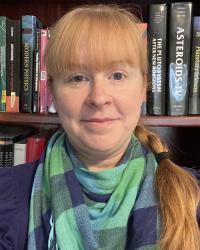
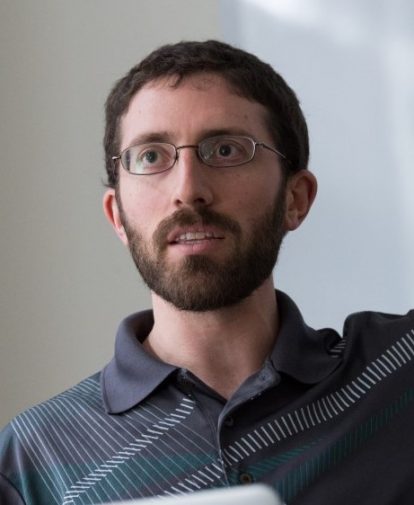
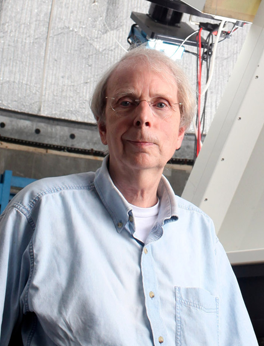
Daniel Krolikowski is a Researcher at Steward Observatory, University of Arizona. He joined in September 2022 to collaborate with Dr. Chad Bender and contribute to the NEID and HPF precision radial velocity spectrometer teams. His role emphasizes software development for NEID data reduction and analysis. Krolikowski holds a Ph.D. in Astronomy from the University of Texas at Austin (2022), where his research focused on star formation, stellar spectroscopy, and precision radial velocity techniques for exoplanet detection. His research interests include studying young planetary systems, stellar magnetic activity, and integrating multi-wavelength data to map the formation and evolution of planets. He aims to characterize planetary systems while mitigating stellar activity noise to improve exoplanet detection accuracy. Krolikowski is actively involved in advancing astronomical software tools and collaborative projects like NEID and HPF, which seek to refine radial velocity measurements for exoplanet science.
Willem-Jan Vriend is a Researcher at the University of Groningen , affiliated with the Faculty of Science and Engineering and the Astronomy Department . He specializes in astrophysics , data systems , and space mission infrastructure , with a focus on the Euclid mission and Astro-WISE technologies . His research interests include galaxy evolution , dark matter , near-infrared astronomy , and distributed computing for large-scale data processing. He contributes to the development of data transmission systems and infrastructure for space missions like Euclid, collaborating with institutions such as the European Space Agency and International Astronomical Union . His work emphasizes high-resolution imaging , data federation , and software engineering for astronomical data analysis. Publications highlight his role in the Euclid Wide Survey and the design of data distribution systems for space telescopes.
Quentin Changeat is an Assistant Professor at the Kapteyn Astronomical Institute, University of Groningen, and an Honorary Research Fellow in the Department of Physics and Astronomy at University College London. His research bridges exoplanet atmospheric studies and computational astrophysics, with affiliations spanning multiple international institutions. Research Interests: Dr. Changeat focuses on the physics and chemistry of exoplanet atmospheres, leveraging data from the James Webb Space Telescope (JWST), Hubble Space Telescope (HST), and Spitzer. His work emphasizes atmospheric retrieval techniques, machine learning applications, and the development of open-source tools like TauREx for spectral analysis. He is actively involved in the ESA Ariel mission, which aims to survey 1000 exoplanets by 2029. Publication Trends: His 15 most recent articles (2019–2024) reveal a strong emphasis on JWST/HST data analysis, atmospheric retrievals of hot Jupiters, and population-level studies. Key themes include thermal inversions, phase-curve degeneracies, and the development of statistical frameworks for large-scale exoplanet characterization. Machine learning and interdisciplinary collaborations feature prominently in his methodology. Awards: Honorary Research Fellow, University College London Academic Contributions: He leads educational initiatives like the ARES Summer School and ORBYTS program, mentors PhD students in exoplanet research, and develops datasets for community use (e.g., Ariel Data Challenge). His lab focuses on atmospheric retrieval algorithms and collaborates with teams at UCL, Flatiron Institute, and ESA.
Ross Turner is a Lecturer in Mathematics and Physics at the University of Tasmania, working within the School of Natural Sciences, Department of Physics. He leads the analytical modeling research stream in the University's Theoretical and Computational Astrophysics Group (Active Galactic Nuclei; AGN) and collaborates with the Australian Centre for Excellence in Antarctic Science (ACEAS). His research spans computational physics with applications in astronomy, theoretical astrophysics, applied mathematics, and computational earth sciences, aligning with the University's themes of Data, Knowledge and Decisions, and Marine, Antarctic and Maritime. Ross received his Doctor of Philosophy in Astrophysics from the University of Tasmania in 2018 and a Bachelor of Science (First Class Honours) in Physics from the same institution in 2013. His research primarily focuses on developing the statistical tools to analyze radio astronomy observations from next-generation large sky surveys, including by the Square Kilometre Array. He created the highly-cited RAiSE (Radio AGN in Semi-Analytic Environments) software package to simulate the physics of jet-inflated lobes emanating from active supermassive black holes. His work in computational earth sciences relates to interpreting large datasets from active glaciers using complex dynamical models and machine learning techniques. Turner's publication record demonstrates strong expertise in both astrophysics and computational geophysics, with recent work spanning AGN jet dynamics, radio galaxy evolution, and innovative applications of machine learning to cryoseismology. His research bridges theoretical modeling with observational astronomy and geophysical applications, showing a consistent trajectory of increasingly sophisticated computational approaches to complex physical systems. Vice Chancellor's Award 2022, Early Career Researcher Award College of Science and Engineering Early Career Researcher Award 2022 Eureka Prize Finalist, Australian Museum, 2022 The Bok Prize, Astronomical Society of Australia, 2014 Multiple Teaching Commendations and Unit Commendations Student-nominated Teaching Appreciation Certificate Ross has been awarded over $2 million (equivalent value) in competitive research funding, including more than 2000 hours of observing time to study AGNs using terrestrial and satellite telescopes. He supports the learning of Honours and higher degree by research students in both applied mathematics and theoretical astrophysics; 70% of his primary supervised Honours students have received a University Medal. He serves as primary or co-supervisor for six current PhD candidates at the University of Tasmania and the International Centre for Radio Astronomy Research (ICRAR). Turner leads the analytical modeling research stream within the University's Theoretical and Computational Astrophysics Group and works with the Compute Antarctic Group as part of ACEAS. His work involves developing computational frameworks that bridge theoretical astrophysics with observational data analysis, creating tools that enable more precise interpretation of complex astronomical phenomena and geophysical processes.
Hugo Buddelmeijer is an active Researcher at the Faculty of Science and Engineering , University of Groningen , affiliated with the Kapteyn Astronomical Institute . He specializes in astronomical data management, scientific visualization, and cosmological surveys. Research Interests : Galaxy evolution, photometric redshifts, data lineage, and visualization techniques for large-scale surveys like KiDS and Euclid. Technical Expertise : Development of simulation tools (e.g., ScopeSim), data catalog systems, and query-driven visualization frameworks. Contributions : Key participant in the KiDS and Euclid missions, focusing on optical/near-infrared imaging and dark matter analysis. His work emphasizes integrating machine learning with astronomical data. Collaborations : Extensive international partnerships with institutions like the European Southern Observatory and projects involving Very Large Telescope observations.
Prof. Dr.-Ing. Dipl.-Phys. Markus Bautsch is a full professor at the Berliner Hochschule für Technik (BHT) in the Department of Mechatronics since 2025. His career spans physics research, software development, and interdisciplinary studies connecting astronomy, music theory, and historical technology. PhD in Physics from Technical University of Berlin (TUB) Extensive work in international product testing consortia (ICRT) Contributions to DIN/DKE standards committees since 2003 Specializing in optomechatronic systems and computational modeling His research interests bridge optomechatronics and archaeoastronomy , with notable publications on ancient astronomical artifacts like the Tal-Qadi Sky Tablet and Rocher des Doms Stele . He has developed software for acoustic transmission lines , cellular automata , and celestial mechanics simulations. Bautsch's 15 most recent publications (2024-2025) demonstrate his interdisciplinary approach through: Gravitational potential calculations for cosmic structures Digital restoration of 19th-century astronomical photographs Software implementations of historical mathematical patterns Analysis of spectroscopic principles in astrophysics Computational modeling of prehistoric orientation systems Programming language evolution from Basic to Component Pascal Scientific achievements include: 2024 Ehrenpreis der Berliner Hochschule für Technik Leadership in EU Twinning projects (2001-2005) Key role in International Consumer Research & Testing (ICRT) (2002-2025) Contributions to consumer protection standards with DIN/DKE As both a physicist and software engineer , Bautsch combines rigorous mathematical analysis with practical implementation skills across 8 programming languages since 1979. His work at the Wilhelm-Foerster-Sternwarte (since 2022) and MOBIUS European Project (2006-2008) demonstrates long-term commitment to public science and applied research.
Anna Volpara is a Research Fellow at the Department of Mathematics (DIMA) of the University of Genova. Her work focuses on numerical analysis and solar imaging techniques, particularly inverse problems in high-energy solar observations. Primary affiliation: Department of Mathematics - DIMA, University of Genova Academic rank: Research Fellow Her research interests include: Inverse problems in astrophysics Hard X-ray observation techniques Fourier-based image reconstruction Kernel methods for solar imaging Recent publications (2023-2025) demonstrate expertise in computational methods for solar flare analysis, STIX imaging, and multi-scale data processing. No scientific awards were mentioned in the available information.
Coleman Krawczyk is a Senior Research Software Engineer at the Institute of Cosmology & Gravitation , University of Portsmouth , and a Citizen Science and Outreach Fellow. He serves as Technical Lead for the Tactile Universe project , creating 3D tactile astronomy models for vision-impaired students. A member of the Zooniverse development team, he builds data aggregation tools for citizen science projects like Global Earth Model (digital twin infrastructure) and Kilonova Seekers (real-time transient detection). Education: PhD from Drexel University (2014) Key Research: Machine learning for gravitational lensing, dark matter analysis, accessible astronomy, and SDSS/MaNGA survey contributions His recent work includes: Machine learning applications for Euclid Q1 Strong Lensing Discovery Engine (2025) GOTO065054+593624 dwarf nova detection (2025) Self-interacting dark matter evidence via SDSS J0946+1006 analysis (2025) LIGO-Virgo-KAGRA outreach initiatives (2024) Selected awards: Annie Maunder Medal for Outreach (2022) for accessible astronomy innovations He contributes to major collaborations including Sloan Digital Sky Survey , CANDELS , and Global Earth Model , while actively participating in Python-based astronomical software development ( Astropy , SkyPy). Current projects focus on machine learning integration with citizen science and 3D printing for inclusive education, maintaining active collaborations with institutions across the UK , USA , and International Sky Surveys .
Dr. Ole Streicher is a Researcher at the Leibniz Institute for Astrophysics Potsdam (AIP), Germany, within the Department of Development of Research Technology. He actively contributes to the 3D and Multi Object Spectroscopy and Supercomputing and E-Science research groups, focusing on astronomical instrumentation and computational solutions for astrophysical research. His research centers on advancing spectroscopic technologies and developing open-source software tools for astronomy. Key contributions include foundational work on the Astropy core package, SunPy for solar physics, and the GNU Data Language, which enhance data analysis capabilities across the astronomical community. He also specializes in data processing pipelines for instruments like MUSE and VIRUS-P, enabling precise spectral and spatial analysis of celestial objects. Streicher's publication trends reveal a sustained focus on bridging observational astronomy with computational science. His work consistently addresses challenges in data reduction, software infrastructure, and instrumentation, facilitating more efficient analysis of complex datasets from next-generation telescopes and surveys. At AIP, he collaborates within cutting-edge research environments dedicated to developing advanced spectroscopic systems and high-performance computing solutions. These teams drive innovation in astronomical instrumentation, supporting the institute's mission to pioneer new observational methodologies and data analysis techniques in modern astrophysics.
Andrea Bellini is a Researcher at the Space Telescope Science Institute (STScI), specializing in observational astronomy with Hubble and James Webb Space Telescopes. His work centers on high-precision astrometry of star clusters across the Milky Way and Magellanic Clouds, focusing on internal kinematics, multiple stellar populations, and cluster dynamics. Bellini's research spans globular clusters (e.g., Omega Centauri, 47 Tucanae, NGC 2808), open clusters, and dwarf galaxies. He pioneers proper motion measurements to study stellar rotation, black holes, planetary nebulae membership, and dark matter distributions. His methodology integrates HSTPROMO and oMEGACat survey data with cutting-edge JWST observations. Recent publications reveal three dominant research thrusts: (1) Kinematic analysis of cluster populations using multi-epoch HST data, (2) JWST-enabled studies of low-mass stellar objects and intracluster media, and (3) Development of Roman Space Telescope instrumentation tools. His work consistently demonstrates leadership in large collaborations like CARMA and HST legacy programs. Bellini actively contributes to mission-critical software development, including the Astronomer's Proposal Tool for the Roman Space Telescope and desktop simulators. His research directly enables breakthroughs in galactic archaeology and stellar evolution through precise dynamical modeling of cluster systems.
Zachory Berta-Thompson is an Assistant Professor in the Department of Astrophysical and Planetary Sciences at the University of Colorado, Boulder. His research focuses on exoplanets, particularly super-Earths and sub-Neptunes orbiting M dwarf stars. He is actively involved in observational astronomy using data from the MEarth Project, Transiting Exoplanet Survey Satellite (TESS), and the James Webb Space Telescope (JWST). His research interests include: Exoplanet atmospheres through transmission spectroscopy Small planets around small stars (M dwarfs) Stellar astrophysics of M dwarfs as exoplanet hosts Development of observational techniques for characterizing exoplanets Berta-Thompson's recent publications demonstrate a strong focus on analyzing exoplanet atmospheres using cutting-edge space telescopes. His work spans from rocky planets like LTT 1445A b to gaseous planets like those in the Kepler-51 system. A recurring theme in his research is understanding how stellar properties, particularly of M dwarfs, affect planetary atmospheres and evolution. His technical contributions include developing open-source software tools for exoplanet research, such as exoatlas and chromatic. Berta-Thompson has been instrumental in several major observational campaigns, including JWST programs to study exoplanet atmospheres. His collaborative approach is evident in the numerous multi-author publications spanning atmospheric science, stellar physics, and observational techniques. As an educator, Berta-Thompson teaches various astronomy courses at CU Boulder including Accelerated Intro Astronomy, Computational Techniques, Research Methods in Astronomy, Observations and Instrumentation, and graduate-level Planetary Atmospheres. He emphasizes hands-on experience and creative approaches to science education, extending his outreach to broader communities through events like TEDx Boulder talks and public astronomy activities.
Sarah Greenstreet is an Affiliate Assistant Professor at the University of Washington's DiRAC Institute and an Assistant Astronomer at NSF NOIRLab. She specializes in small body orbital dynamics, focusing on near-Earth objects, asteroid impacts, and resonant mechanisms. Her work includes developing open-source software for asteroid research and contributing to missions like the Rubin Observatory's LSST. Education: PhD in Astronomy (UBC 2015), MSc Astronomy (UBC 2011), B.S. Physics (WWU 2007). Research interests include asteroid-Earth impact probabilities, planetary defense, and characterization of co-orbital objects. She holds the honor of having asteroid (30535) Sarahgreenstreet named after her. Labs/Teams: DiRAC Institute, Rubin Observatory Community Science Team, B612 Asteroid Institute.
Adam Ginsburg is an Associate Professor and Graduate Coordinator in the Department of Astronomy at the University of Florida, College of Liberal Arts and Sciences. His research focuses on high-mass star formation, radio and millimeter astronomy, and the interstellar medium. He holds a Ph.D. in Astrophysics from the University of Colorado (2013), preceded by an M.S. (2009) and B.S. (2007) from the same university. Prior to UF, he held postdoctoral positions at the European Southern Observatory (2013–2016) and the National Radio Astronomy Observatory (2016–2019). His research interests include turbulence in the interstellar medium, astrochemistry, and the development of astronomical software tools. Recent work emphasizes the Central Molecular Zone (CMZ) and massive protoclusters, utilizing ALMA and JWST data to study star formation dynamics, magnetic fields, and molecular cloud structures. He leads the ALMA-IMF survey and contributes to projects like CASCADE and ACES, advancing understanding of galactic center physics and star formation mechanisms. Ginsburg is also actively involved in software development for observational astronomy, including tools like ndcube and photutils . Notable research trends include 3D structural analysis of the CMZ, magnetic field studies in star-forming regions, and the interplay between turbulence and star formation efficiency. His work bridges observational data with theoretical models, leveraging multi-wavelength observations to address fundamental questions about galactic evolution and stellar birth processes. Grants and collaborations include leadership roles in large-scale surveys and software development initiatives. He advises students through the UF astronomy graduate program and maintains active involvement in departmental governance as Graduate Coordinator.
Dr. John F. Kielkopf is Professor of Physics at the University of Louisville, based in the Natural Science Building, Room 006. His laboratory focuses on astrophysical instrumentation development. Education includes a Ph.D. from The Johns Hopkins University (1969). Research specializes in exoplanet detection systems, astronomical instrumentation design, remote sensing technologies, and computational methods in astrophysics. He leads development of observational systems and software for astronomical research, with applications in planetary science and space observation.
Iain McDonald is a Research Fellow in the Astronomy and Astrophysics Theory Group at the University of Manchester, specializing in computational astrophysics and stellar evolution studies. Research focuses on theoretical modeling of nonequilibrium astrophysical systems, including evolved stars and extrasolar planets. Current projects investigate molecular inventories of oxygen-rich stars using ALMA data, machine learning approaches for stellar classification, and automated spectral energy distribution analysis. Publications demonstrate advanced computational techniques applied to stellar spectroscopy and photometry, with recent work developing PySSED for automated stellar spectral fitting. Collaborations span international observatories and data science initiatives.