Dr. Elizabeth Kierepka is an Assistant Research Professor and Senior Scientist in the Biodiversity & Earth Observation Lab at the NC Museum of Natural Sciences, affiliated with North Carolina State University's College of Natural Resources. Her research spans wildlife genetics with broad interests in ecology and evolution, particularly focusing on reproductive isolation in evolutionary lineages and evaluating management strategies for invasive species. Kierepka investigates questions ranging from evolutionary biology to applied conservation management. Her recent publications examine geographic barriers affecting mammalian phylogeography, optimization of camera trap methodologies, genomic analyses of gray fox lineages, and landscape genetics of endangered species. She leads research projects including density and movement studies of coyotes in barrier island ecosystems and deer ecology across urban-rural gradients.
Angel Petropanagos is a Research Fellow at Novel Tech Ethics within Dalhousie University’s Faculty of Medicine, with expertise in bioethics, feminist philosophy, and clinical ethics. She holds a Ph.D. in Philosophy from the University of Western Ontario, specializing in feminist ethics and bioethics. Her research focuses on fertility preservation technologies, pediatric cancer ethics, and the societal influences on reproductive choices. She has contributed to policy discussions on vaccine injury compensation, clinical ethics education, and pandemic-related mental health practices. Key roles include Clinical Ethics Resident at William Osler Health System, Research Associate at Novel Tech Ethics, and co-chair of the Canadian Fertility and Andrology Society’s Ethics and Law Special Interest Group. She is also the Managing Editor of Impact Ethics, an online forum for bioethical discourse. Her work bridges theoretical ethics with practical policy, emphasizing marginalized voices in healthcare decision-making.
Antonio Serrato-Capuchina is Assistant Professor of the Practice with joint appointments in Messina College and the Biology Department at Boston College. His research employs Drosophila models to study evolutionary genetics, speciation mechanisms, and transposable element dynamics. He teaches advanced courses in molecular biology, genetics, and biostatistics. His awards include the Alliances for Graduate Education and the Professoriate Award (2011) and Minority Presence Fellowship (2012). Recent publications investigate genetic mechanisms of reproductive isolation and transposable element impacts on speciation.
Guid Oei is a Part-time Professor at Eindhoven University of Technology in the Signal Processing Systems group, focusing on Biomedical Diagnostics . He also works as a Gynecologist at the Máxima Medical Center since 1996. Chair of Fundamental Perinatology Leader of the Fundamental Perinatal Care Research Group Co-founder of Woman Mother Child Center, Obstetrics High Care Unit, and NICU at Máxima Medical Center President of Stichting Gynaecongres (2011–present) Collaborator with institutions in Uganda and China His research integrates biomedical engineering with obstetrics to enhance maternal-fetal safety through signal processing and simulation. Key projects include the Technological Research Group Perinatology (TOP) and Impuls initiative with Philips Healthcare. His 15 most recent articles (2018–2025) focus on fetal monitoring , electrohysterography , AI-assisted diagnostics , and simulation-based training in low-resource settings. Common sub-fields include uterine contraction analysis , fetal heart rate variability , umbilical cord physiology , and global maternal health . He has supervised over 20 PhD students and contributed to 288 research outputs . His work aligns with UN SDGs for healthcare innovation and maternal safety. Key collaborations include: MEDICAID ENGINE : MedTech solutions for cardiovascular disease TKI-HTSM/20.0295/PPS2006 MEDUSA : Data utilization in obstetrics National Obstetrics Consortium
Dr. habibe burcu baba is an Assistant Professor in the Department of Gender Studies at Queen's University (Faculty of Arts and Science). She serves as Social Justice & Action Coordinator and has been recognized for her mentorship contributions. Research Interests: Intersectional approaches to reproductive rights Critical theory and feminist activism Health policy analysis through gendered lenses Scientific Awards: Ban Righ Foundation Mentorship Award (2020) for outstanding mentorship and knowledge-sharing with students
W. Lee Kraus, Ph.D. is Professor and Director of the Green Center for Reproductive Biology Sciences at UT Southwestern Medical Center. He holds the Cecil H. and Ida Green Distinguished Chair in Reproductive Biology Sciences and serves as Vice Chair for Basic Sciences in the Department of Obstetrics and Gynecology, Assistant Director for Basic Research at the Simmons Comprehensive Cancer Center, and the inaugural Assistant Dean for Research Development. He is also a member of the Board of Directors of the Endocrine Society (2023-2026). Dr. Kraus earned his Bachelor of Science from Cornell University in 1989, completed his Ph.D. at the University of Illinois, Urbana-Champaign in 1994 under Benita S. Katzenellenbogen, and conducted postdoctoral research at UC San Diego with Jim Kadonaga, supported by NIH and American Cancer Society fellowships. His laboratory investigates signal regulated transcription, chromatin and gene regulation, nuclear receptors, PARPs, and NAD+ metabolism and signaling. The Kraus Lab has pioneered research on ADP-ribosylation mechanisms, revealing how PARP enzymes regulate transcriptional programs in reproduction, development, and cancer. His work has established critical connections between NAD+ metabolism, chromatin modification, and gene expression, with particular focus on hormonal regulation in breast cancer and reproductive tissues. Dr. Kraus has published over 150 original research articles with an h-index of 77 (Google Scholar 2022). His recent work demonstrates increasing sophistication in connecting PARP enzymatic activity with specific transcriptional outcomes across multiple disease contexts, particularly in cancer biology and metabolic regulation. His scientific contributions have been recognized with prestigious awards: Endocrine Society's Richard E. Weitzman Memorial Award (2007) Endocrine Society's Ernst Oppenheimer Award (2014) Cornell University Teaching Excellence Award (2004) Cornell University Research Mentoring Award (2008) Burroughs Wellcome Fund Career Award As a mentor, Dr. Kraus has trained 22 doctoral students, 26 postdocs, and 16 clinical fellows (as of 2022), with most former trainees securing faculty positions or research roles in academia and industry. His research has been continuously supported by major grants from NIH, American Cancer Society, Cancer Prevention and Research Institute of Texas, Endocrine Society, and NSF. The Green Center for Reproductive Biology Sciences under Dr. Kraus's leadership maintains a vibrant research environment focused on basic mechanisms of reproduction, development, and cancer. Beyond academia, he co-founded Ribon Therapeutics and ARase Therapeutics, translating basic discoveries about PARP biology into therapeutic applications, and serves on multiple biotech advisory boards.
Carolyn Zeiner is an Assistant Professor in the Biology Department at the University of St. Thomas. She holds a PhD from Harvard University, MS from Cornell University, and BS from Bucknell University. Her research focuses on microbial processes in environmental systems, with particular emphasis on fungal contributions to biogeochemical cycles. Her research investigates environmental microbiology through the lens of microbial metabolism and community dynamics. Primary interests include: Microbial carbon cycling in soils and impacts on global change Microbe-mineral-metal interactions during decomposition Metabolite-mediated community dynamics Proteomic and bioinformatic approaches to microbial ecology Her publications consistently explore fungal-mediated biogeochemical transformations, particularly manganese oxidation pathways and carbon utilization strategies across diverse Ascomycete fungi. Recent work expands into urban agricultural systems and long-term soil amendment studies. Dr. Zeiner leads the Zeiner Lab where she investigates microbial processes at molecular scales using advanced proteomic techniques. Current projects examine soil microbial responses to organic amendments in urban gardens and mechanistic studies of fungal metal oxidation.
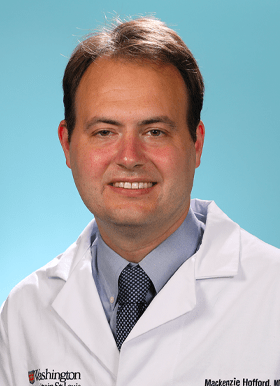
Mackenzie Hofford is Assistant Professor of Medicine in the Division of General Medicine at Washington University School of Medicine, serving as Associate Chief Research Information Officer. His clinical practice focuses on primary care, diabetes management, and chronic disease treatment. Research expertise centers on clinical informatics with emphasis on: Sepsis prediction models EHR data utilization Clinical decision support systems Predictive analytics in critical care Publications demonstrate consistent focus on developing validated tools for sepsis detection, respiratory support classification, and healthcare algorithm implementation across hospital systems. Contributes to policy discussions including responses to healthcare legislation impacting informatics practice. Affiliated with the Institute of Clinical and Translational Sciences (ICTS), Institute for Informatics, and Center for Applied Health Informatics.
Andrew Leslie is an Assistant Professor in the Department of Earth and Planetary Sciences at Stanford University. He previously served as a professor in the Ecology and Evolutionary Biology Department at Brown University and conducted postdoctoral research at Yale University's School of Forestry and Department of Ecology and Evolutionary Biology. His academic journey includes a PhD in Paleontology from the University of Chicago (2010) and a BA in Biochemistry and Geology from the University of Pennsylvania (2004). Leslie's research explores plant evolution through deep time, with particular emphasis on: Phylogenetic relationships and macroevolutionary patterns in conifers Functional morphology and biomechanics of plant reproductive structures Paleobotanical investigations of fossil taxa from Devonian to Cretaceous periods Ecological drivers of conifer diversity and distribution Evolution of complexity in plant reproductive innovations His publications demonstrate a consistent focus on integrating paleontological evidence with contemporary biological approaches, with recent work examining reproductive complexity across vascular plants, serotiny in Cupressaceae, and novel reproductive strategies in early Devonian flora. The research consistently bridges paleobotany, evolutionary biology, and functional morphology. Leslie leads a research laboratory at Stanford and maintains active collaborations with institutions including Yale University, University of Arkansas, and Louisiana State University. He mentors students in paleobotanical research methods and evolutionary studies.
Yiran Zhang is the Proskauer Assistant Professor of Employment and Labor Law at Cornell University’s School of Industrial and Labor Relations (ILR), with an affiliation to Cornell Law School. Her research focuses on legal systems governing care work at the intersection of informal labor markets, the welfare state, and economic households. Key projects include examining public care programs, employee classification of non-traditional laborers in the U.S., and care migration/social reproduction in China. She holds an S.J.D. and LL.M. from Harvard Law School and an LL.B. from Tsinghua University, and is a member of the New York Bar. Research interests include labor law, gender studies, social policy, and global migration. Her work critiques legal frameworks shaping care work dynamics, particularly in contexts like China’s garment industry and global domestic worker migration. Recent articles analyze 'workification' trends, gendered precarization in supply chains, and bureaucratic challenges in care systems. Teaching focuses on labor and employment law, employment discrimination, law of care work, and gender-political economy. No specific grants or advising roles are detailed in the text.
Dequina Nicholas is an Assistant Professor at the University of California, Irvine (UCI), affiliated with the Samueli School of Engineering and the Department of Molecular Biology and Biochemistry. Her research focuses on the interplay between chronic inflammation, metabolic dysfunction, and endocrine disorders such as Type 2 Diabetes (T2D) and Polycystic Ovary Syndrome (PCOS). Her lab employs molecular and cellular biology techniques, transgenic mouse models, and human sample analysis to study immunometabolism. Key projects include investigating pituitary immune cell populations influencing gonadotropin secretion, lipid antigen presentation mechanisms in human diseases, and the role of glucose metabolism in reproductive hormone regulation. Notable achievements include publications in Cell Metabolism and Nature Reviews Endocrinology , and recognition at the La Jolla Institute for Immunology Conference. Her work aims to identify therapeutic targets for metabolic and immune-related diseases, with a focus on translational research.
Dr. Carl Bonner-Thompson is an Assistant Professor in Urban (In)justice at Utrecht University's Human Geography and Spatial Planning Department. His work integrates feminist and queer perspectives to explore how vulnerabilities, care, and digital technologies intersect with marginalized urban experiences. Key areas include digital geographies of LGBTQ+ communities, masculinities, and the spatial politics of inequality. Research interests focus on embodied approaches to digital platforms (e.g., Grindr), gender/sexuality geographies, and urban precarity. He examines how technologies mediate identity and spatial practices, particularly for marginalized groups. Recent publications analyze queer social reproduction in precarious cities and feminist spaces for masculinities. Editorial Board: Gender, Place and Culture: Journal of Feminist Geography Teaching courses: Diverse Cities and Urban Inequality, Inclusive Cities? Theories and Concepts Publications span peer-reviewed journals like Gender, Place and Culture and Geoforum , with a focus on digital embodiment, queer temporalities, and urban marginalization. His work bridges qualitative methods and participatory action research to address social justice issues.
Beth Capper, PhD, is an Assistant Professor in the Department of English and Film Studies at the University of Alberta's Faculty of Arts. Her research and teaching focus on media history/theory, experimental/political film, and critical theories (Marxist, feminist, abolitionist). She has curated experimental film events at venues including the Maysles Cinema and Metro Cinema. She is part of a campus collective rethinking safety protocols. Education: PhD in Modern Culture and Media from Brown University. Teaching emphasizes media as sites of ideological struggle, combining close analysis with historical/political contexts. Courses taught include Film Theory, Political Economy of Media, and specialized film studies seminars. Current research projects include Uncommon Reproductions: Feminism, Cinema, and the Crises of Capitalism (examining feminist filmmakers' responses to neoliberalism) and a book on filmmaker Lizzie Borden. Publications appear in Art Journal , Third Text , and GLQ . Supervises graduate students in media theory, film history, Marxism, and abolitionist studies. Active in curriculum development emphasizing feminist/queer/Marxist frameworks.
Rajiv McCoy is an Assistant Professor in the Department of Biology at Johns Hopkins University (JHU). He holds a PhD in Biology from Stanford University and completed postdoctoral training at Princeton University and the University of Washington. His research integrates computational and statistical approaches to study human evolution, genetics, and reproduction, with a focus on genomic mechanisms underlying aneuploidy, embryo development, and somatic evolution. The McCoy Lab is affiliated with JHU’s Cell, Molecular, Developmental Biology, and Biophysics (CMDB) doctoral program. Key research interests include understanding how germline and somatic evolution shape genome function and reproductive outcomes. The lab employs advanced genomic methods to analyze chromosomal instability, recombination patterns, and the genetic basis of aneuploidy in human embryos. Recent work has explored maternal meiotic recombination, genomic mosaicism, and the evolutionary implications of Neanderthal introgression. Lab members have presented at conferences such as Cold Spring Harbor’s Biology of Genomes and the Broad Institute’s Mutations in Time and Space. Notable collaborations include studies with the Preimplantation Genetic Diagnosis International Society (PGDIS) and the Origins of Aneuploidy Research Consortium (OARC). The lab actively engages in genomic benchmarking, pangenome research, and the development of improved reference genome tools.
Kristin L. Perkins is an Assistant Professor in the Department of Sociology at Georgetown University. Her research focuses on inequality, social stratification, and the intersections of children’s educational outcomes with household composition, residential mobility, and neighborhood dynamics. She holds a PhD in Sociology & Social Policy from Harvard University, alongside degrees in Urban Planning (UC Berkeley) and Urban Studies (Cornell University). Education: PhD in Sociology & Social Policy, Harvard University M.S. in Urban Planning, University of California at Berkeley B.S. in Urban Studies, Cornell University Her work examines housing policies, household instability, and the consequences of residential mobility for children, particularly through the lens of race, class, and neighborhood context. Recent studies include analyses of shared housing as a safety net for older adults and the effects of rental assistance programs on family well-being. Her research has explored gentrification’s spatial impacts, foreclosure patterns in urban areas, and the role of housing instability in teen parenthood. She previously served as a postdoctoral fellow at the Joint Center for Housing Studies.