Gregor Kiczales is a Professor of Computer Science at the University of British Columbia , with a career spanning over three decades. His work focuses on programming language design, modularity, and aspect-oriented programming (AOP). Primary affiliation: University of British Columbia Verification email: gregor@cs.ubc.ca Kiczales' research centers around modularity and aspect-oriented programming , with significant contributions to understanding crosscutting concerns, developing AOP frameworks like AspectJ, and exploring novel abstractions for software systems. His work includes: Foundational research in AOP semantics and implementation Studies on code-design alignment and software architecture Developing registration-based abstractions and late-binding mechanisms Investigating scalability challenges in AOP systems
André Leal Santos is an Assistant Professor at ISCTE - Instituto Universitário de Lisboa, affiliated with the Department of Information Science and Technology (ISTA) and the ISTAR-Iscte research center. He holds a PhD in Computing from the University of Lisbon (2009), co-supervised with Tampere University of Technology, and a Bachelor's degree in Computing from the same institution. His research focuses on the human aspects of software development, particularly in programming education and API usability. Key areas include pedagogical tools, automatic assessment systems, projectional editors, domain-specific languages, and software maintenance. He has developed tools like PandionJ, a pedagogical debugger for Java, and authored a digital book on Kotlin programming. His recent publications reflect a consistent focus on improving developer and learner experiences through innovative software tools and educational methodologies. Themes include API learning support, automated component integration, programming pedagogy, and empirical studies on software development practices. Scientific engagement highlights: Visiting researcher at Carnegie Mellon University (2014) under CMU-Portugal program with Brad Myers Visiting researcher at Aalto University (2020) with Lauri Malmi in LeTech Organizer of ICPEC’24 Program Committee member for ITiCSE, Koli Calling (2017–2023), SPLASH-E’24 Member of the International Committee of the SIGSCE Technical Symposium Participant in the Dagstuhl Seminar on Notional Machines He advises PhD students Afonso Caniço and Ricardo Miranda, and has supervised MSc students. His work bridges academic research and practical applications in both educational and professional software development contexts. He is actively involved in open-source development, with projects hosted on GitHub, and maintains a strong presence in the computing education research community.
Remous-Aris Koutsiamanis is an Associate Professor at IMT Atlantique in Nantes, France, working on networking aspects of geo-distributed systems since September 2020. Previously, he was a postdoctoral researcher at IMT Atlantique in Rennes, France, focusing on Industrial Internet of Things (IIoT) protocols. He earned a Ph.D. in Electrical and Computer Engineering from Democritus University of Thrace (2016), an M.Sc. in Artificial Intelligence from the University of Edinburgh (2006) under a Bodosaki Foundation scholarship, and a B.Sc. in Informatics from the University of Piraeus (2005) with distinction. His research interests include Geo-distributed systems , Industrial Internet of Things , Quality of Service , and Distributed resource management , leveraging algorithmic game theory and network protocols . His work spans deterministic packet delivery, RPL optimization, and wireless scheduling, with a focus on IIoT reliability. He has contributed to journals like IEEE Transactions on Industrial Informatics and conferences like IEEE ICC , ISCC , and WF-IoT . His recent articles emphasize Industrial IoT , Wireless Network Reliability , and Protocol Design . Scientific Awards include the Bodosaki Foundation scholarship for his M.Sc. studies.
Dr. Jolanta Miliauskaitė serves as an Associate Professor and Researcher at the Cybersocial Systems Engineering Group within Vilnius University's Institute of Data Science and Digital Technologies. Her academic position reflects her expertise in cybersocial systems engineering and related fields, with a particular focus on the interface between cyberphysical and cybersocial systems. She maintains an active research profile with numerous publications and conference presentations focusing on fuzzy logic applications, quality of service modeling, and information systems. Dr. Miliauskaitė's research centers on cybersocial systems engineering, with significant contributions to understanding complexity issues in data-driven fuzzy inference systems and developing frameworks for membership function construction. Her work bridges theoretical computer science with practical applications in software engineering, particularly in fuzzy logic applications for quality of service planning in enterprise systems. She has conducted systematic literature reviews and developed methodologies for handling uncertainty in information systems. Her publication record shows a consistent research trajectory from foundational work on algorithm concepts to specialized research on interval type-2 fuzzy sets. Recent publications (2023-2024) demonstrate expansion into social factors affecting software quality and more sophisticated modeling of web service quality. Her work often combines theoretical insights with practical case studies, particularly in enterprise business services and web service quality modeling. DAMSS 2019 Best Poster Award for "On issues related to interval type-2 membership function development" Dr. Miliauskaitė actively mentors doctoral students, currently supervising Darius Sabaliauskas whose dissertation focuses on the "Reasoning mechanism of cognitive systems" (2024-2028). She has participated in significant research projects, including the National Complex Program Project "Theoretical and Engineering Aspects of the Development and Use of Internet of Services Technologies in High-Performance Computing Platforms" under Prof. G. Dzemyda's supervision (2012-2015). Her qualifications are continuously enhanced through Erasmus+ programs and specialized training in scientific methodology. As an active member of the academic community, Dr. Miliauskaitė serves on organizing committees for major conferences including Baltic DB&IS (2012, 2018, 2024) and DAMSS (2018), and participates in program committees for ICMarkTech'24, SAC 2025, SS AIEDUMED'25, and CompSysTech'25. She is also a member of the Lithuanian Computer Society (LIKS), contributing to the broader computer science community in Lithuania.
Assoc. Prof. Dr. Audronė Lupeikienė serves as an Associate Professor and Group Leader at the Cybersocial Systems Engineering Group within Vilnius University's Institute of Data Science and Digital Technologies (formerly Institute of Mathematics and Informatics). Holding a Doctor of Science degree, she has established herself as a leading researcher in information systems engineering with over two decades of scholarly contributions. Her academic profile demonstrates sustained excellence in research, teaching, and service within the Lithuanian and international academic community. Dr. Lupeikienė's research expertise spans Information Systems Engineering , Computer Service Systems Engineering , Knowledge Systems Engineering , and Software Systems Engineering . Her work explores both theoretical foundations and practical applications of information systems, with particular emphasis on service-oriented architectures, business process management systems, and ontology-based component programs. She investigates how these systems can be optimized for performance, quality of service, and effective business-IT alignment in digital environments. Her recent scholarly output (2020-2024) reveals a clear evolution in research focus from foundational work on component-based systems to contemporary investigations of digital business transformation. Notably, her research has expanded into interdisciplinary applications including telemedicine systems for cardiac rehabilitation and energy harvesting technologies, demonstrating versatility across domains while maintaining core expertise in information systems engineering. This trajectory reflects her ability to adapt theoretical frameworks to emerging technological and societal challenges. Dr. Lupeikienė has successfully led and participated in significant research projects including the EU structural support project "Theoretical and engineering aspects of the development and use of Internet of Services technologies in high-performance computing platforms" (2012-2015), the "PEN: Production Effectiveness Navigator" EuroStars project (2011-2014), and earlier work on "Engineering problems of ontology-based component programs" (2003-2005). She has served on organizing committees for numerous international conferences and is an active member of the Lithuanian Computer Association. As an educator, Dr. Lupeikienė has taught a comprehensive range of courses reflecting the evolution of information systems education: Agent technologies (2005-2008), Decision-making systems (since 2003), Information systems (since 2002), Database Theory and Practice (2000-2003), and Computerization of management processes (1995-2002). Her teaching portfolio demonstrates adaptation to technological advancements while maintaining focus on core principles of system design and implementation. Her leadership of the Cybersocial Systems Engineering Group focuses on the intersection of social systems and technological infrastructure, exploring how to design, implement, and optimize systems that effectively serve both organizational and social needs in today's increasingly interconnected digital landscape.
Jim Nelson is an Associate Professor and Analytics Program Coordinator at the College of Business, Southern Illinois University Carbondale (SIU), where he also directs The Pontikes Center for Advanced Analytics and Artificial Intelligence. Joining SIU in 2005 after over a decade in industry and fifteen years of academic experience, he holds a Ph.D. in Information Systems from the University of Colorado, Boulder. Nelson's educational background includes: Bachelor of Science in Computer Science from California Polytechnic State University Master's Degree in Information Systems from University of Colorado, Boulder Ph.D. in Information Systems from University of Colorado, Boulder His research specializes in conceptual modeling and cognitive science, focusing on behavioral aspects of modeling through real-world field studies. He pioneered "hunch mining" for cognitive analytics and explores object-oriented/fuzzy data models, text mining, and telecommunications. His work bridges cognitive theory with practical software engineering challenges. Nelson's publications (2005-2012) reveal a consistent focus on conceptual modeling quality, agile development documentation, and IT workforce dynamics. His studies examine human-model interactions across domains including credit unions and telecommunications policy, demonstrating how cognitive principles enhance modeling effectiveness and organizational IT strategy. Nelson's academic honors include: Dean's Summer Research Fellowship for 'Preconscious Quantum Shift Learning' (2004) Nomination for SIU College of Business Undergraduate Teacher of the Year (2005-2006) Fisher College of Business Undergraduate Teaching Award (2003) Finalist for Columbus Technology Council's TopCAT Award (2003) Nomination for Fisher College of Business Pace Setters Award (2003) His research funding comprises: Boeing Commercial Aircraft: $525,000 (2001) for "Studies of IT Effectiveness and E-Business Performance" Pontikes Center: $2,300 (2007) for "Objective Quantification of IT Job Definitions Through Latent Semantic Categorization" University of Utah: $6,000 (2000) for "The Business Value of Information Technology" As Pontikes Center Director, Nelson coordinates analytics curriculum across all business programs and liaises with the Center's Board of Advisors—comprising Midwest corporate analytics executives—to drive industry-academic collaboration in AI and advanced analytics education.
Professor Ina Schiering is a distinguished academic at Ostfalia University of Applied Sciences, serving as Professor in the Faculty of Computer Science. She will assume the role of Vice President for Research, Development and Technology Transfer in September 2025, and currently holds a Research Professorship (2021-2026). Professor Schiering serves in numerous leadership roles including Managing Director of the Institute for Distributed Systems, Board member of the Center for Digital Technologies (DIGIT), and Deputy spokesperson of the cooperative doctoral program "Digital Transformation to a Sustainable Society" of TU Clausthal and Ostfalia University. Her research interests span IT Security, Privacy (particularly data protection risks and data protection impact assessment), Data Governance, and Datensouveränität. She also focuses on Digital Transformation applications in fields like forest and water management, Assistive Technologies for inclusion, and Internet of Things with Wireless Sensor Networks. Professor Schiering leads a research group with over a dozen members working on projects that bridge technical security aspects with practical applications in healthcare, rehabilitation, and environmental contexts. Professor Schiering's recent publications demonstrate a strong focus on privacy by design frameworks, data protection impact assessments, and the development of assistive technologies like the RehaGoal App. Her work shows a consistent trajectory toward making digital technologies more secure, privacy-preserving, and accessible for diverse user groups, particularly those with cognitive challenges. Her scientific contributions include numerous publications in reputable venues, with recent work appearing in IEEE Access, Springer's IFIP series, and specialized journals in privacy, security, and rehabilitation. She has co-edited several volumes of Privacy and Identity Management proceedings and has made significant contributions to the understanding of data protection in digital environments. Professor Schiering actively supervises students, with opportunities available for Bachelor's and Master's theses in Security, Privacy, and Applied Cryptography. Her lab provides students with hands-on experience in developing practical solutions for real-world challenges in digital security and privacy.
Marti Alcaraz is a Part-Time Lecturer at the Department of Statistics, Mathematics and Informatics within the Miguel Hernández University of Elche. Their professional profile focuses on computing languages and systems, with teaching responsibilities in Computer Engineering and Data Science & Artificial Intelligence programs. Marti teaches courses such as Mobile Device Application Development, Object-Oriented Programming, and Software Engineering Project Management, reflecting expertise in software development, programming methodologies, and project coordination. Their fields of interest align with core computing disciplines, emphasizing practical and theoretical aspects of software systems. Contact details include personal and departmental email addresses. Teaching activities span multiple academic years, with consistent involvement in core curriculum courses for bachelor's degrees.
Laura Dietz is a tenured Associate Professor in the Department of Computer Science at the University of New Hampshire, where she leads the TREMA lab. Her academic journey began with a PhD from the Max Planck Institute for Informatics in Saarbruecken, Germany (2011), followed by postdoctoral positions at the University of Massachusetts Amherst (2010-2015) and University of Mannheim (2015-2016). Her educational background includes PhD studies at both the Max Planck Institute for Informatics (2007-2011) under Prof. Gerhard Weikum and Prof. Tobias Scheffer, and earlier research at Humboldt University in Berlin. She has built a distinguished career bridging theoretical computer science with practical applications in information retrieval and machine learning. Dietz's research primarily focuses on the intersection of information retrieval, natural language processing, and knowledge graphs, with a parallel research initiative in watershed data science. She is particularly known for her work on entity-aspect linking, complex answer retrieval, and the vision of automatic Wikipedia construction. Her approach integrates fine-grained knowledge annotations with text understanding to create comprehensive information systems that go beyond traditional 10-blue-links search paradigms. In watershed data science, she applies similar machine learning techniques to environmental data streams, focusing on solute transport analysis during storm events. Her recent publications reveal a strong trend toward fine-grained semantic understanding, particularly in entity-oriented search tasks. She has pioneered methods for entity-aspect linking that significantly improve retrieval accuracy by capturing different contexts in which entities appear. Her work increasingly integrates knowledge graphs with neural architectures, showing sophisticated understanding of how to leverage both structured and unstructured information for better search experiences. Best paper award at JCDL 2018 for work on entity-aspect linking NSF CAREER Award (2019-2023) for "Utilizing Fine-grained Knowledge Annotations in Text Understanding and Retrieval" OSSI Award 2013 from UMass ICB3 for open-source hardware/software Dietz actively mentors PhD and Masters students through the TREMA lab, with current research focusing on entity ranking, topic extraction, conversational search, and watershed forecasting. Her grant portfolio includes the NSF CAREER award and funding from the Northeast Big Data Innovation Hub for forecasting salinity in rivers during storm events. She has also coordinated the TREC Complex Answer Retrieval track (2017-2019), creating important benchmarks for the IR community. The TREMA lab (Text Retrieval, Entity Modeling, and Applications) serves as the hub for Dietz's research activities, bringing together students and collaborators to work on cutting-edge problems in information access. The lab's work spans both theoretical contributions to information retrieval and practical applications in domains ranging from environmental science to scientific publication analysis.
Wing-Kwong Chan is an Associate Professor in the Department of Computer Science at City University of Hong Kong. With a background that includes industry experience as a software engineer, Dr. Chan returned to academia and has established himself as a leading researcher in software engineering with a focus on emerging technologies. Dr. Chan received his BEng, MPhil, and PhD all from The University of Hong Kong. His academic journey began with a hardware-oriented Computer Engineering degree before shifting to software engineering for his graduate studies. His research interests center on software engineering, particularly the technical aspects interfacing with machine learning, blockchain, and GPU technologies. He addresses challenges in program analysis and concurrency, with recent work focusing on deep learning model verification and robustness. His publications span top venues including TOSEM, TSE, ICSE, ESEC/FSE, and ASE. Dr. Chan's recent publications demonstrate a strong trend toward integrating software engineering principles with deep learning systems, particularly in verification, testing, and robustness of AI models. His work bridges theoretical software engineering concepts with practical applications in emerging technologies. Best Paper Award from COMPSAC'04 Best Paper Award from COMPSAC'08 Best Paper Award from COMPSAC'10 Best Paper Award from QSIC'11 Best Paper Award from QRS'16 Best Paper Award from ISET'18 CityU President's Award 2017 Dr. Chan has successfully advised numerous PhD and MPhil students, with alumni dating back to 2006. He has secured substantial research funding through multiple Hong Kong Research Grants Council projects, ITF grants, and international collaborations. His current research focuses on patch robustness certification for deep learning models, reflecting his ongoing commitment to advancing software engineering practices for emerging technologies. As Program Leader for the MSc in E-Commerce program from the CS Department, Dr. Chan also contributes significantly to academic administration and curriculum development at City University of Hong Kong.
Marianne Huchard is Full Professor of Computer Science at the University of Montpellier, Faculty of Sciences since 2004, serving as Director of LIRMM (Laboratory of Informatics, Robotics and Microelectronics at Montpellier) and head of its Computer Science Department. She also participates in the human resources committee of the MIPS scientific department. She earned her PhD in Computer Science in 1992 researching algorithmic aspects of multiple inheritance in object-oriented programming languages. Her primary research domains are Formal Concept Analysis (theoretical and applied, including Relational Concept Analysis) and Software Engineering (model-driven engineering, component-based development, and software product line migration), with recent work integrating Large Language Models for innovative solutions. Analysis of her 2024-2025 publications reveals a strong interdisciplinary trend: Relational Concept Analysis enhanced by LLMs is being applied to software engineering challenges like user-story generation, class model restructuring, and product line migration, demonstrating significant methodological innovation. Scientific awards: None documented in provided sources. She actively supervises doctoral research: Thomas Georges (defended January 2023): 'Agile Engineering of Software Product Lines for Agricultural Decision Support' Austin Waffo-Kouhoué (defended November 2024): 'Web Accessibility for People with Visual Impairments' Her research is supported by projects including RCAviz (funded by #DigitAg), FCA4J toolkit development, and Web Iris accessibility extension. As leader of the MAREL team (Models And Reuse Engineering, Languages) at LIRMM, she drives research at the formal methods/software engineering intersection and co-created Montpellier's Master's program in Software Engineering.
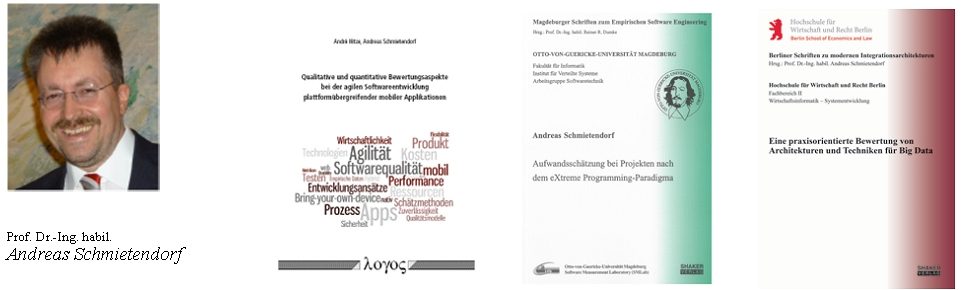
Prof. Dr. Andreas Schmietendorf is a Professor of Business Informatics – System Development at the Berlin School of Economics and Law (HWR Berlin) and holds a private lectureship in Software Engineering at the Otto von Guericke University Magdeburg. He leads the Business Informatics – System Development research group and is actively involved in the HWR doctoral college and Competence Center Digitization. His research focuses on the intersection of software engineering, business informatics, and artificial intelligence, with particular emphasis on: AI-driven changes in software engineering practices Trustworthy AI implementations in domain-specific contexts Web API security and management Digital transformation through low-code development approaches Requirements engineering for trustworthy digital services Prof. Schmietendorf's recent work has centered on the TAHAI (TrustAdHocAI) research project, which investigates trustworthy ad-hoc AI solutions across multiple domains including railway infrastructure, mediation research, and forestry. His research group regularly publishes on software engineering, AI applications, and digital transformation, with a strong focus on practical industry collaborations. The group has produced numerous workshops (ESAPI, KI4SE), conference proceedings, and practical implementations that bridge academic research and industry needs. He has successfully supervised multiple PhD students to completion and maintains an active doctoral supervision portfolio. His research group collaborates extensively with industry partners, particularly Deutsche Bahn, and regularly organizes events that foster academic-industry dialogue. Prof. Schmietendorf is also active in teaching, offering courses on Service Engineering at the University of Magdeburg and various business informatics topics at HWR Berlin. His teaching emphasizes practical applications of software engineering principles and the integration of emerging AI technologies through hands-on exercises and industry-relevant case studies.
陳恭 is a Professor at the Department of Information Management, College of Business, National Chengchi University. With expertise spanning blockchain technology, information security, and software engineering, he has established himself as a leading academic in Taiwan's fintech research community. His work bridges theoretical computer science with practical business applications, particularly in digital finance and secure information systems. Dr. 陳恭 earned his PhD in Computer Science from Yale University (1989-1994), following Bachelor's and Master's degrees from National Taiwan University. His academic journey at National Chengchi University spans over two decades, progressing from Associate Professor to his current position as Professor, with significant administrative roles including Department Chair and Director of the Computer Center. Professor 陳恭's research primarily focuses on blockchain and smart contracts, Open API technology and security, social big data analysis, and programming languages. His work demonstrates a clear evolution from foundational programming language research to cutting-edge blockchain applications. He has made significant contributions to secure multi-party computation, aspect-oriented programming, and blockchain-based systems, with publications in top journals and conferences across computer science, public administration, and business innovation. An analysis of Professor 陳恭's recent publications (2016-2024) reveals a strong concentration on blockchain technology and its financial applications, particularly in smart contracts, consensus algorithms, and secure data dissemination. His research increasingly integrates with IoT systems and demonstrates practical applications in financial technology, showing a clear trajectory from theoretical foundations to real-world business solutions. His notable achievements include: Senior Excellent Teacher (20 years) from National Chengchi University Multiple Distinguished Professor appointments Special Outstanding Talent Award from the National Science Council Multiple Internationalization Excellent Research Awards Professor 陳恭 has secured numerous research grants from both governmental agencies like the Ministry of Science and Technology and private sector organizations including financial institutions and technology companies. His projects often focus on blockchain applications, fintech innovation, and information security, demonstrating strong industry-academia collaboration. He is actively involved in establishing National Chengchi University as a leading center for blockchain research in Taiwan, contributing to research centers focused on fintech innovation and digital transformation. His work has fostered significant collaborations between academia and industry in the rapidly evolving field of digital finance.
Viorel Grigorcea is a Senior Lecturer at the Department of Computer Science within the Faculty of Mathematics and Informatics at the University of State of Moldova (USM). He has been with USM since 1997, becoming a senior lecturer by competition in 2002, and has served as Vice-Dean of the Faculty of Mathematics and Informatics since that same year. His academic journey began with a Bachelor's degree in Applied Mathematics from USM (1991-1996), followed by a Doctorate in Computer Programming from the Institute of Mathematics and Informatics of the Romanian Academy of Sciences (1996-1999). His teaching portfolio includes a comprehensive range of computer science courses: Artificial Intelligence Logic Programming Functional Programming Object-Oriented Programming Programming Fundamentals Programming Techniques Computer Architecture Operating Systems Expert Systems Grigorcea's research has evolved over time, with early work focusing on analogical reasoning, case-based reasoning, and attribute modeling in artificial intelligence systems. In recent years, his research has expanded to include educational assessment, particularly evaluating school results and basic skills of primary and secondary school graduates in Mathematics, Romanian, and Russian. His scientific activity includes continuous collaboration since 2001 on the institutional project 'Research and development of theoretical and practical aspects of modern programming technologies,' building on his earlier work in artificial intelligence systems. Grigorcea is associated with the Web Programming Section at USM, reflecting his engagement with practical programming technologies and applications.
Jooyong Yi is an Associate Professor in the Department of Computer Science and Engineering at UNIST (Ulsan National Institute of Science and Technology). He leads the LOFT (Lab of Software), focusing on autonomous techniques for software reliability in AI-generated code environments. Research Interests: His work spans program analysis, automated repair, testing/debugging, and verification. Core themes include developing scalable methods for bug detection (via static/dynamic analysis), AI-compatible repair systems, and verification frameworks for safety-critical systems. Recent emphasis integrates fuzzing techniques with repair validation. Publication Trends: His 15 most recent works (2015-2025) show progression from foundational program repair techniques (e.g., Angelix, DirectFix) toward AI-era innovations: greybox fuzzing for efficiency, memory-leak repair for web frameworks, and deep-learning library testing. Over 50% of publications focus on optimizing repair validation and scalability. Awards: ACM Distinguished Paper Award at ASE 2023 Students & Grants: Currently advises 5 PhD, 1 MS/PhD, and 2 MSc students. Secured ₩20B+ in funding for projects including: MSIT Binary Micro-Security Patch Technology (2024-2026) Patch Validation for Automated Repair (2023-2026) AI-Powered Low-Code Platform (2023-2025) Memory-Safe Language Integration (2024-2027) Lab: LOFT lab develops verified repair tools (e.g., LeakPair, Verifix) and benchmarks (BUGSC++), prioritizing human oversight in AI-generated software.