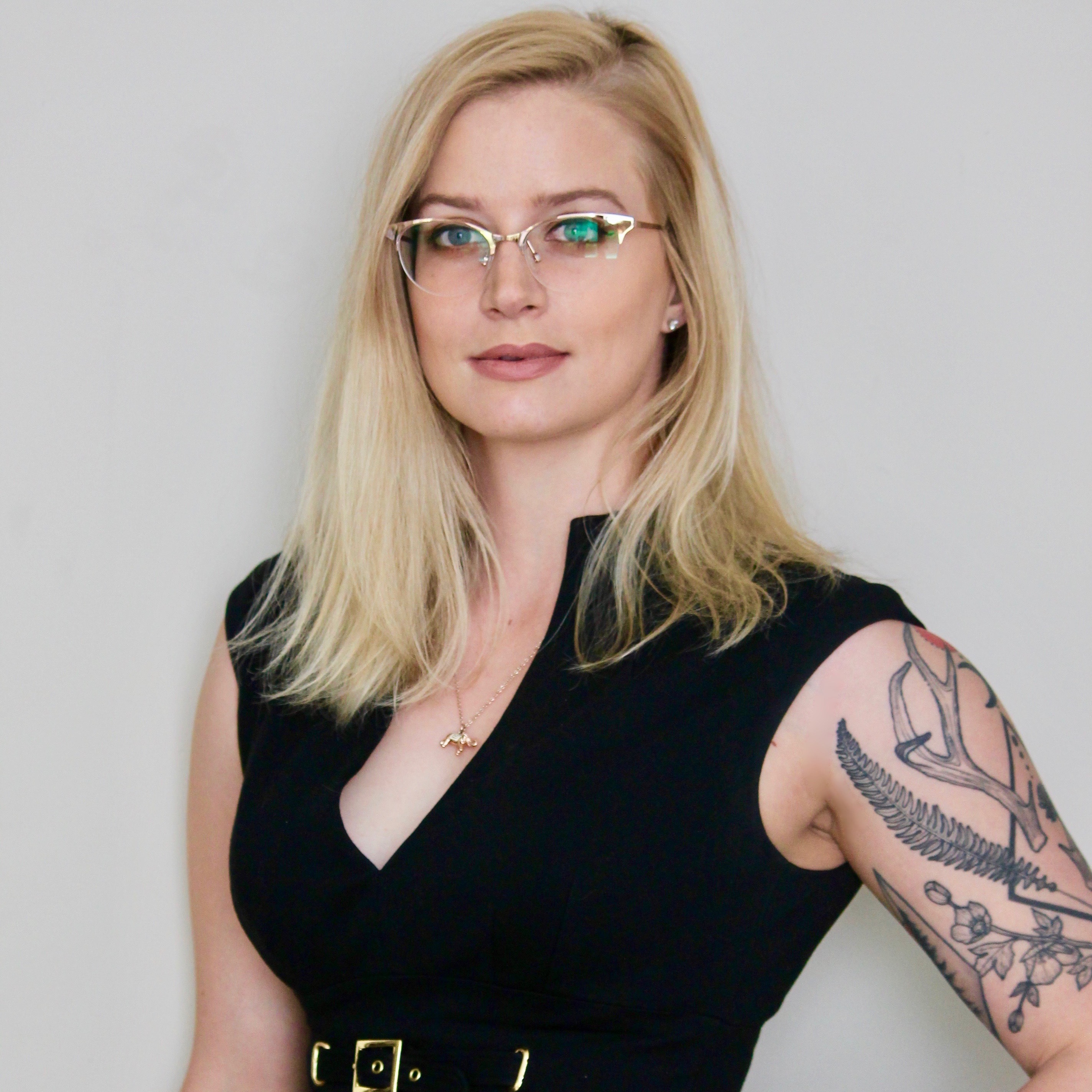
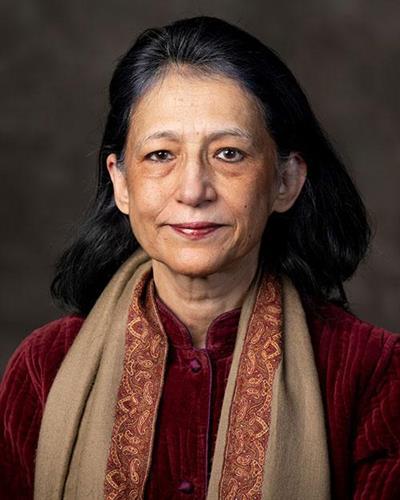
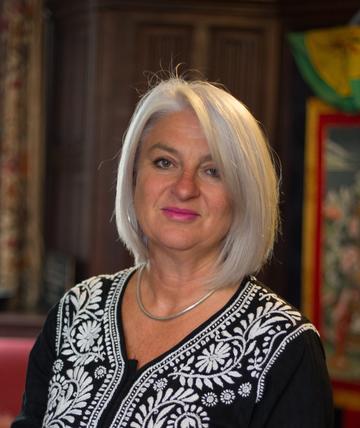
Andrea Korda, PhD (University of California, Santa Barbara), is an Associate Professor of Fine Arts & Humanities and Associate Dean (Research) at the Augustana Campus of the University of Alberta. Her academic career bridges art history, material culture studies, and pedagogical innovation. Educations: BA in Fine Arts, Queen's University MA in Art History, Concordia University PhD in Art History, University of California, Santa Barbara Research Focus: Dr. Korda specializes in 19th-century visual and material culture, with a focus on education's visual dimensions, children's literature, and community-engaged projects like the award-winning Crafting Communities initiative. She co-curated the virtual exhibition Photographies (Bruce Peel Special Collections) and explores hands-on learning through historical crafts. Teaching: Courses include modern art history (AUART 220), photography theory (AUART 225), and special topics in visual culture (AUART 382). She emphasizes experiential learning and digital humanities integration, as seen in her work with the Getty Museum Challenge and OER projects. Collaborations: Leads interdisciplinary teams on projects like Crafting Communities , blending scholarship with public engagement. Her research bridges historical methodologies with contemporary pedagogical practices, fostering connections between academia and communities.
Prof. Dr. Barbara Mittler is Professor of Sinology at Heidelberg University and founding co-director of the Heidelberg Centre for Transcultural Studies (CATS) and the Cluster of Excellence 'Asia and Europe in a Global Context.' Her research explores Chinese cultural policy, print media, musicology, visual culture, and transcultural studies. Mittler's scholarly contributions include groundbreaking work on Cultural Revolution culture, early Chinese print media (particularly women's magazines), and the transcultural flows of cultural production. Her current projects examine Mao as a global icon and comparative studies of Asian 'fathers of the nation.' Her publication record demonstrates consistent focus on cultural transmission mechanisms, with recent research developing transcultural frameworks for understanding cultural exchange and historical analysis. Publications reflect an interdisciplinary approach combining visual analysis, media studies, and historical methodology. Mittler has received numerous honors including the Fairbank Prize, Heinz-Maier-Leibnitz Prize, and memberships in the Leopoldina and Heidelberg Academy of Sciences. She leads major initiatives like the China-Schul-Akademie developing educational materials about China for German schools.
Professor Isabella Alexander is a distinguished legal historian and intellectual property scholar at the University of Technology Sydney (UTS), Faculty of Law. She specializes in copyright law with a particular focus on its historical dimensions and application to cartography and visual works. As a leading researcher in her field, she holds significant research grants including ARC Discovery projects on copyright law in the 21st century and copyright in cartography. Her educational background includes: PhD from the University of Cambridge LLB (Hons) from the Australian National University BA (Hons) from the Australian National University Professor Alexander's research explores how laws inform and regulate the creation, circulation and reception of knowledge and culture from a historical perspective. Her work bridges legal history with contemporary intellectual property challenges, particularly in areas of copyright for visual works, cartography, and digital creativity. She has made significant contributions to understanding the historical development of copyright principles and their application to modern technological contexts. An analysis of her recent publications reveals a strong focus on the intersection of copyright law with visual culture, cartography, and emerging digital challenges including AI-generated content and memes. Her work demonstrates a clear trajectory toward interdisciplinary approaches that connect historical legal frameworks with contemporary technological and cultural phenomena, showing increasing engagement with how historical understanding can inform solutions to modern intellectual property challenges. Her notable scientific achievements include: 2023 LSAANZ Award for published scholarly book/monograph for "Copyright and Cartography: History, Law, and the Circulation of Geographical Knowledge" Professor Alexander has secured significant research funding as Lead Chief Investigator on the ARC Discovery grant "Hacking Copyright Law in the 21st Century: Art, Law, History and Technology" and as sole Chief Investigator on "Copyright and Cartography: Understanding the past, shaping the future." She has actively contributed to policy development through submissions to the Australian Productivity Commission's Inquiry into IP Arrangements and on addressing copyright infringement online through secondary liability and website blocking mechanisms. She currently serves as President of the Australian and New Zealand Law and History Society and is a member of the Governing Board of the International Society for the History and Theory of Intellectual Property, demonstrating her leadership and influence in both national and international academic communities.
Lucien Castaing-Taylor is the John Cowles Professor of Art and Anthropology at Harvard University and Director of the Sensory Ethnography Lab (SEL), currently on leave for Fall 2025. His work bridges anthropology and artistic practice through sensory ethnography, engaging critically with ecological crises and political challenges while maintaining an ethnographic commitment to lived experience. His research spans sensory ethnography, phenomenology, media anthropology, and post-human/multi-species relations, with deep engagement in cultural and political ecology across the Franco-Creole Caribbean, Europe, and American West. Castaing-Taylor interrogates intellectual history and reason while developing methodologies that merge artistic negative capability with ethnographic rigor to capture life's flux without imposing conventional narrative structures. Castaing-Taylor's creative output demonstrates a consistent trajectory from early works like In and Out of Africa (1992) to recent projects such as De Humani Corporis Fabrica (2022), evolving from representational ethnography toward immersive sensory experiences. His filmography and installations increasingly address the Anthropocene, human-animal relations, and embodied knowledge through experimental audiovisual techniques that challenge documentary conventions and expand ethnographic possibilities. His major awards include: Alpert Award in the Arts (2013) True Vision Award (2013) Los Angeles Film Critics' Circle Douglas Edwards Independent and Experimental Film Award (2012) FIPRESCI Award (2012) As Director of the SEL, Castaing-Taylor cultivates a collaborative environment where anthropology converges with experimental filmmaking and installation art. The lab functions as an incubator for boundary-pushing audiovisual research that engages with urgent planetary issues through sensory immersion, fostering new modes of ethnographic inquiry that transcend traditional academic publishing.
Marysol Quevedo is an Associate Professor at the University of Miami's Frost School of Music, specializing in musicology with a focus on Cuban and Puerto Rican musical cultures. Her research explores intersections between music, politics, and identity in post-revolutionary Cuba and the Caribbean diaspora. Research Themes: Cuban avant-garde music and revolutionary ideology Film music analysis (e.g., Leo Brouwer's scores) Cultural diplomacy through symphonic institutions Puerto Rican music historiography Public ethnomusicology and community engagement Publication Trends: Analyzes Cuban composers' negotiation of socialist values with global artistic movements, emphasizing music's role in ideological narratives through film scores, symphonic programming, and diasporic cultural preservation.
Professor Marcin Ciszewski is a distinguished faculty member at the Stanisław Moniuszko Academy of Music in Gdańsk, where he serves at the Faculty of Vocal and Acting. A graduate of the same institution with distinction in 1999, he has established himself as one of Poland's leading countertenors and vocal pedagogues. His educational background includes studies under Professor Piotr Kusiewicz and additional training with renowned instructors including Kinga Chełmińska, Ryszard Minkiewicz, Kai Wessel, Gerhard Kahry, and Dariusz Paradowski. Graduated with distinction from the Academy of Music in Gdańsk (1999) Habilitated doctor of musical arts (2019) Professor at the Faculty of Vocal and Acting Professor Ciszewski specializes in early music performance and is recognized as one of the first Polish countertenors who made significant contributions to the development of vocal art in the authenticity movement in Poland. His research focuses on the history and physiology of countertenor voices, and he regularly conducts lectures and voice training for professional and academic groups. His artistic output spans several hundred concerts across Poland and Europe, featuring collaborations with renowned ensembles, orchestras, and conductors. He has given over a dozen world premieres of both early and contemporary works, including compositions specifically written for him by modern composers. His recordings include extensive work for Polish Radio and Television, the French music television channel Mezzo, and Radio Classique. Notable Achievements Member of the European artists' association Spedidam based in Paris Nominated for the "Fryderyk" music award in the Early Music category Honored with international titles "Outstanding Teacher" and "Excellent Vocal Teacher" Since 2006, Professor Ciszewski has maintained a successful artistic partnership with organist Ewa Bąk, performing at over one hundred national and international organ festivals. Their collaborations have resulted in numerous CD, radio, and television recordings, including world premieres of works by Polish composers such as Marian Sawa and Jacek Urbaniak.
John Lowe is a Teaching Professor of Sequential Art at Savannah College of Art and Design (SCAD), holding this position since 2012. Previously, he served as Dean of the School of Communication Arts (2008–2012), Chair of the Sequential Art Department (2003–2008), and Professor of Sequential Art (2002). His career spans academic leadership and professional inking for major comic publishers like DC Comics, Marvel Comics, and Archie Comics. Education: M.F.A., Sequential Art, Savannah College of Art and Design B.F.A., Drawing/Studio Art, University of Knoxville His research interests focus on advancing sequential art education and visual storytelling techniques. He has curated exhibitions such as Contemporary Cartoonists (2006) and Panel Progressions: 100 Years of Sequential Art (2005). His publications include textbooks like Foundations in Comic Book Art (2014) and articles in Varoom Magazine . Awards: Presidential Fellowship (SCAD, 2006) Outstanding Graduate Student (SCAD, 2002) Board of Trustees Fellowship (SCAD, 2000) He has advised numerous students through his editorial roles in anthologies and has engaged in civic initiatives linking art education to community projects.
Jacek Greszta is a Professor and current Dean of the Faculty of Vocal Performance and Acting at the Academy of Music in Bydgoszcz, serving the 2020-2024 term. He has taught at the institution since 2006 and was awarded the title of Professor of Art in April 2021 after obtaining his postdoctoral degree in musical arts (vocal studies) in 2016. His academic background includes: Studies at the Academy of Music in Warsaw (Faculty of Vocal Studies and Acting, 1986) under A. Dankowska Transfer to the Academy of Music in Poznań (1989) under M. Moździerz, graduating in 1993 Professor Greszta's research centers on operatic vocal performance and Polish musical heritage. As an internationally recognized bass, he has performed 30+ roles across Mozart, Verdi, Puccini, and Moniuszko repertoire in 15+ countries, with scholarly focus on vocal technique preservation and national opera traditions. His academic work bridges performance practice with pedagogy, emphasizing Moniuszko's contributions to Slavic opera. Key recognitions include: Golden Orpheus award for the DVD recording of Paderewski's Manru (2013) Two honors from the Marshal of Kuyavian-Pomeranian Voivodeship for artistic excellence Administratively, he served as Head of the Vocal Studies Department before his deanship, overseeing curriculum development and faculty coordination. His collaborations span major Polish philharmonics and opera houses, including long-term engagements with Silesian Opera (Bytom) and Opera Nova (Bydgoszcz), where he premiered anniversary productions.
Dr. Damien Charrieras is an Associate Professor at the School of Creative Media , City University of Hong Kong, where he serves as Program Leader for the Master of Art in Creative Media and deputy program leader for the PhD in Creative Media. His work bridges cultural studies, new media theory, and the intersection of financial technologies with artistic practices through the ACIM Laboratory for Interventions in Speculative Finance . Doctoral research on digital artists' trajectories in Montreal FRQSC Postdoctoral Fellowship at McGill University Research spans game engine design , datafication of creativity , blockchain in art , and post-anthropocentric creative processes . With over HK$3.14M in grants as Principal Investigator, he explores situated digital creativity in urban contexts, critical worldbuilding pedagogy , and the mediation of technical systems in cultural production. His publications in Cities , Organized Sound , and Human Relations analyze the reconfiguration of artistic practices through software infrastructures and automation paradigms. Scientific awards include: FRQSC Postdoctoral Fellowship
Lisa Walcott is an Associate Professor of Art at Hope College, where she has been a faculty member since 2018. She teaches sculpture courses, the capstone course for art majors, and a First-Year Seminar on artistic processes. Her studio practice focuses on kinetic sculptures and installations that explore themes of home, the everyday, and the feminine experience. MFA in Sculpture from Cranbrook Academy of Art (2010) B.A. from Trinity Christian College (2005) Walcott’s research intersects sculpture, installation art, and kinetic design, often recontextualizing domestic objects to investigate themes of interdependence, repair, and the unseen forces in everyday life. Her work frequently involves mechanical components and materials like wax, motors, and household items to create immersive, motion-driven installations. Her recent artworks, such as Making a Mountain (2024) and A Soft Punch to the Gut (2024), exemplify her focus on transforming utilitarian structures into emotive, kinetic pieces. These works, alongside digital collages like The Way I Figure It (2023), reveal a trajectory toward blending physical materials with conceptual frameworks to explore domestic ingenuity and tension. Walcott actively mentors students through faculty research collaborations and founded the Hope College Art Club. She exhibits nationally at institutions like the Eli and Edythe Broad Art Museum and The Sculpture Center, with solo exhibitions at venues including Manifest Gallery (Cincinnati) and the Urban Institute for Contemporary Art. Her studio practice integrates material investigations and workshops to refine techniques, which she translates into both pedagogy and art. Notable solo exhibitions include Swarm (2013) at the Broad Art Museum and Tight Spots (2021) at Saugatuck Center for the Arts.
Dr. Emily Wall is an Assistant Professor in the Department of Computer Science at Emory University, leading the CAV Lab (Cognition and Visualization). She earned her Ph.D. in Computer Science from Georgia Tech (2020) and completed a postdoctoral fellowship at Northwestern University before joining Emory. Ph.D., Computer Science, Georgia Tech (2020) Postdoctoral Researcher, Northwestern University Current: Assistant Professor, Emory University Her research focuses on enhancing human decision-making through data visualization and visual analytics by addressing cognitive limitations and biases. Key areas include metacognition promotion, computational strategies for bias mitigation, and human-AI collaboration in data analysis. She combines cognitive psychology principles with technical implementation using tools like D3.js and Tableau. Recent publications highlight her work on LLM applications in visual analytics, cognitive bias interventions, and trust calibration in AI systems. Current students like Mengyu Chen, Shiyao Li, and Zhongzheng Xu are presenting at top conferences such as CHI and IEEE VIS. She also explores educational applications through interactive visualization pedagogy and innovative assessment methods. Dr. Wall actively engages in academic service through graduate mentorship, conference judging, and diversity initiatives. Her lab emphasizes both technical proficiency and social justice implications in visualization design, reflected in course projects that merge artistic expression with data-driven storytelling.
Ayesha Jalal is a distinguished Professor of History at Tufts University's School of Arts and Sciences and holds a joint appointment at The Fletcher School of Law and Diplomacy. She currently serves as the Mary Richardson Professor and directs the Center for South Asian and Indian Ocean Studies. With a career spanning over three decades, Professor Jalal has established herself as a leading scholar in South Asian history, particularly focusing on Pakistan studies, the partition of India, and Muslim political thought in the region. Professor Jalal's academic journey began with a double major in History and Political Science from Wellesley College in 1978. She then pursued doctoral studies at the University of Cambridge, earning her PhD in History in 1983. Her early career included prestigious fellowships at Trinity College, Cambridge (1980-84), the Centre of South Asian Studies (1984-87), the Woodrow Wilson Center for International Scholars (1985-86), and the Harvard Academy for International and Area Studies (1988-90). Professor Jalal's research primarily centers on South Asian history with special emphasis on Pakistan, the partition of India, and Muslim political thought. Her work explores the complex interplay between religious identity, nationalism, and state formation in the region. She has made significant contributions to understanding democratic development in Pakistan, sectarian dynamics in South Asia, and the historical connections between the Indian subcontinent and the wider Indian Ocean world. Her recent scholarship has focused on 'Oceanic Islam,' examining transregional Muslim networks and universalist aspirations that transcended colonial boundaries. Professor Jalal's extensive publication record demonstrates a consistent focus on South Asian political history, with particular attention to Pakistan's formation and development. Her recent works show a progression from studies of partition and state formation toward broader examinations of Muslim intellectual history and transregional connections. The 2020-2024 publications reveal a sophisticated engagement with themes of democratic erosion, sectarianism, and the historical roots of contemporary political challenges in South Asia, while also exploring more cultural and religious dimensions through works on Muslim enlightened thought and oceanic connections. Patrus Bukhari Award for the best English language book, The Pity of Partition , Academy of Letters, Government of Pakistan (2015) Britannica Book of the Year recognition (2015) MacArthur Fellowship (1998-2003) As an educator, Professor Jalal has mentored numerous graduate students through thesis supervision and directed research projects. Her teaching portfolio includes courses on Modern South Asia, Contemporary South Asia, Islam and the West, and specialized seminars on South Asian history. She has taught at several prestigious institutions including the University of Wisconsin-Madison, Columbia University, and Harvard University before joining Tufts in 1999. In her role as Director of the Center for South Asian and Indian Ocean Studies, she has fostered interdisciplinary research and provided guidance to emerging scholars in the field. Professor Jalal directs the Center for South Asian and Indian Ocean Studies at Tufts University, which serves as a hub for interdisciplinary research on South Asia and its connections to the wider Indian Ocean world. The center facilitates collaborative projects, hosts visiting scholars, and organizes events that bridge historical, political, and cultural perspectives on the region. Under her leadership, the center has become a prominent institution for South Asian studies, promoting dialogue between academic research and contemporary policy issues.
Dr. Doyle D. Calhoun serves as University Assistant Professor of Francophone Postcolonial Studies within the Department of French at the Faculty of Modern and Medieval Languages and Linguistics, University of Cambridge, where he is also a Fellow of Peterhouse College. His scholarly profile spans African and Caribbean literary studies, cinema analysis, and historical sociolinguistics with a focus on resistance narratives. His educational trajectory includes a Ph.D. in French from Yale University (2022), an M.A. in Linguistics from KU Leuven, and undergraduate studies in Linguistics and French Literature at Boston College. Additional academic development occurred through residencies at Fondation Camargo (Cassis) and Bibliothèque Marmottan (Paris). Calhoun’s research centers on Francophone postcolonial resistance, particularly suicidal acts against French colonialism as documented in The Suicide Archive (2024). His work excavates silenced histories of Atlantic slavery, abolition movements, and Négritude philosophy through literary and cinematic archives, emphasizing Senegalese and Caribbean contexts. He explores how contemporary writers reconstruct erased narratives of enslaved resistance through transmedia practices. His recent publications reveal a methodological convergence between literary analysis, historical recovery, and decolonial theory. Articles frequently address archival silences in colonial documentation while examining how contemporary artists reimagine resistance through linguistic innovation, cinematic storytelling, and embodied protest. Key thematic clusters include the weaponization of silence, subversive uses of missionary linguistics, and the politics of memory in postcolonial contexts. 2024 Malcolm Bowie Prize (Society for French Studies) 2024 William R. Parker Prize (Modern Language Association) 2021 Ralph Cohen Prize (New Literary History) 2016 Vivien Law Prize (Henry Sweet Society) Calhoun actively mentors graduate students in African/Caribbean literatures and cinema studies, with current projects including Africa after 1848 and Florence . His grant history features academic residencies at Fondation Camargo and Bibliothèque Marmottan, alongside a 2021 scholarship from the latter institution. Public engagement includes the 2025 La Noire de... film symposium and contributions to Los Angeles Review of Books and Salon . He contributes to the Cambridge Language Collective and Polyglossia Magazine while organizing events through Peterhouse. His 2025 podcast appearances on Stegi Radio and New Books Network demonstrate active knowledge dissemination beyond traditional academic channels.
Gyu Tag Lee is a Professor in the International Studies Department at George Mason University Korea, specializing in Cultural Studies with a focus on K-Pop, media criticism, and the globalization of culture. He holds a PhD in Cultural Studies from George Mason University (2013), an MA in Communication from Seoul National University, and a BA in English Language and Literature from the same institution. Having completed three years of military service in the Republic of Korea Air Force, he has been teaching at George Mason University Korea since 2014. His research interests span Cultural Studies, Media Criticism, Popular Music, K-Pop and Hallyu, Globalization of Culture, and Music Industry studies. Professor Lee is particularly recognized for his expertise on K-Pop's global expansion, cultural appropriation issues within the industry, and the relationship between Korean cultural identity and global pop music markets. His extensive publications reflect a consistent focus on K-Pop's evolution, from its historical roots to contemporary challenges and future directions. His work examines the tension between local Korean identity and global appeal, the role of digital platforms in fan engagement, and the cultural politics surrounding K-Pop's international success. Professor Lee's research demonstrates how K-Pop functions as both a cultural product and economic phenomenon with significant implications for understanding transnational cultural flows. As a respected commentator in the field, he serves on the selection committee for the Korean Music Awards and has been featured in numerous international media outlets including Wall Street Journal, South China Morning Post, Netflix's documentary Explained, and major Korean broadcasters such as KBS, MBC, and SBS. His insights on cultural appropriation in K-Pop have been particularly influential in shaping discussions about cultural sensitivity and global cultural exchange. Professor Lee teaches courses including Media Criticism, Globalization and Culture, K-Pop, Hallyu, and Korean Society, and Korean Popular Culture in a Global World, bringing his scholarly expertise directly into the classroom to educate the next generation of cultural critics and analysts.
Clare Harris serves as Professor of Visual Anthropology and Head of the School of Anthropology and Museum Ethnography at the University of Oxford, concurrently holding curatorship of Asian Collections at the Pitt Rivers Museum and a Fellowship at Magdalen College. Her academic leadership spans institutional administration, museum curation, and doctoral supervision within Oxford's anthropological ecosystem. Her educational foundation includes a BA from the University of Cambridge and MA/doctorate from SOAS, University of London. Early career roles comprised Lecturer in Anthropology of Art at the University of East Anglia (1994-1998) before her Oxford appointment. Harris pioneers research at the intersection of visual anthropology, Tibetan studies, and museum decolonization. Her work critically examines Himalayan visual culture, colonial/post-colonial photography, and museum representation politics, evolving toward digital repatriation and community-centered curation. She integrates anthropological fieldwork (conducted in Tibetan diaspora communities since the 1990s) with art historical analysis and archival research. Her 13 recent publications (2004-2022) reveal a progressive trajectory from Tibetan art history toward urgent museum decolonization debates, with consistent focus on photographic practices and cross-cultural representation. Key thematic developments include the shift from historical analysis to active digital repatriation projects and increased engagement with contemporary artists. Harris's accolades include: Fellowship of the British Academy (2019) E. Gene Smith Prize for The Museum on the Roof of the World (2014) Visual Anthropology Prize for In the Image of Tibet (2000) She currently supervises five DPhil students while examining over 25 completed doctorates globally. Research funding spans British Academy personal grants, Leverhulme Trust support, and major collaborative projects including AHRC, Wenner-Gren Foundation, and EU grants—most notably the current AHRC-funded Decolonising the Museum: Digital Repatriation of the Gaidinliu Collection . At the Pitt Rivers Museum, Harris leads high-impact curatorial initiatives including the Abramović collaboration ( Gates and Portals ), Nyema Droma's Performing Tibetan Identities , and community projects like My Tibet Museum , establishing innovative frameworks for museum-public engagement.