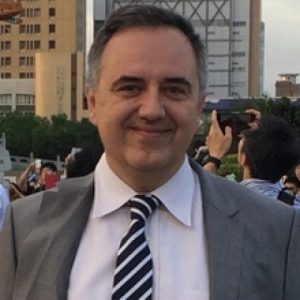
Marco Di Renzo is a CNRS Research Director (Professor) and Head of the iPhyCom group at the Laboratory of Signals and Systems (L2S) at Paris-Saclay University, France. He is affiliated with both CNRS and CentraleSupélec. His roles include: Member of L2S Management Committee and Board Council Member of the Ph.D. School Admission Committee Academic Vice Chair, ETSI Industry Specification Group on RIS Editorial and leadership roles in IEEE communications journals Education: Laurea (cum laude) and Ph.D. in Electrical Engineering from University of L’Aquila (2003, 2007) Habilitation à Diriger des Recherches from Paris-Saclay University (2013) Research focuses on 6G networks , reconfigurable intelligent surfaces (RIS) , and integrated sensing and communications (ISAC) . He explores electromagnetic theory, machine learning applications, and energy-efficient wireless systems. His work addresses challenges in near-field communications, multi-user MIMO, and holographic beamforming. He advocates for physics-driven design principles in next-gen networks. Key awards include IEEE/IEE Fellowships, the Michel Monpetit Prize, and multiple IEEE Best Paper Awards. He holds international visiting professorships at institutions like the University of Oulu (Finland) and Nanyang Technological University (Singapore). Active in standardization via ETSI ISG RIS and contributes to global initiatives like the ITU 6G Vision. His research bridges theoretical models with practical implementations, emphasizing interdisciplinary collaboration between physics, signal processing, and AI.
Nicolas Riviere is a Professor at INSA Lyon in the Department of Mechanical Engineering, working within the Laboratory of Fluid Mechanics and Acoustics (LMFA - UMR 5509). He is part of the "Fluides complexes et transferts" (Complex Fluids and Transfers) group and the Environment team. His teaching activities primarily focus on fluid mechanics at the Mechanical Engineering Department of INSA Lyon, covering: General balances (mass, momentum, energy) Aerodynamics Compressible flows Numerical simulation of flows Free surface hydraulics Prof. Riviere's research centers on free surface hydrodynamics, with applications to natural and industrial risks. His work takes an experimental approach, utilizing the laboratory's channel facilities, particularly the channel intersection installation. His research spans river floods with compound beds, urban flooding, sanitation networks, torrential flows, and flow-obstacle interactions. He has developed a strong interdisciplinary focus, co-leading the "Baignades en Rivières Urbaines" studio with Oldrich Navratil from University Lyon 2 and the EVS Laboratory. His publication record demonstrates consistent contributions to the fields of fluid mechanics and environmental hydraulics, with recent work focusing on open-channel flows, urban flooding phenomena, vegetation-flow interactions, and experimental techniques for studying complex hydraulic phenomena. His research often bridges theoretical fluid mechanics with practical environmental applications. Prof. Riviere has received recognition for his work in environmental fluid mechanics, with numerous publications in high-impact journals in hydraulic engineering and fluid mechanics. He has supervised multiple PhD students and research projects related to environmental fluid mechanics and has collaborated with various institutions on interdisciplinary research projects addressing water-related challenges. The laboratory where he works, LMFA, provides extensive experimental facilities including wind tunnels, hydrodynamic channels, and advanced measurement techniques such as PIV (Particle Image Velocimetry), LDV (Laser Doppler Velocimetry), and other state-of-the-art instrumentation for fluid flow analysis.
Etienne BARTHEL serves as a CNRS Research Director at the Laboratory of Soft Matter Science and Engineering (SIMM), a joint research unit of PSL University (ESPCI Paris), CNRS, and Sorbonne University. His primary affiliations span multiple prestigious French institutions focused on advanced materials research. His research centers on the mechanical behavior of soft and brittle materials, with emphasis on surface mechanics, adhesion phenomena, fracture dynamics, and thin film behavior . Key contributions include fundamental studies on wetting/dewetting processes, plastic deformation mechanisms in glasses, and instability phenomena at interfaces. His experimental and modeling work bridges nanoscale material behavior with macroscopic mechanical responses. Analysis of his recent publications reveals strong focus on silicate glasses, soft matter fracture, microfluidics, and surface characterization techniques . His work frequently employs advanced methods like Brillouin spectroscopy, nanoindentation, and micro-photoelasticity to probe material responses under stress. As a CNRS Research Director, he leads experimental investigations in the SIMM laboratory, supervising PhD candidates and postdoctoral researchers in projects spanning materials physics, surface science, and mechanical engineering. His research program integrates experimental mechanics with theoretical modeling to address fundamental questions in material failure and interfacial phenomena. The SIMM laboratory maintains advanced facilities for soft matter characterization, including micro-mechanical testing setups, surface analysis instruments, and microfluidics platforms where his team conducts cutting-edge research on material interfaces and deformation mechanisms.
Khalifa Aguir is a Professor at Aix-Marseille University, affiliated with the Department of Detection, Radiation and Reliability (DETECT) and the Microsensor Instrumentation (MCI) Team. His research focuses on gas sensing technologies , particularly metal oxide semiconductors , nanomaterials , and thin films for environmental and biomedical applications.
Vladan Koncar is a Full Professor and Research Supervisor at École Nationale Supérieure des Arts et Industries Textiles (ENSAIT), where he directs the GEMTEX laboratory and international relations. His research spans smart textiles, e-textiles, wearable sensors, and energy-harvesting systems, with applications in healthcare, military, and environmental monitoring. Research Interests: Koncar's work focuses on three primary themes: (1) Smart textile design for medical/safety applications; (2) Energy harvesting via textile NFC antennas and metamaterials; (3) Standardization of e-textile reliability and testing. His innovations include textile-based ECG monitors, airflow sensors, and photodynamic therapy fabrics. Projects & Grants: He coordinates major EU initiatives (e.g., ETEXWeld, MAPICC 3D) and industrial collaborations with Petit Bateau and @Health. Key projects involve developing instrumented textiles for healthcare, dynamic lighting systems, and filtration monitoring. Honors: Ordre des Palmes Académiques, Chevalier (French Prime Minister Award, 2019) IPC Golden Gnome & Rising Star Awards (2021-2022) Doctor Honoris Causa (Gheorghe Asachi University, 2010) Annual PEDR Award for PhD supervision since 1995 Labs & Teams: Leads the Human Centered Design Group at GEMTEX, specializing in textile-electronics integration. The lab focuses on structural health monitoring, smart composites, and washable e-textile systems.
Slim Essid is a Full Professor at Télécom Paris, leading the Audio Data Analysis and Signal Processing (ADASP) group. He holds a Doctorat (Ph.D.) and Habilitation from Université Pierre et Marie Curie (UPMC). With 15+ years of research experience, he has advised 15 PhD graduates and currently co-advises 10 others. His work focuses on machine learning, signal processing, and multimodal systems, publishing over 150 peer-reviewed papers. He serves as a reviewer for top journals/conferences (e.g., IEEE Transactions) and research funding agencies. Education: State Engineering Degree, École Nationale d’Ingénieurs de Tunis (2001) M.Sc. (D.E.A.) in Digital Communication Systems, École Nationale Supérieure des Télécommunications, Paris (2002) Ph.D., Université Pierre et Marie Curie (2005) Habilitation (HDR), UPMC (2015) Research Interests: Multimodal learning, self-supervised representations, audio-visual segmentation, music structure analysis, domain generalization, and speech enhancement. Recent publications highlight innovations like TACO (training-free sound-prompted segmentation) and CLOUDS (domain-generalized semantic segmentation framework using foundation models). His work bridges audio processing with vision and language models, emphasizing unsupervised/zero-shot approaches. Key achievements include state-of-the-art methods in sound event detection, speaker diarization, and music segmentation. He collaborates with 14 post-docs and leads projects funded by French/EU agencies.
Maxime Ferreira Da Costa is an Associate Professor at CentraleSupélec, Université Paris-Saclay, affiliated with the Laboratory of Signals and Systems (L2S). His research focuses on theoretical and algorithmic foundations of data science, particularly in inverse problems, structured signal processing, and physical layer security. Key research areas include super-resolution, system calibration, and privacy-enhancing communication schemes. He holds a Ph.D. from Imperial College London (2018), and previously worked at USC and Carnegie Mellon University. Notable achievements include an ANR Young Researcher Grant (2023) for projects on data science and physical layer security. He actively contributes to conferences and workshops, with recent presentations at Institut Henri Poincaré and Université Paris-Saclay. Education: Ph.D. in Electrical Engineering, Imperial College London (2018) M.Sc. Electrical Engineering, Imperial College London (2012) Engineer Diploma, CentraleSupélec (2012) Research interests span continuous inverse problems, off-the-grid methods, wireless security, and sensing systems. Current projects explore goal-oriented resource allocation, fake path injection for privacy, and preconditioned optimization techniques. His work bridges signal processing theory with practical applications in imaging, telecommunications, and sensing.
Ammar Mian is an Associate Professor at Université Savoie Mont Blanc, affiliated with the LISTIC lab and Polytech Annecy-Chambéry. He holds a PhD from CentraleSupélec (2016-2019) and conducted postdoctoral research at Aalto University (2019-2020). His research focuses on statistical signal processing, machine learning, and Riemannian geometry with applications in remote sensing and frugal computations. He leads the Qanat project, an experiment tracking tool for reproducible research. Research interests include covariance-based methods for SAR image analysis, robust detection algorithms for sonar and GPR systems, and optimization on Riemannian manifolds. His work emphasizes reproducibility in ML and efficient computational techniques for resource-constrained environments. Key contributions include real-time SAR time-series change detection, robust classification using second-order deep learning models, and novel methods for handling missing data in EEG signals. His recent articles (2023-2025) explore reproducibility frameworks, GPR-based object classification, and Riemannian geometry applications. No awards listed, but maintains active collaborations through LISTIC and industry partnerships. Advises students via internship programs (e.g., Federated ML energy cost analysis). Lab work involves developing open-source tools like Qanat for experiment management and reproducibility.
Florian Kaltenberger is a Professor in the Communication Systems department at EURECOM, a leading research institute in digital technology based in France. He actively contributes to research and teaching in wireless communications, with a focus on 5G/6G technologies, massive MIMO, and OpenAirInterface-based prototyping. Research Affiliation: EURECOM - Communication Systems Key Projects: SOLDER FP7, Newcom++, COST 2100 Professional Memberships: IEEE, reviewer for major journals and conferences His research centers on signal processing for wireless communications, MIMO systems, channel modeling, and hardware implementation. He specializes in exploiting channel reciprocity in TDD systems and developing practical testbeds for next-generation networks. Recent publications highlight a strong trend toward AI-integrated RAN, open-source 5G/6G testbeds (e.g., OpenAirInterface, X5G), UAV-aided localization, and real-time control using decentralized applications. His work bridges theoretical innovation with field deployment in programmable living labs. Award Highlights: Neal Shepherd Best Propagation Award (2013) He leads research grants under EU frameworks like FP7 and collaborates internationally on open RAN and 6G innovation. Though no formal student list is provided, his role as project lead and frequent co-authorship suggests active mentorship. He also manages EURECOM’s contributions to large-scale collaborative projects. Kaltenberger is deeply involved in lab development, particularly around OpenAirInterface, where he leads efforts in creating end-to-end, multi-vendor, private 5G O-RAN testbeds with real-time AI control and green networking capabilities.
Pierrick Lotton serves as a CNRS Research Director at Le Mans University's Institute of Acoustics (LAUM), a joint research unit between CNRS and the university. He leads critical work within LAUM's Transducers team, focusing on fundamental and applied research in electroacoustics and thermoacoustics. His institutional affiliation places him at France's premier acoustics research laboratory, which maintains extensive facilities for acoustic measurements, ultrasonic experimentation, and transducer development across multiple specialized domains including materials science, opto-acoustics, and bioacoustics. Lotton's research program centers on two interconnected pillars: electroacoustics and thermoacoustics. His electroacoustic investigations pioneer advanced modeling, development, and characterization of audio transducers with particular emphasis on nonlinear behaviors in loudspeakers and electric guitar pickups. Simultaneously, his thermoacoustic research explores acoustic refrigeration systems, complex couplings between acoustic and thermal energy fields, and transient nonlinear phenomena. This dual focus enables innovative cross-pollination between audio engineering and thermal physics, driving advancements in both fundamental understanding and practical applications of acoustic energy conversion. Analysis of his 2019-2024 publications reveals a consistent trajectory in transducer physics, particularly MEMS-based piezoelectric speakers, voice coil dynamics in magnetic environments, and digital acoustic projection systems. His work demonstrates exceptional methodological diversity spanning analytical modeling, experimental validation, and educational innovation. Notable contributions include the ASKNOWN project's open-access acoustics courseware and breakthroughs in understanding transducer nonlinearities for both consumer audio and specialized applications like fish sound localization. No major scientific awards were documented in the available institutional materials, though his sustained publication record in high-impact journals and presentations at European Acoustics Association forums indicate significant peer recognition. His collaborative research network spans France, Germany, Italy, and the Czech Republic, reflecting strong international engagement. Lotton's academic supervision activities aren't explicitly detailed, but his educational initiatives like the ASKNOWN project demonstrate commitment to pedagogy. His research is supported through LAUM's institutional framework and collaborative projects including European initiatives and ANR-funded programs. Current work appears concentrated on advancing MEMS transducer technology, refining thermoacoustic cooling systems, and developing next-generation educational resources for acoustics. As a core contributor to LAUM's Transducers team, Lotton operates within one of Europe's leading acoustics laboratories. His current projects align with LAUM's strategic focus on transducer innovation and thermoacoustic applications, positioning him at the forefront of both theoretical acoustics research and practical engineering solutions. The laboratory's comprehensive infrastructure supports his work from fundamental wave propagation studies to applied device development.
José Picheral is a Professor at CentraleSupélec, affiliated with the Laboratory of Signals and Systems (L2S). He holds a PhD (2003) and HDR (2017) in high-resolution signal processing methods and inverse problems. His research focuses on array processing, source localization, acoustic imaging, and vibration analysis, with applications in aeroacoustics, automotive systems, and industrial monitoring. He has supervised multiple PhD students and contributed to projects like Valeo’s smartphone-based car key replacement system. Education: Engineering Degree: Supélec (1999) and Politecnico di Milano (1999, Erasmus-TIME) PhD: Paris Sud University (2003) Habilitation (HDR): Université Paris Sud (2017) Research Interests: High-resolution methods for distributed sources, sparse signal processing, acoustic imaging, asynchronous measurements, and sensor array design. Current projects include spatial source covariance estimation, EEG spectrum analysis, and automotive applications using smartphone localization. Key Contributions: Over 50 publications in top journals/conferences (e.g., IEEE Transactions, ICASSP). Notable work on MUSIC algorithm robustness, DAMAS optimization, and sparse approaches for tip-timing signals. Advising & Collaboration: Supervised 7 PhD students. Collaborations with SAFRAN, Valeo, and academic teams in Bayesian inference and inverse problems. Active in L2S’s Inverse Problems Group and SYCOMORE team. Labs/Teams: Member of L2S’s Signal Processing and Statistics group, leading research in systems and control, telecommunications, and energy systems.
Dr. Paul Thevenon is an Assistant Professor at ENAC (National Civil Aviation School) in Toulouse, France, since July 2013. He holds a Habilitation à Diriger les Recherches (2023) and focuses on GNSS signal processing, integrity monitoring, and hybrid sensor systems. His research integrates advanced algorithms for cycle slip detection, multipath mitigation, and hybrid navigation filters using 5G/ LTE signals. Education: Bachelor's in Electronic Engineering from École Centrale de Lille (2004) Master's in Space Telecommunications from ISAE (2007) PhD in Signal Processing from ENAC (2010) Research Themes: GNSS robustness against malicious signals (e.g., evil waveforms) Multi-receiver systems for RTK positioning enhancement Integration of non-GNSS signals (5G, LTE) for hybrid navigation Factor graph approaches for carrier phase processing Awards: 2023: Habilitation à Diriger les Recherches Technical Contributions: Developed CNN-based multipath detection systems Advanced RTK ambiguity resolution via multi-rover arrays Validated TDCP measurements in low-cost PPP-IMU filters Labs/Teams: Core member of the SIGNAV lab, specializing in signal processing and navigation systems.
Patrice PAJUSCO is a Professor and Head of the Microwave Department at IMT Atlantique's Brest campus. He holds an engineering degree from École Supérieure d'Electricité (SUPELEC) and has extensive experience in telecommunications research, including roles at CNET and Orange Labs. His work focuses on channel modeling, MIMO systems, and millimeter-wave communication technologies. He leads research in railway communication systems, 5G networks, and antenna array design. Patrice is affiliated with CNRS Lab-Sticc and Pracom, contributing to advanced communication systems and propagation studies. Research interests include MIMO channel sounding, space-time modeling, ray tracing, and UWB applications. His contributions span experimental channel characterization, radio planning, and time reversal techniques. Recent work emphasizes 5G applications in railway environments and millimeter-wave propagation analysis. Collaborations involve developing resilient communication systems and optimizing antenna configurations for dynamic environments. Patrice has advised multiple projects within IMT Atlantique and contributes to interdisciplinary teams in Lab-Sticc. His research addresses challenges in high-frequency communication, urban wireless networks, and energy-efficient systems. Despite no listed awards, his extensive publication record reflects impactful contributions to telecommunications and signal processing.
Thomas Brunet is a researcher at the University of Bordeaux, specializing in physical acoustics and functional materials for acoustics. His work spans ultrasound physics, material characterization, and advanced modeling/simulation techniques. Key collaborations with research groups: APY (Physical Acoustics) , Functional Materials for Acoustics , and GCE (Civil and Environmental Engineering) . Focus areas: acoustic metamaterials , Anderson localization , contactless micromanipulation , and viscoelastic wave propagation . His publications (over 30 in the last decade) demonstrate expertise in ultrasonic imaging, nanophononics, and multiphysics problems involving mechanical, thermal, and fluid interactions. Collaborative projects include DuMAS (Sustainability of Materials) , IMC (Mechanical Engineering) , and MPI (Materials-Procedes-Interactions) initiatives. No formal awards or student advising details are publicly available in the provided data.
Mathias FINK is a Professor at ESPCI Paris on the Georges Charpak chair. His research focuses on fundamental wave physics in complex media with major applications in medical imaging, telecommunications, and geophysics. He pioneered time-reversal mirrors for wave focusing and co-founded 6 technology companies. Key Institutions: ESPCI Paris, Collège de France Research Themes: Wave physics, time-reversal techniques, matrix imaging, metasurface design His work spans multi-echo wave systems , ultrasonic therapeutic devices , and adaptive electromagnetic communication systems . Recent publications emphasize 3D matrix imaging in biological tissues and space-time interface dynamics . Scientific recognition includes: First academic elected at Collège de France (2008) Over 400 peer-reviewed publications 70+ patents and 6 start-ups Collaborations extend to Institut des Hautes Études Scientifiques , Langevin Institute , and Hong Kong University of Science and Technology . His team's volcanic imaging work with seismic noise has revolutionized subterranean mapping.