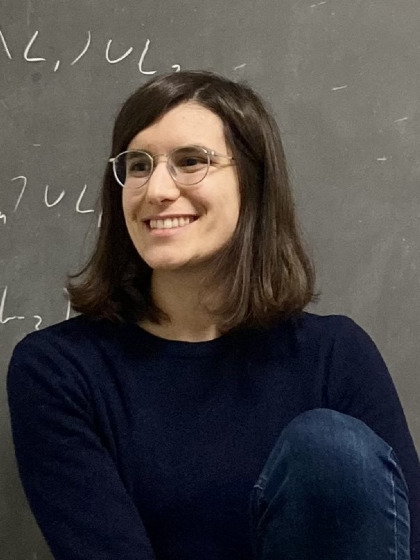
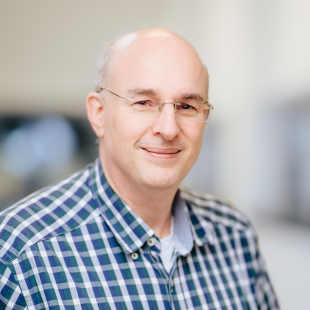
Prof. Halupczok is a Professor at the Chair of Algebra and Number Theory within the Faculty of Mathematics and Natural Sciences at Heinrich Heine University Düsseldorf (HHU). His research focuses on advanced mathematical areas combining geometry, arithmetic, and model theory in valued fields. Key areas include singularities, stratifications, motivic integration, and representation theory of reductive groups over local fields. He also contributes to combinatorics, specifically polyomino games, zero-sum problems, and covering codes. Additional expertise includes model theory of (pseudo-)finite fields and representation theory of real reductive groups and symmetric varieties. Education details are not explicitly provided in the text. His current role emphasizes interdisciplinary research bridging algebra, geometry, and logic. No specific grants, awards, or academic advising details are mentioned here.
Akshay Venkatesh holds the Robert & Luisa Fernholz Professorship in the School of Mathematics at the Institute for Advanced Study (IAS). He is renowned for his work at the intersection of number theory and topology, particularly in exploring algebraic structures related to the topology of locally symmetric spaces. Previously, he served as a Professor of Mathematics at Stanford University (2008–2018) and held positions at the Courant Institute and MIT. Venkatesh's research bridges diverse areas including representation theory, dynamics, and algebraic topology, with a focus on the Langlands program and motivic cohomology. Educations: PhD in Mathematics, Princeton University (2002) B.Sc. in Mathematics, University of Western Australia (1997) Research Interests: Venkatesh investigates the profound connections between number theory and geometry, such as the analogy between prime numbers and knots. He explores the topology of locally symmetric spaces, which encode arithmetic information through their cohomology and geometric structures. His work often reveals unexpected links between algebraic varieties, modular forms, and geometric invariants. Key Contributions: His studies on the topology of locally symmetric spaces have advanced understanding of the Langlands program and motivic cohomology. He has pioneered methods to decode arithmetic properties (e.g., solutions to polynomial equations modulo integers) through topological invariants of geometric spaces. Awards and Honors: Fields Medal (2018) Ostrowski Prize (2017) Infosys Prize (2016) SASTRA Ramanujan Prize (2008) Salem Prize (2007) Honorary Doctorate, University of Western Australia (2019) Labs/Teams: Venkatesh led a special program on analysis and topology of locally symmetric spaces at IAS (2017–2018), fostering interdisciplinary collaborations in number theory and topology. His research often intersects with algebraic geometry and representation theory.
Prof. Dr. Michael Lönne is a Professor at the University of Bayreuth's Faculty of Mathematics, Physics, and Computer Science, holding a position in the Mathematical Institute (Chair VIII). His research focuses on algebraic geometry, topology, and their intersections with monodromy theory, moduli spaces, and braid groups. His work explores topics such as fundamental groups of discriminant complements, monodromy groups of elliptic surfaces, and the topology of moduli spaces for algebraic curves and surfaces. He has contributed significantly to understanding braid monodromy in singularities and Hurwitz spaces, as well as applications of topological methods to problems in algebraic geometry and condensed matter physics. Recent research highlights include studies on Zariski multiplets, genus stabilization in moduli components, and topologically protected transport of colloidal particles. His interdisciplinary work bridges pure mathematics with applications in physics, notably in topological protection mechanisms in dissipative systems. Lönne collaborates internationally, evidenced by co-authored papers with researchers like Fabrizio Catanese and Thomas M. Fischer. His publications span prestigious journals like Duke Mathematical Journal, Geometry & Topology, and Nature Communications.
Michael Gide JABBOUR is an Associate Professor in Quantum Communication at Télécom SudParis, part of the Institut Polytechnique de Paris . He is affiliated with the ISTeC institute and the Department of Communications, Images, and Information Processing (CITI). His research focuses on quantum information theory, quantum optics, and mathematical physics, particularly in infinite-dimensional systems. Key areas include entropy continuity bounds, bosonic quantum channels, and quantum interference phenomena. Education and Career: PhD from École polytechnique de Bruxelles (2015), thesis: Bosonic systems in quantum information theory Postdoctoral fellowships at University of Cambridge (2016-2018), Technical University of Denmark (2018-2019), and École polytechnique de Bruxelles (F.R.S.-FNRS Senior Fellow) Joined Télécom SudParis as Associate Professor in 2020 Research Interests: Explores fundamental aspects of quantum information through entropy analysis, Gaussian channels, and bosonic systems. Recent work addresses entanglement engines, timelike quantum interference, and majorization principles in quantum phase space. His studies bridge quantum thermodynamics with mathematical rigor, emphasizing non-Gaussian operations and infinite-dimensional systems. Publications: 15+ peer-reviewed articles and preprints since 2015, including high-impact journals like Physical Review Letters , IEEE Transactions on Information Theory , and Quantum . Key themes include entropy continuity, bosonic Gaussian states, and quantum interference in time. Future Work: Current projects involve boson-fermion complementarity, complexity of Gaussian optics, and central limit theorems for distinguishable bosons. Ongoing collaborations span quantum thermodynamics and foundational entropy principles.
Dr. Christina Areizaga Barbieri is an Associate Professor at the University of Delaware’s School of Education, specializing in Educational Statistics and Research Methods and the Learning Sciences. She directs the M^3 Lab: Math Methods & Motivation, focusing on improving mathematics education for underrepresented students through cognitive and learning sciences principles. Her work emphasizes instructional tools, classroom climates fostering positive attitudes toward math, and addressing misconceptions in algebra and fractions. Barbieri holds a Ph.D. in Educational Psychology from Temple University and has held postdoctoral and research roles at the University of Delaware. She advises Ph.D. students in Learning Sciences and Educational Statistics, and mentors undergraduates through programs like UDRAW and SOURCE. Education: Ph.D., Educational Psychology, Temple University, 2015 M.Ed., Educational Psychology, Temple University, 2014 B.A., Psychology, City University of New York, 2010 Research Interests: Mathematics education equity, cognitive and learning sciences applications, fraction and algebra learning, instructional design, and student motivation in STEM. Grants & Awards: Recipient of the Cognitive Development Society Diversity Award (2015), Kappa Delta Pi (2013), and NSF/IES grants totaling over $4 million. Recent grants include studies on foundational fraction concepts and geometry learning interventions. Labs & Teams: Director of the M^3 Lab, collaborating with graduate and undergraduate researchers on projects addressing math education challenges and equity.
Professor Craig Costello is a leading cryptographer at the Queensland University of Technology (QUT) , affiliated with the Faculty of Science and the School of Computer Science . His work focuses on post-quantum cryptography , particularly isogeny-based and lattice-based cryptographic constructions , contributing to global efforts in securing digital infrastructure against quantum computing threats. Notable research trends include: Advancements in supersingular isogeny key exchange (SIKE/SIDH) Exploration of pairing-friendly abelian varieties for cryptographic cycles Efficient genus 2 isogeny algorithms and Kummer surface optimizations Development of twin smooth integer detection for cryptanalysis His publications emphasize quantum-resistant protocols , mathematical foundations , and practical cryptographic implementations . Contact: craig.costello@qut.edu.au
Roles & Affiliations: Associate Professor at Faculty of Mathematics, Al. I. Cuza University since 2002. Chancellor of the Faculty (2004-2008). Member of Romanian Society of Mathematical Sciences, American Mathematical Society, and Romanian Society of Fuzzy Systems. Conducts research in algebraic number theory, fuzzy structures, and ring theory. Education: PhD in Pure Mathematics from Université Paris-Sud (1995) with thesis on L-function local constants. Master's (DEA) in Pure Mathematics (1991) and BSc from Al. I. Cuza University (1987). Research Interests: Specializes in algebraic structures including rings/modules, near-rings, and fuzzy algebraic systems. Key achievements include characterizing d-rings via Jacobson radical, proving conjectures on L-function root numbers, and developing fuzzy ring quotient constructions. Active in algebraic coding theory and hyperstructure applications. Grants & Recognition: Directed CNCSIS project (2001). Authored 8 books including Ring Arithmetic, Field Extensions and Applications (2005) and Introducere in teoria codurilor (2013). Presented at over 20 conferences including NATO Advanced Research Workshop (2001). Holds II Prize from 1984 National Student Conference. Teaching: Courses include General Abstract Algebra, Galois Theory, and Cryptography. Developed curricula for master's programs in coding theory and pedagogical methods in algebra instruction.
Mahesh Agarwal is an Associate Professor and Chair of the Department of Mathematics and Statistics at the University of Michigan-Dearborn, affiliated with the College of Arts, Sciences, and Letters. He holds a Ph.D. in Mathematics from the University of Michigan, Ann Arbor, and completed postdoctoral work at McMaster University. Education: B.Sc. (Delhi University), M.Sc. (Indian Institute of Technology, Kanpur), Ph.D. (University of Michigan, Ann Arbor) Dr. Agarwal’s research lies at the intersection of Number Theory and Data Science , with additional contributions to Geometry and Mathematics Education . His Number Theory work focuses on p-adic L-functions, Bloch-Kato conjecture, and automorphic forms, while his Data Science research emphasizes curriculum development and clinical informatics. His geometric studies explore duality in inscribed ellipses and inheritance relations in convex polygons. His publications span journals like the Journal of Number Theory , Mathematische Zeitschrift , and the Journal of the American Medical Informatics Association . Key themes include L-function arithmetic, geometric dualities, and data science education. Awards: National Board of Higher Mathematics Scholarship (1999-2001), multiple Outstanding Graduate Instructor awards (2006, 2007), Best Model for Engaging Students Virtually (2016) Dr. Agarwal has contributed to implementing WeBWork, an online assignment platform, and has supervised research in Number Theory and Data Science. He has also collaborated with institutions like Harvard Medical School and Bentley University.
David Rock is Dean of the School of Education and Professor of Curriculum & Instruction at the University of Mississippi. He holds a B.S. in Mathematics from Vanderbilt University (1987), an M.A. in Mathematics Education (1994), and an Ed.D. in Teacher Education (1998) from the University of Central Florida. Ph.D.: Curriculum & Instruction, University of Central Florida (1998) M.A.: Mathematics Education, University of Central Florida (1994) B.S.: Mathematics, Vanderbilt University (1987) Rock’s research focuses on mathematics education, curriculum development, and pedagogical strategies to reduce math anxiety. He is a prolific author, co-writing 16 books including Teaching Secondary Mathematics (2024) and Teaching K-6 Mathematics (2002). He developed the Internet Math Contests , which engage students globally in collaborative problem-solving. The 15 most recent publications (2024–2008) span algebraic teaching, calculus readiness, statistics pedagogy, and emotional learning strategies. His work integrates technology and addresses equity, particularly in reducing stigma around mathematical struggle. Rock co-heads the National Center for School-University Partnerships and has taught mathematics at middle and high school levels in Florida and Mississippi. He is married to Michelle, a former elementary teacher, and has four children.
Paul Jackson is a Senior Lecturer in the School of Informatics at the University of Edinburgh and serves as Director of the Artificial Intelligence and its Applications Institute (AIAI). He is also affiliated with the Laboratory for Foundations of Computer Science (LFCS) and is an associate member of the Institute for Computing Systems Architecture (ICSA). His work bridges theoretical and applied aspects of formal methods in computer science. Education PhD and MS in Computer Science, Cornell University (1988–1995) MS in Physics, Cornell University (1986–1988) Undergraduate in Engineering, University of Cambridge (1981–1984) Paul Jackson's research focuses on formal verification, particularly the development and application of tools for verifying software, hardware, and hybrid systems. His primary interests include interactive theorem proving (using Lean, Isabelle, and KeYmaera), formal verification of hybrid and cyber-physical systems, non-linear arithmetic, and the integration of symbolic computation with deduction. He has worked extensively with the Nuprl theorem prover and contributed to tools like Victor for SPARK/Ada verification. His recent publications emphasize compositional verification, validated integration using Taylor models, invariant generation for polynomial systems, and dynamic proof presentation. He has been involved in multiple EPSRC and UKRI-funded projects, including work on trustworthy autonomous systems and cache coherence protocols. Scientific Awards and Recognition No specific awards are listed in the provided text. Paul Jackson has advised several PhD students, including Ramon Fernández Mir, Kristjan Liiva, Andrew Sogokon, and Grant Olney Passmore, many of whom have gone on to influential roles in academia and industry. He has held significant administrative roles, including Senior Tutor and Senior Director of Studies, and has contributed to major conferences such as CAV, CICM, and CADE as program committee member or chair. His teaching includes courses on formal verification, automated reasoning, and software engineering.
Jun Yong Park is a Lecturer in Mathematics at the University of Sydney, where he is a member of the pure mathematics research group in the School of Mathematics & Statistics. He received his Ph.D. in mathematics from the University of Minnesota in 2018 under the supervision of Craig Westerland. Prior to joining the University of Sydney, he was a research fellow at the University of Melbourne, Max Planck Institute for Mathematics in Bonn, and IBS Center for Geometry and Physics in Pohang. Dr. Park's research interests lie at the intersection of algebraic geometry and number theory, with a particular focus on the arithmetic theory of algebraic varieties, moduli spaces, and rational points on stacks. His work often explores counting families of varieties over function fields and connections to number theory. His research aligns with the Faculty of Science Research Strengths in "Understanding the Universe" and "Fundamental Laws of Nature." Dr. Park has published numerous papers in prestigious journals including Mathematische Zeitschrift, Mathematische Annalen, and Research in the Mathematical Sciences, with research focusing on moduli stacks of elliptic surfaces, arithmetic geometry, and the distribution of rational points. His publication record shows a strong focus on using motivic techniques to study arithmetic distributions and cohomological stability of moduli spaces. Dr. Park has received support from notable institutions including the Simons Foundation. He is actively involved in the academic community, organizing seminars such as the "Spaces, Functions and Numbers Seminar" at the University of Sydney. He teaches various mathematics courses at the University of Sydney, including Geometry & Topology (MATH3061), Multivariable Calculus and Modelling (MATH1062/1023), and Discrete Mathematics (MATH1004). He has also taught specialized topics courses on elliptic surfaces and number theory, demonstrating his commitment to both teaching and advancing mathematical knowledge.
Justin Schroeder is an Assistant Professor in the Department of Mathematics at Dakota State University, within the College of Arts & Sciences. He holds a Ph.D. in Mathematics from Vanderbilt University (2012) and a B.A. in Mathematics from Carthage College (2007). Ph.D. in Mathematics, Vanderbilt University, 2012 B.A. in Mathematics, Carthage College, 2007 His research focuses on combinatorics and graph theory, with particular emphasis on prime labelings , graph embeddings , Steiner triple systems , and Latin squares . His work combines structural graph theory with number-theoretic and algebraic methods, often exploring labelings and symmetries in discrete structures. The recent publications show a consistent trend in combinatorial design theory and topological graph theory , with several papers on prime labelings of graph families and self-dual embeddings in pseudosurfaces. His collaborations often involve finite field constructions and extremal problems in labeling. The arXiv preprint on rough numbers indicates an interest in analytic number theory as well. Notable scientific awards include: Winner, 2019 Gen Cant Game Design Contest (Polyhedral Park Planner) Bjarni Jónsson Prize for Research, Vanderbilt University, 2012 B.F. Bryant Award for Excellence in Teaching, Vanderbilt University, 2012 AMS Graduate Student Travel Grant, 2012 Graduate Student Summer Research Award, Vanderbilt University, 2011 Dr. Schroeder has advised research projects and co-authored papers with collaborators such as S.A. Schluchter and E. Rarity. He has presented his work internationally at the Macedonian Workshop on Graph Theory and Applications. While no formal grant funding is listed in the text, his research awards and travel grants during graduate studies reflect early recognition of scholarly excellence. He is actively engaged in both theoretical research and academic dissemination through publications and conference presentations. There is no mention of a specific research lab or team, but his collaborative publications suggest participation in a network of combinatorics researchers focused on graph labeling and design theory.
William J. Keith is an Associate Professor in the Department of Mathematics at Michigan Tech University . He specializes in combinatorics with a focus on partition theory , q-series , and identities . His teaching includes courses like Introduction to Linear Algebra and Combinatorics and Graph Theory , though he is currently on sabbatical for Spring 2025. Office hours: Monday/Wednesday 3-4pm (Fisher 314) or via Zoom Research interests center on partition theory , including Schmidt-type theorems , unimodality of major index distributions, and congruences for regular partitions. His work frequently bridges combinatorics with algebraic structures and modular forms. Recent publications highlight his contributions to generalized partition bijections , q-series identities , and graph-theoretic extensions . He is actively involved in mentoring graduate students, including current doctoral advisees Hunter Waldron and Philip Cuthbertson , and has previously supervised master's theses by J. T. Davies and Emily Anible . Keith coordinates the Partitions Seminar (active since 2021) and serves on the Undergraduate Committee , while also acting as an alternate faculty Senator for the Math Department. He emphasizes collaboration, particularly in exploring open problems like refining Stanley's formula and studying overpartition analogues of Gaussian coefficients.
Lara Vicino is a Post-Doctoral Researcher at the University of Groningen , affiliated with the Faculty of Science and Engineering and the Algebra — Bernoulli Institute . Her research focuses on algebraic geometry and coding theory, particularly on Weierstrass semigroups, automorphism groups, and AG codes derived from maximal curves. She collaborates extensively in finite field theory and polynomial structures. Email: l.vicino@rug.nl ORCID: 0000-0002-7480-8681 Phone: +31 50 363 3939 Her recent work explores maximal function fields, scattered sequences, and applications to error-correcting codes. Collaborations include contributions to journals like IEEE Transactions on Information Theory and Algebraic Combinatorics .
Prof. Dr. Jürgen Klüners is a Professor of Computer Algebra and Number Theory at the University of Paderborn, affiliated with the Faculty of Computer Science, Electrical Engineering and Mathematics. His research focuses on algebraic number theory, arithmetic statistics, and Galois theory, with significant contributions to class groups, Pell equations, and L-functions. Projects: TRR 358 (Integral structures in geometry and representation theory), TP A04 (Combinatorial Euler products), TP A02 (Algebraic and arithmetic aspects of aperiodicity) Current Course: Oberseminar "Number Theory and Arithmetical Statistics" His work explores deep connections between algebraic structures and number-theoretic phenomena, particularly through computational methods. Recent publications address ℓ-torsion bounds, conductor densities, and inverse problems in Galois theory. No explicit scientific awards are listed in the provided data. He teaches advanced courses in number theory and arithmetic statistics.