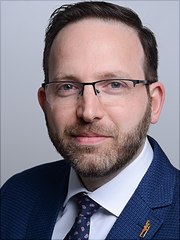
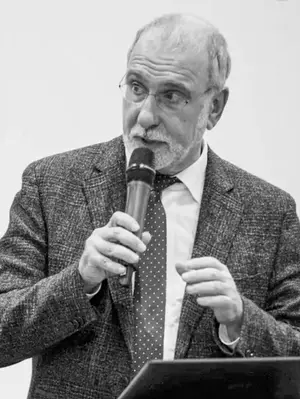
Professor Max Deeg is a leading scholar in Buddhist Studies at Cardiff University , holding a personal chair since 2009. With a career spanning institutions in Germany, Austria, and the UK, his research focuses on transcultural Buddhist history from India to East Asia, Chinese Buddhist travelogues , and interreligious encounters in medieval China. He has held visiting positions at universities in Japan, Nepal, the US, and Germany, and currently directs the Centre for the History of Religion in Asia (CHRA) . PhD from University of Würzburg (1990) Dr. phil. habil. in Religious Studies (1998) Full Professor at University of Vienna (2002-2006) His research explores Buddhist narratives as tools for constructing religious identity, foundation myths in trans-Himalayan contexts, and terminology evolution in Chinese Buddhist translations. Recent publications analyze Indian Buddhist monasticism through Chinese sources and religious concepts like xin (trust) across Buddhist, Manichaean, and Christian traditions. Awarded the KHK Visiting Research Fellowship (2016) and a DAAD Scholarship (1986-87) , Prof Deeg contributes to editorial boards of major journals. He supervises PhD students and teaches Buddhist Studies , Life of the Buddha , and Chinese Buddhist Texts .
Hans Beck serves as Professor of Greek History at the University of Münster (Westfälische Wilhelms-Universität) since 2018, with an additional appointment as Adjunct Professor in the Faculty of Arts at McGill University. His academic career includes previous positions as Professor of Ancient History and Director of Classical Studies at McGill University (2005-2018), Heisenberg Fellow at Goethe-Universität Frankfurt (2004-2005), and Research Assistant at the University of Cologne (1997-2004). Beck earned his academic training through doctoral studies at the Universities of Erlangen, Canterbury, and Cambridge (1989-1996), followed by a fellowship at the Center for Hellenic Studies in Washington, DC (2001-2002). His educational background reflects a strong international foundation in classical studies. His research spans multiple interconnected fields within ancient history, with particular emphasis on the history and culture of ancient Greece, historical geography of Greece, environmental studies of the ancient Greek world, political culture of the Roman Republic, and ancient historiography. Beck's work consistently explores themes of localism, federalism, and political structures across ancient societies, with notable contributions to understanding Greek city-states, regional identities, and comparative political systems. His approach often bridges geographical, historical, and cultural perspectives to examine how ancient communities organized themselves politically and maintained regional identities within larger frameworks. Analyzing his recent publications reveals a sustained focus on local political structures within broader contexts, particularly examining how Greek city-states maintained autonomy while participating in federal leagues. His work increasingly incorporates comparative approaches, connecting Greek political structures with those of Rome and even ancient China, reflecting his editorial work on cross-cultural studies. Beck demonstrates particular expertise in analyzing how physical landscapes shaped political organization and how religious practices reinforced regional identities. Fellow of the Royal Society of Canada (2018) Anneliese Maier Research Award from Alexander von Humboldt Foundation (2014) Heisenberg Fellowship from Deutsche Forschungsgemeinschaft (2004) Doctoral scholarship from German Academic Exchange Service (1995) Doctoral scholarship from Hanns Seidel Foundation (1994) Beck has supervised numerous doctoral students including Jordan Christopher (2022), Chandra Giroux (2021), Wentian Fu (2020), Rebecca Robinson (2017), Alex McAuley (2015), and François Gauthier (2015), covering diverse topics from ancient Qin and Macedon to cult practices in ancient empires. His academic leadership extends to directing research projects B3-49 'Belonging in/to Lakonia' and B3-40 'Localism and Religion in Ancient Greece' within the Excellence Cluster focusing on 'Religious Diversity and Legal-Political Unity.' As head of the project 'Belonging in/to Lakonia' and 'Localism and Religion in Ancient Greece,' Beck leads interdisciplinary research teams examining archaeological and historical evidence from the Sanctuary of Apollo at Amyklai and its surroundings. His work integrates textual analysis with material culture studies, creating comprehensive approaches to understanding ancient regional identities and religious practices. Beck's leadership in these projects demonstrates his commitment to bridging traditional disciplinary boundaries in classical studies.
Armin Falk is a Professor of Economics at the University of Bonn, leading the BonnEconLab since 2004 and co-founding the briq Institute on Behavior & Inequality. He holds affiliations with the IZA, DIW, CEPR, and Max-Planck-Institut. His research focuses on behavioral economics, exploring how social preferences like fairness and trust influence decision-making, and investigates early childhood development's role in inequality. Falk has received prestigious awards, including the Leibniz Prize and Yrjö Jahnsson Award. His work combines lab experiments, field studies, and representative data analysis. Education includes a PhD in Economics from the University of Zurich after studies in Economics, Philosophy, and History at the University of Cologne. Key research highlights include global climate action support studies (Nature Climate Change, 2024), socioeconomic disparities in child development (JPE, 2021), and global economic preferences surveys (QJE, 2018). He co-authored the book *Warum es so schwer ist, ein guter Mensch zu sein* to popularize behavioral economics. Awards include recognition for contributions to behavioral and development economics. Mentoring programs like *Balu und Du* aim to reduce educational inequality. His work bridges academic research with public discourse through media contributions and policy engagement.
Prof. Dr. Øyvind Eide is a Professor in Digital Humanities at the University of Cologne, affiliated with the Department of Digital Humanities under the Faculty of Arts and Humanities. He holds a PhD in Digital Humanities from King’s College London (2013). His research focuses on transformative digital intermedial studies, critical spatial formalization of cultural heritage information, and the relationship between texts and maps as media. He previously served as Chair of the European Association for Digital Humanities (EADH) from 2016–2019 and is actively involved in ICOM’s CIDOC committee. Eide’s work bridges theoretical and practical dimensions of digital humanities, emphasizing spatial analysis, ontology modeling, and interdisciplinary methodologies. His academic contributions include seminal works on network visualization in humanities, cultural heritage ontologies, and the application of critical formalization in media studies. Current research explores the interplay between verbal and spatial expressions of geography in historical narratives. Eide teaches courses such as 'Modelling and Digital Maps' and 'Digital Cultural Heritage,' reflecting his commitment to both research and education. Notable projects include the Ibsen Manuscripts digitization initiative, the GeoModelText tool for spatial narrative analysis, and contributions to archaeological document interconnection through the CIDOC CRM framework. He is Vice Director of the Scholarly Platform: Reflecting and Shaping the Digital Age at the University of Cologne.
Bénédicte Savoy (born May 22, 1972 in Paris) is a renowned French art historian and Professor of Modern Art History at the Technical University of Berlin since 2009. Since 2016, she has also held positions at the Collège de France in Paris (2016-2021) and in November 2024 was appointed to the 'Cátedra del Prado' visiting professorship at the Prado Museum in Madrid. She is internationally recognized as a leading expert on cultural property restitution, particularly regarding colonial-era art theft and looted artifacts. Her research focuses on the complex histories of cultural displacement, with particular emphasis on European museums' colonial collections. Savoy has pioneered critical approaches to provenance research and has been instrumental in reshaping global debates about museum ethics and restitution practices. Her work bridges art history, postcolonial studies, and cultural policy, challenging traditional museum narratives and advocating for more transparent and ethical approaches to cultural heritage. Savoy's publications form a cohesive intellectual trajectory examining how cultural property has been transferred, often forcibly, across borders and continents. Her recent work increasingly focuses on African cultural heritage in European collections, with detailed case studies of Cameroon and broader analyses of restitution politics. The themes of historical justice, museum transparency, and decolonization of cultural institutions run consistently through her scholarship. Gottfried Wilhelm Leibniz Prize (2016), Germany's most prestigious research award TIME 100 most influential people in the world (2021) Ritterin der französischen Ehrenlegion (2022) Deutscher Kulturpolitikpreis (2022) Berliner Wissenschaftspreis (2023) Clark Prize for Excellence in Arts Writing (2024) Prix Européen de l'Essai 2025 (2025) As co-author of the groundbreaking 2018 report on African cultural restitution commissioned by French President Emmanuel Macron, Savoy has significantly influenced international policy. Her work has secured major research funding, including collaborative projects with African scholars. She has led influential research teams examining colonial collections, most notably the seven-member team that produced the 'Atlas der Abwesenheit' documenting Cameroonian cultural heritage in Germany. Her advocacy continues to shape museum practices worldwide, pushing institutions toward greater accountability regarding their colonial-era acquisitions.
Rhenish Friedrich Wilhelm University of BonnGermany
Prof. Dr. Julia A. B. Hegewald is a Professor of Oriental Art History at the University of Bonn, Germany, affiliated with the Institute of Oriental and Asian Studies (IOA) and the Department of Asian and Islamic Art History (AIK). Her research focuses on artistic expressions of dependency in Asian art, particularly South Asian, using 're-use' theory to explore cultural integration and creativity under adversity. She holds a Ph.D. from SOAS, University of London, and a Habilitation from RWTH Aachen. Key academic roles include founding the Cam-Kar Research Institute in Mysore (since 2002) and serving on editorial boards for journals like the Journal of Global Archaeology and Veranda . She has led major projects, including the Emmy Noether Junior Research Group on Jainism in Karnataka (2005–2014). Awards include the DFG Emmy Noether extension (2011–2014) and the Prix en études indiennes (2010). Hegewald has authored over 3 books, edited 6 volumes, and published 77 academic articles. Her work bridges art history with cultural studies, addressing themes like Jaina temple architecture, Indo-Islamic syncretism, and modern Indian urban planning. She actively contributes to global academic networks, including the European Association for Asian Art and Archaeology (EAAA).
Alberto Cantera Glera is a Professor at the Institute of Iranian Studies within the Department of History and Cultural Studies at Freie Universität Berlin. His research focuses on Zoroastrian studies, Avestan language and literature, Iranian linguistics, and manuscript studies. He teaches courses on Young Avestan, Pahlavi, Zoroastrian rituals, and Iranian literature, with office hours held on Thursdays from 3-5 p.m. Professor Cantera Glera's research interests center on Zoroastrian religious practices, particularly the Long Liturgy, Avestan textual criticism, and the transmission of Zoroastrian texts through manuscript traditions. His work bridges linguistic analysis with religious studies, examining how ritual practices evolved from ancient to medieval Iran. He has made significant contributions to understanding the relationship between oral performance and written transmission in Zoroastrian traditions, as well as the linguistic features of Avestan and Middle Persian texts. His recent publications reveal a consistent focus on Zoroastrian ritual structures, particularly the Long Liturgy, with increasing attention to the relationship between textual manuscripts and ritual performance. The articles show progression from linguistic analysis of Avestan texts toward broader studies of ritual practice, sacred geography, and the historical development of Zoroastrian religious authority. His work demonstrates sophisticated integration of manuscript evidence with ritual theory and historical linguistics. PRIX ROMAN ET TANIA GHIRSHMAN 2021 Professor Cantera has supervised numerous PhD students including Nils Purwins, Stefan Härtel, Yusef Saadat, Jaime Porro, Soheil Delshad, and Xue Li. His research has been supported through various academic projects related to Zoroastrian manuscript studies and Avestan textual criticism, contributing significantly to the field of Iranian studies at Freie Universität Berlin.
Eliese-Sophia Lincke is a Junior Professor at the Department of History and Cultural Studies, Freie Universität Berlin, since May 2022. Her work bridges computational methods with Egyptology, focusing on digital tools for studying ancient texts. Bachelor's and Master's in Egyptology, Humboldt-Universität zu Berlin (2007) PhD in "The Conception of Spaces in Language" (TOPOI Cluster, 2012) Research interests include: Digital Humanities : Developing machine learning models for Hieroglyphic, Demotic, and Coptic text processing Linguistic Typology : Analyzing classifier systems in Ancient Egyptian and Sign Languages Spatial Linguistics : Investigating prepositions and spatial adverbs in Egyptian-Coptic Recent publications focus on Neural Lemmatization , OCR for Coptic , and Classifier Semantics , demonstrating her commitment to computational Egyptology. Scientific awards include the Humboldt-Preis 2008 for best Master's thesis and the Prize for Good Teaching 2014 . She has co-organized workshops like "Wege zum Ägyptischen" and served as Co-Editor for Lingua Aegyptia . Her teaching contributes to the Digital Studies of Ancient Texts Master's program.
Prof. Dr. Andrea Sick is Professor of Cultural and Media History/Theory at the University of the Arts Bremen (HfK Bremen) where she leads the Digital Media study program. She founded the Binational Artistic PhD Program, collaborating with institutions including Leiden University, University of Groningen, and University of Gothenburg. Her research explores intersections between technology, art, and cultural production through both academic and curatorial work. Education includes studies in German Studies, Political Science, Cultural Studies, and Art History at Heidelberg, Bremen, and Hamburg universities, culminating in a 2001 PhD from Universität Hamburg on cartographic knowledge systems. She co-directs the art-science project thealit Frauen.Kultur.Labor , producing exhibitions, conferences, and publications. Research focuses span: Technological media's impact on artistic production Art-biology-information technology intersections Performance art history/theory Queer Studies frameworks Artistic research methodologies Generative AI in cultural analysis Her work critically examines how digital tools transform cultural documentation and archival practices. Recent projects include: Latent Museums (AI analysis of museum collections) The Dynamic Archive (ongoing digital archiving project) Re Capitulating.Queer (2024-2026 curatorial project) Administrative roles include: Dean of Art and Design (2012-2018) Co-Rector for Research & International Affairs (2018-2023) Lead of Binational Artistic PhD Program (since 2022) Awards include the Heinrich-Böll-Stiftung doctoral scholarship (1998-2001). She mentors 12+ PhD students in artistic research, including projects on sonic archaeology, queer archives, and decolonial practices.
Prof. Dr. Lorenz Korn is a Professor of Islamic Art History and Archaeology at Otto-Friedrich University Bamberg since 2003. His academic journey includes studies at the University of Tübingen and Oxford, followed by postdoctoral research at Harvard University. He specializes in medieval Islamic architecture, focusing on Egypt, Syria, Iran, and Central Asia, with particular attention to religious symbolism, epigraphy, and material culture. His research spans projects funded by institutions such as the DFG and Gerda Henkel Foundation, including studies on Mongol migration routes in Iran, Seljuk mosque architecture, and the Rabʿ-i Rashidi in Tabriz. He has led archaeological expeditions in Iran, Oman, and Spain, emphasizing interdisciplinary approaches combining art history with archaeology and scientific analysis. Key research interests include Islamic metalwork, stucco decoration techniques, and the role of inscriptions in architectural context. Korn has authored over 60 publications, including monographs on Ayyubid architecture and co-edited volumes on Islamic art and archaeology. His work bridges scholarly rigor with public engagement, evident in exhibitions and educational outreach. Recent projects include dendrochronological analysis of the Alhambra dome and field research in Spain’s Aljarafe region. He advises students in the Islamic Art History and Archaeology master’s program, fostering next-generation scholars through hands-on training in fieldwork and artifact analysis.
Viktor Golinets is a Professor of Hebrew Linguistics at the Heidelberg University of Jewish Studies , where he has held the Chair of Hebrew Linguistics since 2018. Previously, he served as a Junior Professor at the same institution from 2012 to 2018. His academic journey includes a PhD in Ancient Near Eastern Studies from the University of Munich (2010) and a Magister degree in Semitics from Ludwig-Maximilians-Universität München (2004). Education: PhD (Altorientalistik, LMU Munich, 2010), Magister (Semitics, LMU Munich, 1997-2004) Professional Roles: Professor (Heidelberg University of Jewish Studies, since 2018), Junior Professor (Heidelberg University of Jewish Studies, 2012-2018), Scientific Assistant (University of Basel, 2007-2012) Golinets’ research focuses on the linguistic and textual history of the Hebrew Bible , ancient Bible translations , and historical grammar of Hebrew . He specializes in Masoretic studies, Semitic epigraphy, and comparative analysis of Northwest Semitic languages like Amorite, Aramaic, and Ugaritic. His work addresses textual criticism, biblical hermeneutics, and the evolution of Hebrew from Masoretic to modern usage. His publications and articles reveal a strong emphasis on Hebrew onomastics , epigraphic analysis , and the role of language in Jewish cultural identity . He has contributed to international colloquia on textual criticism and Semitic philology. Memberships: German Oriental Society, European Association of Biblical Studies, International Association for Comparative Semitics, Association of Judaists in Germany, and others Golinets serves as Deputy Rector at Heidelberg University of Jewish Studies and has collaborated on projects like the Hebrew-Greek Text-Critical Synopsis of the Book of Jeremiah and the Biblia Hebraica Transkripta. His expertise in Hebrew manuscripts and Semitic languages informs both his teaching and research.
Prof. Dr. Diamantis Panagiotopoulos is a Professor of Classical Archaeology at Heidelberg University's Institute of Classical Archaeology, serving as its Managing Director since 2012. His academic foundation includes a doctorate from Heidelberg University (1996) and a habilitation from Salzburg University (2003), both focused on Aegean Bronze Age archaeology. Panagiotopoulos's research explores Aegean Bronze Age societies, with emphasis on seal practices, iconography, cultural interactions, and archaeological landscapes. His work integrates theoretical frameworks with material culture analysis to examine Minoan-Mycenaean administration, transcultural exchanges in the Eastern Mediterranean, and heritage preservation strategies. His publications reflect a strong trajectory toward computational methods in archaeology and interdisciplinary approaches, with recent articles leveraging digital tools for seal analysis and landscape modeling. Earlier works established foundations in ritual studies and cross-cultural encounters. Awards include fellowships from the German Archaeological Institute (DAI), DAAD, and DFG, recognizing his contributions to Bronze Age archaeology. He directs excavations at Koumasa (Crete) and co-leads the Heidelberg Corpus of Minoan and Mycenaean Seals.
Professor Shervin Farridnejad is a faculty member at the Asia-Africa Institute of the University of Hamburg, where he holds the Professorship of Iranian Studies since September 2022. He also serves as the Head of the MA program 'Manuscript Cultures' at the Centre for the Study of Manuscript Cultures (CSMC) within the Cluster of Excellence 'Understanding Written Artefacts'. PhD in Ancient and Middle Iranian Philology and Zoroastrian Studies (2014) - Georg-August University Göttingen MA in Ancient Iranian Studies (2007-2009) - Georg-August University Göttingen MA in Fine Arts and Art History (2003-2006) - Tarbiat Modares University Tehran BA in Fine Arts (Painting) (1998-2002) - Tehran University His research focuses on Zoroastrianism , particularly examining its cultural and religious history from antiquity to the early Islamic period. He investigates the dynamics between Zoroastrians and non-Zoroastrians, Zoroastrian art and iconography, and manuscript cultures. His work also extends to Judeo-Persian literature , Ancient Iranian philology , and Persian calligraphy . Recent publications highlight ritual practices in Zoroastrianism, including sacrificial food traditions and gift-exchange theology. The 2024 article on canine roles in Zoroastrian meat ethics and 2023 works on Safavid manuscript iconography demonstrate his interdisciplinary approach combining textual analysis with visual culture studies. 2022-2024: Editorial board member for Sasanian Studies series 2020-2023: Book Review Editor of the journal Iranian Studies 2016-2022: Co-editor of Ancient Iran Series 2015-2024: Contributor to Bibliographia Iranica and DABIR journals As an active academic leader, he serves as Sustainability Officer of the Asia-Africa Institute, member of the CSMC Steering Committee, and deputy member of the Faculty Council of Humanities at University of Hamburg. His teaching spans from introductory courses on Iranian history to specialized seminars on Zoroastrian rituals and Persian manuscript cultures.
Dr. Alexander Heinemann is a Lecturer and curator at the University of Tübingen's Institute of Classical Archaeology. Previously, he held a lecturer position at Freiburg University (2006-2017) and participated in archaeological projects across Turkey, Greece, and Italy. His work centers on Roman state monuments, visual narratives, and classical reception studies. PhD in Classical Archaeology (Heidelberg, 2003) Magister Artium in Classical Archaeology (Heidelberg, 1999) Research focuses include Roman Imperial topography , Greek vase painting , and visual culture analysis . His monograph on Dionysian imagery and co-edited volumes on symposion culture and visual narration highlight interdisciplinary approaches. Recent publications analyze Roman imperial iconography, Hellenistic ivory art, and Dante's archaeological engagement. Key themes involve political symbolism , ritual practices , and artifact contextualization . Traveling Fellow, German Archaeological Institute (2004/5) Gerda Henkel Foundation Fellow (2003/4) Active in public outreach through exhibitions like 'Vom Trinken und Bechern' and collaborative editorial projects, he serves as co-founder of das Rollpodest platform for archaeological collections.
Prof. Dr. Thomas Gunzelmann serves as Honorary Professor for Spatial Heritage Conservation at the University of Bamberg's Chair of Heritage Conservation within the School of Archaeology, Heritage Conservation Studies and Art History. Born in Bamberg in 1958, he has built a distinguished career spanning both academic scholarship and practical heritage conservation, with particular expertise in cultural landscape research and urban heritage preservation. His professional journey uniquely combines long-term government service at the Bavarian State Office for Historic Preservation (1988-2024) with academic contributions since 1996, creating a valuable bridge between theoretical understanding and on-the-ground conservation practice. University of Bamberg - Honorary Professor (2022-present) Bavarian State Office for Historic Preservation - Department Head (1988-2024) Master's Program in Heritage Conservation - Lecturer (1996-present) University of Coburg - Lecturer (1996-present) Gunzelmann studied geography, history and administration at universities in Bamberg, Braunschweig and Bayreuth, completing his doctoral thesis in 1987 on 'The preservation of the historical cultural landscape.' This foundational work established his lifelong research trajectory at the intersection of historical geography and practical conservation. His academic credentials are complemented by deep practical experience, particularly through his leadership of the 'Großinventar Bamberg' project documenting Bamberg's urban heritage. His research focuses on the theory and practice of cultural landscape research, with particular emphasis on urban heritage conservation, settlement patterns (especially rural settlements), historical cultural landscapes for leisure and recovery, and the spatial impact of monuments. Gunzelmann's work consistently explores the relationship between cultural landscape preservation and contemporary challenges including urban development, energy infrastructure, and community engagement. His publications reveal a methodological evolution from traditional historical-geographical approaches to incorporating digital tools like GIS for heritage site analysis, demonstrating his adaptability to emerging technologies in conservation practice. Gunzelmann's scholarly output shows remarkable thematic consistency while adapting to contemporary challenges in heritage conservation. His publications demonstrate expertise across multiple dimensions - from theoretical frameworks for understanding cultural landscapes to practical guides for municipal heritage management. Particularly notable is his work on the 'Kommunales Denkmalkonzept' (Municipal Heritage Concept), which represents a significant contribution to practical heritage management frameworks. His research also shows increasing attention to interdisciplinary approaches connecting geography, history, architecture, and urban planning to create holistic understandings of cultural landscapes. Co-developer of the 'Kommunales Denkmalkonzept' framework for municipal heritage management Significant contributor to the 'Großinventar Bamberg' documentation project Author of influential publications on cultural landscape methodology Creator of practical tools for GIS-based heritage site analysis Through his long-standing role in the Master's program in Heritage Conservation at the University of Bamberg and Coburg University, Gunzelmann has mentored generations of heritage professionals. His practical impact extends through frameworks adopted by municipalities and conservation authorities, particularly in Bavaria. His work demonstrates how academic research can directly inform and improve conservation practice, creating a valuable feedback loop between theory and application. Gunzelmann has been actively involved with various research teams and projects related to cultural landscape documentation and analysis. His collaborations with colleagues like Armin Röhrer on the historical cultural landscapes of Bamberg showcase his team-based research approach. The 'Kulturlandschaftsstationen' project in the Fladung Rhön region exemplifies his commitment to creating practical tools for cultural landscape interpretation. His recent website updates indicate ongoing engagement with digital methodologies for heritage site analysis, particularly through QGIS applications.