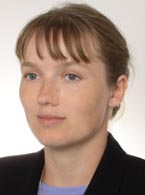
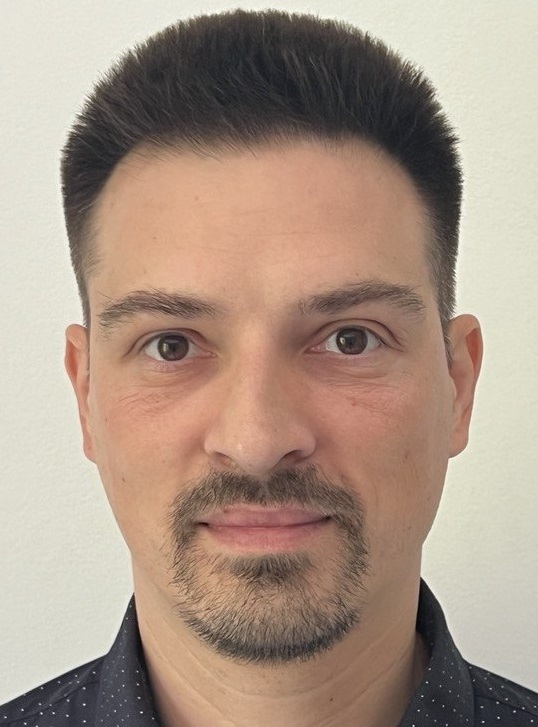
Aleksandra Rzepka is a Researcher at the University of Zielona Góra , affiliated with the Institute of Mathematics. Her scientific work spans approximation theory, game theory, and nonlinear wave propagation, with applications in multivariate linear models and stochastic equations. Research Interests : Fourier series, topological measure theory, iterative algorithms (Gaussian and Archimedes-Borchardt), nonlinear wave dynamics, and interdisciplinary applications of mathematics. Teaching : Lectures mathematics for technical, natural, and economic faculties, and organizes popular science workshops for primary/secondary students. Projects : Participates in EU-funded initiatives like the Widza Education Development Programme, focusing on practical collaborations with entrepreneurs.
Rafał Zalas is a researcher at the Department of Computer Science Applications at the University of Zielona Góra. His work spans diverse mathematical and computational domains, including iterative methods for fixed point problems , approximation theory using Fourier series , combinatorial geometry , and multivalued stochastic equations . His research focuses on convergence conditions for non-expanding operators, summability of Fourier series, and combinatorial properties of geometric partitions. He also explores applications in economics, social sciences, and computer science education, particularly through open-source tools. At the Institute, he teaches operational research and mathematical analysis . His projects include EU-funded initiatives like Modern teaching and practical cooperation with entrepreneurs .
Professor Andrzej Góźdź is a distinguished theoretical physicist at the Department of Theoretical Physics, Institute of Physics, Faculty of Mathematics, Physics and Computer Science at Maria Curie-Skłodowska University (UMCS) in Lublin, Poland. He holds a professorship and conducts research primarily in symmetry theory in physics, algebraic models of physical systems, nuclear theory, and quantum gravity. His academic contributions span several decades with numerous publications in prestigious physics journals. Professor Góźdź's research focuses on fundamental aspects of theoretical physics, particularly symmetry theory in nuclear and quantum systems. He investigates algebraic models of physical systems, the theory of the atomic nucleus, quantum gravity, and the foundations of quantum mechanics with special emphasis on quantum time. His work often bridges mathematical physics with practical applications in nuclear structure and quantum phenomena. The professor frequently collaborates with international research groups, as evidenced by his extensive publication record with colleagues from various countries. Analysis of Professor Góźdź's recent publications (2017-2019) reveals a consistent research trajectory focused on symmetry applications in nuclear physics, quantum mechanical foundations, and computational methods. His work demonstrates a strong emphasis on group theory applications to nuclear structure, particularly exploring high-rank symmetries in nuclei. Several publications address quantum time and delayed choice phenomena, reflecting his interest in foundational quantum mechanics questions. The professor also contributes significantly to computational physics, developing symbolic-numerical algorithms for solving complex boundary-value problems in nuclear and atomic physics. h-index (Web of Science): 14 h-index (Google Scholar): 4 h-index (Scopus): 3 Total publications: 124 As an academic supervisor, Professor Góźdź maintains regular consultation hours (Mondays 10:00-12:00 and Tuesdays 8:00-9:00; 12:00-13:00) and likely mentors graduate students in theoretical physics. His research activities involve participation in national and international grants focused on theoretical nuclear physics and quantum mechanics. Professor Góźdź is part of specialized research teams at UMCS exploring symmetry applications in nuclear structure. His collaborations with researchers like A. Pędrak, A. Dobrowolski, and international colleagues (particularly from Russia and France) indicate involvement in interdisciplinary teams combining theoretical physics with computational approaches.
Krzysztof Malarz is an Associate Professor and Head of the Department of Applied Computer Science and Computational Physics at AGH University of Science and Technology's Faculty of Physics and Applied Computer Science. He leads the Complex Systems Group, focusing on interdisciplinary research bridging physics and social sciences. His editorial responsibilities include roles at Open Physics and PLoS One . Research interests span: Statistical mechanics of phase transitions Percolation theory in complex lattices Sociophysical models of opinion dynamics Network science and computational approaches to social systems Econophysics and wealth distribution Recent publications (2021-2025) demonstrate consistent focus on universality in percolation thresholds, social balance dynamics, and opinion formation models. Work frequently employs Monte Carlo methods, agent-based simulations, and analytical physics techniques to explore critical phenomena in social and physical systems. The Complex Systems Group under his leadership investigates emergent behaviors in networked systems, with resources including high-performance computing facilities. No funded projects or student advisees are detailed in available sources.
Dr. Robert Smyk is an Assistant Professor in the Department of Automation at Gdańsk University of Technology's Faculty of Electrical and Automation Engineering. His office is located on floor 112 of the faculty building, and he can be contacted via email at robert.smyk@pg.edu.pl or by phone at +48 58 347 1332. Dr. Smyk's research spans several interconnected domains: Hardware-focused computing : FPGA implementations, residue arithmetic systems, and high-speed digital converters Algorithm development : Novel approaches to residue number system operations and signal processing optimizations Engineering applications : Computer vision for infrastructure inspection, cryptographic systems, and sensor data processing His publications demonstrate consistent focus on improving computational efficiency through mathematical optimizations and hardware-aware designs. With 67 publications documented in institutional repositories, his recent works explore: algorithmic improvements for residue arithmetic (2023-2025), thresholding/edge detection for industrial vision systems (2018-2022), and hardware architectures for specialized converters. Teaching activities include extensive involvement with 163 documented educational engagements.
Mariusz Węgrzyn is a Lecturer in the Department of Automation and Computer Science at the Faculty of Electrical and Computer Engineering, Cracow University of Technology. His research focuses on algorithm design, embedded systems, and FPGA applications, with recent publications on square root computation, IoT-based fire detection, and test vector optimization for soft processors. University: Cracow University of Technology School: Faculty of Electrical and Computer Engineering Department: Department of Automation and Computer Science Academic Rank: Lecturer Research Trends: Mariusz Węgrzyn’s work spans hardware acceleration, numerical algorithms, and IoT systems. His 2025 publications emphasize FPGA efficiency and floating-point approximation, while 2021 studies explore energy optimization in safety systems and test vector reduction. Contact: Email: mariusz.wegrzyn@pk.edu.pl
Professor Dariusz Horla is a faculty member at the Faculty of Automation, Robotics and Electrical Engineering at Poznań University of Technology, where he works in the Institute of Robotics and Machine Intelligence. He holds the title of Professor with a habilitation degree (dr hab. inż.) in automation and control engineering. His research focuses on advanced control systems, particularly anti-windup compensation techniques, model predictive control applications for nuclear power plants, UAV control systems, and fractional-order controllers. Professor Horla has published extensively across these domains, with recent work addressing challenges in cooperative control systems, optimization methods for control applications, and practical implementations of advanced control algorithms in real-world systems. Analysis of his recent publications (2015-2025) reveals a strong emphasis on practical control applications, particularly in nuclear power plant systems and unmanned aerial vehicles. His work bridges theoretical control methods with industrial implementation challenges, often focusing on optimization approaches and stability considerations in constrained systems. Professor Horla has supervised multiple doctoral students and has developed significant educational materials in control systems and automation. His intellectual property contributions include inventions related to UAV height control systems, demonstrating the practical impact of his research. His academic service includes participation in habilitation committees and development of educational materials that have shaped control engineering education at Poznań University of Technology.