Minah Oh is a Professor and Chair of the Department of Mathematics & Statistics at James Madison University (JMU), where she has served since 2010. Her research focuses on numerical analysis, scientific computing, finite element methods, and optimal control, with a particular emphasis on axisymmetric problems and multigrid techniques. She holds a Ph.D. in Mathematics/Numerical Analysis from the University of Florida (2010) and degrees from Yonsei University (B.S., 2005). Her work bridges theoretical mathematics and computational applications, addressing challenges in PDE discretization, optimal control problems, and geometric numerical methods. Recent publications explore finite element approaches for state-constrained control problems and the analysis of axisymmetric domains using de Rham complexes and Fourier-based methods. No scientific awards are explicitly listed in the provided materials. Her advising and grants sections remain unspecified in the text. Dr. Oh maintains an academic website at educ.jmu.edu/~ohmx for further details.
Sandra Paterlini is a Full Professor in the Department of Economics and Management at the University of Trento, Italy. She holds academic roles including Co-Chair of the ERCIM Working Group on Optimization Heuristics and Vice-Chair of the IEEE Task Force on Portfolio Optimization. Her career includes visiting positions at institutions such as the University of Minnesota and Ludwig-Maximilians-Universität München. She earned a PhD in Computational Methods for Financial and Economic Decisions from the University of Bergamo, an MSc in Financial Mathematics from the University of Warwick, and a Laurea in Economics from the University of Modena and Reggio E. Her research focuses on quantitative finance, risk management, portfolio optimization, and network analysis, with applications to ESG, systemic risk, and financial stability. Key research contributions include methodologies for sparse graphical modeling, systemic risk analysis, and ESG scoring frameworks. She has received multiple awards for research excellence and serves on editorial boards of journals like Computational Statistics & Data Analysis and Frontiers in Applied Mathematics and Statistics . Her work bridges academia and policy, with contributions to the European Central Bank’s Financial Stability Directorate and involvement in global conferences on computational finance and econometrics.
Prof. Felix Krahmer is a TUM Tenure Track Assistant Professor of Optimization and Data Analysis at the Department of Mathematics, Technische Universität München (TUM), part of the School of Computation, Information and Technology. Previously, he held a Junior Professorship (W1) for Mathematical Data Analysis at the University of Göttingen (2012–2015). His research focuses on mathematical foundations of data science, including compressed sensing, signal quantization, uncertainty quantification, and optimization algorithms. He has led an Emmy Noether research group and contributed to the ZeMat interdisciplinary project. Education : PhD in Mathematics (2009), New York University, advisors: Percy Deift & Sinan Güntürk MSc in Mathematics (2007), New York University BSc in Mathematics (2004), Jacobs University Bremen Research Interests : Krahmer’s work bridges theoretical mathematics and applied data science. Key areas include compressed sensing algorithms, high-dimensional signal reconstruction, quantization theory for analog-to-digital conversion, and optimization methods for inverse problems. He also explores applications in imaging (e.g., MRI reconstruction) and stochastic processes. Key Contributions : His research on phase retrieval, sigma-delta quantization, and compressed sensing recovery has advanced signal processing techniques. Recent efforts focus on uncertainty quantification for high-dimensional inverse problems and the mathematical analysis of consensus-based optimization. Grants & Awards : Emmy Noether Research Group Grant (DFG) Funding from BMBF (ZeMat project) Teaching & Outreach : Krahmer has taught advanced courses on compressed sensing, functional analysis, and random matrix theory. He co-organized workshops on probabilistic techniques and clinical risk prediction, emphasizing interdisciplinary collaboration. Labs/Teams : Member of the TUM Data Science Research Group, focusing on optimization, imaging, and uncertainty quantification. Active in the Munich Center for Quantum Science and Technology (MCQST).
Dr. Chutima Boonthum-Denecke is a Professor in the Department of Computer Science at Hampton University's School of Science. She joined Hampton University in 2006 as an Assistant Professor and now serves as Director of the Information Assurance and Cyber Security Center (IAC@HU). She leads the NSF CyberCorps Scholarship for Service program and has contributed to NSF initiatives like ARTSI and STARS Alliances. Her educational background includes a Ph.D. in Computer Science from Old Dominion University (2007), an MS in Applied Computer Science from Illinois State University (2000), and a BS in Computer Science from Srinakharinwirot University (1997). Dr. Boonthum-Denecke's research integrates artificial intelligence, natural language processing, and cybersecurity. Key interests include: Developing intelligent tutoring systems and educational games Secure coding practices for software engineering NLP applications in information retrieval and assessment tools Cyber-physical security for IoT and robotics Her recent publications (2016-2021) focus on machine learning applications in cybersecurity, including sentiment analysis for threat detection, blockchain-enhanced IoT security, and vulnerability assessments of emerging technologies. Collaborative work with students frequently addresses privacy ethics in AI assistants, RFID implants, and cloud systems. She mentors students through the IAC@HU lab, resulting in award-winning conference presentations on cybersecurity topics. As Principal Investigator of NSF CyberCorps, she oversees scholarship programs that bridge academic research with national security needs.
Mustafa A. Mustafa is a Senior Lecturer (Associate Professor) in the Department of Computer Science at The University of Manchester, where he leads the Trusted Digital Systems Cluster as part of the university-wide Centre for Digital Trust and Society. His academic journey spans prestigious institutions including The University of Manchester, where he completed his PhD, and KU Leuven in Belgium, where he served as a post-doctoral research fellow. Dr. Mustafa earned his educational qualifications through an impressive academic path: a B.Sc. in communications from the Technical University of Varna, Bulgaria (2007), an M.Sc. in communications and signal processing from Newcastle University, UK (2010), and a Ph.D. in computer science from The University of Manchester, UK (2015). His doctoral research focused on "Smart Grid Security: Protecting Users' Privacy in Smart Grid Applications," laying the foundation for his subsequent research career. Dr. Mustafa's research expertise centers on information security, data privacy, and applied cryptography with particular focus on smart grid systems, smart city applications, e-health, and IoT. His work addresses critical challenges in securing peer-to-peer electricity trading markets, smart metering infrastructure, electric vehicle charging systems, and health data management. He has developed innovative solutions for keyless car sharing systems, frictionless authentication mechanisms, and privacy-preserving protocols for data collection and distribution. His scholarly contributions demonstrate a consistent trajectory toward increasingly sophisticated privacy-preserving techniques applied across multiple domains. Recent work shows a growing integration of artificial intelligence and machine learning approaches with traditional cryptographic methods, particularly in federated learning systems and large language model verification. His research bridges theoretical cryptography with practical implementations in energy systems and healthcare applications. Dr. Mustafa's scientific achievements have been recognized with several prestigious awards: Winner of the Student Video Competition at IEEE SmartGridComm 2017 for "Secure and Privacy-friendly Local Electricity Trading" Best Paper Award at SECURWARE 2017 Distinguished Achievement Award as Postgraduate Research Student of the Year nominee by the School of Computer Science of The University of Manchester (2015) Dame Kathleen Ollerenshaw Research Fellowship (2018-2023) As an academic supervisor, Dr. Mustafa has mentored numerous graduate students through their PhD and Master's research, with a particular focus on privacy and security challenges in emerging technologies. His current supervision portfolio includes research on privacy-friendly multi-agent systems for smart grids, security for IoT in e-health, vulnerability detection in IoT cryptography, and bot detection systems. He has secured significant research funding through multiple competitive grants including EnnCore: End-to-End Conceptual Guarding of Neural Architectures (EPSRC, 2020-2024), SCorCH: Secure Code for Capability Hardware (EPSRC, 2019-2023), and SNIPPET: Secure and Privacy-friendly Peer-to-peer Electricity Trading (FWO-SBO project, 2019-2023). Dr. Mustafa leads the Trusted Digital Systems Cluster within the Centre for Digital Trust and Society at The University of Manchester. His research group comprises PhD students, postdoctoral researchers, and collaborators working on cutting-edge security and privacy solutions. The team maintains strong international collaborations, particularly with KU Leuven in Belgium, and contributes to standards development as evidenced by Dr. Mustafa's role as an expert in the IEC/SYC/WG 3 "IEC Smart Energy Roadmap."
Yuanzhu Chen is a Professor in the School of Computing at Queen’s University, affiliated with the Faculty of Arts and Science. He previously served as Professor and Department Head at Memorial University of Newfoundland (2005–2021). His research focuses on computer networking, mobile computing, complex networks, and applied machine learning, emphasizing wireless innovation beyond traditional wired systems. He holds a PhD from Simon Fraser University (2004) and a B.Sc. from Peking University (1999). Education: PhD in Computing Science (Simon Fraser University, 2004); B.Sc. in Computer Science (Peking University, 1999). Earlier roles include Post-doctoral Researcher at Simon Fraser University (2004–2005) and leadership positions at Memorial University, including Department Head (2019–2021). Research Interests: Network Coding and Opportunistic Routing Mobile and Wireless Network Protocols Complex Network Analysis Machine Learning Applications Indoor Positioning Systems Social Network Dynamics Selected Awards: Recipient of Queen’s University President's Award for Distinguished Teaching. Lab Affiliation: Director of the Wireless Networking and Mobile Computing Lab (WineMocol). Active in collaborative projects involving smartphone sensors, community-based environmental monitoring, and stock market prediction using web data.
Konstantinos Spiliopoulos is a Professor and Director of Statistics at Boston University's Department of Mathematics and Statistics, part of the College of Arts & Sciences. He leads research in Applied Mathematics and Probability and Statistics groups, focusing on stochastic processes, machine learning, and mathematical finance. His research interests include stochastic analysis of complex systems, multiscale phenomena, and their applications to neural networks, PDEs, and financial modeling. Notable areas of study involve mean-field limits, rare event simulation, and asymptotic methods in stochastic differential equations. He has received grants such as DMS-EPSRC funding for analyzing online training algorithms in recurrent and deep neural networks. His work bridges theoretical advancements with practical applications in data science and computational methods. Spiliopoulos maintains an active presence in interdisciplinary research, addressing challenges in systemic risk, network dynamics, and optimization. His contributions span from fundamental probability theory to applied problems in engineering and finance.
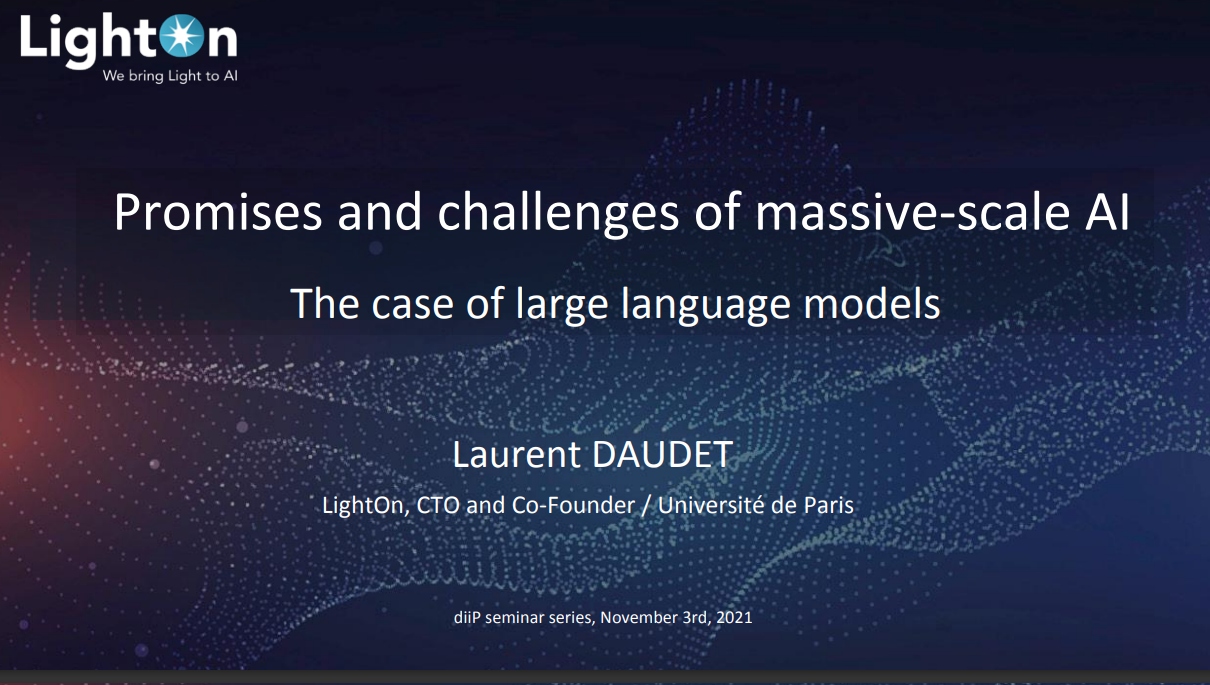
Laurent Daudet is a Professor of Physics at Université Paris Cité (on leave) and CTO & co-founder of LightOn, a startup developing optical computing technologies. His research spans signal processing, wave physics, and machine learning, with a focus on scalable AI solutions. He holds a PhD in Applied Mathematics from Marseille University and is a graduate of École Normale Supérieure in Paris. Research Interests: Laurent’s work bridges academia and industry, addressing challenges in massive-scale AI, optical computing, and hardware optimization. He leads cross-disciplinary R&D projects at LightOn, advancing technologies like the Optical Processing Unit (OPU) for low-power, parallel computing. Awards: Fellow of the Institut Universitaire de France Grants & Advising: Over 200 scientific publications and patents; collaborates globally with researchers and engineers. Former academic roles include Visiting Senior Lecturer at Queen Mary University of London and Visiting Professor at the National Institute for Informatics (Tokyo). Labs & Teams: Leads LightOn’s R&D initiatives, integrating optics, ML, electronics, and software engineering to tackle AI scalability challenges.
Arrvindh Shriraman is an Associate Professor and Program Director of Software Systems at Simon Fraser University's School of Computing Science in Surrey. His research focuses on energy-efficient software, multicore memory systems, and optimizing hardware/software interfaces for parallel programming. He holds a Ph.D. (2010) and M.S. (2006) in Computer Science from the University of Rochester, and a B.Eng. (2004) from the University of Madras. He teaches courses on parallel programming and energy-conscious software design. His research interests include synchronization mechanisms for domain-specific architectures, cache optimization, and FPGA-based acceleration. He has contributed to frameworks like Mu-grind for HLS-generated RTL instrumentation and TAPAS for parallel accelerator generation. Notable projects include RANGE-BLOCKS for synchronization in domain-specific systems and TapeFlow for gradient computation in neural networks. His work emphasizes real-time verification of autonomous systems and safety-critical trajectory planning for underwater vehicles. Shriraman collaborates closely with the Tangent Lab, exploring cutting-edge solutions in hardware-software co-design and embedded systems. His teaching and research bridge theoretical computer science with applied engineering challenges, addressing scalability, efficiency, and safety in modern computing systems.
Erald Troja is a Tenured Associate Professor in the Mathematics, Computer Science and Science Division at St. John's University's Collins College of Professional Studies. He serves as the acting Program Director for the Cyber Security Systems program and the Director of the National Security Agency Center of Academic Excellence in Cybersecurity (NCAE). He holds a Ph.D. in Computer Science from The Graduate Center, CUNY, and previously served as an Assistant Professor at IONA College. With over 20 years of industry experience, he worked as a Sr. Systems Engineer at Time Warner Cable and Charter Communications. His research focuses on cybersecurity, privacy-preserving computations, location privacy, applied cryptography, and mobile computing. Recent work includes gamification of cybersecurity education using the metaverse, AI integration in cybersecurity curricula, and mitigating threats in autonomous systems. He has published in top-tier venues like IEEE Access, Ad Hoc Networks, and IEEE VTC. Teaching interests include network security, wireless security, and cryptography. He has developed innovative pedagogical methods like escape room-style learning and virtual reality-based training. His contributions to cybersecurity education and research have positioned him as a leader in advancing practical cybersecurity solutions and educational frameworks.
Francesca Grisoni serves as an Assistant Professor in the Department of Biomedical Engineering at Eindhoven University of Technology (TU/e), where she currently leads the Molecular Machine Learning team. She additionally holds appointments as an ICMS Core member and Associate Professor at EAISI (Eindhoven Artificial Intelligence Systems Institute), reflecting her cross-disciplinary role at the intersection of computational science and biomedical applications. Academic Background : Grisoni completed her Environmental Sciences degree and earned a Ph.D. in 2016 from the University of Milano-Bicocca, where her dissertation focused on interpretable machine learning for molecular property prediction. During doctoral studies, she conducted research at ETH Zurich's Department of Chemistry and Applied Biosciences and the U.S. EPA's National Center for Computational Toxicology. Ph.D., University of Milano-Bicocca, 2016 (Dissertation: Interpretable machine learning for molecular property prediction) Environmental Sciences, University of Milano-Bicocca Her research integrates artificial intelligence, chemistry, and biology to develop computational methods for drug discovery, emphasizing wet-lab experimental validation alongside algorithmic innovation. Key focus areas include overcoming activity cliffs in molecular machine learning, generative modeling for scaffold hopping, and AI-augmented decision-making in therapeutic development, with the ultimate goal of achieving 'better decisions faster' in drug discovery pipelines. Analysis of her recent 2025 publications reveals a concentrated trend toward chemical language models and generative deep learning frameworks, specifically addressing low-data drug discovery challenges through active learning and neural network architectures. These works bridge computer science with pharmacology, targeting bioactivity prediction, molecular representation, and enzyme design while maintaining strong ties to experimental validation. Scientific Awards : Lush Young Researcher Prize Early Career Award 2022 from the Dutch Royal Netherlands Academy of Arts and Sciences (KNAW) ERC Starting Grant (2022) Grants and Supervision : Dr. Grisoni secured the prestigious ERC Starting Grant in 2022 to advance her molecular machine learning research. Institutional records indicate she has supervised 7 students (as shown in TU/e's 'Supervised Work (7)' repository section), though specific names aren't provided in the source material. Her group maintains active industry collaborations, including past engagement with Bracco Pharmaceuticals. Laboratory and Team : The Molecular Machine Learning team operates under the ICMS and EAISI frameworks, merging computational AI development with experimental wet-lab validation. This collaborative unit focuses on fragment-based molecular design, chirality representation (evidenced by fragSMILES work), and high-throughput nanoparticle identification using machine learning, as highlighted in recent press coverage and datasets.
Miguel Mujica Mota is a Senior Lecturer at the Faculty of Technology, National Autonomous University of Mexico (UNAM), and a member of the Centre of Applied Research Technology. His research focuses on airport operations, multimodal transport systems, and simulation modeling. He has expertise in analyzing capacity challenges in multi-airport systems, particularly in Mexico City, and developing decision support systems for airport security and resource allocation. His work integrates sustainability and efficiency, addressing topics like environmental reporting in airlines and post-pandemic airport recovery strategies. Research Contributions: Dr. Mujica Mota has published extensively on airport capacity optimization, multimodal transport integration, and simulation-based methodologies. Key projects include the X-TEAM D2D initiative for door-to-door travel and the IMHOTEP project for smart passenger flow management. His work often involves collaboration with institutions like Schiphol Airport and the H2020 EU framework. Research Interests: Airport terminal design, air traffic management, simulation modeling, multimodal logistics, and sustainable aviation. Awards: A-BOOST Research Fund (2020) Beste paper award EMM2018 X-TEAM D2D Project Recognition (2020) Activities: Organized conferences like the 2023 EUROSIM Simulation Seminar and served on committees for events such as the 2024 Multilog Conference. Grants & Projects: Involved in EU-funded initiatives like H2020, focusing on multimodal integration and sustainable transport solutions. His research also explores climate change impacts on infrastructure and simulation-based validation approaches.
Patrick Brown is an Associate Professor at the University of Toronto , affiliated with the Department of Statistical Sciences and cross-appointed to the Centre for Global Health Research and St. Michael's Hospital . His research focuses on spatio-temporal data modeling , Bayesian inference , and non-parametric methods for spatial epidemiology and environmental sciences. Fields of Interest : Spatial Statistics, Cancer Statistics, Statistical Software Education : PhD from University of Lancaster His methodological work encompasses Bayesian inference for non-Gaussian spatial data, Gaussian Markov random fields, and computational techniques like INLA and MRA. Applied research themes include disease mapping, environmental risk assessment, and public health surveillance using real-world data sources such as electronic health records and wastewater monitoring . He has developed key R packages (mapmisc, geostatsp, diseasemapping) supporting spatial statistical applications. Current collaborative projects span diverse fields: Ultra-diffuse galaxy detection with astrophysical applications Multi-pollutant mortality studies in Canadian cities SARS-CoV-2 seropositivity tracking Homelessness population estimation using EHR Geospatial cancer risk tools for Nova Scotia His work bridges statistical innovation with global health challenges , emphasizing computationally efficient solutions for large-scale spatiotemporal datasets.
Jan Martin Nordbotten is a full-time Professor at the Department of Mathematics, University of Bergen (UiB), with adjunct positions at Princeton University and NORCE. His research focuses on applied mathematics, particularly in porous media, CO2 storage, fluid dynamics, and interdisciplinary applications in hydrology, biomedicine, and ecology. He completed his PhD at UiB in 2004 and became Norway's third youngest professor in 2007. His work emphasizes numerical methods, multiscale modeling, and experimental validation. Affiliations: UiB (full-time), Princeton (adjunct), NORCE (adjunct) Research Group: Center for Sustainable Subsurface Resources Research interests span mathematical modeling of subsurface processes, including flow in fractured media, geomechanics, and phase-field fracture. Notable contributions include analytical and numerical solutions for CO2 leakage, multiphase flow, and development of tools like DarSIA for image processing in porous media. Publications highlight advancements in mixed-dimensional models, finite element methods, and experimental validation of CO2 storage forecasts. His work bridges theoretical mathematics with practical applications in energy and environmental systems.
Yong-Bin Kang is a Senior Data Science Research Fellow at the ARC Centre of Excellence for Automated Decision Making and Society (ADM+S) at Swinburne University of Technology, affiliated with the School of Social Sciences, Media, Film and Education. He holds a PhD in AI from Monash University and leads numerous transdisciplinary research projects applying artificial intelligence to address complex societal challenges. Education: PhD in Faculty of IT, Monash University, Australia Dr. Kang's research focuses on Responsible AI and Society, with specific interests in developing Societal-AI platforms that integrate social data with ethical principles. His work spans healthcare, humanitech, education, financial planning, environmental health, and justice domains. He investigates how AI can enhance decision-making processes while promoting societal well-being, with particular attention to ethical implementation and human-centered approaches. His expertise encompasses AI, natural language processing, machine learning, and decision-making optimization. Analysis of Dr. Kang's recent publications reveals a strong trajectory toward socially responsible AI applications across diverse domains. His work consistently bridges technical AI capabilities with social implications, particularly focusing on ethical frameworks, community-centered design, and addressing societal inequalities through technology. The publications demonstrate increasing collaboration across disciplines including criminology, environmental science, mental health, and education. Dr. Kang is actively involved in significant research funding initiatives, with multiple ongoing projects that address critical societal challenges through AI. His supervision availability includes Doctorate (PhD) candidates, indicating his commitment to mentoring the next generation of researchers in AI and data science fields. Current Flagship Areas: Digital Capability Innovative Society Manufacturing Futures Sustainable Development Goals: Good Health and Well Being (SDG 3) Industry, Innovation and Infrastructure (SDG 9) Affordable and Clean Energy (SDG 7)