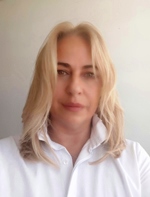
Radmila Suzić is a Professor at Singidunum University, specializing in Applied Linguistics, English Language Teaching, and Digital Education Tools. She holds a PhD in Teaching Methodology from the University of Novi Sad's Faculty of Philosophy (2016) and has published extensively on language anxiety, curriculum development, and technology integration in education. Fields of Interest: Applied Linguistics, Language Anxiety, English Language Teaching, Curriculum Development, Translation Studies, Digital Education Tools Email: rsuzic@singidunum.ac.rs Key Collaborations: Co-authored works with M. Nedeljkovic, A. Puška, T. Dabić, and B. Radić-Bojanić Notable Publications: 'Evolving Methodologies' (2024), studies on multi-criteria analysis in agricultural selection, and research on digital tools in language teaching Her recent articles focus on agricultural decision-making models, digital transformation in education, and cross-cultural language studies. She actively participates in international conferences like SINTEZA and CILRAID.
Srđan Divac is a Teaching Assistant at the Department of General Electrical Engineering and Electronics within the Faculty of Technical Sciences, University of Kragujevac . He earned his PhD in 2025 (average grade: 9.88) after completing his master's (2018, grade: 10) and bachelor's (2017, grade: 9.67) studies at the same institution. His research focuses on: Numerical methods in electromagnetics Measurement uncertainty analysis for electrical machines Dynamic hysteresis modeling in ferromagnetic materials Harmonic interpolation techniques for nonlinear circuits Instantaneous magnetisation power analysis Equivalent circuit parameter estimation Key article trends include simulation of magnetic hysteresis loops, electromagnetic computation for power systems, and advanced modeling of ferromagnetic and permalloy materials under varying excitation frequencies. His work appears in journals like Applied Sciences and Energies , as well as conferences such as IcETRAN and PES .
Dragan D. Mancic is a full professor at the Faculty of Electronics, University of Niš, Serbia, where he has been actively contributing since earning his PhD in 2002. He holds a permanent academic position in the Department of Electronics and continues to engage in national research projects and scientific publications. Research Interests: His work spans electronics, power electronics, ultrasonic transducers, piezoceramics, impedance spectroscopy, and thermal modeling. He applies these to areas such as renewable energy systems, friction stir welding, and ceramic material characterization. His interdisciplinary focus bridges electrical engineering, materials science, and applied physics. The recent publications highlight consistent research in transducer design, thermal analysis in manufacturing, and electrical characterization of doped ceramics. These works reflect a strong trend toward modeling, simulation, and experimental validation in both biomedical and industrial applications. Scientific Projects: EE-273023B: Development of solar radiation receivers TR-33035: Grid-connected rotating photovoltaic system III-43014: Remote sensing and environmental monitoring Dr. Mancic has co-authored three monographs and has 15 publications in journals with impact factors. He advises students and researchers through collaborative projects and academic supervision, though specific advisees are not listed. He is actively involved in scientific research management under the Ministry of Science. Labs and Research Teams: He collaborates within research groups focused on power electronics, ultrasonic systems, and advanced materials at the Faculty of Electronics in Niš, contributing to both theoretical and applied engineering solutions.
Prof. Igor Dejanović is a Regular Professor at the Department of Informatics, Faculty of Technical Sciences, University of Novi Sad. He holds a BSc (2000) and MSc (2008) in Computer Science from the same institution, followed by a PhD in 2012 with a thesis on 'Contributions to Methods of Rapid Software Development Based on Extensible Domain-Specific Specifications'. Positions Held: 2000–2004: Technical Associate at Faculty Computing Center 2004: Selected as Assistant Professor 2008: Promoted to Assistant Professor 2012: Promoted to Associate Professor 2017: Promoted to Full Professor Research focuses on domain-specific languages, software patterns, model-driven development, and software configuration management. He has contributed extensively to software engineering methodologies and education in technical informatics.
Stefan Ćirković is a Teaching Associate in the Department of Information Technologies at the Faculty of Technical Sciences in Čačak, University of Kragujevac. His office is located at Saint Sava 65, 32102 Čačak, Serbia. He is currently pursuing doctoral studies in Information Technology (2023–present) at the same institution. Education: Doctoral Academic Studies – Information Technology, University of Kragujevac (2023–present) Master of Academic Studies – Information Technology, University of Kragujevac (2022–2023) Basic Academic Studies – Information Technology, University of Kragujevac (2018–2022) Specialized Program – Cybersecurity, University of Kragujevac (2024) Research Focus: Ćirković specializes in applied artificial intelligence with significant work in cybersecurity, medical imaging, and network systems. His research demonstrates strong emphasis on practical AI implementations including real-time object detection (YOLO algorithm), anomaly detection in networks, federated learning for healthcare applications, and cybersecurity techniques using large language models. His work frequently intersects with medical informatics, particularly in diagnostic applications. Publication Trends: Recent publications (2024–2025) show predominant focus on AI/ML applications across multiple domains. Cybersecurity remains a core theme with novel approaches to web application security and network anomaly detection. Medical applications feature prominently, especially in diagnostic imaging (kidney stones, skin cancer) and hemodialysis optimization. Methodologically, there's consistent exploration of deep learning architectures and real-time systems. Laboratory Affiliations: Associated with the Computer Science Laboratory at the Faculty of Technical Sciences in Čačak. Utilizes institutional resources including the Moodle e-learning platform and Microsoft 365/Teams infrastructure for academic activities.
Milan Marjanović is an Assistant Professor at the Department of Mechanical Engineering, Faculty of Technical Sciences in Čačak, University of Kragujevac. Holding an M.Sc. in Mechanical Engineering, he teaches Thermodynamics, Applied Thermodynamics, Renewable Energy Sources, and Machine Elements. His research focuses on Thermal Engineering, Thermoenergetics, and Renewable Energy systems. Born 1990 in Užice Completed primary/secondary education in Požega Faculty of Mechanical Engineering and Civil Engineering, Kraljevo (2012) Master's in Energy Engineering (2014) Research spans biomass combustion optimization, solar energy systems, and hydraulic simulation tools. Active in academic projects like the national PRIZMA 2023 initiative for Active Condensation Hybrid Systems. Key publications include work on: Biomass-fired district heating efficiency AI-driven solar energy prediction models Hybrid photovoltaic-thermal collector testing Industry 4.0 curriculum development for Mechatronics Scientific contributions appear in journals like Case Studies in Thermal Engineering and conferences including COAST 2024. Awards include Ministry scholarships and 'Mašinijada' competition victories. Collaborates with industry partners on mechanical testing equipment development.
Ivan Miletić is an Associate Professor at the Faculty of Engineering Sciences, University of Kragujevac, specializing in Machine Structures and Mechanization. His academic career at the university includes significant contributions to mechanical engineering research and education within the Department of mechanical structures and mechanization. His research interests span across several key areas in mechanical engineering, with a strong focus on machine design, structural analysis, and materials science. Professor Miletić has made substantial contributions to the understanding of cycloid reducers, gear design, and the mechanical properties of advanced materials. His work bridges theoretical analysis with practical applications in automotive, aerospace, and industrial machinery sectors. Professor Miletić's publication record demonstrates a strong focus on mechanical design optimization and structural analysis. His recent work has particularly emphasized the development and analysis of cycloid reducers, gear systems, and advanced composites. He has also contributed significantly to design automation methodologies and structural optimization techniques, applying advanced computational approaches to solve complex engineering problems across multiple disciplines. His scholarly contributions have practical applications in diverse fields including automotive engineering, aerospace technology, and industrial machinery design. Professor Miletić maintains an active research profile with publications spanning from 2020 to 2025, indicating ongoing scholarly productivity in mechanical engineering disciplines. As an educator, Professor Miletić has been instrumental in developing curriculum and mentoring students in mechanical engineering disciplines. His election to the position of Associate Professor in 2021 reflects his significant contributions to both research and teaching at the Faculty of Engineering Sciences.
Živko Bojović is affiliated with Singidunum University, holding a doctoral degree in Telecommunications and Signal Processing from the University of Novi Sad. His career includes roles as an engineer and manager in telecommunications companies like Telekom Srbija and PTT Serbia. He has extensive experience in academic publishing, with monographs on network technologies and textbooks on software-defined networking (SDN) and IoT applications. His research focuses on cybersecurity, machine learning applications in healthcare, smart government systems, and network virtualization. Education: PhD in Telecommunications (2011), Postgraduate studies in Telecommunications (2000-2001), Bachelor’s in Electronics with Telecommunications (1986-1992). He also completed high school in Peć with a mathematical focus. Research Interests: He explores advanced networking technologies including SDN, 5G/6G networks, IoT security, and educational technology innovations. His work bridges theoretical advancements with practical implementations in healthcare diagnostics and public sector digitization. Recent studies include applying machine learning to predict thrombosis and thyroid cancer metastasis, reflecting his interdisciplinary approach. His articles collectively highlight trends in smart systems (e.g., government services, energy grids) and network security, with frequent contributions to journals like Computer Applications in Engineering Education and Journal of Network and Systems Management . The Wiley Top Cited Article award (2020-2021) recognizes his impactful work on rapid transition to distance learning during crises. Prof. Bojović holds IEEE membership and sits on editorial boards for journals like Inventi Impact: Software Engineering . He actively participates in EU Horizon projects focusing on 6G privacy and smart city analytics.
Miloš Dobrojević serves as a Professor at Singidunum University's Faculty of Informatics and Computing in Belgrade, Serbia. His academic foundation includes doctoral, postgraduate, and bachelor studies at the University of Belgrade's Faculty of Mechanical Engineering. His research spans Artificial Intelligence , Internet of Things , and Computer Vision with emphasis on practical applications. Key focus areas include metaheuristic optimization of neural networks for tasks like crop yield prediction, medical diagnostics, and cybersecurity. Recent work demonstrates strong industry relevance in precision agriculture, drone detection systems, and sustainable homestead automation. Analysis of his 15 most recent publications reveals a consistent pattern of applying modified metaheuristics to enhance deep learning models across diverse domains. His work bridges theoretical AI advancements with real-world implementations in agriculture, healthcare, and energy systems. Scientific Contributions: Author of 3 textbooks including 'Veb informacioni sistemi' (2024) and 'Veb programiranje' (2021) Published 40+ journal/conference papers between 2003-2025 Active contributor to Springer book chapters on AI applications Dobrojević's work demonstrates strong practical orientation with projects in Serbian renewable energy transition, flood prevention systems, and municipal e-government solutions. His recent collaborations with researchers like N. Bacanin and M. Zivkovic show consistent output in high-impact journals. Current projects focus on generative AI for medical data and computer vision for agricultural optimization. His laboratory work centers on IoT-based monitoring systems for environmental applications, particularly water management in mountainous regions. Ongoing research explores drone detection networks and waste classification systems using advanced computer vision techniques.
Nada Damljanović is a Full Professor at the Department of Mathematics within the Faculty of Technical Sciences in Čačak, University of Kragujevac, Serbia. Her academic progression includes positions as Junior Teaching Assistant (2003-2007), Teaching Assistant (2007-2012), Assistant Professor (2012-2017), Associate Professor (2017-2022), and Full Professor (2022-present). Education includes: BSc in Mathematics (2002) from University of Belgrade MSc in Mathematics (2007) from University of Niš PhD in Mathematics (2012) from University of Niš Her research focuses on automata theory , fuzzy systems , semiring structures , and multi-criteria decision-making methods . She investigates mathematical foundations of weighted automata, lattice-based algebraic structures, and applications in engineering decision models. Recent work explores fuzzy relation inequalities and computational methods for automata equivalence. Publications predominantly address mathematical modeling in computer science and decision theory. Most articles focus on automata bisimulations (2010-2014), shifting toward multi-criteria analysis and applied mathematical methods in engineering (2015-2020). Recent works integrate mathematical frameworks with signal processing and electrical engineering applications. She leads/participates in key research projects: Quantitative automata models (QUAM, 2022-2024) Computation methods development (174013, 2011-present) Weighted pushdown automata (DFG-funded, 2019-2020) Algebraic structures in information processing (144011, 2006-2010) Editorial activities include Co-Editor-in-Chief of Mathematica Moravica and Associate Editor for Kragujevac Journal of Mathematics . Teaches undergraduate courses in Mathematics, Discrete Mathematics, and Quantitative Methods, plus graduate courses in Mathematical Modeling and Fuzzy Systems.
Marija Paunović serves as an Assistant Professor at the Department of Natural Sciences within the Faculty of Hospitality and Tourism at the University of Kragujevac. She was elected to this academic position on July 14, 2021, and maintains regular consultation hours on Mondays from 10:00-12:00 AM. Despite working in a faculty primarily focused on hospitality and tourism, her expertise lies in advanced mathematical disciplines with applications across multiple fields. Her educational background includes basic academic studies at the Faculty of Mathematics in Belgrade, Master's studies at the Faculty of Economics in Belgrade, and dual Doctorates of Science from the Faculty of Technical Sciences in Novi Sad and the Faculty of Computer Sciences in Belgrade. This diverse academic foundation enables her to bridge theoretical mathematics with practical business applications. Dr. Paunović's research centers on Applied Mathematics with specializations in Fixed Point Theory, Uncertainty Theory, and Phases of Mathematics. Her work demonstrates how abstract mathematical concepts can solve concrete problems in image processing, fractional calculus, and business analytics. She has developed innovative approaches to fuzzy metrics and credibility measures that have practical applications in data analysis and decision-making under uncertainty. An analysis of her recent publications (2019-2024) reveals a strong focus on extending fixed point theorems with applications to fractional differential equations and integral systems. Her research consistently bridges pure mathematics with practical applications, particularly in image processing and uncertainty modeling. She frequently collaborates with an international network of researchers, most notably V. Parvaneh, producing high-impact work published in reputable mathematics journals. Member, secretary and founder of the Serbian Actors' Association Member of the Serbian Mathematician Society Delegate member of International Actuarial Association committees (Supranational Relations and Advice & Assistance) Dr. Paunović has secured significant research funding including the 'Mathematical Methods in Image Processing under Uncertainty – MaMIPU' grant (No 7632) through Serbia's PRIZMA program. She has also contributed to projects supporting rural development programming and payment systems, actuarial assessments for insurance companies, and digital learning games for mathematics education. Her interdisciplinary approach connects mathematical theory with applications in economics, medicine, engineering, and education.
Dora Selesi is a Full Professor at the Department of Mathematics and Informatics, Faculty of Sciences, University of Novi Sad, Serbia. She holds joint appointments at the Medical Faculty and University Centre of Applied Statistics on a partial-time basis. Her academic role includes chairmanship of the Analysis, Probability and Differential Equations division, alongside editorial roles in journals like Novi Sad Journal of Mathematics and Filomat . Education: PhD in Mathematics, University of Novi Sad (2007), thesis: Generalized stochastic processes in infinite dimensional spaces with applications to singular stochastic partial differential equations MSc in Mathematics, University of Novi Sad (2004) Research Interests: Focuses on stochastic processes, stochastic analysis, functional analysis, and their applications to partial differential equations. Key areas include generalized stochastic processes, Malliavin calculus, chaos expansions, fractional calculus, and stochastic PDEs. Her work bridges pure mathematics and applied fields like mathematical physics and epidemiology. Teaching: Teaches advanced courses on mathematical analysis, differential equations, measure theory, actuarial mathematics, and biomathematics. She emphasizes computational tools (e.g., Mathematica, MATLAB) and interdisciplinary applications in her teaching. Affiliations: Active member of societies such as the American Mathematical Society (AMS), European Women in Mathematics (EWM), and the International Society for Analysis, its Applications and Computation (ISAAC). She has organized conferences like the DAAD school on Chaos expansions and contributed to academic committees. Labs & Teams: Leads research on stochastic processes and chaos expansions, collaborating with international scholars. Her workgroup has produced notable research in generalized functions and stochastic differential equations.
Velibor Isailovic is an Associate Professor at the Faculty of Engineering Sciences, University of Kragujevac, Serbia, where he is affiliated with the Department of Applied Mechanics and Automatic Control. His academic work centers on information technology and control systems within engineering contexts. His research interests include Information Technology , Automatic Control , Applied Mechanics , Control Systems , Engineering Informatics , Mechatronics , and Industrial Automation . These fields reflect his interdisciplinary role bridging mechanical engineering and computing. While specific publications are not detailed in the source text, his affiliation with the Department of Applied Mechanics and Automatic Control suggests a focus on automation, robotics, and intelligent systems in industrial and mechanical applications. There are no listed scientific awards or honors in the provided information. Velibor Isailovic advises students within his department, though no named students are listed. He contributes to academic and research activities at the university, likely participating in funded projects related to automation and information systems in engineering. He is part of the research and teaching team within the Department of Applied Mechanics and Automatic Control, which is involved in various national and international research initiatives, laboratories, and technical developments.
Sanja Aleksic is an Associate Professor at the Faculty of Electronic Engineering, University of Nis, specializing in Microelectronics and Microsystems. Her academic career began with a Physics degree from the Faculty of Philosophy in Nis (1995), followed by a Master's (2009) and PhD (2015) in Applied Physics from her current faculty. Her research focuses on semiconductor materials, photoacoustic spectroscopy, and electronic device modeling. She has published extensively in peer-reviewed journals, with 9 papers indexed with impact factors. Her work bridges applied physics and engineering, particularly in analyzing thermal and elastic properties of materials using advanced techniques like photoacoustic analysis and neural network modeling. Education: Bachelor's in Physics, Faculty of Philosophy, University of Nis (1995) Master's in Applied Physics, Faculty of Electronic Engineering, University of Nis (2009) PhD in Applied Physics, Faculty of Electronic Engineering, University of Nis (2015) Research Interests: Microelectronics, semiconductor characterization, thermoelastic effects, photoacoustic signal analysis, and material property modeling. Notably, her work employs electro-acoustic analogies to study silicon and TiO₂-coated materials, as well as neural network approaches for high electric field stress modeling in VDMOSFETs. Her recent studies (2020–2025) emphasize cutting-edge topics like solar parking canopy optimization and biomarker-based clinical outcomes in pandemic scenarios. Publications: Over 30 peer-reviewed articles, with a focus on photoacoustic techniques, semiconductor device simulation, and energy systems. Her work spans journals like Journal of Applied Physics , International Journal of Thermophysics , and Journal of Computational Electronics . Key themes include material property extraction, thermal-mechanical coupling, and sustainable energy solutions. Awards: None explicitly listed in provided texts. Labs/Teams: Engaged in interdisciplinary research at the Faculty of Electronic Engineering, collaborating on projects involving material characterization, renewable energy systems, and bio-medical applications. Active in both national and international research networks, though specific lab affiliations are not detailed here.
Sladjana D. Marinković is a Full Professor in the Department of Mathematics at the Faculty of Electronics, University of Niš, Serbia. She has been a prominent figure in mathematical research, particularly in special functions and q-calculus, since earning her PhD in 2005. Education: PhD in Mathematics, Faculty of Natural Sciences and Mathematics, University of Niš (2005) Master's in Mathematics, Faculty of Electronics, University of Niš (1995) BSc in Mathematics, Faculty of Philosophy, University of Niš (1986) Her research focuses on special functions , q-calculus , orthogonal polynomials , fractional calculus , and operational methods . She has made significant contributions to the theory of deformed exponential functions, q-integral inequalities, and generalized polynomial systems, often in collaboration with researchers like Predrag M. Rajković and Miomir S. Stanković. The analysis of her recent publications reveals a consistent trajectory in theoretical and computational mathematics , particularly in the development and application of q-analogues and deformed operators. Her work bridges pure mathematical analysis with applications in applied and computational fields, often published in high-impact journals such as Computational and Applied Mathematics , Fractional Calculus and Applied Analysis , and Journal of Nonlinear Mathematical Physics . Scientific Contributions: 18 papers published in journals with impact factors Active participation in 1 national research project She has not been documented as advising students in the provided text, nor are any grants or awards explicitly mentioned. However, her sustained research output and leadership in her department indicate a strong academic presence. There is no indication of part-time status, retirement, or emeritus position; she appears to be an active, full-time faculty member. She is not associated with any named laboratory or research team in the given text, but her collaborations suggest integration within a broader mathematical research network at the University of Niš.