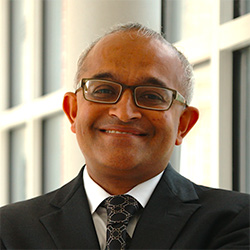
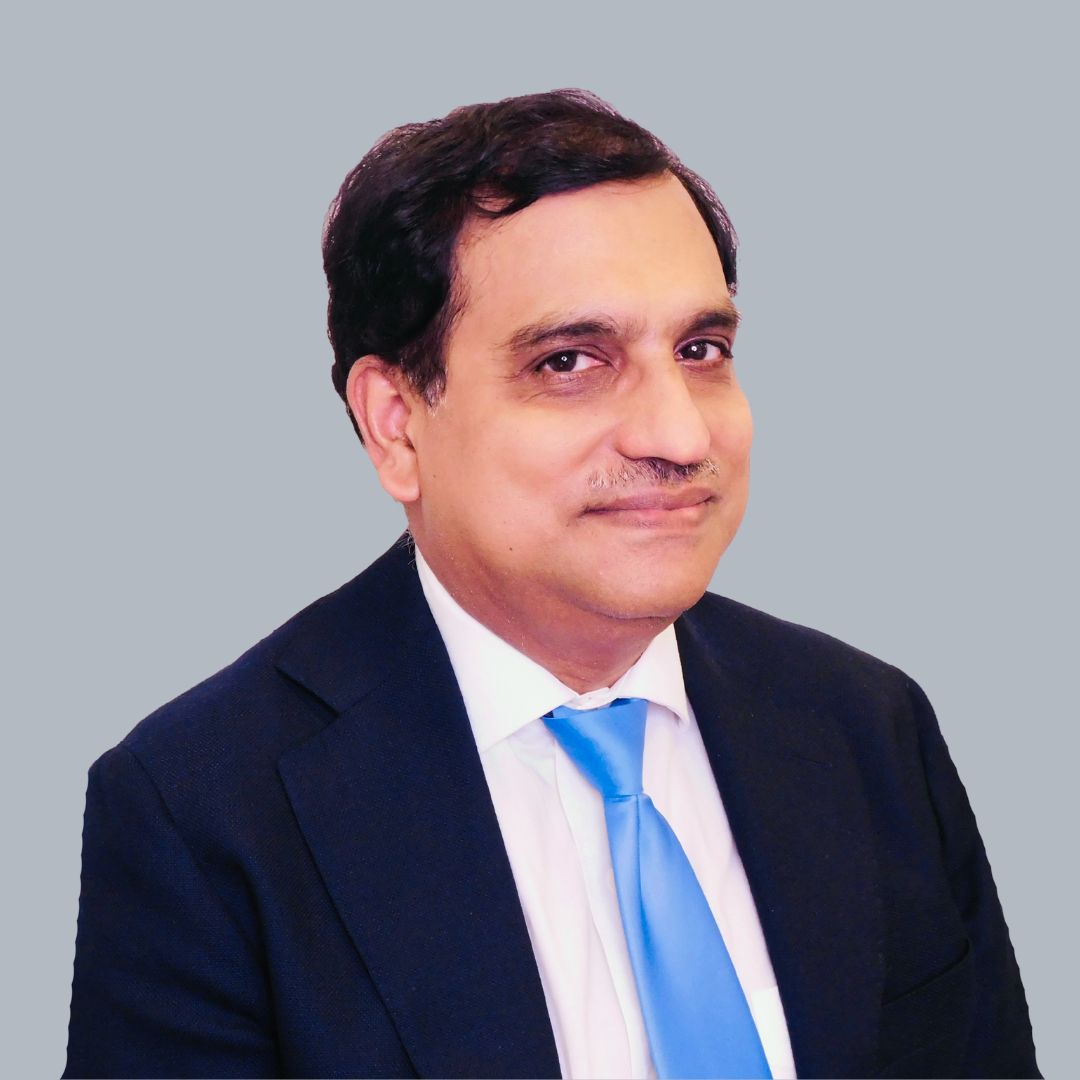
V.S. Subrahmanian is the Walter P. Murphy Professor of Computer Science at Northwestern University and a Faculty Fellow at the Northwestern Buffett Institute for Global Affairs. His research focuses on AI-driven solutions for security challenges, including forecasting terror attacks, preventing poaching, and analyzing social media threats. Education includes a PhD and MS in Computer Science from Syracuse University (NY) and an MSc (Tech.) from Birla Institute of Technology and Science (India). Research interests span AI applications in cybersecurity, predictive modeling for security policy, and machine learning for geospatial/social network analysis. Recent work addresses deepfakes, banking crisis forecasts, and airline profit optimization. Notable publications include works on Android malware detection, adversarial attack defenses, and geospatial conflict analysis. His research has influenced international security policies and industry practices. No scientific awards are listed in the provided text. Advising/grants information appears incomplete in the source material. Active involvement in multidisciplinary teams tackling global security challenges is implied through his institutional affiliations.
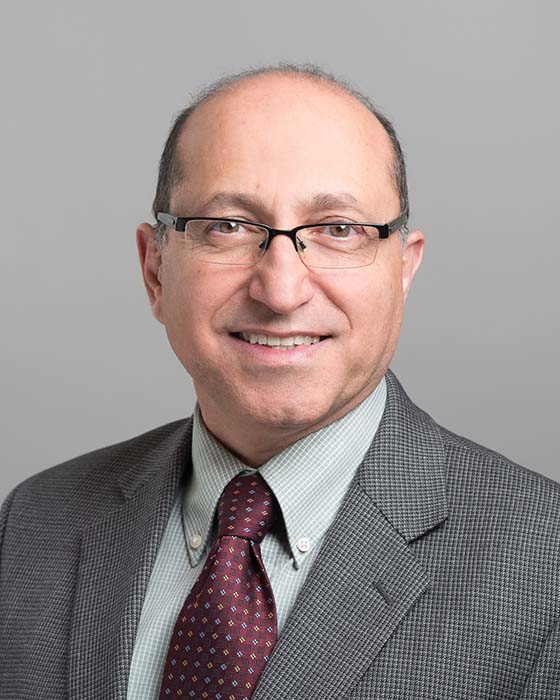
Nidhi Rastogi is an Assistant Professor at the Department of Software Engineering within the Golisano College of Computing and Information Sciences (GCCIS) at Rochester Institute of Technology (RIT). She leads the AI4Sec Research Lab, which focuses on data-driven AI solutions for cybersecurity, emphasizing interpretability and practical applications. Her research interests span Cyber Threat Intelligence, Artificial Intelligence, Graph Analytics, and Healthcare Analytics. Education: Ph.D. in Computer Science (2018), Rensselaer Polytechnic Institute M.S. in Computer Science (2008), University of Cincinnati Bachelor of Information Technology (2003), University of Delhi Research Interests: Transdisciplinary work in cybersecurity, AI, heterogeneous networks, and graph analytics. She develops systems for threat intelligence, explainable AI, and security monitoring. Notable projects include the CyNER library for cybersecurity NER, TINKER framework for open-source CTI, and personal health knowledge graphs. Awards & Mentoring: Students advised include Le Nguyen (1st place at UPSTAT23), Tanvirul Alam (IEEE SP Travel Grant), and Dipkamal Bhusal. Recent recognitions include program committee roles for ACM CCS'24 and ACSAC'24. Labs & Collaborations: The AI4Sec Lab collaborates with federal agencies, national labs, and enterprises. Current projects address autonomous vehicle security, healthcare analytics, and systemic cyberattack detection using graph-based methods.
Hayretdin Bahsi is an Assistant Professor at the School of Informatics, Computing, and Cyber Systems at Northern Arizona University . His research focuses on cybersecurity, with expertise in malware detection, IoT security, and machine learning applications in defense mechanisms. He collaborates internationally on maritime cybersecurity, healthcare systems, and critical infrastructure protection. Research Interests include Android malware analysis, botnet detection, explainable AI in intrusion detection, and threat modeling for AI-driven systems. His work addresses challenges like concept drift in malware detection and privacy-preserving techniques for IoT networks. Publications span 66 scholarly works since 2009, emphasizing cybersecurity trends in AI, IoT, and healthcare. Recent contributions explore large language model (LLM) applications in vulnerability detection and cyber threat modeling for healthcare systems. Collaborations include projects on maritime cyber-insurance, cyber incident management in low-income countries, and datasets like MedBIoT for IoT botnet analysis. His work bridges theory and practice, addressing real-world cybersecurity challenges.
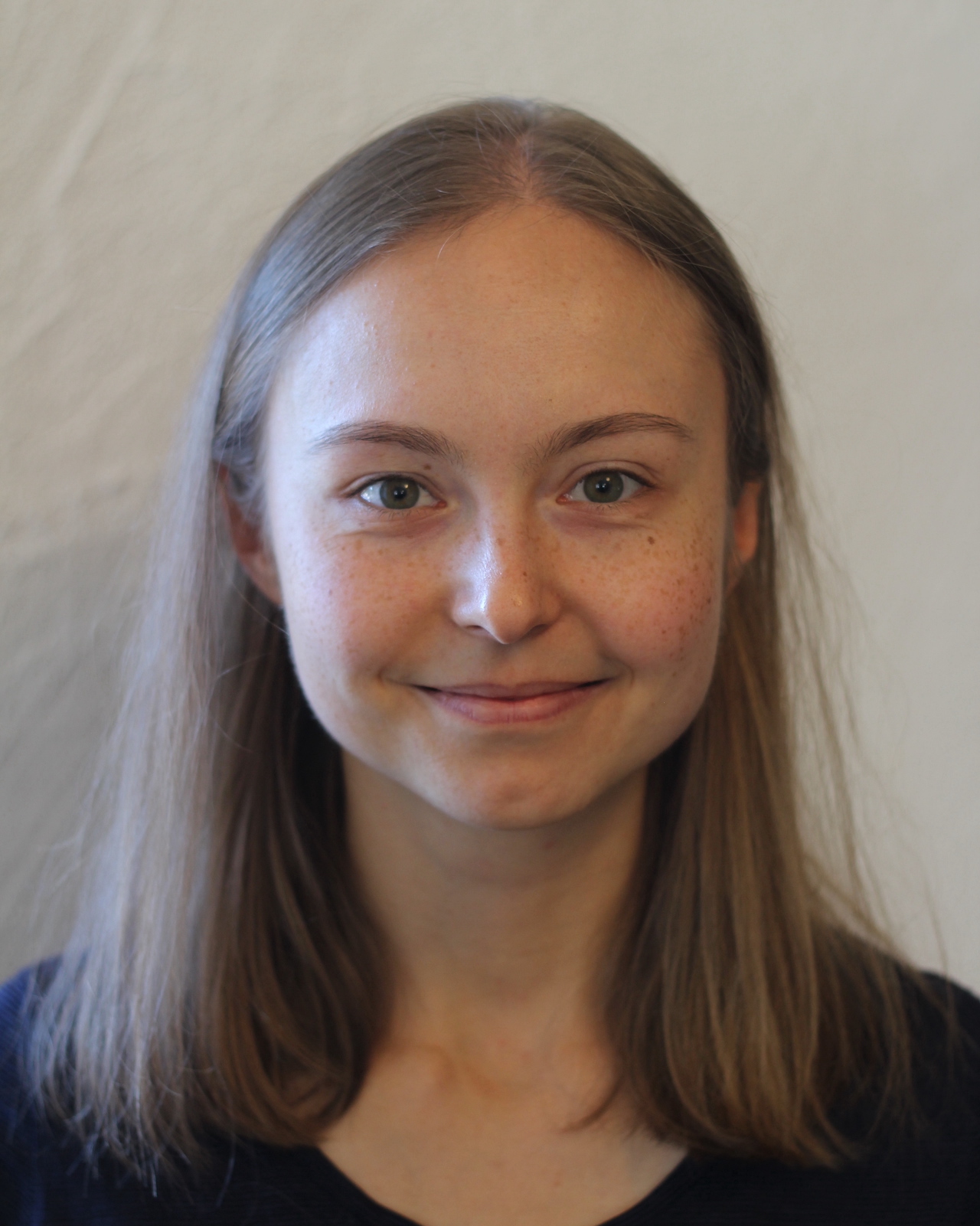
Karthik Dantu is an Associate Professor in the Department of Computer Science and Engineering at the University at Buffalo, State University of New York, within the School of Engineering and Applied Sciences. His research focuses on mobile sensor networks, robot networks, networked embedded systems, mobile computing, wireless networks, and embedded operating systems. He leads the Distributed Robotics and Networked Embedded Sensing (DRONES) Lab and has received significant funding including an NSF CAREER Award. Dr. Dantu's educational background includes: PhD in Computer Science from University of Southern California (2009) BE in Computer Science from Sri Jayachamarajendra College of Engineering (1999) His research interests center on algorithmic and systems challenges in Edge Computing Systems, with particular focus on enabling seamless vision sensing in cloud-edge environments. Dantu's work bridges mobile systems and robotics, developing novel approaches for UAV software, visual SLAM, and distributed sensing. His research addresses critical challenges in resource-constrained environments, security, and real-time performance for mobile and robotic systems, with emphasis on practical implementations that solve real-world problems in autonomous systems. Dr. Dantu's publication record shows a strong trajectory in mobile systems and robotics research, with increasing focus on edge computing applications for visual sensing. His recent work demonstrates expertise in adapting visual SLAM to edge environments, securing mobile systems through technologies like Rushmore, and developing novel approaches for UAV software reliability and depth sensing. The research spans theoretical algorithms and practical system implementations, with particular strength in bringing academic research to practical applications in robotics and mobile computing. Dr. Dantu has received several scientific honors: NSF CAREER Award on Enabling Seamless Vision Sensing in Cloud-Edge Systems Outstanding service award from the Office of International Services NSF Travel Grant for SenSys 2005 Conference Travel Grant for SIGCOMM 2002 As an advisor, Dr. Dantu has mentored numerous PhD students to completion, with graduates now working at companies like Samsung Research and Zoox Inc., or continuing academic careers as Assistant Professors. His research is supported by substantial grants including a DARPA OFFSET Sprint 4 award ($470k), an NSF CAREER award ($550k), and multiple NSF collaborative grants totaling over $1.5 million. He serves on numerous conference committees including Mobicom, MobiSys, and ICRA, demonstrating leadership in the mobile systems and robotics research communities. Dr. Dantu leads the Distributed Robotics and Networked Embedded Sensing (DRONES) Lab at UB, which focuses on developing algorithms and systems for mobile sensor networks, robot networks, and embedded sensing applications. The lab's work spans theoretical foundations to practical implementations, with particular expertise in UAV systems, visual SLAM, and edge computing for robotics, maintaining strong collaborations with industry partners and other academic institutions to advance the state of the art in mobile and robotic systems.
Dr. Mohammad Iftekhar Husain is a Professor and Graduate Coordinator in the Department of Computer Science at California State Polytechnic University, Pomona (Cal Poly Pomona). He serves as the Inaugural Director of the PolySec Cyber Lab, a federally funded center for cyber security and forensics education, research, and outreach (~$2.5M in grants), and directs the university's Virtual Reality Lab. His career spans over a decade of leadership in cyber security program development, extramural funding, and academic governance. Education: B.S., Computer Science, Yamagata University (Japan) M.S. & Ph.D., Computer Science and Engineering, SUNY-Buffalo Dr. Husain's research focuses on data privacy in social networks, neurophysiological cyber security solutions, and blockchain applications. He has secured $18.4M in principal investigator grants, including NSF SFS, EAGER, and REU Site projects, and trained students placed in top institutions like UC campuses, MIT Lincoln Lab, and government agencies such as NSA and DHS. His work on brainwave authentication earned a US patent (USPTO 10,198,566) and media coverage in Time Magazine and PC Magazine . Scientific Awards: 2016 College of Science Distinguished Teaching Award Early Promotion and Tenure (2016) 2020 Faculty Learning Community for Leadership Pipeline Development Cohort As academic leader, he founded the Cal-Bridge CS Ph.D. pathway program for underrepresented students, chairs the CPP Academic Senate Academic Programs committee, and led university IT initiatives including Cyber Security Cluster Hiring and High-Performance Computing Lab development.
Shahrokh Valaee is a Professor and Associate Chair for Undergraduate Studies in the Edward S. Rogers Sr. Department of Electrical and Computer Engineering at the University of Toronto, part of the Faculty of Applied Science and Engineering. He founded and directs the Wireless and Internet Research Laboratory (WIRLab). Education: BSc and MSc in Electrical Engineering from University of Tehran PhD in Electrical Engineering from McGill University Research Interests: Focuses on wireless networks (vehicular/sensor networks, B5G/6G), signal processing (indoor localization, machine learning for medical imaging), and integrated sensing/communication. His work spans: Localization in GPS-denied environments Machine learning for healthcare with limited/imbalanced data Reconfigurable Intelligent Surfaces (RIS) and drone networks Publications: Recent articles (2014-2016) show strong focus on indoor localization techniques, vehicular network protocols, and network coding, with emerging trends in machine learning applications for wireless systems and healthcare. Awards: Connaught Award (2012, 2013) NSERC Discovery Accelerator Award (2010) MaRS Innovations cPOP Award (2012) IEEE Fellow (FIEEE) Engineering Institute of Canada Fellow (FEIC) Leadership: Advises graduate students at WIRLab, where research combines theory with practical implementation (GPU-based ML, Android localization). Manages projects in integrated sensing/communication, ML for health, and B5G networks. Labs/Teams: Directs WIRLab with focus on wireless signal processing, networking, and ML implementations. Current team includes postdocs and PhD students working on localization, B5G networks, and medical ML applications.
Aravind Machiry is an Assistant Professor at Purdue University's Electrical and Computer Engineering Department and a founding member of the Purdue Systems and Software Security (PurS3) Lab . His research focuses on system security, particularly vulnerability detection, prevention, and secure system development using static/dynamic program analysis, fuzzing, type systems, and machine learning. Designing practical solutions for software and embedded system security Recipient of NSF CAREER and Amazon Research awards Active participant in SPLASH 2025 as OOPSLA Review Committee member His recent work includes automated vulnerability detection in embedded software, spatial memory safety enhancements, and security analysis of GitHub workflows. He has received recognition for his research through multiple distinguished paper awards and industry funding. Selected scientific awards include NSF CAREER Award (2024) Amazon Research Award (2022) Test of Time Award at FSE 2023 for DynoDroid Distinguished Paper Award at OOPSLA 2022 for 3c Qualcomm Innovation Fellowship (2025) His research team has developed frameworks like ARGUS for taint analysis of CI/CD workflows and FuzzUEr for UEFI interface fuzzing, discovering hundreds of critical vulnerabilities in open-source projects and thousands of command injection flaws in GitHub repositories.
Dr. Lenka Mareková is a postdoctoral researcher in the Applied Cryptography Group at ETH Zürich. Previously, she completed her PhD in the Information Security Group at Royal Holloway, University of London, supervised by Martin R. Albrecht. Affiliation: ETH Zürich - Department of Computer Science Cryptographic analysis of secure messaging platforms Research focus on end-to-end encryption and real-world security implementations Her research interests span cryptographic protocol analysis, secure communication systems, and privacy-preserving technologies. The 10 most recent publications in her DBLP profile reflect expertise in: Secure messaging protocols (Telegram, Delta Chat) Cloud storage security (MEGA analysis) E-voting systems (Zerovote, E-cclesia) Mobile security frameworks (Android policy enforcement) Mesh network vulnerabilities Current work appears to focus on practical cryptographic implementations and their real-world security implications. Contact via hi@lenka.sh or lenka.marekova@inf.ethz.ch .
Abhik Roychoudhury is a Provost's Chair Professor of Computer Science at the National University of Singapore (NUS), leading the Trustworthy and Secure Software (TSS) research group since 2001. His work focuses on automated program repair, software testing, security, and agentic AI. He is a Senior Advisor at SonarSource following the acquisition of his startup AutoCodeRover. He holds an ACM Fellowship and has received the ICSE Most Influential Paper Award for program repair research. Education: M.S. and Ph.D. in Computer Science from State University of New York at Stony Brook (1997-2000). Research interests include program analysis, software security, and AI-driven software engineering. His team has pioneered techniques like SemFix and Angelix for program repair, and AFLNet for protocol fuzzing. He has served as editor-in-chief of ACM TOSEM and conference chair for ICSE and FSE. Awards include the NUS Outstanding Graduate Mentor Award (inaugural recipient) and IEEE New Directions Award. His work bridges academia and industry, with contributions to projects like the DesCartes initiative for critical urban systems. Key collaborations include Microsoft on API repair and IBM on AI research centers. His recent focus includes agentic AI for software engineering, reflected in AutoCodeRover's acquisition by SonarSource.
Prof. Dr. Johannes Kinder is a Professor and Chair of Programming Languages and Artificial Intelligence at the Institute of Informatics , Ludwig Maximilian University of Munich. His research focuses on software security through program analysis and machine learning, particularly targeting malware detection , vulnerability analysis , and reverse engineering . He has held faculty positions at Royal Holloway, University of London, and Bundeswehr University Munich. Research Interests include: Securing software systems via program and machine learning techniques Detection of software vulnerabilities and malware Preventing exploitation through binary analysis Applications of formal methods in systems security Recent Publications highlight advancements in binary function embedding , malware detection in npm , and speculative execution attack modeling . His work appears in top venues like USENIX Security and IEEE S&P . Education : Diplom from TU Munich (2005), Doctorate from TU Darmstadt (2010). Professional Roles : General Chair, ACM CCS 2019 Doctoral Symposium Chair, ESSoS 2016 Program Committee member for NDSS 2026, IEEE S&P 2022-2025
Byungwoon Park is a Professor in the Department of Aerospace Engineering at Sejong University, specializing in Global Navigation Satellite Systems (GNSS) and precision positioning technologies. His research focuses on advancing navigation systems through innovations in Real Time Kinematics (RTK), smartphone sensor integration, and aviation applications. Professor Park's primary research interests include Global Navigation Satellite System (GNSS), Real Time Kinematics (RTK), smartphone sensor integration, aviation navigation, and urban positioning systems. His work has significantly contributed to improving positioning accuracy in challenging environments such as urban canyons and deep urban areas. He has developed techniques for achieving sub-meter accuracy in smartphone positioning and has made substantial contributions to international GNSS standardization efforts. His recent research has focused on multi-constellation GNSS integration, lunar navigation systems, tropospheric error modeling using LEO satellites, and advanced smartphone positioning techniques. Professor Park has successfully implemented methods to achieve 1m horizontal accuracy in Android smartphone positioning using SFMC SBAS and has developed Compact Network RTK technology that reduces bandwidth requirements for GPS correction in 100x100 km areas to 700bps. 'Google Smartphone Decimeter Challenge 2022' Gold Medal Third Place Winner of the Smartphone Decimeter Challenge (2024) Professor Park leads the Navigation Systems Laboratory at Sejong University, which conducts research on various navigation systems including GNSS. His work spans theoretical research, practical implementation, and industry collaboration, with numerous publications in prestigious journals and conference proceedings. He has advised multiple graduate students and has been actively involved in both domestic and international research collaborations focused on advancing navigation technologies.
Andrea Continella is an Associate Professor at the Faculty of Electrical Engineering, Mathematics and Computer Science of the University of Twente, where he contributes to the International Secure Systems Lab (iSecLab). His research focuses on systems security, particularly embedded firmware security, Android app security, malware detection, and program analysis techniques for vulnerability discovery. Ph.D. in Computer Science and Engineering, Politecnico di Milano (cum laude) Postdoctoral Researcher, Computer Science Department, UC Santa Barbara Visiting Researcher, School of Computer Science, University of Sydney Key research contributions include: Developing automated analysis techniques for embedded firmware (KARONTE, ShieldFS) Creating privacy leak detection mechanisms for mobile applications Designing ransomware defense systems using self-healing filesystems Advancing IoT security through misconfiguration detection (S3 buckets) and protocol analysis Pioneering semi-supervised methods for network traffic fingerprinting (FlowPrint) Scientific awards: Dutch Cyber Security Best Research Paper Award 2024 Runner-up USENIX Security Distinguished Reviewer Award 2024 Professional activities: Keynote speaker on firmware security (2024) Member of IPN Cyber Security Special Interest Group Oral presentations on automated vulnerability research (2023)
Lianying Zhao is an Associate Professor in the School of Computer Science at Carleton University and serves as a Director of the Carleton Computer Security Lab (CCSL). His research focuses on low-level platform security, including hardware, firmware, hypervisor, and operating systems, with an emphasis on trusted computing, authentication, privacy preservation, and security metrics. He leads the CCSL research group, collaborating with interdisciplinary teams to address critical security challenges in IoT, cloud systems, and web applications. Education: Not explicitly listed in provided texts. Roles: CCSL Director, Research Supervisor, and Graduate Program Advisor. Dr. Zhao’s work spans hardware security improvements, firmware vulnerability analysis, and user-centric security metrics. Recent research highlights include studies on router configuration habits, tracker detection in web browsers, and CVSS score discrepancies. He has supervised numerous graduate students in cybersecurity domains, contributing to over 30 peer-reviewed publications since 2013. His lab affiliations include CCSL and CISL, where he collaborates on projects such as secure deletion frameworks, TLS validation vulnerabilities, and hybrid decision-making models for cloud security. Current research also explores cross-regional login throttling mechanisms and AI-driven vulnerability detection in embedded systems.
Alexandru G. Bardas is an Associate Professor at the University of Kansas in the Department of Electrical Engineering & Computer Science (EECS) and the Institute for Information Sciences (I2S) . He received his PhD from Kansas State University under advisors Xinming (Simon) Ou and Scott A. DeLoach. His research focuses on cybersecurity from a systems perspective , including moving target defenses, security operations center (SOC) metrics, DevOps security, power grid cybersecurity, and defensive technologies for political activists. He explores UDP-based DDoS detection, DNS traffic analysis, and the intersection of AI with cybersecurity, emphasizing foundational knowledge over tool-specific training. Key research areas: Cybersecurity, Systems Security, Moving Target Defenses, SOC Metrics, DevOps Security Recent publications in ACSAC 2024 , USENIX Security 2024/2023 , and IEEE Security & Privacy 2022 Dr. Bardas has received significant recognition including: NSF CAREER Award (2022) for SOC automation Bellows Scholar (2021) at KU NSA SoS Honorable Mention (2023) He actively advises students across disciplines, with graduates now at Sandia National Laboratories , Blue Cross Blue Shield , and Pacific Northwest National Laboratory . Dr. Bardas participates in NSF grant reviews , serves on program committees for SOUPS and MILCOM , and leads outreach initiatives like the GenCyber Summer Camp .
Dr. Panagiotis Andriotis is a Lecturer in Computer Science at the School of Computer Science, University of Birmingham, within the College of Engineering and Physical Sciences. He is also a GIAC Certified Forensic Examiner (GCFE, GASF) and a Senior Fellow of the Higher Education Academy (SFHEA). His interdisciplinary research spans Cyber Security, Human Factors, and Mobile and Ubiquitous Computing. He teaches courses in Computer Science, Cyber Security, and Digital Forensics. His educational background includes a PhD in Computer Science from the University of Bristol (2016), an MSc with Distinction in Computer Science from the same institution (2011), and a BSc in Mathematics from the National and Kapodistrian University of Athens (2004). Dr. Andriotis’s research interests focus on user-centered security, particularly in mobile environments. He investigates how users interact with Android’s permission systems, develops novel authentication mechanisms like Bu-Dash, and explores adversarial machine learning in cybersecurity. His work bridges technical and human aspects, aiming to improve both system robustness and user experience. His recent publications reflect a strong trend in adversarial machine learning, mobile malware detection, usable privacy, and the societal implications of AI in education. He has contributed to high-impact journals such as IEEE Transactions on Cybernetics, ACM Transactions on Privacy and Security, and Elsevier’s Journal of Information Security and Applications. Best Paper Award at HCI International 2020 Impact Award, UWE Bristol Student Union GIAC Certified Forensic Examiner (GCFE) GIAC Advanced Smartphone Forensics (GASF) SANS Lethal Forensicator Coin Dr. Andriotis has advised PhD students, including Andrew McCarthy, and has been involved in funded research projects such as those related to fuzzing, software security, and critical infrastructure protection in collaboration with Airbus. He has served as an External Examiner at Cardiff Metropolitan University and is currently on the editorial boards of Digital Threats: Research and Practice (ACM) and the Journal of Responsible Technology (Elsevier). He has held visiting roles at the National Institute of Informatics in Tokyo, including as a JSPS Fellow and Toshiba Fellow. He leads research in digital forensics and security, with a lab focus on mobile ecosystems, behavioral modeling, and AI-driven threat detection. His team explores both technical and human dimensions of cybersecurity, contributing to tools and frameworks that enhance mobile security and user awareness.