Andrew Connor is a Senior Lecturer in Archaeology and Ancient History at Monash University. He specializes in Ptolemaic and Roman Egypt, papyrology, and the social and religious history of ancient Egyptian communities. His research focuses on Egyptian temples during the Roman period, ancient economic practices, and the editing and publication of documentary papyri. Connor has particular expertise in the Fayum depression and Dakhleh Oasis regions. Connor's publications demonstrate a consistent focus on Egyptian religious institutions, economic systems, and textual evidence from archaeological sites. His recent work includes publications on temple administration, Greek papyri, and digital archaeology. He has received multiple teaching awards including the Faculty Citation for Outstanding Contribution to Student Learning (2017), Faculty Citation for Overseas Programs (2018), and Vice Chancellor's Citation for Outstanding Contribution to Student Learning (2018). Connor teaches courses on Greek and Roman history, archaeology, and ancient languages at both undergraduate and postgraduate levels. He serves as Honours Coordinator for the School of Philosophical, Historical, and International Studies.
Laurent Bricault is a Professor of Roman History at the University of Toulouse Jean Jaurès, affiliated with the ERASMUS research team (Reception of Antiquity: Sources, Memory, Issues) under the Heritage, Literature, History (PLH) unit. His academic career spans institutions like the University of Poitiers (Master's 1986), Sorbonne (Doctorate 1994, HDR 2006), and Toulouse (since 2008). He specializes in the history of ancient religions, particularly Egyptian cults in the Roman world, provincial coinage, and Lagid/Roman Egypt. University of Poitiers - Master's in Ancient History (1986) Sorbonne - Doctorate in Egyptology (1994) Sorbonne - Habilitation to Direct Research (2006) Bricault's research explores the diffusion of Isiac cults, religious syncretism, and numismatic evidence for ancient beliefs. His recent publications focus on Mithraic studies, Egyptian deities in the Mediterranean, and domestic religious practices. He organizes international conferences and edits the Bibliotheca Isiaca series, contributing to the understanding of polytheistic traditions. Bricault co-edits the Supplements to the Bibliotheca Isiaca and collaborates on the Roman Provincial Coinage project. He curated the international exhibition Rome and the Mystery of Mithra (2021-2023) and maintains the RICIS online database for Isiac cult inscriptions. His work bridges epigraphy, numismatics, and cultural history to analyze religious networks across the Roman Empire.
Piotr Głogowski is a researcher at the Institute of History, University of Wrocław, specializing in ancient epigraphy and Near Eastern studies. His work bridges the Hellenistic, Roman, and Persian periods, with a focus on the Levant and Phoenicia. Education: BA & MA in History and Classical Philology (University of Wrocław, 2012-2015); Erasmus exchanges at Bilkent University (2013/2014, 2016/2017); PhD in History (University of Wrocław, 2021). Research areas include ancient epigraphic cultures, Phoenician identity, Achaemenid Persia, and Greco-Persian military dynamics. His publications analyze inscriptions as cultural markers and explore historical narratives in Diodorus. Notable grants: Principal investigator for the National Science Center's Preludium project (2021-2024) on Near Eastern epigraphic culture, and internal grants for studies on Phoenician regional identity and Cappadocian politics. Scientific Awards: Gerda Henkel Foundation Scholarship (2020)
M. Rahim Shayegan is a prominent scholar in Iranian and Near Eastern studies, specializing in Old and Middle Iranian philology, Achaemenid-Sasanian history, and Greco-Roman-Iranian cultural interactions. He holds a PhD from Harvard University and has conducted postdoctoral research at the University of Göttingen and Sorbonne. His work bridges philology, epigraphy, and historical analysis to explore ancient political ideologies, religious traditions, and cross-cultural exchanges. Education: PhD, Iranian Philology & Ancient History, Harvard University MA, Iranian Philology, Sorbonne University BA, Philosophy & Comparative Philology, University of Cologne Research Interests: Iranian epigraphy and royal inscriptions Political dynamics of pre-Islamic Iranian empires Greco-Roman and Iranian cultural dialogues Zoroastrianism and ancient Near Eastern religions His publications include seminal works like Arsacids and Sasanians: Political Ideology in Post-Hellenistic Persia (2011) and Cyrus the Great: Life and Lore (2019). He has held prestigious fellowships at the Guggenheim Foundation and is a member of the Austrian Academy of Sciences. Awards: Ehsan Yarshater Book Award (2012) Academia Europaea Membership (2019–) Courses Taught: Achaemenid Civilization Sasanian History Old Persian Cuneiform Zoroastrianism and Ancient Religions
Professor D Graham J Shipley is the Professor of Ancient History at the University of Leicester's School of Archaeology and Ancient History since 2002. His research focuses on Hellenistic and Classical antiquity, particularly on political landscapes, environmental studies, and urban planning. He holds a D.Litt. from the University of Oxford (2020) and is a Senior Fellow of the Higher Education Academy (2014). Education: Graduated in Classics from Oxford University. Academic roles include serving on the Oxford Classical Texts Committee and the UK Education Honours Committee. Previously chaired the Council of University Classical Departments and convened the Dorothy Buchan Memorial lectures. Research interests emphasize ancient geography, socio-political structures, and environmental interactions. His work spans studies of Sparta, Greek urban planning, and the cultural impact of Hellenistic expansion. Recent publications examine Pseudo-Skylax's geographical texts and post-Alexandrian political dynamics. Scientific Awards: Senior Fellow of the Higher Education Academy (2014) D.Litt. (Doctor of Letters) from University of Oxford (2020) Advising and Grants: No specific advisees listed, but supervises research in ancient history and archaeology. Active in collaborative projects such as the Laconia Survey. Grants have supported archaeological fieldwork and publication initiatives. Labs/Teams: Collaborates with the Oxford Classical Texts Committee and has led interdisciplinary teams in regional archaeological surveys.
Kai Brodersen is a Professor of Ancient Culture at the University of Erfurt (since 2008) and a Full Professor of Ancient History at the University of Mannheim (since 1996/97). He previously served as Vice-Rector at the University of Mannheim and President of the University of Erfurt (2008–2014). Brodersen has held visiting professorships at Newcastle upon Tyne, St. Andrews, Royal Holloway, Oxford, and UWA Perth, and has been an honorary lecturer at the University of Sibiu since 2014. He was a Senior Fellow at the Wissenschaftskolleg Greifswald (2019/20). Born in 1988, with four children and four grandchildren ORCID: 0000-0003-1202-7625 His research spans ancient history, historiography, geography, rhetoric, mythography, paradoxography, Septuagint studies, ancient jokes, inscriptions, curse tablets, early Greek and Hellenistic history, Roman provinces, gender dynamics in antiquity, and the history of science and reception (including Asterix). He has contributed to children's literature and has a particular focus on applied sciences in antiquity.
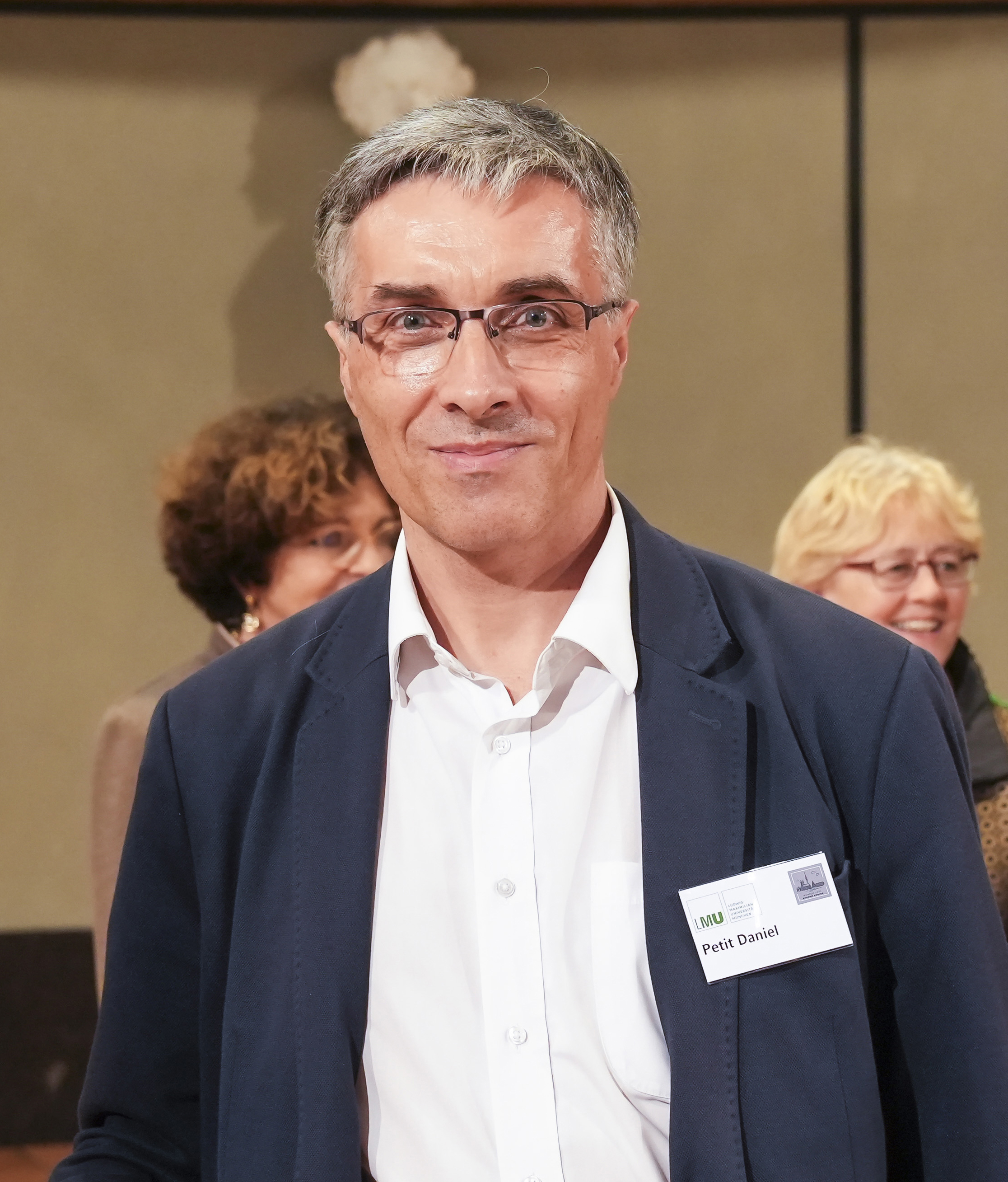
**Daniel Petit** is a **Full Professor of Indo-European Linguistics** at the **École normale supérieure (ENS)** since 2003 and **Director of Studies in Baltic and Indo-European Linguistics** at the **École pratique des hautes études (EPHE)** since 2011. He holds a PhD in Greek Linguistics (1996) and a Habilitation in Baltic Linguistics (2002), both from Paris-Sorbonne Université. His research focuses on historical syntax, comparative grammar of Indo-European languages, Baltic linguistics, and the history of comparative linguistics. **Education**: PhD in Greek Linguistics, Paris-Sorbonne Université (1996) Habilitation in Baltic Linguistics, Paris-Sorbonne Université (2002) Agrégation de Grammaire (1st rank, 1990) Multidisciplinary background including classics, Lithuanian, and Greek linguistics. **Research Interests**: Explores syntactic evolution in Indo-European languages, Baltic language structures, and the historical development of comparative linguistics. Specializes in Latvian, Old Prussian, Ancient Greek, and Lithuanian linguistics and philology. **Awards**: Correspondent member of the Académie des Inscriptions et Belles-Lettres (2021) Vice-chair of the Indogermanische Gesellschaft (2016-2021) Chevalier des Palmes Académiques (2011) **Advising & Leadership**: Supervised 9 PhD students (4 defended, 5 ongoing) and served on 28 doctoral committees. Organized 15 international conferences. Currently serves as Secretary (Chief Editor) of the *Bulletin de la Société de Linguistique de Paris* since 2017.
Dominic Goodall is a Director of Studies at the French School of Asian Studies (École française d'Extrême-Orient), specializing in Sanskrit Philology, History of Śaivism, and Epigraphy. Based at the Pondicherry Research Center in India, he has been a member of the EFEO since 2000 and previously served as Director of the Pondicherry Center from 2002 to 2011. His academic journey began with studies in Greek and Latin at Pembroke College, Oxford, followed by Sanskrit (BA with Pali, 1990), and medieval Tamil at the University of Hamburg (1990-1991). He completed his doctorate at Wolfson College, Oxford under Professor Alexis Sanderson on the theological school of Śaivasiddhānta in 10th-century Kashmir. Goodall's research focuses on the critical edition and translation of previously unpublished Śaiva scriptures and theological commentaries, particularly from South India. His scholarly work bridges Sanskrit philology with epigraphic studies of Southeast Asia, especially Cambodia. He has made significant contributions to understanding the transmission of Śaiva Siddhānta traditions across South and Southeast Asia through textual analysis of both manuscripts and inscriptions. His publication record demonstrates a consistent focus on early Śaiva Tantric literature, particularly the Niśvāsatattvasaṃhitā as the earliest surviving Śaiva Tantra. Goodall has pioneered the study of Cambodian inscriptions in Sanskrit, revealing important connections between Indian religious traditions and Khmer civilization. His work shows a methodological commitment to rigorous textual criticism combined with historical and religious analysis. Foreign Corresponding Member of the Academy of Inscriptions and Belles-Lettres (2016) Co-editor of Tāntrikābhidhānakośa (Viennese dictionary of Hindu tantric terminology) Contributor to Encyclopaedia of Manuscript Cultures in Asia and Africa Goodall has supervised numerous research projects on South Asian manuscript cultures and epigraphy. His leadership in the Pondicherry manuscript project has been instrumental in preserving and making accessible important Sanskrit textual traditions. He has organized multiple international workshops on early Tantric traditions and regularly collaborates with scholars across Europe and Asia. Based at the Pondicherry Research Center, Goodall continues to direct the EFEO's efforts in documenting and analyzing South Asian religious traditions, with particular emphasis on Śaiva Siddhānta traditions as reflected in both manuscript and inscriptional evidence from India and Southeast Asia.
Nikolaos Stampolidis is a distinguished Professor of Classical Archaeology at the University of Crete, where he has served since 1984, progressing from Lecturer to full Professor since 1994. He currently holds multiple prestigious positions including Director-General of the Acropolis Museum (since June 2021) and Director of the Museum of Cycladic Art (since 1996). Previously, he served as Dean of the Faculty of Letters and Arts at the University of Crete (1994-1997) and Head of the Department of History and Archaeology (1991-1993). Stampolidis earned his undergraduate degree from the Aristotelian University of Thessaloniki (1970-1974), followed by postgraduate studies in Bonn, Germany (1975-1977) with a DAAD scholarship. He completed his dissertation in Athens (1978-1979) with a Greek government scholarship, achieving Magna cum laude distinction. His research focuses on Mediterranean interconnections during the Early Iron Age, with special emphasis on Cretan archaeology, particularly the Eleutherna site he has excavated continuously since 1985. His work spans homeric archaeology, Greek sculpture across multiple periods, epigraphy, funerary practices, and the dialogue between antiquity and contemporary art. His excavations at Eleutherna have revealed significant insights into geometric-archaic period customs and cultural exchanges across the Mediterranean. Stampolidis' scholarly output demonstrates a consistent focus on Mediterranean cultural networks, particularly between Crete, the Cyclades, Cyprus, and the Near East during the Early Iron Age through Hellenistic periods. His research combines meticulous excavation work with innovative interpretations of cultural interactions, often bridging archaeological evidence with literary sources like Homer. The recurring themes in his work include the analysis of funerary practices, the study of Mediterranean trade networks, and the examination of how cultural influences traveled across the ancient world. His numerous honors reflect his significant contributions to archaeology and Greek culture, including being named Honorary Citizen of Eleutherna (1995), receiving the Tourism Award for his contribution to Crete's development (2015), and being awarded the Grand Commander of the Order of Phoenix by the President of the Hellenic Republic (2016). Throughout his career, Stampolidis has supervised numerous graduate students through the Post-graduation program in Classical Archaeology at the University of Crete, which he directed since 2005 (previously co-directing from 1991-2005). His research has been supported by multiple funding sources including UNESCO, the University of Crete, the Institute of Mediterranean Studies, the Mediterranean Archaeological Society, various Greek Ministries, the INSTAP, and European Community programs including INTERREG IIIA and the 3rd European Community Support Framework. Stampolidis directs the long-term excavation and research project at Eleutherna, Crete, which has evolved into a major archaeological site with its own museum. His work at Eleutherna represents one of the most significant ongoing archaeological projects in Greece, combining excavation, conservation, publication, and public presentation of findings through both the on-site museum and numerous international exhibitions he has curated.
Paul Christesen serves as the William R. Kenan Professor of Ancient Greek History in the Department of Classics at Dartmouth College and holds a Life Fellowship at Clare Hall, University of Cambridge. His academic leadership includes chairing the Classics Department while maintaining active research and editorial commitments. Education B.A. from Dartmouth College M.A. from Columbia University M. Phil. from Columbia University Ph.D. from Columbia University His research integrates ancient Greek political systems with sport historiography , featuring groundbreaking work on Spartan society and Olympic victor lists. He pioneers geospatial methodologies through Geographic Information Systems to analyze archaeological settlement patterns, bridging traditional philology with digital humanities. Current projects examine sport's relationship to democratic development across historical eras. Christesen's publications reveal evolving focus from foundational Olympic chronology studies toward interdisciplinary analyses of sport's societal impact, increasingly incorporating digital archaeological approaches and comparative political frameworks. His editorial work shapes contemporary discourse in classical reception studies. Scientific Awards William R. Kenan Professorship (prestigious endowed chair) Life Fellowship at Clare Hall, University of Cambridge As an educator, Christesen teaches core courses including Classical Studies 1: Antiquity Today and specialized seminars on Greek athletics and Archaic history. His departmental leadership and editorial projects demonstrate significant institutional impact, though specific grant details and student mentorship records aren't provided in source materials.
Viktor Golinets is a Professor of Hebrew Linguistics at the Heidelberg University of Jewish Studies , where he has held the Chair of Hebrew Linguistics since 2018. Previously, he served as a Junior Professor at the same institution from 2012 to 2018. His academic journey includes a PhD in Ancient Near Eastern Studies from the University of Munich (2010) and a Magister degree in Semitics from Ludwig-Maximilians-Universität München (2004). Education: PhD (Altorientalistik, LMU Munich, 2010), Magister (Semitics, LMU Munich, 1997-2004) Professional Roles: Professor (Heidelberg University of Jewish Studies, since 2018), Junior Professor (Heidelberg University of Jewish Studies, 2012-2018), Scientific Assistant (University of Basel, 2007-2012) Golinets’ research focuses on the linguistic and textual history of the Hebrew Bible , ancient Bible translations , and historical grammar of Hebrew . He specializes in Masoretic studies, Semitic epigraphy, and comparative analysis of Northwest Semitic languages like Amorite, Aramaic, and Ugaritic. His work addresses textual criticism, biblical hermeneutics, and the evolution of Hebrew from Masoretic to modern usage. His publications and articles reveal a strong emphasis on Hebrew onomastics , epigraphic analysis , and the role of language in Jewish cultural identity . He has contributed to international colloquia on textual criticism and Semitic philology. Memberships: German Oriental Society, European Association of Biblical Studies, International Association for Comparative Semitics, Association of Judaists in Germany, and others Golinets serves as Deputy Rector at Heidelberg University of Jewish Studies and has collaborated on projects like the Hebrew-Greek Text-Critical Synopsis of the Book of Jeremiah and the Biblia Hebraica Transkripta. His expertise in Hebrew manuscripts and Semitic languages informs both his teaching and research.
Simon Swain is Professor of Classics and Greco-Arabic at the University of Warwick, concurrently serving as Vice-President (Engagement) at the university and Vice-President (Research and Higher Education Policy) at the British Academy. His leadership roles include former positions as Pro-Vice-Chancellor (International), Chair of the Faculty of Arts, and multiple terms as Head of the Department of Classics. His educational background includes: MA, Oxford (Pembroke College), 1980-1984 D.Phil., Oxford (Wolfson College), 1987 Swain's research centers on the reception of Greek thought in the Islamic Middle Ages and the social-cultural history of the Greek East during the Roman period. He investigates the transmission of ancient Greek science, medicine, and political thought into Islamic scholarship, employing interdisciplinary approaches that bridge Classics, History, and Islamic Studies. His work emphasizes textual transmission, cultural adaptation, and the socio-political contexts of knowledge transfer. Analysis of his publications reveals consistent engagement with Greco-Roman intellectual history and its Islamicate legacy. Key thematic trajectories include the evolution of medical knowledge from Galen to medieval Arabic texts, political theory in imperial contexts, and sociolinguistic dynamics of bilingualism. His editorial projects demonstrate increasing focus on cross-cultural transmission, particularly through critical editions of foundational texts like Ibn Abī Uṣaybiʿah's medical biographies. His honors include: Fellow of the British Academy (2015) Wellcome Trust Collaborative Investigator Award Swain supervises postgraduate research in Greek world studies, late antiquity, and Greco-Arabic scholarship. He has secured major funding from AHRC, Leverhulme, Wellcome, and EU bodies for collaborative projects examining ancient knowledge systems. Current initiatives like the "Streamlining Galen" project support early-career researchers while investigating how canonical medical texts were adapted for medieval Islamic pedagogy. He actively leads research collectives including the "Streamlining Galen" project team, which analyzes condensed medical texts that facilitated the teaching of Galenic medicine in medieval Islamic institutions. His collaborative approach extends to mentoring networks that connect Warwick with international scholars across Classics and Islamic Studies disciplines.
Peter O’Brien is an Assistant Professor of Classics in the King’s-Dalhousie Joint Faculty, with formal affiliations at both Dalhousie University and the University of King’s College. Holding degrees from the University of Windsor (BA Hons), Dalhousie (MA), and Boston University (MA, PhD), he has been a faculty member since 2001 after teaching at a Boston private school. Roles: Graduate Coordinator, King’s-Dalhousie Carnegie Professor, Public Orator (2011-present), Vice-President (2017-2021) Editorial: Co-Editor of Mouseion: Journal of the Classical Association of Canada Teaching: Specializes in Virgil, Ovid, Catullus, and late Roman history Research Focus: Literary analysis of Ammianus Marcellinus’ historiography, Virgilian allusions in late antiquity, and Neo-Latin literature with Canadian themes. His work spans classical formation, emotional rhetoric in Jesuit texts, and classical tradition in Atlantic Canada. Publications Trends: 15 recent works (2006-2019) demonstrate expertise in Latin historiography, Virgilian intertextuality, and Neo-Latin studies. Key themes include rhetorical analysis of imperial speeches, classical reception in colonial contexts, and sacred/secular dynamics in historical narratives. Scientific Awards: Recognized for teaching excellence and graduate advising (2006, 2007, 2010). Holds leadership roles in the Classical Association of Canada (Vice-President 2022-2024). Advising & Outreach: Served as graduate coordinator, contributed to Halifax Humanities 101 and Halifax Thinks community programs, and coordinated the Foundation Year Programme at King’s College.
Eleni Bozia is an Associate Professor of Classics and Digital Humanities at the University of Florida. She leads the Data-Driven Humanities Research Group and serves as Associate Director of the Digital Epigraphy and Archaeology Project, focusing on 3D digitization of cultural heritage and AI integration in humanities. Her research explores linguistic/cultural diversity in Imperial Greek/Latin literature and its intersections with modern globalism. Bozia holds dual doctorates from the University of Florida (2009) in Classical Studies and Universität Leipzig (2018) in Digital Humanities. Her scholarly work bridges classical studies with digital innovation, including computational analysis of ancient texts, virtual reality for experiential learning, and collaborative global preservation initiatives. Recognized with awards from La Fondation Hardt and the American Academy in Rome, her contributions span peer-reviewed articles, edited volumes, and public engagements like TEDx talks. She actively promotes interdisciplinary collaboration through roles in the Florida Digital Humanities Consortium and the Literary Encyclopedia. Bozia’s research portfolio includes groundbreaking books on Lucian’s works, multilingual practices in antiquity, and digital epigraphy. She advocates for reimagining classical pedagogy through technology, emphasizing accessibility and relevance for younger generations. Her lab’s projects like the Digital Rosetta Stone and 3D artifact preservation redefine how ancient knowledge is studied, shared, and experienced in the digital age.
Sophia Aneziri is an Associate Professor at the National and Kapodistrian University of Athens within the School of Philosophy and Department of History and Archaeology . Her academic career spans teaching and research in Ancient History and Greek Epigraphy, with a focus on the Hellenistic and Roman periods. Education: BA in History and Archaeology (1989), University of Athens; PhD in Ancient History and Greek Epigraphy (1997), Heidelberg University, supported by scholarships from Greece and Baden-Württemberg. Professional Appointments: Faculty member since 2004; previously adjunct faculty at Universities of Corfu, Crete, Thessaly, and Hellenic Open University; contract researcher at the National Research Center. Research Interests: Dr. Aneziri’s work bridges Greek Epigraphy, Ancient Economy, and the socio-religious dynamics of endowments. She explores female euergetism, professional associations (e.g., Dionysiac technitai), and legal-economic frameworks of perpetual foundations in antiquity. Publication Trends: Her recent articles (2025–2020) analyze endowments, ruler cults, and naming conventions in the Roman period. She emphasizes the intersection of economic practices, religious rituals, and institutional development across Greek and Hellenistic societies. Academic Contributions: She has presented at the XVI International Congress of Greek and Latin Epigraphy (2022) and contributed to Cambridge University Press volumes on professionalism and theater history.