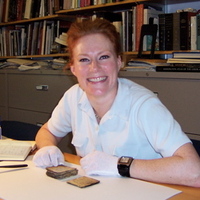
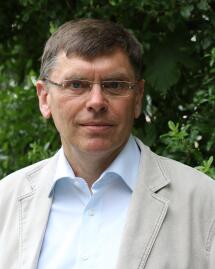
Christopher M. Chinn is a Professor of Classics at Pomona College since 2007, specializing in Augustan and Imperial Roman poetry. He teaches Latin and Greek languages alongside translation courses like Ancient Epic and Introduction to the Greeks and Romans . Research Focus: Roman poetry, ecocriticism, art-text relationships Key Contributions: Studies on Statius, Pliny, and intertextual analysis His work bridges visual art analysis with literary interpretation, particularly in Flavian-era texts. Recent publications address environmental themes in ancient Mediterranean literature and the evolution of ekphrastic techniques. Scientific Awards & Honors Jim Greenfield Dissertation Fellowship (University of Washington, 2001-2002) Downing-Pomona Exchange Fellow (2009) Pomona College Summer Research Grant (2011) His teaching includes advanced language courses and senior seminars on classical studies, reflecting his commitment to both pedagogy and research in ancient literature.
Nicole Julia Giannella serves as an Assistant Professor in the Department of Classics at Cornell University, affiliated with the College of Arts and Sciences, Medieval Studies Program, and Society for the Humanities. Her academic credentials include a Ph.D. in Classics from the University of Southern California (2014) and a B.A. in Political Science and Latin from Vassar College (2006). Dr. Giannella's research examines slavery, freedom, and ownership through Roman legal, literary, and philosophical lenses. Her monograph The Mind of the Slave: The Limits of Ownership in Roman Law and Society (University of Michigan Press) establishes foundational work in the field, while her current project investigates letters of enslavement. Key methodologies integrate legal analysis with literary criticism, particularly regarding Senecan ethics and Roman social hierarchies. Her 2019-2024 publications reveal consistent thematic focus on enslaved agency, legal personhood, and patron-freedman dynamics. Articles demonstrate interdisciplinary reach across Roman law, social history, and mobility studies, with recurring examination of trust mechanisms in slave societies and philosophical justifications for slave treatment. She actively participates in Cornell's Medieval Studies Graduate Association and Medieval Studies Student Colloquium, contributing to academic community building through reading groups and program development.
Professor Roy Gibson holds the position of Professor in the Department of Classics and Ancient History at Durham University, where he has been since September 2018. Previously, he served as Professor of Latin at the University of Manchester (1994–2018) and held roles at Sidney Sussex College, Cambridge, including Junior Research Fellow and Director of Studies in Classics (1992–94). He earned his BA (1987) and PhD (1993) in Classics from Cambridge. He is also a member of the Institute of Medieval and Early Modern Studies at Durham. His research focuses on Cicero’s Ad Familiares , Ovid, and Pliny the Younger. He co-directs the AHRC-funded Ancient Letter Collections project and offers school talks on ancient letters and letter collections, particularly Cicero and Pliny. Gibson has published extensively, including his acclaimed monograph Man of High Empire: the Life of Pliny the Younger (2020), and has been recognized as Chair of the Classical Association (UK) from 2013 to 2020. He supervises PhD students on topics such as Ovid, Roman love elegy, Augustan poetry, Pliny the Younger, Cicero’s Ad Familiares , and Roman epistolography. His work bridges textual analysis, historical context, and philosophical inquiry, reflecting his deep engagement with ancient literature and its cultural significance.
Christoph Hammann is a researcher at the Department of New Testament Studies within the Faculty of Protestant Theology at the University of Münster, working under Professor Eve-Marie Becker's chair since August 2022. He is currently completing his habilitation on "Authority, Power, and Rule in the Lukan Double Work: Exegetical Investigations of Luke's Ascending Christology Against the Background of Greek-Roman Biography, Historiography, and Epic" (2022-present). His research spans multiple interdisciplinary areas at the intersection of biblical studies, ancient philosophy, and cultural history. Hammann's primary interests include Pauline theology and epistolography, the Lukan works in Greco-Roman cultural context, the relationship between natural science and theology in early Christianity, philosophy of the Imperial Period and Late Antiquity, conceptions of history in the New Testament, and the beginnings of Christianity in Rome. His academic background combines classical philology (specializing in Greek studies) with Protestant theology, enabling unique cross-disciplinary approaches to biblical texts. Hammann's publication record reveals a consistent engagement with how early Christian texts interacted with and transformed contemporary Greco-Roman discourses on topics like purity, authority, and cosmology. His work often examines the philosophical and medical contexts of biblical concepts, particularly in relation to heart metaphors, sacrificial practices, and Christological development. DAAD Congress Travel Grant (2023) Publication subsidy for dissertation (2019) PhD Prize from Philipps-Universität Marburg (2019) Multiple international research grants from Evangelisches Studienwerk Villigst (2015-2018) Fondation Hardt research grant (2017) Hammann actively contributes to academic life through teaching undergraduate and graduate courses in New Testament exegesis (including Greek language instruction), organizing conferences such as the upcoming Colloquium Biblicum Lovaniense LXXIV on The Corinthian Letters (2025), and co-editing scholarly volumes like "Opfer in Antiochien" (2023). He serves on multiple academic committees and is a member of several scholarly societies including the Society of Biblical Literature (since 2025) and the Münster School of Ancient Cultures (since 2023). His research group within the Excellence Cluster "Religion and Politics" focuses on ancient cultural contexts of early Christianity, with particular attention to the intersections between biblical texts and Greco-Roman philosophical, medical, and political discourses. Hammann also leads student excursions to Rome to study early Christian sites and Pauline contexts.
Victoria Rimell is Professor of Latin and Director of Research in the Department of Classics at the University of Warwick, Faculty of Arts. She previously served as Associate Professor at Sapienza University of Rome and held research fellowships at University College Oxford and Cambridge. She joined Warwick in 2016 and was promoted to Professor in 2018. She also holds administrative roles including Deputy Head of Department and Coordinator of the joint degrees in Classics and English. Education: MA, King's College Cambridge MPhil, King's College Cambridge PhD, King’s College London MSc, University of Warwick Her research bridges Latin literature and Roman culture with modern philosophical and political thought, focusing on authors such as Seneca, Ovid, Martial, Petronius, and Horace from the first century BCE to the second century CE. She explores themes of space, enclosure, vulnerability, mourning, and identity, often engaging with critical theory, gender studies, and classical receptions. Her work frequently draws interdisciplinary connections to modern art, literature, and philosophy. The recent publications highlight a strong trajectory in Senecan studies, particularly on consolation, grief, and ethical self-fashioning, alongside continued engagement with Ovid, Martial, and Horace. The works reflect a deep integration of classical texts with contemporary theoretical frameworks, including psychoanalysis, feminist theory, and spatial theory. Topics such as the ‘labour of empire,’ ‘creative self-reproach,’ and ‘care of the other’ underscore her focus on emotional and ethical dimensions in Roman literature. Scientific Awards and Recognition: Member, Academia Europaea (2020) Leverhulme Trust Research Grant for 'Care of the Other: Senecan Consolation and the Work of Mourning' Victoria Rimell actively supervises PhD students on topics ranging from humanitas to adulatio and the disabled body in Martial. She has secured external research funding and serves on editorial boards for Classical Philology , MD , and The Journal of Roman Studies . She also contributes to interdisciplinary research through the Centre for Research in Philosophy, Literature, and the Arts. She teaches undergraduate and postgraduate modules on Latin literary texts, Roman laughter, vulnerable bodies, and ancient literature and thought. She leads a research group and collaborative projects on imperial space, the ancient novel, and Vergil and the Feminine (co-edited with Dr Elena Giusti). Her current Leverhulme-funded project continues to expand the dialogue between classical texts and modern ethical theory.
AnneMarie Luijendijk is the William H. Danforth Professor of Religion at Princeton University and Head of New College West , one of Princeton’s residential colleges, where she has served on the faculty since 2006. A leading papyrologist and historian of early Christianity, she specializes in the social history of Christianity in late-antique Egypt using both literary and documentary papyri. Education Ph.D., Harvard Divinity School, 2005 (New Testament and Early Christianity) Specialization in New Testament Studies, Vrije Universiteit Amsterdam (prior to Harvard) Research Interests Luijendijk’s scholarship bridges papyrology, early Christian studies, and social history. She investigates the everyday lives of early Christians through the papyrus letters and documents that survive from Roman and late-antique Egypt. Her current projects include: From Gospels to Garbage – a forthcoming monograph on the readers, owners, and eventual discard of the earliest Christian manuscripts; Papyrus acquisitions in the 1920s; Fashion, Footwear, and Faith in Late Antiquity – an exploration of dress, status, and religious identity. Her earlier work has illuminated Christian lot divination, the Gospel traditions in Oxyrhynchus, and the role of women and clergy in Egyptian communities. Selected Publications & Editorial Projects Greetings in the Lord: Early Christians and the Oxyrhynchus Papyri (Harvard University Press, 2008) Forbidden Oracles? The Gospel of the Lots of Mary (Mohr Siebeck, 2014) My Lots Are in Thy Hands: Sortilege and its Practitioners in Late Antiquity (co-edited with William E. Klingshirn, Brill, 2018) Re-Making the World: Christianity and Categories (co-edited, Mohr Siebeck, 2019) From Roman to Early Christian Cyprus: Studies in Religion and Archaeology (co-edited, Mohr Siebeck, 2020) Leadership & Service From 2013 to 2020 she chaired Princeton’s Committee for the Study of Late Antiquity , fostering interdisciplinary research across the humanities. She regularly organizes and participates in international workshops, including Princeton–Humboldt Strategic Partnership events, and has secured collaborative grants to advance papyrological research. No individual Ph.D. or master’s advisees are explicitly listed in the provided sources. Laboratories & Collaborations While no dedicated laboratory is mentioned, Luijendijk works closely with the Institute for the Study of the Ancient World (ISAW) at NYU, the Princeton Humanities Council , and international papyrology networks. Her research benefits from digital humanities resources such as the Papyrological Navigator and her Academia.edu profile, which has over 27,000 public views and ranks her among the top 2 % most followed scholars on the platform.
Lieve Van Hoof is a Research Professor (BOF-ZAP) at Ghent University, affiliated with the Department of History and the Department of Literary Studies within the Faculty of Humanities. She is currently on sabbatical in Bamberg, collaborating with Peter Riedlberger on an ERC Starting Grant project ("ACO") focused on late antique council acts. Her academic work bridges classical literature, history, and political science. Her research centers on the socio-political role of Greek and Latin literature in the Roman Empire, especially during Late Antiquity (300–600 AD). Key interests include epistolography, rhetoric, lobbying, and the use of literature for social promotion. She investigates how texts functioned as instruments of influence and status negotiation in imperial society. The most recent publications reveal a consistent focus on intellectual and political culture in Late Antiquity, analyzing figures such as Libanius, Plutarch, Jordanes, and Cassiodorus. Her work explores themes of crisis, communication, monarchy, and cultural identity, often combining literary analysis with socio-historical interpretation. Scientific Awards: ERC Starting Grant Advising and Grants: As a Research Professor and ERC project collaborator, Lieve Van Hoof is actively involved in high-level academic research and likely supervises graduate students and junior researchers, though specific advisees are not listed. Her participation in the ERC-funded ACO project indicates leadership in securing and managing competitive research funding. Labs and Research Teams: She is part of Peter Riedlberger's ERC project team on late antique council acts in Bamberg and is associated with research environments at Ghent University, contributing to interdisciplinary scholarship in Classics and Ancient History.
Jordi Redondo Sánchez is a Professor in the Department of Classical Phil at the University of Valencia, where he is affiliated with the Faculty of Philology, Translation and Communication. His academic work centers on Greek Philology, with a strong emphasis on classical reception, ancient Greek literature, and translation studies, particularly in Catalan and Iberian contexts. His research interests include Hellenistic poetry, epigram, tragedy, rhetoric, linguistic analysis of classical texts, and the transmission of classical culture through medieval and modern literature. He is a member of two research groups: the GIRLC (Research Group on the Reception of Classical Literatures) and GIRHA (Resources Innovation Group in Ancient History), reflecting his interdisciplinary engagement with both literary and historical dimensions of the ancient world. The majority of his recent publications (2021–2024) are critical reviews and literary analyses focusing on Euripides, Sophocles, Theocritus, Bion, Pausanias, and Herodotus, as well as studies on biblical translations such as the Montserrat Bible and the Interconfessional Catalan Bible. His articles often explore narrative motifs, translation variants, linguistic features, and the interplay between myth and literature across cultures and periods, demonstrating a consistent scholarly focus on philological precision and cultural continuity. He earned his PhD from the University of Salamanca in 1986 with a thesis on the linguistic study of Antiphon’s speeches, supervised by Dr. Antonio López Eire. No scientific awards or student advisement information is mentioned in the provided texts. His active research and publication record suggest ongoing contributions to classical scholarship, particularly in the areas of textual criticism, reception studies, and Iberian engagement with the classical tradition.
Lindsay Allen is Lecturer in Greek & Near Eastern History in the Department of Classics at King's College London. Her research focuses on the Achaemenid Persian empire and its scholarly reception. Education: PhD from University College London (2002) BA in Classics from University of Oxford (1997) Research explores the history, material culture, and modern reception of the Achaemenid Persian empire (550-330 BC). Special interests include archaeological exploration history, antiquities circulation, and the interpretation of Persian history in Western scholarship. Recent publications examine seventeenth-century engagements with Iranian antiquities, Arthur Upham Pope's Persian art surveys, and nineteenth-century antiquities markets. Scholarly output demonstrates consistent focus on the social contexts of archaeological discovery and interpretation. Publications analyze museum collections, early modern scholarship, and the diaspora of Persian artifacts. Professional affiliations include the London Centre for the Ancient Near East. Research projects include 'Apadana: Achaemenid sculptural diaspora network' supported by Iran Heritage Foundation.
Christopher V. Trinacty is an Associate Professor of Classics at Oberlin College, affiliated with the College of Arts and Sciences. He holds a PhD from Brown University (2007), MA from the University of Arizona (2000), and BA from Pitzer College (1996). His primary research focuses on Seneca the Younger, particularly his tragedies and Naturales Quaestiones , exploring Stoic philosophy and intertextuality with Augustan poets like Horace, Virgil, and Ovid. He has published a commentary on Seneca’s Natural Questions and contributed to volumes such as C.H. Sisson Reconsidered . Trinacty teaches Latin and Greek language, Roman history, and courses integrating public humanities projects, such as an Ancient Science class website . He curated an exhibition on the island of Aegina at Oberlin’s Terrell Library and actively presents at international conferences (e.g., University of Athens, University of Cincinnati). His work bridges classical literature with modern interpretations, as seen in studies linking Seneca to contemporary media like Batman. Education: PhD in Classics, Brown University, 2007 MA in Classics, University of Arizona, 2000 BA in Classics, Pitzer College, 1996 Research Interests: Senecan tragedy and philosophy, Augustan poetry reception, Stoic natural science, intertextuality in Roman literature, ancient science communication, and digital humanities. Recent Scholarly Work: Explores Seneca’s engagement with Augustan literary tradition, the impact of natural disasters on Stoic thought, and cross-media adaptations of classical myths. Key publications include Senecan Tragedy and the Reception of Augustan Poetry (2014) and commentary on Seneca’s Natural Questions (2022). Labs/Teams: Leads Oberlin Classics’ public humanities initiatives, including student-driven commentaries and digital projects like Horace’s Epistles website.
Eve-Marie Becker is Professor of New Testament at the University of Münster, where she has held a faculty position since September 2018. Previously, she served as Professor of New Testament Exegesis at Aarhus University in Denmark from 2006 to 2018 and held visiting positions including Distinguished Visiting Professor at Emory University. Her academic trajectory includes significant research fellowships at the Israel Institute for Advanced Studies in Jerusalem and the Alfried Krupp Kolleg at WiKo Greifswald (2024-2025). Her academic credentials include: Habilitation in New Testament at the University of Erlangen (2004) Doctor of Theology from the University of Erlangen-Nuremberg (2001) Studies in Protestant Theology at Marburg and Erlangen (1991-1997) Professor Becker's research spans multiple interconnected domains within New Testament scholarship. Her primary focus areas include the Gospel of Mark and Synoptic Gospels, Philippians and Pauline literature, literary history with emphasis on historiography and epistolography, hermeneutics, person/personality studies, and historical Jesus research. Her scholarly approach integrates historical-critical methodology with literary and cultural analysis, particularly examining early Christian texts within their ancient communication systems. Her recent publications reveal a concentrated interest in ancient letter writing traditions, especially comparative studies of Paul's correspondence alongside Roman letter writers like Cicero and Seneca. This research trajectory is reflected in major projects including 'Epistolary Visions of Transformational Leadership: Cicero - Paul - Seneca' (EVTL) and 'Cosmocracy and Pantocracy in Early Christianity (KoPaC).' Her work consistently bridges historical investigation with theological interpretation, demonstrating how early Christian writings functioned within their historical contexts while maintaining contemporary relevance. Among her notable scholarly recognitions are: Habilitationspreis from Friedrich-Alexander-Universität Erlangen-Nürnberg (2005) DAAD Postdoc Research Fellowship (2003) Doctoral scholarship from Studienstiftung des deutschen Volkes (1998) Professor Becker maintains active involvement in numerous academic organizations and editorial responsibilities. She serves as Convener of the New Testament Fachgruppe of the Wissenschaftliche Gesellschaft für Theologie (WGTh), co-editor of Meyers Kritisch-exegetischer Kommentar, and co-editor of the De Gruyter series 'Epistula.' Her editorial board memberships include prestigious journals such as New Testament Studies, Journal of Biblical Literature, and Journal for the Study of Paul and His Letters. She also contributes to church-related initiatives through her work with the Evangelical Church in Germany (EKD) and the Union Evangelischer Kirchen (UEK). At the University of Münster, Professor Becker teaches a comprehensive curriculum spanning introductory courses on the New Testament to advanced seminars on Pauline epistolography and historical Jesus research. Her teaching reflects her scholarly commitment to both textual analysis and theological interpretation of early Christian writings, preparing students for rigorous academic engagement with biblical texts.
Professor Alfons Fürst serves as Director of the Catholic Theological Faculty and holds a professorship at the University of Münster. His office is located in Room 410 at Domplatz 23, Münster. Consultations are by appointment, and he can be reached at afuerst@uni-muenster.de. His research focuses on Origen's legacy, ancient Christian theology, and the intersection of pagan and Christian monotheism in antiquity. Education details are available in the linked CV PDF. Teaching activities include foundational courses on Christianity in culture and society, advanced seminars on topics like Constantine the Great, Jerome, and Origen's philosophical influence. Recent semesters (2022–2025) feature recurring modules on church history and early Christian art. No scientific awards are explicitly listed in the provided text. Advising and grants details are unavailable here. His research activities include leadership in the Seminar for Ancient Church History and participation in initiatives like the Colloquium Adamantianum.
Victoria Rimell is a Professor of Latin Language and Literature at the University of Warwick since 2018, with a career spanning prestigious institutions including Sapienza University of Rome and the University of Cambridge. Her work bridges Latin literature, critical theory, and the cultural history of the Roman Empire. Education PhD (2001), University of London (King’s College) MPhil in Classics (1996), University of Cambridge BA (MA) in Classics (First Class, 1995), King’s College, Cambridge Rimell’s research explores the reception of Classics through lenses of spatial theory and literary criticism . Her books, including The Closure of Space in Roman Poetics (2015), interrogate how Roman authors like Ovid, Martial, and Seneca conceptualized imperial space and identity. Her forthcoming articles in journals like the American Journal of Philology examine themes such as care ethics in Seneca’s writings and the poetics of dislocation in ancient literary theory. Recent work focuses on intersections of literary theory , epigram , and imperial ideology , with contributions to edited volumes like Complex Inferiorities (2018) and The Production of Space in Latin Literature (2018). Her scholarship often reinterprets canonical texts through modern theoretical frameworks, emphasizing gender , power , and knowledge systems . Scientific Awards 2016 PROSE Awards Honorable Mention for The Closure of Space in Roman Poetics 2009 W.B. Stanford Memorial Lectures at Trinity College Dublin Editorial board member of Classical Philology Council member of The Society for the Promotion of Roman Studies Rimell has held administrative roles such as Director of Research (2017) and Coordinator for joint degrees in Classics and English/Philosophy (2016). She has contributed to academic advisory roles at the American Academy in Rome and collaborated on projects like Imagining Empire (2017) with Markus Asper.
Dario Internullo is a researcher in Medieval History at Università degli Studi Roma Tre and a member of the Humanities Faculty at the University of Bamberg, working under the ERC Starting Grant 'ACO'. His research focuses on paleography, papyrology, and medieval documentary culture, particularly papyrus documents from Ravenna and the materiality of medieval administrative texts. His educational background includes a Laurea (2006–2009), Laurea Magistrale (2009–2011), and PhD in History (2011–2015), all from Roma Tre University. He has held postdoctoral positions at the University of Naples Federico II and Roma Tre. Internullo's research interests lie at the intersection of material culture, archival practices, and intellectual history. He investigates how medieval chanceries used writing, citation, and documentary forms to construct authority and memory. His work on Latin papyri in the early medieval West challenges assumptions about the decline of papyrus use after antiquity. He also studies educational institutions, elite patronage, and urban identity in medieval Rome. His recent publications reveal a strong trend in analyzing the materiality and structure of medieval documents, especially papyri and archival records. He frequently explores the continuity between late antique and medieval documentary practices, emphasizing the persistence of papyrus in ecclesiastical and civic administration. His thematic focus includes scribal culture, rhetorical practices, and the transmission of classical knowledge. PhD scholarship, Università degli Studi Roma Tre (2011–2015) Mobility grant for research in Paris (2017) Abilitazione Scientifica Nazionale (ASN) for Associate Professor in Medieval History (2019) Internullo has collaborated with international scholars and institutions, including the University of Basel and the University of Bamberg. He has co-edited special journal issues and published extensively on paleography and medieval documentation. While no direct advising or grant leadership is mentioned, his participation in ERC-funded projects indicates active involvement in large-scale collaborative research. He has not established a formal lab but contributes to digital and editorial projects in papyrology and medieval studies.
Pietro Antonio Podolak is a Research Fellow at the Department of Philosophy and Cultural Heritage, Ca' Foscari University of Venice. He holds a PhD in Greek and Latin Philology (University of Pisa, 2006) and has held prestigious fellowships including Alexander von Humboldt-Stiftung (Würzburg, 2008-2010) and Leverhulme Trust (Warwick, 2012-2013). His research focuses on: Medieval philosophy and logic (particularly 12th-century scholasticism) Byzantine-Latin theological exchanges Critical editions of patristic and medieval texts Reception of Neoplatonism in Renaissance humanism Early Christian eschatology and anthropology Podolak's recent publications demonstrate strong focus on textual criticism of Tertullian's eschatological works, Byzantine-Latin polemical literature, and 12th-century logical commentaries. His scholarship bridges philological precision with philosophical analysis across late antiquity to Renaissance periods. Awards & Grants: ERC Starting Grant (2022-2027) for 'Polyphonic Philosophy' project Alexander von Humboldt-Stiftung Fellowship Leverhulme Trust Fellowship He leads the ERC research team investigating logic developments in 1070-1220, collaborating with scholars specializing in medieval philosophy and manuscript studies.