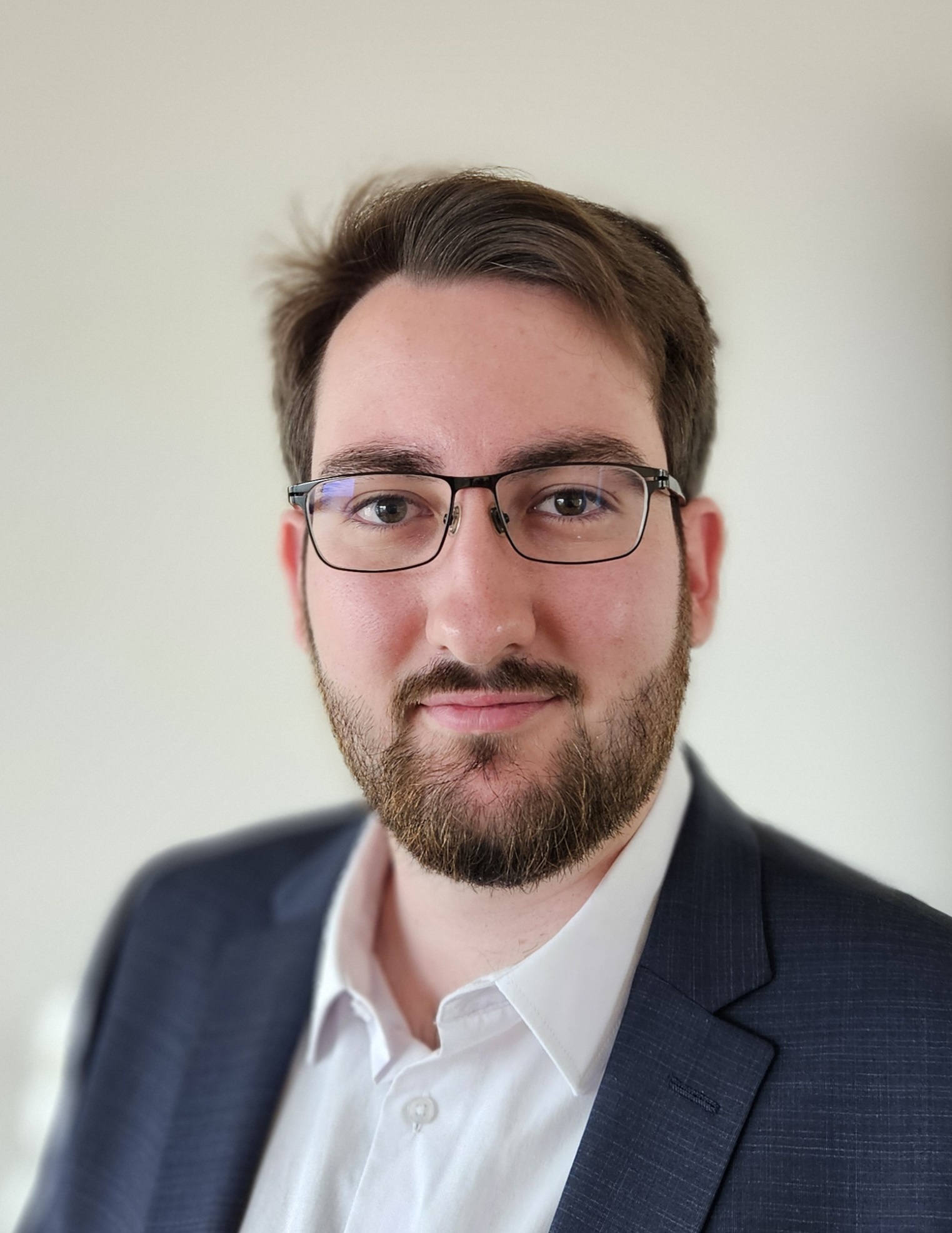
Maria Brbic is an Assistant Professor of Computer Science at EPFL, previously a postdoctoral researcher at Stanford University under Jure Leskovec. Her research focuses on developing machine learning methods for biological and biomedical applications, particularly representation learning of high-dimensional datasets, open-world semi-supervised learning, and single-cell genomics. Her work includes the STELLAR method for spatial cell type discovery (Nature Methods 2022), the ORCA framework for open-world learning (ICLR 2022), and contributions to the Fly Cell Atlas (Science 2022). She is involved in the Chan Zuckerberg Biohub and Neuro-omics projects. She received the University of Zagreb's best thesis award, was recognized as a MIT Rising Star in EECS, and won the Basel Computational Biology Conference best poster award. Her research bridges computer science with cutting-edge biomedical discovery.
Marco Mazzarisi serves as an Assistant Professor in the Department of Mechanics, Mathematics and Management at the Polytechnic University of Bari, Italy, specializing in Manufacturing Technology and Systems (ING-IND/16 classification). Based at Via Orabona 4, 70125 Bari, he can be contacted via marco.mazzarisi@poliba.it or the departmental line +39 080 596 3522. His research centers on laser-based additive manufacturing processes, with primary expertise in Laser Metal Deposition (LMD) and Directed Energy Deposition. Key investigation areas include real-time process monitoring using coaxial infrared systems and off-axis optical techniques, defect detection (particularly subsurface voids), melt pool dynamics analysis, and sustainability assessment through exergetic analysis. His work focuses on nickel-based superalloys (Inconel 718) and stainless steels (AISI 316L), addressing critical challenges in geometric accuracy, energy consumption, and material compatibility in hybrid manufacturing. Analysis of his 2020-2025 publications reveals consistent innovation in LMD monitoring methodologies. His research demonstrates strong interdisciplinary integration between thermal physics, optical engineering, and sustainable manufacturing principles. Notable contributions include the development of off-axis monitoring frameworks, causal models for void prediction, and exergy-based sustainability metrics that bridge process quality with environmental impact assessment. Scientific awards: No awards, fellowships, or medals are documented in the provided materials. Advising and grants: No information regarding graduate student supervision, research grants, or funding sources is provided in the source text. Laboratory facilities: The text does not specify any dedicated laboratories, research teams, or collaborative groups associated with Dr. Mazzarisi's work.
Dr. Sunil Wahal is the Jack D. Furst Professor of Finance and Director of the Center for Responsible Investing at the W.P. Carey School of Business, Arizona State University. He joined ASU in 2005 after faculty positions at Emory University (1997-2005) and Purdue University (1995-1997). Ph.D., University of North Carolina-Chapel Hill M.B.A., Wake Forest University B.A. Economics, Shri Ram College of Commerce, University of Delhi Dr. Wahal's research focuses on quantitative investment strategies , institutional investor behavior , and market microstructure . He examines topics including momentum trading, profitability premiums, high-frequency trading efficiency, and delegated portfolio management for large institutional investors. His work spans public equities, fixed income, and private equity. His publications reveal expertise in investment management (e.g., manager selection, pension fund activism), trading systems (alternative trading systems, soft dollars), and institutional dynamics (fund competition, forbearance in underperformance). The Spängler IQAM Prize (2014) recognized his influential work in investments. Consultant to Avantis Investors (2019-present) Former consultant to Dimensional Fund Advisors (2005-2019), AJO Partners, Mercer Investment Advisors, and Aronson+Johnson+Ortiz Associate Editor: Journal of Financial and Quantitative Analysis, Journal of Banking and Finance He supervises ASU's Student Investment Management (SIM) Funds, training students in systematic investing through his Portfolio Engineering course. The program produces graduates sought by major asset managers, hedge funds, and investment boutiques.
Peter Macgregor is a Lecturer at the School of Computer Science, University of St Andrews, specializing in algorithms for data science and machine learning. His research focuses on graph theory, clustering algorithms, and computational geometry for similarity search. Primary Affiliation: School of Computer Science, University of St Andrews Research Themes: Spectral clustering, Clustering algorithms, Graph algorithms, Similarity search, Theoretical computer science Research Interests: Data Science and Machine Learning are at the core of Peter Macgregor's research, with a particular emphasis on Spectral Clustering, Clustering Algorithms, and Computational Geometry. He explores topics like kernel density estimation for similarity graphs, efficient data structures for dynamic datasets, and theoretical guarantees for clustering methods. Scientific Output Trends: His recent work (2022-2025) spans spectral clustering optimizations, dynamic DBSCAN variants, and similarity graph approximations. Publications focus on algorithmic efficiency, clustering quality metrics, and theoretical foundations of machine learning.
Sven Karbach is an Assistant Professor for Data-Driven Mathematical Modelling and Computing in Finance at the University of Amsterdam. He coordinates the Stochastics and Financial Mathematics Master Program and is affiliated with the Stochastics group at the Korteweg-de Vries Institute, Computational Science Lab (CSL) at the Informatics Institute, and the AI4Fintech initiative. Education: BSc Mathematics, University of Wuppertal (2013-2016) MSc Mathematics, University of Wuppertal (2016-2018) Doctor of Mathematics, University of Amsterdam (2018-2022) Research Focus: Robust finance methods in infinite-dimensional models Hedging and trading in energy markets Deep Spatio-Temporal Hedging for climate risk mitigation Stochastic volatility and covariance modeling Renewable energy market risk networks Recent Article Trends include applications of affine processes in Hilbert spaces, measure-valued CARMA models for energy markets, and spatio-temporal hedging techniques. His work bridges mathematical rigor with practical AI integration in fintech. Scientific Awards & Grants: Barmenia mathematics award (2017, 2019) Deutschlandstipendium (2015–2016, 2016–2018) €25,000 grant for 'Deep Spatio-Temporal Hedging' €35,000 joint grant with Simon Trimborn for 'Risk Networks of Renewable Energy Markets' Students include PhD candidates Diogo Sousa Franquinho and Konstantinos Chatziandreou. His research team explores advanced mathematical frameworks for sustainable energy finance.
Arkajyoti Saha is an Assistant Professor in the Department of Statistics at the Donald Bren School of Information and Computer Sciences , University of California, Irvine. Previously, he was a UW Data Science Postdoctoral Fellow at the University of Washington, working with Drs. Daniela Witten and Jacob Bien. His academic journey includes a PhD in Biostatistics from Johns Hopkins Bloomberg School of Public Health (advised by Drs. Nilanjan Chatterjee and Abhirup Datta), and bachelor's/master's degrees in Statistics from the Indian Statistical Institute, Kolkata. Research Focus: His work bridges statistical methodology and computational tools for high-dimensional and spatially dependent data. Key areas include scalable algorithms for spatial genomics, environmental monitoring, and machine learning applications such as random forests for dependent data. He also develops R packages like RandomForestsGLS to address challenges in correlated data analysis. Publications: His recent work spans spatial variable gene identification, fuzzy clustering theory, and environmental sensor calibration. He emphasizes methodological innovation in statistical genetics and geospatial statistics. Education & Mentorship: Encourages prospective students to contact him directly. His academic background reflects a strong foundation in theoretical and applied statistics, with a focus on bridging computational efficiency and statistical rigor.
Brooks Paige serves as an Associate Professor in Machine Learning at University College London's Department of Computer Science, where he leads research at the intersection of artificial intelligence, computational biology, and environmental science. His work bridges theoretical machine learning with high-impact applications in drug discovery, genomics, and climate modeling. His research portfolio spans: Machine Learning (core methodology development) Artificial Intelligence (generative models and deep learning) Information Systems (data-intensive applications) Cognitive and Computational Psychology (human-AI interaction aspects) Analysis of his 56 publications (2021-2025) reveals a dominant focus on generative modeling for molecular design, particularly protein-ligand binding prediction and antibody-epitope analysis. His methodological innovations include Gibbs sampling variants, Gaussian processes on non-Euclidean domains, and active learning frameworks, applied across biomedical and environmental domains including Arctic sea ice forecasting and urban analytics. No scientific awards are documented in available sources. Similarly, student advisement records, research grant details, laboratory facilities, and collaborative team structures remain unspecified in the current dataset.
Qiuming Yao is an Assistant Professor in the Department of Computer Science at the School of Computing, University of Nebraska-Lincoln since 2020. His research develops computational methods for integrating multi-omics data to decode complex biological systems at the interface of computer science, biology, and medicine. PhD in Computer Science, University of Missouri, 2014 MA in Statistics, University of Missouri, 2014 Dr. Yao's work pioneers scalable algorithms for genomics, transcriptomics, proteomics and metabolomics integration. His lab investigates microbiome ecology (environmental/health impacts), genetic mutation functionality (gene therapy applications), molecular isoform quantification (medical/plant contexts), and interpretable machine learning. He bridges frequentist and Bayesian statistical frameworks to model biological uncertainty while developing tools for causal inference in high-dimensional omics data. His publication record (2012-2021) reveals consistent innovation in bioinformatics tool development, with flagship projects including Motif Raptor for transcription factor analysis, Storm/Omega2 for metagenomic pipelines, and P3DB/Musite for phosphorylation databases. These tools, published in Nature Genetics, Nature Communications, and Bioinformatics, demonstrate cross-domain applicability from human genetics to plant proteomics through rigorous algorithmic design. No scientific awards were documented in the source material. Dr. Yao actively mentors postdocs (offering salaries exceeding NIH standards), graduate RAs (with tuition waivers), undergraduates, and visiting scholars through his Integrated Digital Omics Lab. His lab culture emphasizes interdisciplinary collaboration, self-directed learning, and translating computational research into publishable outcomes for academic or industry careers. The Integrated Digital Omics Lab (IDOL) cultivates a collaborative environment where computer scientists, biologists, and statisticians develop omics integration frameworks. The lab welcomes researchers passionate about algorithm development for biological discovery, with current focus on microbiome modeling, mutation impact prediction, and interpretable machine learning for molecular systems.
Taras Bodnar is a Professor at the Department of Management and Engineering, Linköping University. His research focuses on high-dimensional statistical methodologies with applications in finance, portfolio optimization, and econometrics. He specializes in developing and analyzing advanced statistical models for asset allocation, risk management, and multivariate meta-analysis. Bodnar's work often involves Bayesian methods, shrinkage estimation techniques, and copula modeling to address challenges in financial data analysis. His recent contributions include the HDShOP package for portfolio selection and advancements in nonlinear shrinkage tests for large-dimensional covariance matrices. His research bridges theoretical statistics with practical financial applications, addressing issues such as dark uncertainty and efficient frontier estimation in high-dimensional settings. Key research interests include: High-Dimensional Portfolio Optimization Bayesian Analysis in Financial Contexts Covariance Matrix Estimation and Testing Uncertainty Quantification in Multivariate Analyses Statistical Software Development for Finance Recent publications (2024-2025) emphasize methodological innovations in portfolio selection, copula modeling, and robust statistical inference. His work has implications for both academic theory and practical investment strategies, particularly in managing large and complex financial datasets.
Yu Yao is a Lecturer in Machine Learning at the School of Computer Science, The University of Sydney. He joined in December 2023 and focuses on developing robust and interpretable machine learning systems. His research emphasizes robustness to data noise, adaptable ML systems, and disentangled representation learning. Yao holds a PhD from The University of Sydney under Professors Tongliang Liu and Dacheng Tao, followed by postdoctoral positions at Mohamed bin Zayed University of Artificial Intelligence and Carnegie Mellon University. Education: PhD in Computer Science (University of Sydney), postdoctoral research at MBZUAI and CMU. Research interests include causal inference in ML, multimodal learning, and label noise mitigation. He has published extensively in top venues like ICML, NeurIPS, and ICLR, and served as an Area Chair for AJCAI 2023, NeurIPS 2025, and ICLR 2025. Awards: Outstanding Reviewer (NeurIPS 2023, ICLR 2023), University of Sydney Research Excellence Prize (2019) Teaching: Advanced Machine Learning (USYD), Guest Lectures on noisy label learning (MBZUAI, China University of Petroleum) Service: Action Editor for TMLR, Area Chair for ICML/ICLR/NeurIPS, reviewer for top journals and conferences His lab focuses on trustworthy AI, with ongoing projects on causal mechanisms in robust learning and interpretable multimodal systems. Current advisees include PhD candidates Ruojing Dong and Jiyang Zheng (co-advised with Prof. Liu), and master's student Kai Lian.
Shyamprasad Natarajan Raja is a Researcher at the Department of Micro and Nanosystems at KTH Royal Institute of Technology. His work focuses on developing solid-state nanogap and nanopore platforms for single molecule sensing applications. He holds a BEng in Mechanical Engineering from IIT Madras (India), and MSc and PhD degrees from ETH Zurich (Switzerland). His research spans nanomaterials, nanofabrication, microfluidics, and sensing technologies, with a strong emphasis on phonon transport in low-dimensional materials like nanowires and graphene. His research has been supported by grants such as the SSF Sweden Israel Research Collaboration (2022–2027) and the Ragnar Holm Foundation (2018). Key areas of exploration include nanofabrication techniques for precise sensors, molecular interactions using nanopores, and thermal properties of nanomaterials. Recent advancements include scalable fabrication of silicon nanopores, high-bandwidth measurement systems for tunnel junctions, and studies on graphene thermal conductivity under annealing conditions. Raja’s publications highlight interdisciplinary approaches, blending materials science, electronics, and biotechnology. His work on crack-defined gold break junctions and phonon transport limits in nanowires demonstrates a deep integration of experimental and theoretical methodologies. Future research directions include expanding applications of nanopore-based biosensors and optimizing nanogap platforms for real-time molecular analysis.
Prof. Dr. Jilles Vreeken is tenured faculty at the CISPA Helmholtz Center for Information Security , where he leads the Exploratory Data Analysis group. He also serves as an Honorary Professor at Saarland University . Research focuses on causal inference, machine learning, and data mining Develops unsupervised methods for robust, interpretable models PI on grants like HAICU's Neuro-Explicit Models and Crushing Antimicrobial Resistance His recent work spans causal discovery in non-stationary time series ( SPACETIME ), federated binary matrix factorization, interpretable neural search patterns, and data modification rule mining from event logs. He applies information-theoretic approaches to address hidden confounding, selection bias, and multi-environment causal modeling. Key trends in his publications include: Integrating causal inference with machine learning via algorithmic Markov conditions Advancing federated learning for privacy-preserving causal discovery Creating interpretable pattern mining frameworks for graphs, sequences, and high-dimensional data Developing MDL-based methods for reliable dependency and rule discovery Scientific Recognition: 2018 - IEEE ICDM Tao Li Award 2018 - IEEE ICDM Best Paper 2015 - UdS-CS Busy Beaver Teaching Award 2011 - ACM SIGKDD Best Student Paper 2010 - ACM SIGKDD Doctoral Dissertation Runner-Up 2009 - ECML PKDD Best Student Paper As an educator, he has supervised 15+ PhD/MSc students and taught courses like Topics in Algorithmic Data Analysis and Information-Theoretic Machine Learning . His research group pioneers methods for trustworthy information processing and causal anomaly detection , with applications in materials science, epidemiology, and cybersecurity.
Simon Weber is a researcher affiliated with the ETH Zurich (Department of Computer Science). His work focuses on Unique Sink Orientations (USOs) , a combinatorial abstraction of optimization problems like Linear and Quadratic Programming. Simon's research spans three areas: (1) Structure of USOs and their links to Oriented Matroids; (2) Constructions of high-dimensional USOs to analyze algorithm complexity; and (3) Algorithmic improvements for sink-finding. He also explores topics in graph compression, neural networks, and ∃R-complete problems. Key Publications: PhD thesis on USO reductions, ∃R-completeness in neural training, and USO phase analysis. Scientific Contributions: Advances in USO complexity, FPT algorithms for MaxCut, and recognition of geometric hypergraphs and nerves of convex sets. He has supervised multiple theses at ETH Zurich, including topics on USO visualization, MaxCut algorithms, and necklace splitting. His teaching experience includes being a Head Assistant for courses like Geometry: Combinatorics & Algorithms and Topological Data Analysis . Simon's work has been recognized with Best Paper and Best Student Paper Finalist awards at SC19.
Lin Ma is a Professor in the Department of Mechanical Engineering at the University of Virginia. His research focuses on 4D diagnostics and thermal-fluid systems, including novel optical measurement techniques for combustion and propulsion studies. He holds a Ph.D. from Stanford University (2006), an M.S. from Stanford (2001), and a B.S. from Tsinghua University (2000). Key research areas include laser-based diagnostics, tomography, non-intrusive measurements in harsh environments, and thermal management of energy systems. His work emphasizes 3D flow visualization and combustion analysis using advanced imaging techniques like VLIF and tomographic chemiluminescence. Notable awards include the NSF Career Award (2009) and the Air Force Summer Faculty Fellowship (2014-2016). His research has been applied to gas turbine exhaust characterization, battery thermal management, and high-speed combustion diagnostics in supersonic environments. Collaborations involve developing algorithms for 3D reconstruction and error correction in turbulent flow measurements.
Ren Wang is an Assistant Professor in the Department of Electrical and Computer Engineering at Illinois Institute of Technology. He joined the university in 2022 after a postdoctoral fellowship and lecturing role at the University of Michigan. His research focuses on trustworthy machine learning, adversarial robustness, and applications in power systems and healthcare. He holds a Ph.D. from Rensselaer Polytechnic Institute and degrees from Tsinghua University. Education: Ph.D. in Electrical, Computer, and Systems Engineering (ECSE), Rensselaer Polytechnic Institute, 2020 M.S. in Electrical Engineering (EE), Tsinghua University, 2016 B.S. in Electrical Engineering (EE), Tsinghua University, 2013 Research Interests: His work emphasizes enhancing machine learning trustworthiness through robustness, privacy, and interpretability. Key projects include immune-inspired adversarial defense systems, quantum-resistant machine learning, and applications in smart grids and bioinformatics. Current trends in his publications address backdoor detection, continual learning, and federated learning security. Grants & Awards: NSF FMitF Award (2023): Verified Robustness in Power System-Informed Neural Networks ORAU Ralph E. Powe Junior Faculty Enhancement Award (2023) NSF CRII Award (2023): Immune-Inspired Learning Foundations DOE Midwest Center for Microgrid Cybersecurity (2025) Advising & Labs: Leads the Trustworthy and Intelligent Machine Learning (TIML) Lab, mentoring over 20 graduate students and visiting researchers. Current projects span adversarial ML, graph learning, and healthcare model purification. The lab collaborates with institutions like Northwestern University and Oak Ridge National Lab. Recent Activities: Organized workshops on Generative AI interpretability (2024), Midwest Machine Learning Symposium (2025), and served on editorial boards for IEEE Transactions on Signal Processing and Electronics .