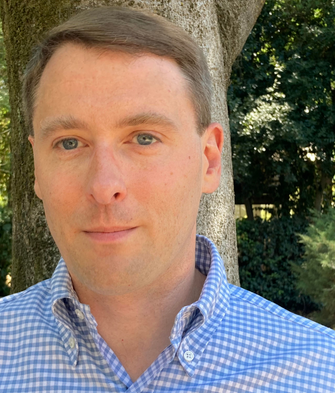
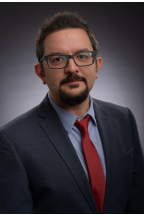
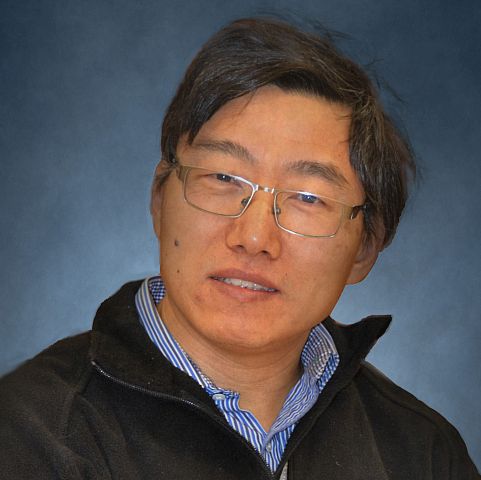
James Bremer is a Professor in the Department of Mathematics and holds a cross-appointment in the Department of Computer and Mathematical Sciences at the University of Toronto's Scarborough campus. His research focuses on developing efficient numerical algorithms for solving elliptic boundary value problems, integral equations, and special function transforms.
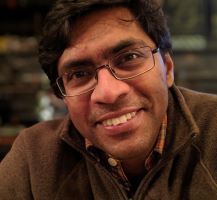
Chaitanya Swamy is a Professor and University Research Chair in the Department of Combinatorics & Optimization at the University of Waterloo, Canada. His primary affiliation is within the Faculty of Mathematics, and he holds positions in both the Department of Combinatorics & Optimization and the School of Computer Science. He obtained his Ph.D. in Computer Science from Cornell University under the supervision of David Shmoys, followed by postdoctoral research at Caltech's Center for the Mathematics of Information. Swamy’s research focuses on algorithms, particularly in combinatorial optimization, approximation algorithms, algorithmic game theory, stochastic optimization, network design, scheduling, and online algorithms. His work spans theoretical contributions and practical applications, including algorithm design for facility location, network routing, and mechanism design. He has contributed to foundational results in approximation algorithms, such as the development of primal-dual methods and LP-rounding techniques. Swamy has held significant editorial roles, including as an associate editor for Discrete Optimization and SIAM Journal on Computing . He has organized major conferences like CanaDAM 2021 and sessions at ISMP 2018. His teaching record includes courses on combinatorial optimization, scheduling, and algorithmic game theory. He has advised numerous Ph.D. and Master’s students, many of whom have gone on to prestigious academic and industry positions. Swamy’s research has been recognized through awards for his students, including the University of Waterloo Alumni Gold Medal. He actively contributes to the academic community through committee work for conferences like STOC, APPROX, and SODA, and his publications reflect a deep engagement with both theoretical and applied aspects of algorithms and optimization.
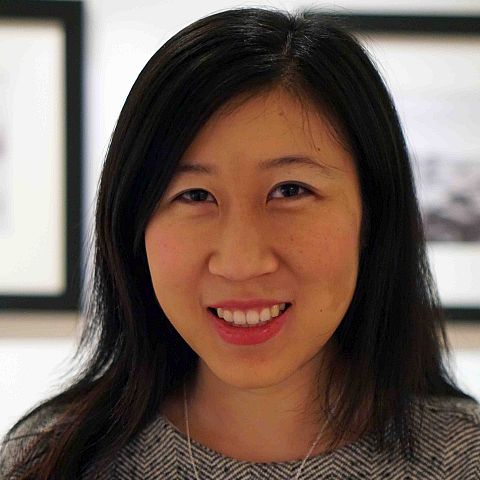
Amy R. Wu serves as Associate Professor in Mechanical and Materials Engineering at Queen's University and holds the Mitchell Professorship in Bio-inspired Robotics. She leads the Biomechanics x Robotics Laboratory (BxRL) and contributes to the Ingenuity Labs Research Institute. Her academic credentials include: Ph.D. in Mechanical Engineering, University of Michigan Postdoctoral Research, Biorobotics Laboratory, EPFL, Switzerland Dr. Wu's research bridges biomechanics and robotics to enhance legged mobility through innovations in human-robot interaction , exoskeleton design , and gait assistance . Her work focuses on developing robotic systems that adapt to human movement patterns, particularly for spinal cord injury rehabilitation and stability augmentation during walking. Analysis of her 2019-2023 publications reveals consistent advancement in exoskeleton control algorithms, gait stability metrics, and human adaptation studies. Key trends include modular exoskeleton systems (Symbitron), neuromuscular controllers for ankle assistance, and haptic feedback integration for motor learning enhancement. No scientific awards are documented in the provided materials. Dr. Wu mentors graduate students through BxRL, where her team conducts human subject testing and robotic development. Research is supported by institutional resources at Ingenuity Labs, though specific grant details remain unspecified. The Biomechanics x Robotics Laboratory operates within Queen's Ingenuity Labs Research Institute, facilitating interdisciplinary collaboration on projects like outdoor stability assessment, winter walking adaptations, and teleoperation interfaces for drone control.
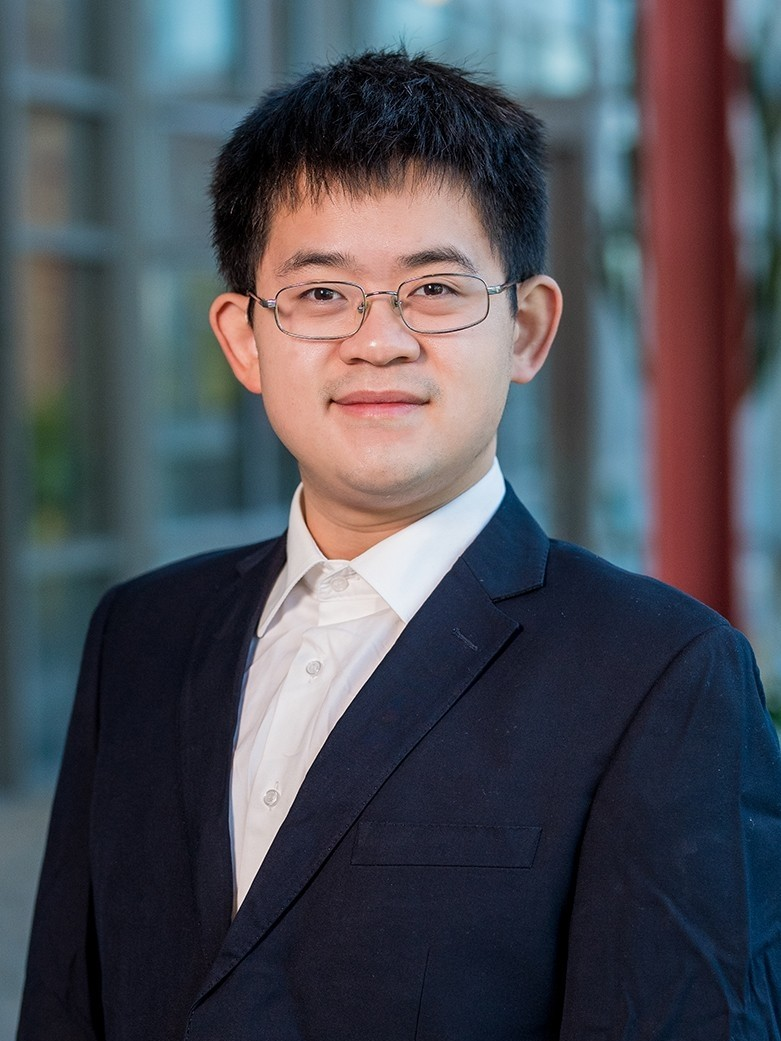
Linyi Li is an Assistant Professor in the School of Computing Science at Simon Fraser University (SFU), leading the Trustworthy Artificial Intelligence (TAI) Lab. His research focuses on certifiably trustworthy deep learning systems, combining machine learning and computer security. He holds a PhD from the University of Illinois Urbana-Champaign (UIUC) and a B.Eng. from Tsinghua University. Affiliations: Simon Fraser University, TAI Lab Education: PhD in Computer Science, UIUC, 2023 B.Eng (Cum Laude), Tsinghua University, 2018 His research interests include deep learning , trustworthy machine learning , large language models , and software engineering . He emphasizes rigorous certification of robustness, fairness, and numerical reliability in AI systems. Recent work includes the InfiBench benchmark for evaluating code LLMs and advancements in neural network verification. Recent Research Trends: His publications span certified robustness, fairness guarantees, and scalable verification techniques for deep learning models. He also explores scientific evaluation of foundation models and adversarial defense mechanisms. Awards: Rising Stars in Data Science AdvML Rising Star Award Wing Kai Cheng Fellowship Finalist: Qualcomm Innovation Fellowship (2022) Winner: VNN-COMP'23 Competition (Team α, β-CROWN) Advising & Grants: As a PI, he oversees the TAI Lab's research. Though no specific grants are listed, his work is funded through competitive awards and university resources. Labs/Teams: Leads the TAI Lab at SFU, focusing on foundational and applied research in trustworthy AI.
Sharan Vaswani is an Assistant Professor in the School of Computing Science at Simon Fraser University (SFU). His research focuses on designing algorithms for sequential decision-making under uncertainty, stochastic optimization, and their interplay with machine learning generalization. He holds a PhD from the University of British Columbia (2019) and postdoctoral experiences at the University of Alberta and Mila. His academic journey includes MSc (UBC, 2015) and BTech (BITS Pilani, 2012) degrees. Education: PhD (UBC, 2019), MSc (UBC, 2015), BTech (BITS Pilani, 2012) Postdoctoral Work: University of Alberta (2020-2021), Mila (2019-2020) Teaching includes courses on Probability and Computing (CMPT 210), Optimization for Machine Learning (CMPT 409/981), and Theoretical Foundations of Reinforcement Learning (CMPT 419/983). His research group focuses on developing scalable optimization algorithms with theoretical guarantees. He advises multiple PhD and MSc students, contributing to areas like constrained MDPs, adaptive learning rates, and reinforcement learning theory. Research Highlights: Contributions to bandit algorithms, stochastic gradient methods, and reinforcement learning theory. Notable work includes global convergence analysis of policy gradients and variance-reduced optimization frameworks.
Chris J. Maddison is an Assistant Professor at the University of Toronto, holding joint appointments in the Department of Computer Science and the Department of Statistical Sciences. He is also a CIFAR AI Chair at the Vector Institute and a member of the ELLIS Society. Maddison earned his DPhil from the University of Oxford and previously worked as a Senior Research Scientist at Google DeepMind and a member at the Institute for Advanced Study. His research focuses on advancing machine learning methodologies, particularly in leveraging data’s natural structure for efficient learning, with applications in drug discovery, causal inference, and AI safety. Education: DPhil in Computer Science, University of Oxford His research interests span machine learning, AI safety, reinforcement learning, and the integration of logical reasoning into large language models. Maddison has contributed to foundational work on gradient estimation techniques and was a key member of the AlphaGo project. He actively explores how statistical structures in real-world data influence AI capabilities. Recent publications emphasize evaluating conversational agents, mitigating AI safety risks, and enhancing logical reasoning in LLMs. His work bridges theoretical advancements with practical applications, such as code generation and multi-agent systems. Awards: NeurIPS Best Paper Award (2014), Open Philanthropy AI Fellowship Maddison advises multiple PhD students and postdoctoral researchers, fostering collaborations across academia and industry. His former advisees now hold roles at institutions like OpenAI, Stanford, and Magic AI. He teaches advanced courses in machine learning and statistical methods, including CSC 2541 (Large Models) and STA 314 (Machine Learning). Maddison is affiliated with the Schwartz Reisman Institute for Technology and Society, extending his impact to societal implications of AI. His lab’s interdisciplinary approach combines algorithmic innovation with real-world problem-solving.
Arash Arami is an Associate Professor in the Department of Mechanical and Mechatronics Engineering at the University of Waterloo, cross-appointed in Systems Design Engineering. He directs the Neuromechanics and Assistive Robotics Laboratory and maintains affiliations with Waterloo Robohub, the Centre for Bioengineering and Biotechnology, Waterloo AI institute, and KITE institute at Toronto Rehab Institute. He earned his Doctorate in Electrical Engineering from EPFL (2014), Master of Science from University of Tehran (2009), and Bachelor of Science from University of Tabriz (2006), all in Control Engineering. His research in Assistive Robotics and Rehabilitation Engineering integrates Machine Learning with Neuromechanics to develop intelligent systems for human movement analysis. Key focus areas include exoskeleton control algorithms, wearable sensor systems, and neural control modeling for rehabilitation applications. Recent publications demonstrate interdisciplinary work spanning robotics, biomedical engineering, and materials science, with emphasis on real-time human locomotion prediction, exoskeleton-human interaction, and data-driven health monitoring solutions. Dr. Arami serves as Chair of the NSERC Scholarship Committee (2021-2023) and mentors graduate students through the Mechatronics Exchange Study program. His teaching includes core courses in control systems, robot manipulators, and biomechanical engineering. The Neuromechanics and Assistive Robotics Laboratory fosters collaborations with clinical partners at Toronto Rehab Institute, focusing on translating robotic innovations into practical rehabilitation tools through interdisciplinary teamwork.
Professor Hassan Rivaz is a Full Professor and Concordia University Research Chair in Medical Imaging with Deep Learning at Concordia University's Gina Cody School of Engineering and Computer Science. He holds appointments in the Department of Electrical and Computer Engineering and is cross-appointed to the Department of Computer Science & Software Engineering. Dr. Rivaz serves as the Founding Director of the IMPACT Lab and actively supervises PhD students in Electrical and Computer Engineering and Computer Science programs. Dr. Rivaz received his PhD from Johns Hopkins University in 2011, Master's degree from the University of British Columbia, and Bachelor's degree from Sharif University, followed by postdoctoral training at McGill University. His academic journey includes prestigious awards such as the NSERC Post-Doctoral Fellowship and Jeanne Timmins Costello Post-Doctoral Award. His research focuses on advancing medical image analysis through deep learning techniques, particularly in ultrasound imaging applications. Dr. Rivaz has made significant contributions to quantitative ultrasound, cancer detection, lymphedema assessment, and ultrasound elastography. His work bridges theoretical algorithm development with practical clinical applications, addressing challenges in medical image denoising, segmentation, registration, and tissue characterization. The IMPACT Lab under his direction develops innovative solutions for medical imaging problems with direct clinical relevance. Analysis of his recent publications reveals a strong emphasis on deep learning applications for ultrasound image processing, with particular focus on denoising techniques, elastography improvements, and segmentation algorithms. His work consistently addresses the challenge of working with real clinical data rather than simulated environments, contributing to more practical medical imaging solutions. Dr. Rivaz has received numerous prestigious awards including: Concordia University Research Chair in Medical Imaging with Deep Learning (2023–2028) QBIN/RBIQ Rising Star in Bio-Imaging in Quebec (2022) Concordia University Research Chair in Medical Image Analysis (2018-2023) Petro-Canada Young Innovator Award (2016–2018) He actively mentors graduate students, with many recipients of competitive scholarships including NSERC CGS, FRQNT, and FRQS awards. Dr. Rivaz serves on editorial boards for top journals including IEEE Transactions on Medical Imaging (since 2017), Medical Image Analysis (since 2025), and IEEE Transactions on Ultrasonics, Ferroelectrics and Frequency Control (since 2018). He has organized major conferences including IEEE EMBC 2020, ISBI 2021, and IEEE IUS 2023, and served as Area Chair for MICCAI from 2017 to 2024. As Founding Director of the IMPACT Lab, Dr. Rivaz leads a multidisciplinary research team focused on innovative medical imaging solutions. The lab maintains strong collaborations with hospitals and research institutions to translate imaging technologies into clinical practice. Current projects include developing AI-powered ultrasound analysis tools, quantitative imaging biomarkers for cancer diagnosis, and advanced techniques for ultrasound elastography with applications in tissue characterization and disease detection.
Renée J. Miller is a Professor and Canada Excellence Research Chair in Data Intelligence at the Cheriton School of Computer Science, University of Waterloo. Her research focuses on data integration, data management, and open data systems. She holds a PhD in Computer Science from the University of Wisconsin-Madison and bachelor’s degrees in Mathematics and Cognitive Science from MIT. Her work addresses challenges in data preparation, integration, and curation, aiming to reduce the burden on data scientists. She co-authored foundational papers on data exchange and schema mapping, earning the ICDT Test-of-Time Award (2013) and the Alonzo Church Award (2020). Miller has led major initiatives like the NSERC Business Intelligence Network and the International Very Large Data Base Foundation. Her grants include NSERC Accelerator Awards and funding from IBM, SAP, and Microsoft. Notable students include Ariel Fuxman (SIGMOD Dissertation Award winner) and Oktie Hassanzadeh (IBM PhD Fellow). Her research group, the Miller Lab, develops tools like Clio for schema mapping and systems for data lake exploration (RONIN, JOSIE).
Furkan Alaca is an Assistant Professor at Queen's University's School of Computing, part of the Faculty of Arts and Science. His research focuses on user authentication systems, addressing security and usability challenges. He holds a Ph.D. (2018) in Computer Science from Carleton University, an M.A.Sc. (2012) in Electrical and Computer Engineering, and a B.Eng. (2010) in Communications Engineering, all from Carleton University. His academic career includes teaching roles at Queen's University and the University of Toronto Mississauga, where he taught courses such as Cryptography, Cybersecurity, and Discrete Mathematics. He is affiliated with Queen's Security Research Group and Computer Security Research Lab. Research interests include computer and internet security, usable security, authentication mechanisms, and systems security. He has contributed to advancements in web authentication frameworks, malware analysis, and privacy-preserving technologies. His work spans conferences like IEEE and ACM, with notable publications in cybersecurity, machine learning, and network efficiency. Current teaching includes CISC 447 (Introduction to Cybersecurity) and CISC 468 (Cryptography). He has advised on courses ranging from undergraduate programming to graduate-level security topics.
Qingguo Li is a Professor and Associate Head at the Department of Mechanical and Materials Engineering , Queen's University , and a member of the Ingenuity Labs Research Institute . He specializes in biomechanical system design, energy harvesting, wearable sensors, gait analysis, and load carriage systems. His research integrates robotics, biomedical engineering, and sensor technology to develop human-centric devices and mobility aids. Current Roles : Professor, Associate Head, Queen's University Research Institute : Ingenuity Labs Research Institute Lab : Bio-Mechatronics and Robotics Laboratory His work focuses on biomechanical energy harvesting , IMU-based motion analysis , and assistive device development . Key applications include stroke rehabilitation, gait monitoring, and wearable power generation systems. Articles span cable-driven robots , smart walkers , and 3D printing mechanisms , emphasizing human-robot interaction and dynamic modeling . The lab explores sensor calibration , adaptive control algorithms , and human movement optimization . Areas of impact include rehabilitation engineering , load carriage stability , wearable sensor accuracy , and assistive robotics . His team develops solutions for gait asymmetry detection , post-stroke mobility , and low-cost energy systems , leveraging machine learning and kinetic modeling .
Magdy M. A. Salama is a Professor and University Research Chair at the University of Waterloo's Department of Electrical and Computer Engineering, Faculty of Engineering. He holds a P.Eng. license and is a Fellow of the IEEE. His research spans Energy Systems (Power Quality, Smart Grids, Renewable Energy) and Biomedical Engineering (Medical Imaging, Sleep Analysis). He has authored/co-authored over 460 publications and supervised numerous graduate students. Education: PhD (University of Waterloo), M.Sc. and B.Sc. (Cairo University). Awards include the IEEE Fellow distinction, University Research Chair, and multiple teaching/research awards from the University of Waterloo. Research trends in his articles focus on Smart Grid resiliency, renewable integration, cyber-physical security, and biomedical applications of AI. Notable projects include voltage sag mitigation, EV fleet electrification, and blockchain-based energy trading platforms. Scientific Awards: IEEE Fellow, University Research Chair, Teaching Excellence Award (2000) Grants/Consultation: Extensive industry and institutional collaborations on power systems and biomedical tech. Labs/Teams: Active in High Voltage Lab, Smart Grids Research Group, and Medical Image Processing Lab.
Agustinus Kristiadi is an Assistant Professor in the Department of Computer Science at Western University, London, Ontario, Canada. He is also a Faculty Affiliate at the Vector Institute. His research focuses on probabilistic machine learning, uncertainty quantification, and decision-making under uncertainty in foundational models like deep neural networks and large language models, with applications in scientific domains such as chemistry and biology. His recent work on efficient reward-guided text generation in large language models has been accepted to ICML 2025 and COLM 2025. His research has been recognized through a Best PhD Thesis Award and multiple spotlight papers at leading machine learning conferences. He actively contributes to the scientific community through mentoring underrepresented students and open-source development. Agustinus is currently hiring funded PhD and MSc students to work on large-scale probabilistic models, decision-making under uncertainty, and AI for Science applications. Prospective students must demonstrate mathematical maturity, programming proficiency, and reliability.
Brian Greenfield, MD, FRCPC, ABPN is an Associate Investigator at the Research Institute of the McGill University Health Centre (RI-MUHC) and affiliated with the Brain Repair and Integrative Neuroscience (BRaIN) Program. He is a professor at McGill University and focuses on childhood suicide research through genetic predisposition, disease pathways, treatments, and predictive testing. His work intersects with mental health, borderline personality disorder (BPD), and externalizing disorders in youth. Email: brian.greenfield@muhc.mcgill.ca Dr. Greenfield's research explores the genetic and clinical dimensions of suicide risk in children and adolescents. He investigates biomarkers, predictive algorithms, and treatment models to address mental health crises, particularly in borderline personality disorder and suicidal behaviors. His publications highlight innovative approaches to suicide prevention in youth, including outpatient rapid-response systems, diagnostic tools for BPD, and population-level surveillance algorithms. Research keywords include psychiatry, genetics, health economics, and clinical psychology. As part of the BRaIN Program at RI-MUHC, Dr. Greenfield contributes to translational neuroscience and integrative mental health studies, bridging clinical practice with research to improve outcomes for vulnerable young populations.
Prof. Norbert Lütkenhaus is a Professor and Executive Director of the Institute for Quantum Computing (IQC) at the University of Waterloo, cross-appointed to the Department of Applied Mathematics. He holds affiliations with Perimeter Institute and the Centre for Applied Cryptographic Research. His research focuses on quantum communication theory, particularly quantum key distribution (QKD) and quantum repeaters. He has pioneered methods to bridge abstract quantum protocols with practical optical implementations, emphasizing secure key rate calculations and overcoming quantum channel limitations. Education: PhD (2003) in Physics from University Erlangen-Nürnberg, MSc (1993) and BSc (1990) from Ludwig-Maximilians-Universität München and RWTH Aachen, respectively. Awards include the 2015 American Physical Society Outstanding Referee Award and a 2009 University of Waterloo Excellence Award. Research interests span QKD protocols (e.g., decoy-state BB84, phase-error mitigation), quantum repeater architectures, and entanglement verification. He develops numerical tools for key rate analysis and addresses implementation security loopholes. His work includes theoretical frameworks for long-distance quantum communication and practical QKD system optimizations. Teaching includes courses on quantum information processing (PHYS 768/QIC 890) and mechanics (PHYS 115). He contributes to international standards via ETSI’s QKD-ISG and the QCrypt steering committee. His patents cover QKD system designs and phase-randomization techniques.