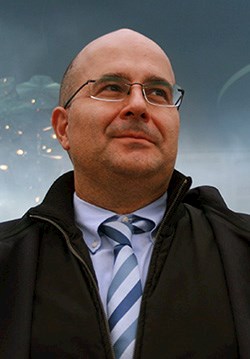
Cicek Cavdar is an Associate Professor at the School of Electrical Engineering and Computer Science (EECS) at KTH Royal Institute of Technology , Sweden. She leads the Intelligent Network Systems research group and specializes in Telecommunication Networks , with a focus on Beyond 5G/6G Mobile Networks , Energy Efficiency , and AI-Assisted Network Management . PhD in Computer Science (2009) from University of California, Davis and Istanbul Technical University Her research spans Cell-Free Massive MIMO , Reconfigurable Intelligent Surfaces (RIS) , UAV Communication Systems , and Green Network Technologies . She actively contributes to 6G Network Architecture and Non-Terrestrial Networks , including satellite and aerial systems. Recent publications highlight AI-driven network optimization for handover management, energy-aware resource allocation , and multi-agent reinforcement learning in complex communication environments. She teaches advanced courses in Communication Systems , Machine Learning , and Software Engineering at KTH.
Henrik Boström is a Professor of Computer Science specializing in Data Science Systems at the Division of Software and Computer Systems, KTH Royal Institute of Technology. His research focuses on trustworthy machine learning , with emphasis on conformal prediction (for confidence-calibrated predictions) and explainable AI . He is the developer of Python packages crepes (conformal classifiers/regressors) and xrf (explainable random forests). His primary research domains include: Developing robust methods for uncertainty quantification in predictive models Creating interpretable machine learning frameworks Optimizing ensemble techniques for high-dimensional data Applying ML to healthcare informatics and industrial diagnostics Analysis of his recent publications reveals strong emphasis on: (1) advancing conformal prediction theory for trustworthy AI, (2) enhancing interpretability of complex models like random forests and GNNs, and (3) developing efficient algorithms for uncertainty-aware learning in domains including healthcare, graph data, and high-dimensional regression. He serves as examiner for multiple degree projects and teaches courses including Programming for Data Science (ID2214) and Research Methodology and Scientific Writing (II2202) . He leads development of open-source tools for conformal prediction and model interpretation.
Yang Liu is a tenured Associate Professor at the Department of Management and Engineering , Linköping University, Sweden, and an Adjunct Professor at the University of Oulu, Finland. His expertise spans smart manufacturing, clean energy transition, and Industry 4.0 applications. He holds an M.Sc. and D.Sc. from the University of Vaasa, Finland. Research & Awards: Liu's work focuses on sustainable systems, decision support systems, and AI-driven energy efficiency. He has authored over 140 Web of Science publications, including top 0.1% ESI Hot Papers. He is ranked among the world's top 2% scientists (Stanford-Elsevier) and leads globally in 'big data analytics in manufacturing' and 'Industry 4.0-driven circular economy' research. Leadership & Projects: He leads projects like FlexSUS (EU Horizon 2020) and PERSEUS, developing tools for smart urban energy planning and 15-minute city models. He serves as Editor-in-Chief of Cleaner Engineering and Technology and Guest Editor for multiple journals. His research emphasizes bridging data science with sustainability challenges in manufacturing and energy systems. Key Achievements: Top-ranked in global citations, ESI Highly Cited Papers, and industry-driven sustainability frameworks. Grants: Leads EU-funded projects and collaborates with Siemens Energy on energy transition solutions. Labs & Teams: Part of the Environmental Technology and Management (MILJÖ) division and Unit for Product Service Innovation (MILJOPSI) at Linköping.
Sara Zahedi is a Professor of Numerical Analysis at the Department of Mathematics, KTH Royal Institute of Technology, working within the Division of Numerical Analysis, Optimization and Systems Theory. She serves as an Associate Editor for the SIAM Journal on Numerical Analysis and contributes to the SCI Faculty Board to enhance collaboration and transparency in academic decision-making. Her educational background includes a doctorate from KTH on numerical methods for fluid interface problems followed by a postdoctoral position at Uppsala University. Doctorate: KTH Royal Institute of Technology Postdoctoral Position: Uppsala University Zahedi's research bridges mathematical theory and practical applications, focusing on computational methods for partial differential equations in evolving domains. She pioneers Cut Finite Element Methods (CutFEM) to eliminate re-meshing requirements in multiphase flow simulations, ensuring accuracy and robustness when interfaces separate immiscible fluids. Her work specifically targets challenges in large deformations and time-dependent geometries. Analysis of her recent publications reveals a concentrated research trajectory in advancing CutFEM for diverse applications including Stokes flow, Darcy flow, Maxwell's equations, and hyperbolic conservation laws. Key trends include high-order conservative schemes, divergence preservation, stabilization techniques for unfitted meshes, and extensions to surface PDEs and multi-physics problems. Her scientific recognition includes: European Mathematical Society Prize (2016) for outstanding contributions by young researchers Wallenberg Fellowship (2019) with extension granted in 2024 Zahedi serves as examiner for Degree Projects in Scientific Computing (SF250X, SF259X) and course responsible for Engineering Mathematics projects (SA120X). Her Wallenberg Fellowship provides substantial research funding supporting her work on numerical algorithm development. While specific lab structures aren't detailed, her research operates within KTH's Division of Numerical Analysis, emphasizing collaborative development of simulation tools for industrial and scientific applications. Her current research focuses on extending CutFEM to complex multi-physics scenarios with emphasis on conservation properties and computational efficiency, with potential applications in aerospace, biomedical engineering, and environmental modeling.
Yael Feldman Maggor is a Postdoctoral Fellow at KTH Royal Institute of Technology, affiliated with the Media Technology & Interaction Design Division and the Digital Futures research center. Her work bridges educational technologies, artificial intelligence, and science education, with a focus on enhancing pedagogy through innovative tools. Research Themes: Generative AI in education, self-regulated learning, learning analytics, chemistry education, and ethical considerations in AI integration. Key Projects: Contributions to the International Journal of Science Education, development of AI-driven evaluation frameworks, and pandemic-era online teaching analysis. Methodologies: Expertise in quantitative and qualitative research, educational data mining, and design of interactive learning platforms. Recent publications emphasize cross-cultural trust in AI, generative AI applications in chemistry education, and explainable AI for teacher professional development. She co-authored studies on nanotechnology courses for educators and self-regulation strategies in online learning environments.
Titti Mattsson is a Professor of Public Law at the Faculty of Law, Lund University, specializing in Health Law, Social Welfare Law (including child law and elder law), and Human Rights Law. She served as Pro Dean of Research at the same faculty from 2021 to 2023. Editor of the European Journal of Health Law Board member of the Swedish Institute of Human Rights, Swedish National Agency for Health and Care Analysis, and Swedish National Council on Medical Ethics Vice Chair of the Region Skåne Ethical Board Coordinator of the Health Law Research Centre and the Law and Vulnerabilities Group at Lund University Her research focuses on the governance of welfare state issues from national and transnational perspectives, emphasizing outcomes for vulnerable groups and the individual through a human rights lens. Key areas include legal, social, and ethical issues in health and community care for children, disabled persons, and older adults. She leads interdisciplinary projects such as Children's Rights and Evidence-based Care (2020-2023) and Child Care Investigation in Private Government (2018-2022), funded by organizations like Forte and the Kamprad family research foundation. Her work contributes to UN Sustainable Development Goals, particularly in Social Sciences and Law. Mattsson teaches public law, health law, and elder law at advanced levels, supervises six doctoral projects, and engages in outreach through expert assignments and collaborations with international institutions like Emory University and Haifa University.
Jim Dowling is a distributed systems researcher at KTH Royal Institute of Technology, focusing on large-scale distributed systems, machine learning, and big data. His work emphasizes improving system dependability, performance, security, and scalability through middleware, peer-to-peer systems, and cloud-native solutions. He leads courses such as Advanced Course in Large Scale Machine Learning and Deep Learning and Scalable Machine Learning and Deep Learning , demonstrating his commitment to education in AI and distributed computing. His research spans topics like feature stores, Kubernetes integration, and AI-driven environmental analytics (e.g., ANIARA project for edge infrastructure automation and ExtremeEarth for Copernicus data analysis). He has contributed to scalable ML pipelines, cloud storage systems (HopsFS-S3), and hyperparameter optimization tools like Maggy. Key projects include the Hopsworks platform for machine learning operations and the development of cloud-native tools for big data analytics. His work bridges theoretical distributed systems research with practical applications in AI, healthcare, and environmental science. He has advised on numerous collaborative initiatives but no formal students are listed. His grants and lab activities are centered around Hopsworks and the ANIARA project, reflecting his focus on scalable, self-managing systems.
David T. Robinson is the James and Gail Vander Weide Distinguished Professor at Duke University’s Fuqua School of Business, serving as Research Director of Duke's Innovation and Entrepreneurship Initiative. He holds an honorary doctorate from the Stockholm School of Economics and is a Research Associate at the National Bureau of Economic Research (NBER). His academic journey includes a PhD and MBA from the University of Chicago, an M.S. from the London School of Economics, and a B.A. from the University of North Carolina at Chapel Hill. His research focuses on private equity, venture capital, entrepreneurial finance, and the intersections of innovation, climate policy, and financial literacy. Key contributions include analyses of racial disparities in entrepreneurship financing, the environmental impacts of credit policies, and the governance of strategic alliances. Robinson has advised entities like the Swedish House of Finance and the Private Equity Research Council. Education: PhD & MBA, University of Chicago (2001) MSc, London School of Economics (1993) BA, University of North Carolina at Chapel Hill (1992) Honorary Doctorate, Stockholm School of Economics Professional Roles: Current: Core Faculty in Innovation & Entrepreneurship at Duke Past: Professor of Finance at Columbia University Visiting Professorships at SSE (Stockholm School of Economics) His recent publications explore topics such as minority entrepreneurship barriers, liquidity dynamics in private equity, and the environmental costs of easy credit. He has secured grants from institutions like the National Science Foundation and the Ewing Marion Kauffman Foundation.
Liane Colonna is an Assistant Professor in Law and Information Technology at the Department of Law, Stockholm University , where she investigates ethical and legal challenges arising from AI-driven practices in higher education. She also engages in methodologically oriented research at the intersection of AI and Law, contributing to the Wallenberg AI, Autonomous Systems and Software Program – Humanities and Society. Additionally, Liane serves as the director of the Swedish Law and Informatics Research Institute (IRI) and is a member of the New York Bar since 2008. Primary Affiliation: Department of Law, Stockholm University Institute Leadership: Director, Swedish Law and Informatics Research Institute (IRI) Professional Status: Member of the New York Bar Research Interests: Ethical and legal challenges of AI in higher education Methodological approaches in AI and Law Data protection and privacy by design Regulatory frameworks for AI and emerging technologies Privacy implications of lifelogging and health IoT International data governance and surveillance law Publications demonstrate expertise in AI regulation, GDPR compliance, and privacy-preserving technologies, particularly for assisted living and educational contexts. Her work bridges technical implementation with legal accountability, emphasizing human oversight and ethical design.
Mikael Wiberg is full Professor of Informatics at Umeå University, Sweden, where he leads research groups in Design Informatics and Digital Interaction & Design. He is co Editor-in-Chief of ACM Interactions and has held chaired and guest professorships at Uppsala, Södertörn and Chalmers universities. His work sits at the intersection of human-computer interaction, materiality, architecture and emerging technologies. Education: PhD in Informatics, Umeå University, 2001 Docent (Associate Professor) in Informatics, Umeå University, 2004 Research interests revolve around interactivity, mobility, materiality and architecture . Wiberg coined the notion of “materiality of interaction” to study how digital resources merge with physical materials, spaces and artefacts. Recent strands include more-than-human design, human-building interaction, autonomous systems UX, and social justice in HCI, all interrogating how interactive technologies shape—and are shaped by—human and non-human actors. Across more than two decades he has published in top venues such as ACM TOCHI, Design Issues, Int. Journal of Design, Human-Computer Interaction journal and the magazine ACM Interactions . His 2018 MIT Press monograph The Materiality of Interaction consolidates his theoretical stance and has become a touchstone for architectural and material HCI discourse. Editorial & scientific awards: Co Editor-in-Chief, ACM Interactions (2019-) Member, Royal Skyttean Society (Kungliga Skytteanska Samfundet) Board member, Professors’ Association, Umeå University He currently leads interdisciplinary projects on digital heritage archives, autonomous vehicle experiences for children with intellectual disabilities, and sustainable interaction infrastructures. Although the provided text does not enumerate specific grants or doctoral students, his continuous project leadership and editorial roles evidence sustained funding and supervisory activity. Wiberg directs the Design Informatics research environment and is a core member of Umeå’s Internet of Things group, fostering collaboration between informatics, architecture, design and social sciences. His overarching agenda asks how interactive technologies can support just, sustainable and aesthetically rich futures at architectural and urban scale.
Giuseppe Grossi is Professor of Business Administration at Kristianstad University (Sweden), Research Professor of Accounting at Nord University (Norway), and Visiting Professor at Kozminski University (Poland). He serves as a part-time Associate Professor at the University of Siena (Italy) and has held visiting/researcher positions at Stockholm University, Sydney University, Victoria University of Wellington, and Kozminski University (2015–present). Kristianstad University: Department of Business Administration, Faculty of Economics Nord University: Research Professor of Accounting Kozminski University: Visiting Professor Research Focus: His work bridges smart cities , hybrid organizations , government accounting , and public sector auditing , emphasizing intersections with sustainability, governance, and digital transformation. He explores how accounting systems shape public value creation and accountability in complex institutional settings. Recent Publications: His 15 most recent articles (2023–2025) analyze topics including: Socio-technical imaginaries in smart city sustainability Performance measurement for social sustainability in municipalities Digital transformation's impact on auditing practices Hybrid organizations' accounting tensions IPSAS implementation across European countries Leadership dynamics at the European Court of Auditors Leadership & Editorial Roles: Grossi chairs the Comparative International Governmental Accounting Research (CIGAR) network since 2023 and serves on editorial boards of 12 journals, including Accounting, Auditing and Accountability Journal and Pacific Accounting Review . He is Editor-in-Chief of Journal of Public Budgeting, Accounting and Financial Management (since 2018) and Associate Editor of Qualitative Research in Accounting & Management (since 2021). Grants & Projects: He leads/co-leads research funded by the Swedish Research Council, Polish National Science Centre, Portuguese Foundation for Science and Technology, and Nordic Council of Ministers. Current projects include 'Measuring vulnerability – Reporting on social sustainability in Swedish municipalities' and 'Reinventing Auditing: A new role of the European Court of Auditors.'
Bobby Lee Townsend Sturm JR is an Associate Professor at KTH Royal Institute of Technology, leading the MUSAiC project (ERC-2019-COG). He holds a PhD in Electrical and Computer Engineering from UC Santa Barbara (2009), followed by postdoctoral research at LAM, Paris 6, and academic roles at Aalborg University and Queen Mary University of London. His research focuses on AI ethics in music, generative AI for music, and folk music preservation. Current roles at KTH include teaching and supervising in Machine Learning, Music Informatics, and AI Ethics. He has pioneered AI music generation challenges (e.g., 2020 Double Jigs Challenge) and investigates societal impacts of AI on traditional music cultures. His work bridges technical innovation with cultural and ethical considerations, addressing issues like data colonialism, algorithmic bias, and human-AI collaboration in creative contexts. Education: PhD (UCSB, 2009), Postdoc (Paris 6), Academic appointments at Aalborg University (2010–2014) and Queen Mary University (2014–2018) Key Projects: MUSAiC (ERC), Virtual Session System for Irish Music, Traditional Music Dataset Analysis Teaching: Courses in Machine Learning, Music Acoustics, and ICT Innovation Publications span peer-reviewed journals and conferences, emphasizing ethical AI, music generation, and interdisciplinary research in MIR (Music Information Retrieval). He actively collaborates with musicians, anthropologists, and technologists to ensure culturally informed AI development.
Ericka Johnson is a Professor and Deputy Prefect at Linköping University, working within Gender Studies in the Department of Thematic Studies. She is affiliated with the Center for Medical Humanities and Bioethics (CMBS), Bodies Hub, and the P6: Body, Knowledge, Subjectivity research collective. Her work bridges Science & Technology Studies, medical humanities, and gender studies, with a focus on how data representation intersects with AI systems and how technologies 'refract' invisible discourses to make them visible. Johnson's research program investigates how the world becomes data, exploring connections between ontologies, epistemologies, and AI. She employs feminist science studies frameworks to examine medical technologies and material-discursive practices around the body. Her metaphor of refraction—comparing how technologies reveal hidden discourses to how prisms refract light into visible spectra—has become influential in feminist technoscience research. She is particularly known for identifying 'intersectional hallucinations' in synthetic medical data, where AI systems generate data that misrepresents complex, overlapping identities. Her major projects include 'Social complexity and fairness in synthetic medical data' (funded by WASP-HS and Vinnova), which examines how machine learning-generated data can overrepresent 'standard' patients while underrepresenting minorities, and 'The Constant Torment' project exploring prostate anxiety and its relationship to masculinity, resulting in her book 'A Cultural Biography of the Prostate.' Her recent publications span critical data studies, human-robot interaction, and the sociotechnical dimensions of AI, consistently examining how technologies shape and are shaped by social, cultural, and gendered contexts. As a supervisor, Johnson mentors doctoral students Isabel García Velázquez, Alexandra Gribble, and Dominika Lisy, as well as postdoctoral researcher Maria Arnelid. Her research is supported by major grants from WASP-HS (NetX) and Vinnova, focusing on fair and representative synthetic data, and she participates in the Wallenberg Autonomous Systems Program (WASP) Humanities and Society initiative. Johnson is actively involved in interdisciplinary research communities including the Center for Medical Humanities and Bioethics, Bodies Hub (researching bodies, identity, and gender), and the P6 research collective. These frameworks support her collaborative work at technology's intersection with gender, society, and healthcare, with practical implications for developing more equitable AI systems in medical contexts.
Jannis Angelis is an Associate Professor at the Department of Industrial Economics and Management (Indek), Royal Institute of Technology (KTH), with a focus on interdisciplinary research bridging technology and management. His educational background includes a PhD in Operations Management from the University of Cambridge, MPhil in Political Economy from Cambridge, MA in China Studies from SOAS, Certificate in Medical Innovation from Oxford, and MSc in International Relations from Stockholm University. His research explores operational flexibility, digital transformation, and sustainable competitiveness across industries. Key themes include: Blockchain 4.0 for value-added services in business ecosystems Strategies to manage EV battery material scarcity via circular economy Data-driven performance management in healthcare and pandemic scenarios Lean operations and servitization in knowledge-intensive sectors His work has been supported by a Vinnova-funded project on blockchain in automotive sectors and collaborations with organizations like Cling Systems and William Bergh. He has supervised nine PhD students and 400+ student projects. Scientific awards include: Shingo Prize for Lean and Operational Excellence Skinner Best Paper Award Voss Best Paper Award Recent publications analyze blockchain applications, circular supply chains, and AI-driven management systems, reflecting his commitment to advancing digital and sustainable operational frameworks.
Peiyuan Chen is an Associate Professor at the Department of Electric Power Engineering, Chalmers University of Technology. He holds a B.Eng. from Zhejiang University (2004), an M.Sc. from Chalmers (2006), and a Ph.D. from Aalborg University (2010). His research focuses on power system operation and planning with wind power integration, emphasizing time series modeling, statistical analysis, and optimization. He contributes to projects on grid-forming converters, inertia estimation, frequency control, and renewable energy system stability. Research Interests: • Power Systems and Renewable Integration • Grid-Forming Converters and Stability Analysis • Time Series Modeling and Statistical Methods • Machine Learning for Energy Applications • Frequency Control and Synthetic Inertia Recent Publication Trends include studies on deep learning for heating load classification, wind turbine type optimization, fault ride-through capabilities, and inertia estimation in converter-dominated grids. His work bridges theoretical power system analysis with practical implementations in Nordic and European energy networks. Projects (2017-2024) include grants from the Swedish Energy Agency, Swedish Research Council (VR), and collaborations with institutions in Sweden, China, and Italy. Key areas: grid strength metrics, multiport converter applications, and citizen energy communities.