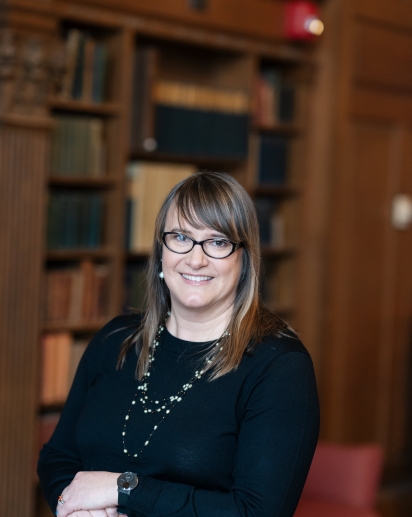
Dr. Bruna Petreca is a Professor and Reader in Human Experience and Materials at the Royal College of Art's Materials Science Research Centre. She specializes in integrating human experience into materials development, focusing on circular economy, digital environments, and health/wellbeing. Her research leads projects like the UKRI Textiles Circularity Centre and EPSRC Dematerialisation initiatives, emphasizing sustainable fashion, consumer behavior, and digital tools. Educated at the University of São Paulo (BA in Fashion/Textiles) and the RCA (PhD in Design Products), she has a postdoctoral background at TU Delft. Awards include 2013 Human Centred Design prizes and recognition for her work on material experience frameworks. She collaborates internationally, chairs research ethics at RCA, and co-leads projects on AI design tools and circular fashion. Her teaching spans undergraduate/postgraduate levels, emphasizing materials science, human-centered design, and sustainable practices. Education: PhD (RCA), Postdoc (TU Delft), BA (USP) Key Projects: Textiles Circularity Centre (UKRI), Consumer Experience Digital Tools (EPSRC), Brazil-UK Natural Polymers Network Awards: Best Concept/Human Centred Design (2013), Best Poster Presentation (2013) Research Themes: Circular fashion, material experience frameworks, embodied design, AR tools for sustainability
Dr Liz Tregenza is a Lecturer in Cultural and Historical Studies at London College of Fashion, University of the Arts London, specializing in 20th-21st century fashion history and business networks with emphasis on digital innovation and sustainability. Her academic credentials include: PhD in History of Design, University of Brighton (2015-2018) MA in History of Design, Royal College of Art (2012-2014) BA in Fashion Design, University of Leeds (2008-2012) PgCert Academic Practice, University of the Arts London (2023-2025) Tregenza's research examines fashion through intersecting lenses of business history, migration studies, and digital transformation. Her work reveals how Jewish émigré entrepreneurs shaped London's wholesale couture industry while exploring contemporary issues like vintage commodification and online secondhand markets. Historical business networks in fashion Sustainable prosperity models Migration-driven industry innovation Digital marketplace evolution Analysis of her 15 most recent publications shows consistent focus on archival business records to reconstruct historical fashion economies, with increasing attention to digital transformation. Key threads include Jewish émigré contributions to London's fashion infrastructure, the paradoxes of 'sustainable prosperity' in historical contexts, and the commodification of vintage fashion through platform capitalism. Her professional recognition includes: Fellowship of Advance HE (FHEA) Fellow of the Royal Historical Society Tregenza has secured significant research funding as Co-I on Pasold Research Fund grants for 'Everyday Fashion: Extraordinary Stories of Ordinary Clothes' (2019) and the 'Sartorial Society Series' online seminars (2020), facilitating collaborative conferences across UK institutions. Her media engagements with Vogue, Harper's Bazaar, and Cosmopolitan demonstrate public impact. She actively contributes to interdisciplinary research networks including the Sartorial Society Series and collaborates on major publications like 'Everyday Fashion: Interpreting British Clothing Since 1600', focusing on transnational fashion histories and methodological innovation in material culture studies.
Erja Sipilä is a University Lecturer and Vice Dean for Education at the Faculty of Information Technology and Communication Sciences, Tampere University. She specializes in interdisciplinary research at the intersection of e-textiles, educational technology, and sensor systems. Her work includes developing wearable healthcare devices for swallowing movement analysis and advancing flipped learning methodologies in engineering education. She actively contributes to smart clothing innovation and RFID technology research, particularly in additive manufacturing applications. Her research focuses on practical solutions for healthcare monitoring, user-centered textile sensor design, and improving STEM pedagogy through blended learning systems. Key projects include the Smart Campus Innovation Lab and initiatives to transition traditional teaching to online/digital formats. She has led curriculum development efforts in electronics engineering, emphasizing hands-on project work and anonymous feedback systems to enhance student learning experiences. Erja has organized workshops on educational technology and participated in SEFI conferences, highlighting her commitment to academic networking and educational policy. While no specific awards are listed, her contributions to pedagogical innovation and wearable technology development demonstrate impactful academic engagement.
Jacqueline D. Wernimont is the Distinguished Chair in Digital Humanities and Social Engagement at Dartmouth College , where she holds an appointment as Associate Professor in Film and Media Studies. She is faculty affiliate in Women's, Gender, and Sexuality Studies and Quantitative Social Sciences. Her work bridges digital humanities, data history, and multisensory data representation.
Megan Hofmann is an Assistant Professor holding dual roles at Northeastern University's Khoury College of Computer Sciences and the Department of Mechanical and Industrial Engineering (College of Engineering). She earned her PhD in Human-Computer Interaction from Carnegie Mellon University in 2022. Her research focuses on accessibility and digital fabrication, particularly in healthcare contexts, including automated machine knitting and medical making. She leads the Accessible Creative Technologies (ACT) Lab, which develops tools like Maptimizer (custom tactile maps), OPTIMISM (collaborative optimization frameworks), and KnitGIST (generative knitting design). Her work addresses challenges in assistive technology fabrication, such as creating accessible medical devices and optimizing rapid prototyping in healthcare. Recent projects include NSF-funded research on interactive smart textiles and studies on distributed manufacturing during the COVID-19 pandemic. Hofmann’s contributions span interdisciplinary domains, blending computer science, mechanical engineering, and healthcare innovation. Grants & Awards: Recipient of a $550,000 NSF grant for smart textile tools (2024). Labs: ACT Lab focuses on inclusive digital fabrication systems.
Ehsan Esfahani is an Associate Professor and Director of Graduate Studies in the Department of Mechanical and Aerospace Engineering at the University at Buffalo's School of Engineering and Applied Sciences. He is affiliated with the Stephen Still Institute for Sustainable Transportation and Logistics. His research focuses on AI-driven robotics, human-machine interaction, and bio-mechatronics systems. Education: PhD in Mechanical Engineering, University of California, Riverside (2012) MS in Electrical Engineering, University of California, Riverside (2012) MS in Mechanical Engineering, University of Toledo (2007) BS in Mechanical Engineering, Isfahan University of Technology (2004) Research Interests: Brain-computer interfaces for CAD/robotic systems Human-robot collaboration and neuroergonomics Bio-inspired robotics and tactile sensing Swarm intelligence and multi-agent systems Variable stiffness actuators for safe manipulation Key Contributions: Esfahani's work bridges AI with physical systems, emphasizing real-time human-in-the-loop control. Recent trends in his publications focus on scalable swarm robotics, human-swarm interaction dynamics, and adaptive gripper designs for confined environments. His neurophysiological approaches assess cognitive load in collaborative tasks, enhancing system safety and efficiency. Awards: American Power Public Associations DEED Scholarship (2012) UC Riverside Dissertation Year Fellowship (2011–2012) Lung-Wen Tsai Memorial Scholarship (2010) Advising & Labs: Directs the HILS Lab (Human-Inspired Learning Systems), exploring human-centered robotics. Active in grants focusing on AI-driven factories, cognitive modeling in surgery, and variable stiffness mechanisms. Collaborates on projects like SHaSTA (Human-Swarm Team Simulator) and MyoTrack rehabilitation systems. Labs & Teams: HILS Lab: Human-AI collaboration frameworks Stephen Still Institute: Transportation logistics and sustainability
Prof. Katerina Rose is a Professor of Clothing Technology & CAD at Reutlingen University's TEXOVERSUM School of Textiles. She leads the Department of Clothing Technology and CAD, focusing on innovative textile design methodologies. Her expertise includes 3D pattern construction, technical textiles manufacturing, and AI-driven garment design. Her research emphasizes digital avatars for clothing simulation, low-cost 3D scanning technologies, and soft tissue modeling. Notable projects include the InBiO initiative for bio-based automotive interiors and the FLAX365 regional textile chain initiative. She holds a patent (DE102020119338A1) for patternless garment cutting methods. Teaching areas: Clothing Technology, CAD Pattern Construction, Technical Textiles Manufacturing Labs: Sewing & CAD Lab, Material Testing Lab, Electronic Textiles Lab Key collaborations: Hometrica Consulting, SciTePress, Browzwear Recent work explores microwave imaging for body dimension capture and AI-enhanced pattern generation, published in journals like Communications in Development and Assembling of Textile Products. Her contributions bridge textile engineering with digital innovation in fashion and medical applications.
Anders-Petter Andersson is an Associate Professor at the Department of Design within NTNU's Faculty of Architecture and Design. His work focuses on health-promoting technologies, multisensory interaction design, and co-design methodologies with marginalized populations. He has led projects involving families with disabled children, elderly dementia patients, and community stakeholders through initiatives like RHYME.no and HackOurHealthEcology. His research integrates music, narrative, and cultural expression to enhance social relationships and creativity. Key projects include Polly World installations and ORFI interactive systems. He teaches courses such as User-Centered to Post-Human Design and supervises PhD candidates including Ann Kristin Forshaug. Andersson is affiliated with MusicalFieldsForever, the Center for Health Promoting Research, and serves as chairman of Den Gode Idé Foundation. His work emphasizes universal design principles and participatory design practices. Key Projects: RHYME.no, Polly World series, ORFI installations, Music-based environmental therapy program Collaborations: Norwegian Research Council, Diakonhjemmet University, AHO, Lund University Methodologies: Action Research, Participatory Design, Research-by-Design, Self-Ethnography Research interests span interactive music composition, health-promoting environments, and regenerative learning communities. He advocates for eco-centric design approaches and has published extensively on topics like tangible interaction and multisensory interfaces.
Ridoan Karim is a Senior Lecturer at the Department of Business Law & Taxation, School of Business, Monash University Malaysia. His work bridges Business Law, International Trade Law, Environmental Law, Energy Law, and Technology Policy , with a focus on energy justice, AI ethics, blockchain applications, and legal frameworks for emerging technologies . Primary Research Areas: Energy Justice, AI Ethics, Blockchain Legal Issues, Privacy Law, and Sustainable Development Geographic Focus: Malaysia, Bangladesh, and broader Southeast Asian contexts Recent Research Trends His publications from 2018-2025 show consistent exploration of: Legal implications of AI integration in energy, healthcare, and manufacturing Blockchain technology for energy systems, health coverage, and financial transparency Energy justice frameworks across Southeast Asia and emerging economies Privacy law development in smart cities and digital environments Comparative legal studies between common law and Islamic/Shari'ah frameworks Scientific Awards No specific awards mentioned in available texts.
Afroditi Psarra is an Associate Professor of Digital Arts and Experimental Media (DXARTS) at the University of Washington, where she runs the DXARTS SoftLab. Her work bridges art, science, and technology with a focus on critical discourse in the creation of artifacts. She has presented her work at internationally renowned media art festivals such as Ars Electronica, Transmediale, CTM, Eyeo, Piksel, and WRO Biennale, as well as venues like Bozar, Onassis Stegi, EMST (Greek Museum of Contemporary Art), and Walker Art Center. Dr. Psarra's research centers on the art and science interaction with a critical discourse in the creation of artifacts. She is particularly interested in the use of the body as an interface of control, and the revitalization of tradition as a methodology of hacking existing norms about technical objects. Her practice builds on and extends the work of Cyber and Techno-Feminism(s) and the idea of female (and feminized) bodies as matrices of information. Her educational background includes a Ph.D. from Complutense University of Madrid, Spain (2014). Her recent publications and projects demonstrate a consistent exploration of wearable technology, e-textiles, physical computing, and sound art. Psarra's work often examines the intersections of technology with gender, embodiment, and cultural critique, particularly through her investigations of voice assistants, RF technologies, and bodily interfaces. She frequently collaborates with other artists and researchers across disciplines to create interactive installations and performances that challenge conventional technological paradigms. Dr. Psarra's scholarly output spans multiple domains including human-computer interaction, media art, performance studies, and critical technology studies. Her work consistently addresses themes of technological embodiment, materiality, and the politics of interface design across her various projects from voice assistant subversion to RF ecology explorations. 2019 Bergstrom Award for Art & Science Mellon Faculty Fellow 2019-20 As an educator, Dr. Psarra teaches courses in mechatronic art, material and cultural bias in algorithmic systems, and special topics in digital arts. She has mentored numerous students through their creative research projects and has been involved in various interdisciplinary initiatives at the University of Washington, including collaborations with the Systems Biology program. Her teaching emphasizes hands-on experimentation, critical making, and the exploration of technology through artistic practice. Dr. Psarra leads the DXARTS SoftLab, which serves as a research space for exploring soft materials, electronics, and interactive systems. The lab supports projects that bridge traditional craft techniques with digital technologies, particularly focusing on e-textiles, wearable computing, and embodied interaction. Under her direction, the SoftLab has become a hub for interdisciplinary research that combines art, engineering, and cultural critique.
Hilkka-Maija Fagerlund is a Lecturer at Aalto University's Department of Design within the School of Arts, Design and Architecture. Her expertise focuses on advanced woven fabrics and jacquard workshop methodologies. Email: hilkka-maija.fagerlund@aalto.fi Phone: +358443573129 Research Interests As a textile design specialist, her work emphasizes: Textile Innovation through jacquard weaving and pattern development Sustainable Design principles in fabric creation Material Experimentation with hybrid structures Collaborative Design between institutions like Tama Art University Digital-Physical Integration in textile workflows Climate-Responsive Textiles through Designs for a Cooler Planet Publication Trends (2019-2025) Her research output demonstrates consistent focus on jacquard innovation and sustainable material applications across multiple exhibitions and collaborative publications. Key themes include pattern development, digital weaving technologies, and climate-conscious design solutions. Scientific Awards 2024: Heimtextil University Contest Student Prize 2024: Näyttely24 Award 2019: Aalto ARTS Grant 2019: ITHIB Fabric Design Contest awards 2019: Dorothy Waxman Prize finalist 2019: Minna Canth 175 competition winner 2015: Dorothy Waxman Prize finalist (as advisor) 2016: Protoshop finalist (as advisor) Student Advising She has mentored multiple award-winning students including: Leonardo Hidalgo Uribe Mithila Mohan Hanna-Kaisa Korolainen Teija Vartiaisen
Associate Professor Wei-Yu Chiu is an academic at Deakin University, affiliated with the Faculty of Science, Engineering and Built Environment/School of Information Technology. His research spans system optimization, multi-objective optimization, evolutionary computation, machine learning, and control theory, with applications in smart energy systems, control systems (bilinear matrix inequality), and robotics (warehouse automation). His work focuses on smart energy systems (demand response), control systems (bilinear matrix inequality), and robotics (warehouse automation). He actively supervises Masters and PhD students and seeks postdoctoral collaborators through the Deakin Fellowship. Recent publications (2023–2026) emphasize multiagent reinforcement learning for microgrid resilience, energy-efficient textile manufacturing with deep transfer learning, and bilinear matrix inequality optimization for control systems. Topics include blockchain-enabled energy trading, path planning in robotics, and risk-constrained battery utilization. Education: PhD in Mathematics, National Tsing Hua University, Hsinchu, Taiwan Collaborations are centered on multirobot systems, transactive energy, and synthetic data generation for energy networks.
Dr. Elisa Roldan-Ciudad is a Lecturer in Biomedical Engineering at the Department of Engineering, Manchester Metropolitan University. She holds a PhD in Biomedical Engineering (2019) and is a Fellow of the Higher Education Academy (FHEA). Her research focuses on biomaterials, tissue engineering, and biomechanics, particularly in the design of electrospun scaffolds and ligament/vascular implants using machine learning-driven approaches. She actively contributes to academic governance through roles such as Departmental Athena Swan Lead and membership in the UK Metamaterials Network. Education: MEng (Biomedical Engineering, University of Zaragoza, 2011), MSc (Health and Safety, University of Barcelona, 2009), and PGCLTHE (Manchester Metropolitan University). Professional memberships include the Engineering Professors Council and Turing University Network. Teaching spans undergraduate and postgraduate courses in mechanical engineering, design, and biomedical applications. She supervises PhD students in biomaterials and biomedical manufacturing. Research highlights include biomimetic scaffold optimization and gender equality initiatives in engineering departments. She has collaborated with clinical institutions like the Ludwig Maximilian University of Munich and industry partners such as AlphaSIP S.L. Service roles include EPSRC Peer Review College membership and editorial contributions to journals like Nanomaterials . Her work bridges computational methods (machine learning) with material science to advance regenerative medicine and sustainable biomaterials.
Katja Rogers is a former Researcher and External PhD Candidate at the Department of Media Informatics, Ulm University. She earned her M.Sc. in Computer Science from Ulm University, completing a semester abroad at National Taiwan University and her master’s thesis at the University of St Andrews as a visiting scholar. Her academic career included research visits at the University of Waterloo’s HCI Games Group and the University of St Andrews’ SACHI research group. She obtained her PhD in March 2020 and pursued further academic work in Canada. Education: M.Sc. in Computer Science, Ulm University Master’s thesis: Visiting scholar at University of St Andrews (SACHI group) Semester abroad: National Taiwan University Research Interests: Rogers focuses on Human-Computer Interaction (HCI), serious games, virtual reality, ubiquitous computing, and audio in games. Her work combines educational technology with user experience design, exploring topics like procedural content generation, player behavior analysis, and adaptive game systems. Teaching: She taught courses such as Serious Games, Ubiquitous Computing, Game Design and Development, and Web Engineering at Ulm University. She also led seminars on Research Trends in Media Informatics. Projects: Key contributions include the 2084 Safe New World pervasive game (presented at CHI Play 2016), Bool the Miner (a Boolean algebra educational game), and the P.I.A.N.O. interactive piano learning system. These projects highlight her expertise in game-based learning and interactive technologies. Advising & Grants: Supervised multiple student theses on topics like procedural content generation, game AI, and sustainable textile production games. Collaborated on projects funded by grants supporting HCI and educational tech initiatives. Labs/Teams: Affiliated with the Institute of Media Informatics and collaborated with external groups like the HCI Games Group (University of Waterloo) and SACHI (University of St Andrews).
Egidio Falotico is a Tenure Track Assistant Professor (RTD-B) at the BioRobotics Institute, Scuola Superiore Sant’Anna, Pisa, Italy. He leads the BRAin Inspired Robotics (BRAIR) Lab and holds roles such as Principal Investigator (PI) for the PROBOSCIS project and co-leader of Sub-Project 10 (Neurorobotics) in the Human Brain Project (HBP). His research focuses on brain-inspired motor control, soft robotics, and neurorobotics, integrating computational neuroscience with robotic systems. Education: Dual PhD in Biorobotics (Scuola Superiore Sant’Anna) and Cognitive Science (University Pierre et Marie Curie). Master’s in Computer Science (University of Pisa). Research interests include control mechanisms for soft robots using AI, bio-inspired motor control, and neuroscientific principles applied to robotics. He has contributed to projects like HBP, where he developed the Neurorobotics Platform, and PROBOSCIS, aiming to create elephant-trunk-inspired robots. Teaching includes leading PhD courses on Brain-Inspired Motor Control and Robotics at the University of Pisa. He has supervised EU-funded students and managed interdisciplinary teams in neurorobotics and soft robotics. Key projects involve HBP’s Neurorobotics Platform, soft robot control (e.g., PROBOSCIS), and collaborations in sensorized systems and adaptive learning algorithms. His work bridges neuroscience, AI, and robotics to advance soft robotic systems and bio-inspired models.