Dr. Rebekka Burkholz is a tenured faculty member at the CISPA Helmholtz Center for Information Security in Saarbrücken, Germany, leading the Relational Machine Learning Group . Her research bridges machine learning and complex network science to develop robust, data-efficient models with applications in molecular biology. Previously, she held positions at Harvard T.H. Chan School of Public Health and ETH Zurich. PhD in Systems Design (2016) from ETH Risk Center Mathematics and Physics BSc/MSc from TU Darmstadt Her work focuses on sparse training methods and theoretical deep learning , addressing challenges like computational efficiency and adversarial robustness. Recent publications explore: Sparse training via implicit sparsification GNN optimization through rescaling and rewiring Integration of domain knowledge in biomedical modeling Theoretical guarantees for batch normalization and lottery tickets Scientific awards include: Zurich Dissertation Prize (2016) CSF Best Contribution Award (2016) She actively advises PhD students and collaborates with interdisciplinary teams in biostatistics and systems biology.
Prof. Heinrich Lukas is a Professor of Data Science in Physics at the Technical University of Munich, affiliated with the TUM School of Natural Sciences and the Department of Physics. His research focuses on experimental particle physics, leveraging advanced data science techniques and computational methods in collaboration with the ATLAS experiment at CERN's LHC. He actively contributes to detector calibration, high-energy collision analysis, and machine learning applications in physics. Recent work includes studies on vector-like quarks, Higgs boson properties, and off-shell phenomena, utilizing cutting-edge simulation-based inference and cloud computing infrastructure. His interdisciplinary projects span from collider physics to healthcare-related studies, such as analyzing dermatitis treatments in clinical registries. Key research interests include: Machine learning-driven particle physics analysis Collider data interpretation (ATLAS experiment) Jet physics and flavor tagging Searches for Beyond Standard Model particles Computational infrastructure optimization Publications (2025) highlight contributions to missing transverse momentum reconstruction , vector-like quark searches , and neural simulation-based inference . Collaborations involve international teams working on ATLAS Run-2 datasets and LHC Run 3 computing frameworks. Current efforts emphasize leveraging AI infrastructure for particle physics while maintaining involvement in medical data analysis.
Prof. Dr. Matthias Althoff is an Associate Professor of Cyber-Physical Systems at the Technical University of Munich (TUM), leading the Chair of Cyber-Physical Systems within the TUM School of Computation, Information and Technology. His research focuses on formal safety verification, model-based design, and reachability analysis for systems such as autonomous vehicles, robotics, and power grids. Education: He earned his diploma in Mechatronics and Information Technology (2005) and PhD (2010, summa cum laude) from TUM. He held postdoctoral positions at Carnegie Mellon University (2010–2012) and served as a junior professor at TU Ilmenau (2012–2013) before joining TUM as a full professor in 2013, becoming an associate professor in 2019. Research Interests: His work spans cyber-physical systems, formal methods for safety assurance, autonomous vehicles, modular robotics, and smart grid control. He develops tools like CommonRoad and CORA for scenario-based testing and reachability analysis. Awards: He has received the IEEE/ACM William J. McCalla ICCAD Best Paper Award (2012) and the Best Poster Award at the IEEE Intelligent Vehicles Symposium (2009). Labs/Projects: Leads the Cyber-Physical Systems group, collaborating on projects such as the Scenario Factory for automated vehicle testing and CommonPower for safe smart grid control. He also co-founded startups RobCo and aiina .
Prof. Dr. Rüdiger von Eisenhart-Rothe is a full Professor and Chair of Orthopedics at the Technische Universität München (TUM), leading the Department of Orthopedics and Sports Orthopedics at the Klinikum rechts der Isar. His research focuses on regenerative medicine, osteo-oncology, endoprosthetics, and the application of machine learning in surgical planning. He completed his medical studies at LMU Munich and business administration at the University of Hagen, followed by a habilitation in orthopedics at Frankfurt’s Friedrichsheim Hospital. Notably, he received the Perthes Prize twice (2003, 2010) for contributions to shoulder and elbow surgery. His work integrates advanced imaging techniques, virtual planning, and biomaterial research to address challenges in joint replacement, infection control, and sarcoma management. Recent projects emphasize AI-driven diagnostic tools and personalized surgical approaches. Prof. von Eisenhart-Rothe collaborates with interdisciplinary teams to advance clinical outcomes in orthopedic surgery, particularly in knee and hip arthroplasty. Awarded the Perthes Prize twice, his contributions span academic leadership, clinical innovation, and translational research at TUM’s School of Medicine and Health. Current initiatives include optimizing prosthetic alignment via 3D modeling and evaluating synovial biomarkers for infection diagnosis.
Nicolai Kröger is a researcher at the Chair of Communication Networks (Prof. Kellerer) at the Technical University of Munich (TUM). He holds an M.Sc. in Electrical and Computer Engineering from TUM, where his thesis focused on P4 switch performance modeling using queuing theory. His current research centers on 6G networks for critical telemedicine applications, particularly within the 6G-Life project, emphasizing end-to-end communication for medical robotics and surgical systems. He contributes to projects like the 6G Future Lab Bavaria and collaborates with the MITI group at Rechts der Isar Hospital to develop medical testbeds requiring high availability and low latency. Kröger also supervises student theses on 5G/6G security, network optimization, and in-network computing. His technical expertise spans programmable networks (P4), SDN, and performance analysis of network devices. He serves as a supervisor for student projects and internships, including implementations of medical testbeds and security analyses of cellular broadcast messages. His work bridges academic research with practical applications, aiming to advance communication networks for healthcare and future 6G systems.
Pan Pan is a Professor in the Department of Biomedical Engineering at Huazhong University of Science and Technology, with extensive research contributions spanning medical image analysis, computer vision, and underwater wireless communications. Their work demonstrates strong interdisciplinary collaboration between biomedical engineering and computer science, with significant industry partnerships including Alibaba. Research interests focus on medical image analysis (particularly automatic breast ultrasound systems), deep learning applications in healthcare diagnostics, and secure underwater communications . Their work bridges theoretical advances with practical clinical applications, developing innovative segmentation algorithms, tumor detection systems, and secure communication protocols for specialized environments. Analysis of recent publications reveals a strong trend toward integrating multi-modal data fusion techniques with uncertainty-aware deep learning models for medical diagnostics. The research spans both fundamental algorithm development (novel segmentation networks, feature matching optimization) and domain-specific applications (ABUS tumor detection, ICU mortality prediction, underwater sensor networks). Pan Pan maintains active collaborations with major Chinese technology companies and academic institutions, evidenced by the consistent publication record in top-tier conferences including CVPR, ICCV, and NeurIPS. While specific awards aren't documented in the provided materials, the research impact is demonstrated through numerous high-impact publications across computer vision and biomedical engineering venues. The research program shows particular strength in translating computer vision techniques to medical applications, with significant contributions to semi-supervised learning approaches for medical image segmentation where labeled data is scarce. Recent work also demonstrates growing interest in secure communications for specialized environments like underwater sensor networks.
Piotr Pacyna is a researcher at the Faculty of Electronics, Telecommunications and Informatics, Gdansk University of Technology. He is actively engaged in academic research, with a focus on cybersecurity, identity management, and network protocols. His research interests include: Cybersecurity Identity Management Systems Network Protocols Virtualization in Future Internet Wireless Networks Group Key Distribution Piotr's recent publications highlight his work in blockchain-based identity discovery, self-healing cryptographic protocols, and network security frameworks. His contributions span both theoretical and practical implementations in cybersecurity and network systems.
Dr. Sven Burger is a leading Researcher at the Zuse Institute Berlin (ZIB) within the Modeling and Simulation of Complex Processes department. His work focuses on Nanophotonics , Quantum Technologies , and Optical Resonance Computation , particularly in photonic crystals, plasmonic systems, and quantum light sources. Key projects: NanoLab GRIPS 2024 , MATH+ TES QT , MATH+ PaA-1 (perovskite solar cells), Colour Impression of Solar Cells Collaborations: MATH+ , BIFOLD , Research Campus MODAL His research spans Bayesian optimization for quantum systems, quasinormal mode expansions , chiral plasmonics , and terawatt-scale photovoltaics . Recent work emphasizes RPExpand software for resonance analysis and AAA algorithm applications in photonic design. He contributes to quantum key distribution via plug&play single-photon sources, hot carrier dynamics in plasmonic nanocrystals, and high-efficiency light extraction for deep-UV LEDs. His computational methods address non-Hermitian systems , exceptional points , and self-interference nanoparticle tracking .
Julie Delon is a faculty member at Université Paris-Cité , France, recognized internationally for her expertise in optimal transport theory and its applications to Gaussian mixture models . In March 2024 she delivered an invited workshop presentation at Humboldt-University of Berlin on “Optimal Transport with Invariances between Gaussian Mixture Models,” outlining novel theoretical contributions and practical algorithms for computing Wasserstein and Gromov-Wasserstein distances between GMMs. Her research spans the mathematical foundations of OT, including barycenters, geodesic spaces, and invariant transport plans, and extends to concrete applications such as texture synthesis , color transfer , and evaluation metrics for generative models (FID) . The work integrates rigorous theory with efficient computational schemes, offering new tools for machine-learning practitioners and probabilistic modelers.
Massimiliano Pontil is a Professor at University College London's Department of Computer Science within the Faculty of Mathematical & Physical Sciences, with additional affiliation at the Italian Institute of Technology in Genoa. He leads cutting-edge research at the intersection of machine learning and dynamical systems theory. His research focuses on developing theoretical frameworks for learning transfer operators of stochastic dynamical systems using kernel methods. Pontil's work provides rigorous spectral learning bounds and addresses representation learning challenges in modeling time-evolving phenomena. His research spans both theoretical foundations and practical applications in data-driven science and engineering. Pontil's recent publications reveal a strong emphasis on Koopman operator theory, with particular attention to spectral analysis, error bounds, and efficient algorithms for large-scale dynamical systems. His work connects kernel methods with dynamical systems theory to create mathematically grounded approaches for forecasting and understanding temporal phenomena. His scientific contributions include multiple publications in top-tier venues including NeurIPS and ICLR, with recent work on invariant representations, long-term forecasting, and randomized algorithms for operator regression. Pontil collaborates extensively with researchers including Vladimir Kostic, Karim Lounici, and Pietro Novelli, leading a productive research group in this specialized area of machine learning theory.
André Siegel is a Lecturer for special tasks at the Electronic Media Technology Group, Department of Electrical Engineering and Information Technology, Technical University of Ilmenau. He is actively involved in research and teaching related to audio engineering and acoustics, with a focus on spatial sound reproduction and simulation. His research interests span Audio Engineering , Room Acoustics , Binaural Sound Reproduction , Spatial Audio , Acoustic Simulation , and Audio Signal Processing . His work emphasizes practical implementations in real environments, including crosstalk cancellation, head-related transfer function measurement, and sound field analysis. The publications reflect a consistent research trajectory from 2005 to 2013, with a concentration on spatial audio technologies, room simulation methods, and perceptual aspects of sound reproduction. Key themes include the optimization of stereo and binaural systems, low-frequency acoustic behavior, and advanced measurement techniques using vector sensors and spherical arrays. André Siegel has not been awarded any scientific prizes or fellowships mentioned in the available data. He collaborates with researchers such as Hans-Peter Schade, Stephan Werner, and Julius T. Fricke. His work contributes to both academic knowledge and practical applications in room acoustical consultancy and immersive audio systems. He is based in Helmholtz Building, Room H 3529, and can be contacted at andre.siegel@tu-ilmenau.de.
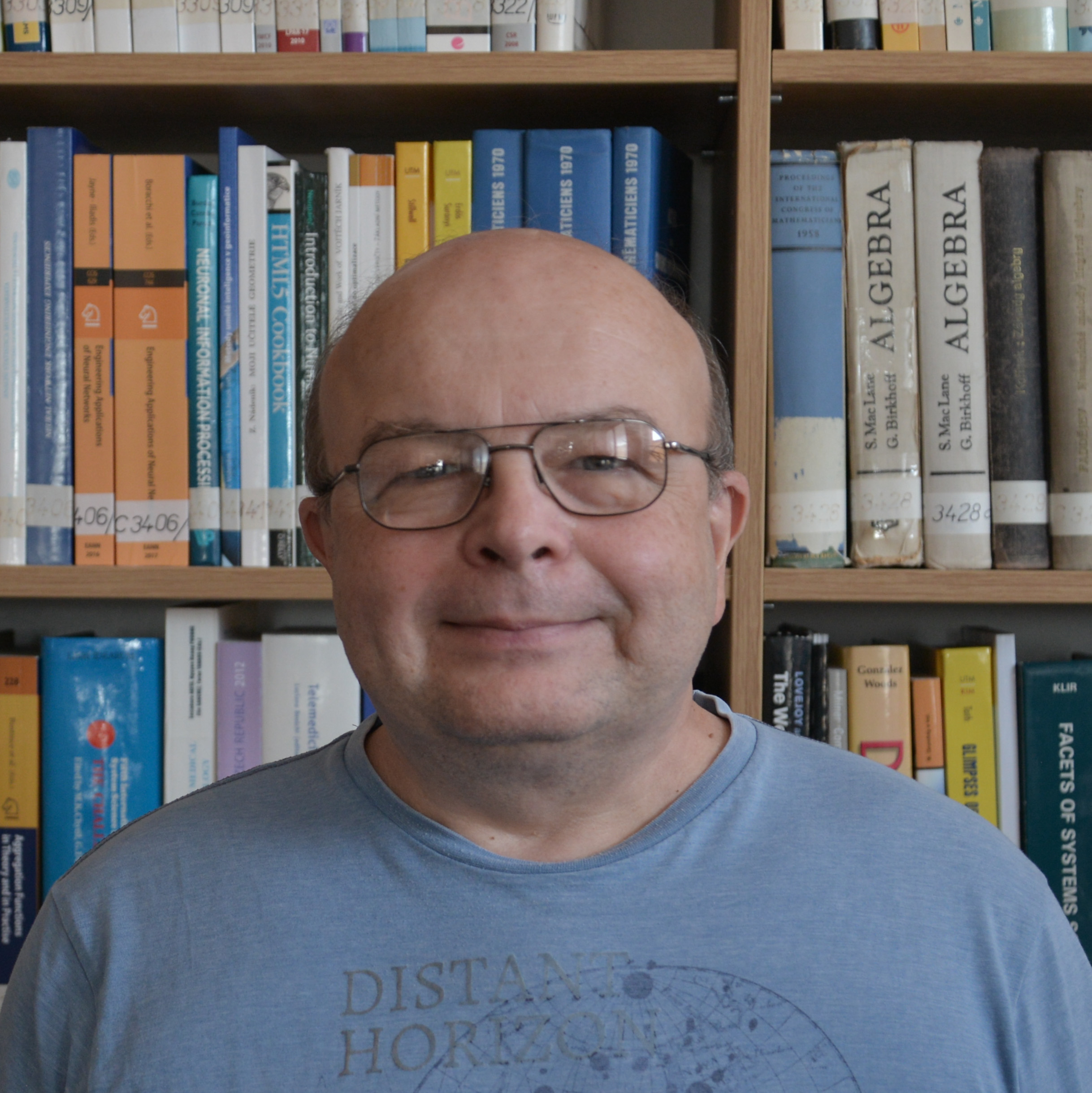
Jiří Šíma is a senior scientist at the Department of Theoretical Computer Science, Institute of Computer Science, Czech Academy of Sciences. He holds the academic title of Research Professor (DrSc.) and has been a key researcher at ICS CAS since 1994. He has also served as head of the department (2010–2012, 2021–2023) and has held external lecturing positions at Charles University, Masaryk University, and Czech Technical University. His educational achievements include a CSc. (Ph.D.) in 1993, an Associate Professor qualification (doc.) and RNDr. in 2000, and a DrSc. in 2009 from the Slovak University of Technology. These qualifications reflect his deep expertise in theoretical computer science and neural networks. Šíma's research focuses on the theoretical foundations of neural computation, including the computational power of analog and spiking neural networks, energy complexity in deep learning models, formal language recognition by neural automata, and complexity theory. His work bridges theoretical computer science and artificial intelligence, with a strong emphasis on mathematical rigor and computational models. The 15 most recent publications highlight a consistent trend in analyzing the computational capabilities and energy efficiency of neural networks. His recent work (2020–2024) centers on energy complexity in fully-connected and convolutional networks, while earlier work explores analog neuron hierarchies, hitting sets for branching programs, and the limitations of spiking neurons. The research spans subfields such as formal languages, computational complexity, dynamical systems, and neurocomputing, demonstrating a cohesive and long-term research trajectory in theoretical machine learning. Best ICS Paper Award (2024) Best ICS Paper Award (2021) Second/Third Best ICS Paper Award (2019) Best ICS Paper Award (2018) Otto Wichterle Award (2003) Award of the CAS for young scientists (1998) Šíma has been principal investigator on multiple Czech Science Foundation grants, including LEDNeCo (2025–2027), AppNeCo (2022–2024), and FoNeCo (2019–2021). He has also served on grant evaluation panels and scientific councils, including at the Czech Science Foundation and Charles University. Although no formal students are listed, he has collaborated extensively with researchers such as J. Cabessa, P. Vidnerová, S. Žák, and P. Orponen. He is actively involved in the academic community, serving on program committees for major conferences such as ICANN, ICONIP, SOFSEM, and MFCS. His work is primarily conducted within the Department of Theoretical Computer Science at ICS CAS, a leading research group in theoretical computer science in the Czech Republic.
Nathanaël Fijalkow is a Researcher at CNRS in LaBRI (Bordeaux) and a Research Fellow at The Alan Turing Institute in London. His primary research fields include games , machine learning , automata theory , and dynamical systems , with a focus on synthesizing programs from logical specifications and probabilistic models. Research Interests span program synthesis (programming by example), controller synthesis (temporal logic specifications), games on graphs (parity/mean payoff games), probabilistic automata (bounded ambiguity), and invariants for linear dynamical systems. He bridges formal methods with machine learning through projects like DeepSynth . Scientific Contributions include: Undecidability results for probabilistic automata Advances in parity game algorithms (quasi-polynomial lower bounds) Foundations of probabilistic modal logics Efficient synthesis techniques using SMT solvers and distributional learning Supervision involves guiding postdocs and PhD students such as Guillaume Lagarde, Antonio Casares, and Pierre Ohlmann. He has secured grants like the Momentum DeepSynth project (2019-2021) , aiming to merge formal methods with ML for program synthesis.
Martim Brandão is a Lecturer (Assistant Professor) in Robotics and Autonomous Systems at King’s College London, where he leads the Responsible Robotics and AI (RRAI) Lab and serves as Co-Director of the UKRI Centre for Doctoral Training in Safe and Trusted AI. His research focuses on ethical, explainable, and safe AI and robotics, with applications in human-robot interaction, motion planning, fairness, and societal impact. His research interests include: Explainable AI and Motion Planning Fairness and Bias in AI Systems Human-Robot Interaction and Social Robotics Adversarial Robustness in Robotics Value Alignment and Ethical AI Inclusive and Participatory Robotics Design His recent publications (2023–2025) reflect a strong trend toward socially responsible robotics, focusing on fairness in navigation, explainability of planning failures, worker-centered agricultural robotics, environmental justice in drone delivery, and the dangers of bias in drowsiness detection and LLM-driven robots. His work emphasizes user understanding, societal impact, and ethical safeguards in autonomous systems. He has advised and collaborated with numerous students and researchers across diverse topics in robotics and AI. He is actively involved in shaping responsible robotics through: Leadership in the RRAI Lab Co-directing a national CDT in Safe and Trusted AI Developing fairness-aware algorithms Advocating for inclusive and ethical design practices His lab and research group focus on: Responsible Robotics and AI Explainability in Multi-Agent Planning Fairness in Coverage and Navigation Human-Centered Evaluation of AI Systems
Dieter A. Fensel is a Full Professor at the Institute of Computer Science, Faculty of Computer Science, University of Innsbruck, Austria . He has held academic positions at the University of Karlsruhe, Vrije Universiteit Amsterdam, and the University of Amsterdam. He founded the Digital Enterprise Research Institute (DERI) in Galway and Innsbruck and co-founded the Semantic Technology Institute International (STI2). His work spans semantic technologies, knowledge engineering, and intelligent systems. PhD in Political Science, University of Karlsruhe (1993) Habilitation in Applied Computer Science, University of Karlsruhe (1998) Masters in Computer Science (TU Berlin) and Social Science (FU Berlin) His research interests focus on the Semantic Web, ontologies, knowledge representation, web services, and intelligent systems. He investigates how semantics can enhance data interoperability, service composition, and knowledge sharing in distributed environments. His work bridges formal methods with practical applications in e-commerce, tourism, and digital enterprises. He emphasizes the role of semantics in enabling machine-understandable content and automated reasoning across domains. The research trends in his publications and projects reveal a consistent focus on semantic technologies, from foundational work on knowledge representation (e.g., KARL language) to large-scale EU projects on data ecosystems (PlanetData, BYTE), travel (EuTravel), and energy (ENTROPY). His work evolved from theoretical AI and knowledge engineering to applied semantic web services, linked data, and digital innovation in societal domains. His scientific awards include: Carl-Adam-Petri-Award of the Faculty of Economic Sciences, University of Karlsruhe (2000) As an academic advisor, Dieter Fensel has supervised over 25 PhD students and served on numerous Master’s and PhD committees. He has led more than 100 national and international research projects with total funding in the hundreds of millions of euros, including major grants from the EU’s 7th Framework Program, Horizon 2020, and Science Foundation Ireland. These projects span domains such as big data, ambient assisted living, transportation, and digital services. He co-founded and led several research labs and teams , including: Digital Enterprise Research Institute (DERI), Galway and Innsbruck Semantic Technology Institute (STI) Innsbruck Semantic Technology Institute International (STI2) Co-founder of the European Semantic Web Conference (ESWC) and International Semantic Web Conference (ISWC) These organizations foster global collaboration in semantic technologies and have become central hubs for research, innovation, and community building in the field.