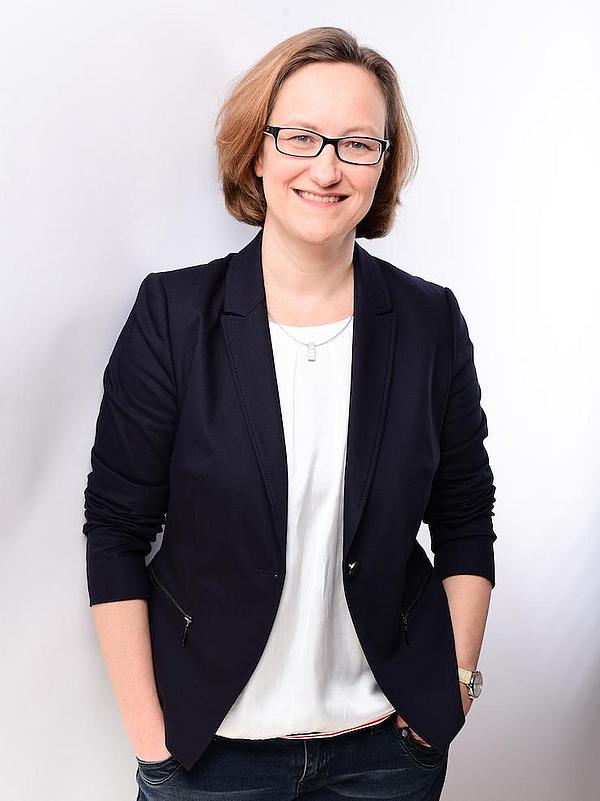
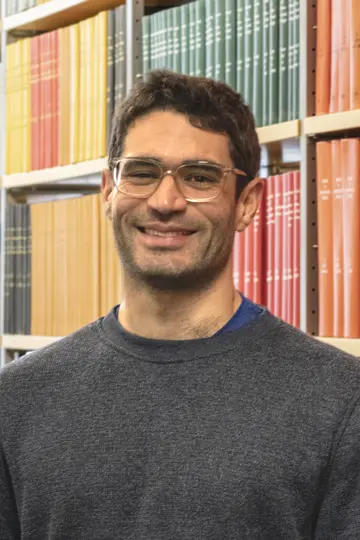
Prof. Laura Vargas Koch serves as Junior Professor at RWTH Aachen University, leading the Teaching and Research Unit of Algorithmic Game Theory and Discrete Mathematics (GDM). Her interdisciplinary work bridges mathematics, computer science, and economics through rigorous theoretical frameworks. Her research focuses on: Algorithmic Game Theory : Analyzing fair pricing mechanisms and equilibrium structures in traffic flow systems Combinatorial Optimization : Developing approximation algorithms for clustering problems and graph-based optimization Analysis of her 2021-2025 publications reveals evolving expertise in dynamic traffic modeling, routing game equilibria, and auction mechanism design. Her work consistently addresses theoretical foundations while maintaining practical relevance to transportation networks and resource allocation systems. The GDM unit under her direction provides specialized coursework and fosters collaborative research at the intersection of discrete mathematics and economic modeling.
Hao Liu is a researcher affiliated with institutions like Chinese Academy of Sciences , Beihang University , and Stanford University . His work spans Computer Science , Artificial Intelligence , and Robotics . Key affiliations: National Space Science Center (Beijing), School of Astronautics (Beihang), Key Laboratory of Pervasive Computing (Tsinghua) Research interests include Machine Learning , Image Processing , Graph Neural Networks , and Wireless Communication Optimization His recent publications focus on: Advanced control systems for fuzzy models Medical imaging via hyperspectral analysis Transformer-based approaches in NLP and vision Quantum-safe and edge computing protocols
Nicole Megow is a Professor holding the chair for Combinatorial Optimization in the Faculty of Mathematics and Computer Science at the University of Bremen since 2016. She is affiliated with several research clusters including Humans on Mars Initiative, Minds, Media, Machines, and Dynamics in Logistics. Her academic journey includes positions at TU Berlin, Max Planck Institute for Informatics, TU Darmstadt, and TU Munich. Professor Megow's research focuses on mathematical optimization, algorithm design and analysis, and operations research. Her specific interests span combinatorial and discrete optimization, efficient algorithms, scheduling theory, resource allocation, packing problems, network design, routing, and uncertainty models including online, stochastic, robust, and explorable approaches. Her work bridges theoretical foundations with practical applications in logistics and decision-making systems. Her recent publications demonstrate a strong trend toward integrating prediction models with traditional optimization frameworks, particularly in scheduling and matching problems. She has made significant contributions to understanding the role of uncertainty in optimization problems, developing algorithms that work effectively with incomplete or uncertain information. Her work spans multiple prestigious venues including Mathematical Programming, Algorithmica, SODA, STACS, and NeurIPS. Dissertation Award by the German Operations Research Society (2007) Berlin Science Award for Young Researchers (2013) Heinz Maier-Leibnitz Prize (2013) Listed among Germany's top 40 researchers below 40 (Capital, 2014, 2015) Professor Megow actively supervises PhD students and postdocs, including Max Stahlberg, Joes Biburger, Sarah Morell, Bart Zondervan, Zhenwei Liu, and Alexander Lindermayr. She serves on numerous program committees for major conferences including SODA, IPCO, and STOC, and holds editorial positions for several prestigious journals. Her current research projects include Optimization under Explorable Uncertainty (DFG funded), How robots learn how to use structure (seed grant from MMM research cluster), and Scheduling Invasive Multicore Programs Under Uncertainty (within TCRC 89).
Professor Asaf Shapira is a faculty member in the Department of Theoretical Mathematics at Tel Aviv University's School of Mathematical Sciences. He has been actively contributing to combinatorics and graph theory research for over a decade, with numerous publications in top journals including Journal of the ACM, Advances in Mathematics, and Geometric and Functional Analysis. Professor Shapira's research focuses on extremal combinatorics, graph theory, and property testing. His work explores fundamental questions in Ramsey theory, hypergraph theory, and probabilistic methods in combinatorics. He has made significant contributions to the study of graph regularity, removal lemmas, and extremal problems in dense and sparse graphs. His recent publications demonstrate a consistent focus on theoretical aspects of combinatorics with connections to theoretical computer science. A notable trend is his work on developing polynomial bounds for various combinatorial theorems and exploring connections between combinatorial structures and computational complexity. His research often bridges pure mathematics with theoretical computer science applications. Professor Shapira teaches advanced courses at Tel Aviv University including Extremal Graph Theory, Basic Combinatorics, and seminars on specialized topics in combinatorics. His teaching spans undergraduate and graduate levels, reflecting his commitment to educating the next generation of mathematicians.
Tibor Szabó is a Professor in the Combinatorics and Graph Theory group at the Department of Mathematics, Freie Universität Berlin. He holds a PhD from The Ohio State University, advised by Ákos Seress. Prior to his current position, he held roles at McGill University, ETH Zürich, the Institute for Advanced Study (Princeton), and the University of Illinois (UIUC) as a J.L. Doob Research Assistant Professor. Research Interests: His work focuses on combinatorics and combinatorial optimization, including extremal problems, random structures and algorithms, pseudorandom graphs, positional games, and the combinatorics of linear programming. He explores tools from algebra, probability theory, and topology applied to combinatorics. Teaching: He teaches courses such as Algorithmic Combinatorics, Extremal Combinatorics, and runs the Combinatorics Seminar. His lecture notes include works on positional games and explicit constructions in extremal combinatorics. Students & Postdocs: Notable PhD advisees include Yamaan Attwa, Silas Rathke, Simona Boyadzhiyska, and Patrick Morris. Postdoctoral fellows include Olaf Parczyk and Anurag Bishnoi. His research has involved collaborations with over 50 co-authors. Funding & Grants: Supported by grants from the Swiss National Science Foundation (SNF) and German Research Foundation (DFG), focusing on topics like positional games and extremal graph theory.
Prof. Stefan Wrobel is a Professor of Computer Science at the University of Bonn and Director of the Fraunhofer Institute for Intelligent Analysis and Information Systems (IAIS). He holds leadership roles, including Co-Director of the Lamarr Institute for Machine Learning and Artificial Intelligence and Managing Director of the Bonn-Aachen International Center for Information Technology (b-it). His research focuses on AI, machine learning, and big data applications in industry and society. He earned his PhD from the University of Dortmund and has held academic positions at Magdeburg University and Berlin Technical University. Active in national/international AI initiatives, he chairs the Fraunhofer Strategic Research Field on Artificial Intelligence and co-leads the Machine Learning Rhine-Ruhr (ML2R) Competence Center. Education: Master's (Georgia Tech), PhD (University of Dortmund). Research emphasizes intelligent algorithms, data analysis, and AI ethics. Awarded GI-Fellow (2022) and honored by the German Computer Science Society for contributions to AI history. Key roles include Editorial Board member of Machine Learning journals and advisory roles in AI ethics and certification. Scientific contributions span over 100 publications in machine learning, data mining, and visual analytics. Advised numerous PhD students on topics like graph mining and trustworthy AI. Leadership in institutions like Fraunhofer Technology Hub for Machine Learning and the German Computer Science Society's Special Interest Group on Knowledge Discovery.
James Reed Farre is a Researcher and Research Group Leader at the Max Planck Institute for Mathematics in the Sciences (MPI MiS) in Leipzig, leading the Geometry on Surfaces group since October 2023. Previously, he held roles including Juniorprofessor (W1/Assistant Professor) at Ruprecht-Karls-Universität Heidelberg (2022–2023), Gibbs Assistant Professor at Yale University (2021–2022), and an NSF Postdoctoral Fellow at Yale (2019–2020). He earned his PhD in Mathematics from the University of Utah in 2019 under Kenneth Bromberg. His research focuses on hyperbolic geometry, dynamics of earthquake flows, Teichmüller theory, and geometric group theory. Notable areas include affine laminations, hyperconvex representations of surface groups, and ergodic theory in geometric contexts. Farre has contributed to understanding minimal surfaces in hyperbolic 3-manifolds and has explored applications of bounded cohomology to discrete groups. Publications span topics like shear-shape cocycles, horocycle orbit closures, and Hamiltonian flows for pseudo-Anosov mapping classes. His work bridges pure geometry with computational methods, as seen in CAD algorithm development for rigid subsystems. Farre is actively involved in mentoring and has contributed to STEM education initiatives, including the Freshman Research Initiative.
Martin Grohe is a Professor at the School of Logic and Theory of Discrete Systems , part of the Department of Computer Science at RWTH Aachen University . His research spans Algorithms and Complexity , Logic , Database Theory , Graph Theory , and Machine Learning , with a focus on integrating logical frameworks into computational models. His recent work explores graph neural networks , Weisfeiler-Leman algorithms , and parameterized complexity , as seen in publications on isomorphism testing , database repairing , and probabilistic query evaluation . While no specific scientific awards are mentioned, his contributions to graph theory and machine learning are widely recognized through numerous peer-reviewed publications.
Sandra Keiper is a Lecturer at the Institute of Mathematics within Faculty II - Mathematics and Natural Sciences at Technical University of Berlin. She has held academic positions since at least 2011, including roles as Tutor, Assistant, and Lecturer, with teaching responsibilities in Analysis, Linear Algebra, and Partial Differential Equations for both mathematicians and engineers. Research interests include: Compressed Sensing and Sparse Signal Recovery Numerical Linear Algebra with applications to high-dimensional data Wavelet and curvelet transforms for geometric multiscale analysis Approximation theory for finite-valued and cartoon-like functions Deep learning and graph approximation techniques Professional activities : Active in teaching since 2011 (Analysis I-III, Functional Analysis, Integral Transforms) Supervising theses since 2015 on topics like Compressed Sensing and Deep Learning Invited lectures at Caltech, ETH Zurich, and Alan Turing Institute Research stays at Hausdorff Institute, ETH Zurich, and Duke University
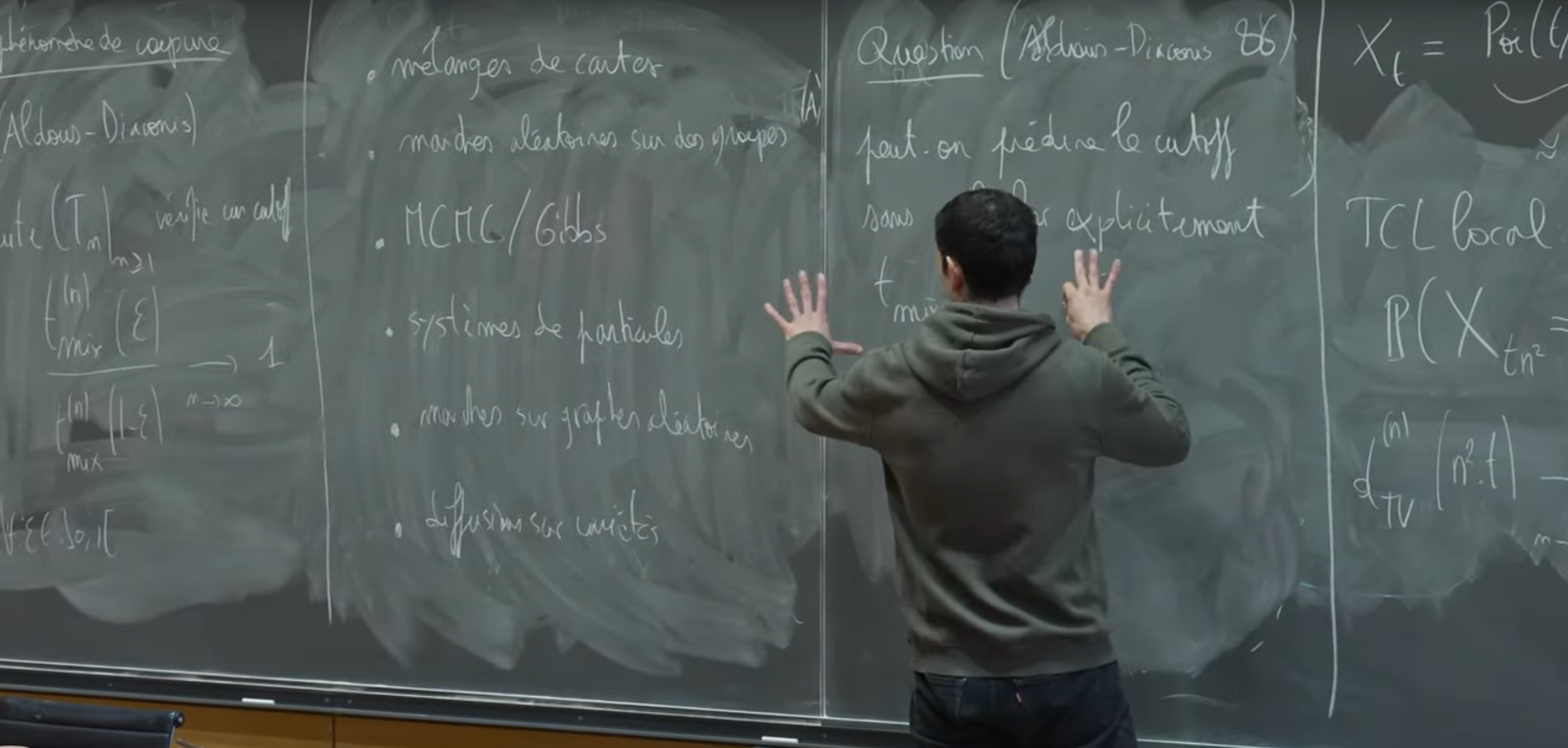
Justin Salez is a Professor of Mathematics at Université Paris-Dauphine & PSL University and an Institut Universitaire de France junior fellow. He serves as Principal Investigator for the ERC Consolidator Grant CUTOFF project, focusing on the cutoff phenomenon in Markov processes. His academic affiliations include editorial roles at Electronic Journal of Probability and co-organizing the CEREMADE Colloquium. Education: Mathematics Aggregation (2007-2008), Master in Probability (2006-2007), Master in Theoretical Computer Science (2005-2006), PhD (2008-2011). Professional Experience: Full Professor (2019-present) and Assistant Professor (2012-2019) at Paris Dauphine/Diderot, Postdoc at UC Berkeley (2011-2012). His research centers on Markov chain mixing times , non-negative curvature , and functional inequalities , with applications to random graphs, interacting particle systems, and MCMC algorithms. Key themes include entropy dissipation, cutoff criteria, and spectral analysis. The 15 most recent publications highlight advances in cutoff theory, curvature-entropy relationships, and functional inequalities. These span journals like Transactions of the American Mathematical Society , Annals of Probability , and Annals of Applied Probability , reflecting interdisciplinary work in probability, spectral theory, and statistical physics. Scientific Awards: ERC Consolidator Grant (2023), Marc Yor Prize (2024), Bourbaki Seminar (2024), Saint-Flour Lecture (2025), and Institut Universitaire de France fellowship (2019). As an advisor, he has supervised or is supervising PhD students including Alexandre Bristiel , Hong Quan Tran , and Guillaume Conchon-Kerjan . His lab, CEREMADE, hosts a monthly colloquium he co-organizes, fostering interdisciplinary dialogue in probability, analysis, and statistics.
Professor Stefan Glock is an Assistant Professor of Discrete Mathematics at the University of Passau's Faculty of Computer Science and Mathematics, a position he has held since September 2022. Prior to this appointment, he spent three years as a Junior Fellow at the Institute for Theoretical Studies at ETH Zurich, following the completion of his doctorate at the University of Birmingham. Stefan Glock received his mathematics education at Technische Universität Ilmenau from 2009 to 2014, then pursued his PhD at the University of Birmingham, which he completed in 2018. His doctoral dissertation, "Decompositions of Graphs and Hypergraphs," was the runner-up for the Richard-Rado-Preis 2018. Professor Glock's research focuses on discrete mathematical structures, with particular emphasis on their asymptotic properties. His work spans several interconnected fields of combinatorics: Extremal Combinatorics : Investigating the maximum or minimum possible size of mathematical structures satisfying certain properties Probabilistic Combinatorics : Applying probability theory to solve combinatorial problems Graph Theory : Studying properties of graphs and networks Ramsey Theory : Examining conditions under which order must appear in large structures Design Theory : Creating arrangements of elements satisfying specific balance properties Discrete Geometry : Analyzing geometric problems with discrete structures Analysis of Professor Glock's recent publications reveals a consistent focus on solving long-standing open problems in combinatorics using innovative methods that combine probabilistic techniques with structural insights. His work often bridges theoretical mathematics with applications in theoretical computer science, particularly in the analysis of algorithms and network structures. A significant portion of his research addresses fundamental questions about graph and hypergraph decompositions, which have implications for coding theory, cryptography, and network design. Professor Glock has received notable recognition for his contributions to mathematics: Runner-up for the Richard-Rado-Preis 2018 for his dissertation "Decompositions of Graphs and Hypergraphs" Awarded funding through the prestigious DFG Emmy Noether Programme in 2024 for his research group on "the interplay of structure and randomness in mathematics" As a faculty member at the University of Passau, Professor Glock leads the Discrete Mathematics research group and actively collaborates with mathematicians worldwide. He has established a strong research program that has attracted funding for academic visitors and supports multiple research projects. His approach to mathematical problems emphasizes developing new methods that have far-reaching implications beyond the specific problems being solved. Professor Glock's research group at the University of Passau focuses on the interplay between structure and randomness in discrete mathematics. The group maintains active collaborations with leading institutions including ETH Zurich, University of Birmingham, and various research centers across Europe. Through the DFG Emmy Noether Programme funding, his group is expanding its research on combinatorial structures and their applications.
Stefan Hougardy is a Professor at the Research Institute for Discrete Mathematics, part of the Mathematisch-Naturwissenschaftliche Fakultät at the University of Bonn. He is actively engaged in research and teaching, with a focus on discrete mathematics and combinatorial optimization. He contributes to academic governance through roles in examination boards, teaching mentoring, and faculty committees. Stefan Hougardy's research lies at the intersection of theoretical computer science and practical optimization. His primary interests include approximation algorithms, the Traveling Salesman Problem (TSP), Steiner trees, graph theory, and VLSI design automation. He develops efficient algorithms for NP-hard problems and analyzes their theoretical performance guarantees. His work often bridges theory and application, particularly in electronic design automation and mathematical programming. His recent publications demonstrate a strong focus on the complexity and approximation of combinatorial optimization problems. Key themes include the analysis of local search heuristics like k-opt for TSP, edge elimination techniques, fast matching algorithms, and optimal legalization in chip design. His work combines rigorous theoretical analysis with practical implementation and computational experiments. MPC 'Outstanding Paper of the Year' Award 2024 Stefan Hougardy supervises graduate students and leads seminars on discrete mathematics and optimization. He is involved in the Bonn International Graduate School of Mathematics and the Hausdorff Center for Mathematics, contributing to doctoral education and mentoring. While specific grant details are not listed, his sustained research output and leadership roles suggest active funding support. He also contributes to curriculum development and academic quality assurance through various institutional committees. He is affiliated with the Research Institute for Discrete Mathematics at the University of Bonn, a leading center for combinatorial optimization and algorithmic research. The institute is closely linked with the Hausdorff Center for Mathematics, fostering collaboration in discrete and applied mathematics.
Thorsten Schmidt is Professor of Mathematical Stochastics at the University of Freiburg, succeeding Prof. Ernst Eberlein in the summer semester of 2015. He also serves as Senior Financial Engineer at MathFinance. Previously, he held professorships at Chemnitz University of Technology (2008-2015), Technical University Munich (2008), and University of Leipzig (2004 onwards). From 2017-2019, he was a Research Fellow at the Freiburg Institute for Advanced Studies (FRIAS) in a joint research group with the University of Strasbourg and USIAS on the topic of Linking Finance and Insurance. His research focuses primarily on financial and actuarial mathematics, stochastic processes, and statistics, with recent work on machine learning methods and their applications in financial mathematics and AI regulation. In Freiburg, his goal with his young team is to tackle complex challenges with improved mathematical models and apply these methodologies to various fields. Key Research Areas: Financial mathematics and credit risks Pricing and hedging of derivative financial products Statistics of stochastic processes Energy markets and nonlinear filter theory Machine learning applications in finance and insurance His recent publications show a strong trend toward integrating machine learning with traditional mathematical finance, particularly in risk management, insurance-finance arbitrage, and robust financial modeling. His work increasingly addresses ethical considerations in AI applications within finance, reflecting his broader interest in responsible AI development. Notable Awards: IDA Award Finance (2015) FRIAS-USIAS Research Fellow (2017/2018) IDA Award Machine Learning and AI (2020) MAPFRE Research Grant (2020) Luis Bachelier Fellow (2021) As Editor-in-Chief of Statistics and Risk Modeling and Associate Editor for Mathematical Finance and International Journal of Theoretical and Applied Finance, Schmidt plays a significant role in academic publishing. He leads the CRC 'Small Data' research center with Harald Binder, focusing on medical problems where disease progression must be estimated with few data points per patient. His LeanAI project, funded by the Vector Foundation, explores the connection between machine learning and theorem-proving software LEAN, aiming to develop AI that can translate between mathematics and formal proof systems. His laboratory work centers around the application of stochastic methods combined with machine learning to solve problems in finance and insurance where data is limited ('Small Data' initiative), with significant funding from DFG (€12 million for CRC Small Data) and the Carl Zeiss Foundation.
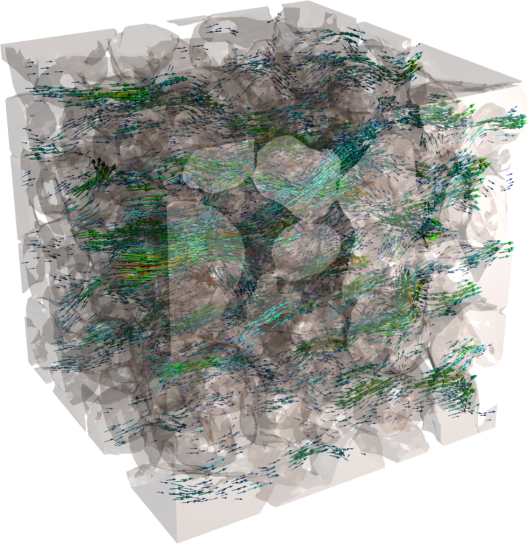
Christian Engwer is a full Professor at the University of Muenster in the Institute for Applied Mathematics, specializing in Analysis and Numerics. He leads the Engwer Group focused on Applications of Partial Differential Equations and is actively involved in the Cells in Motion initiative as a supervisor in the CiM-IMPRS Graduate Programme. His research centers on developing numerical methods for partial differential equations, particularly addressing challenges in complex geometries and multi-physics applications. He specializes in Unfitted Discontinuous Galerkin methods, which allow simulations on complex geometries without requiring domain-fitted meshes. His work spans porous media modeling, biological systems, and bioelectromagnetism applications, with significant contributions to EEG/MEG forward modeling in neuroscience. Analysis of his recent publications reveals a strong focus on model order reduction techniques, stabilized numerical schemes for cut-cell meshes, and applications in bioelectromagnetism. His work demonstrates a consistent trajectory toward developing robust, efficient numerical methods applicable to real-world problems in medical imaging and biological modeling, with increasing emphasis on high-performance computing implementations. Professor Engwer actively supervises doctoral students, with recent completions including Lukas Renelt (2025), Michael Wenske (2021), and Maria Carla Piastra (2019), among others working on topics related to numerical methods and biomedical applications. He leads several major research projects including BrainStorm: Highly Extensible Software for Advanced Electrophysiology and MEG/EEG Imaging (NIH-funded since 2019), multiple EXC 2044 Cluster of Excellence projects through 2025, and the InterKI interdisciplinary teaching program on machine learning and artificial intelligence. His group develops several important software packages including DUNE (Distributed and Unified Numerics Environment), duneuro (for bioelectromagnetism applications), and TPMC (Topology Preserving Marching Cubes). These tools support research in numerical methods and their applications to complex scientific problems.
Angkana Rüland is a Professor at the University of Bonn's Mathematical Institute and holder of the Hausdorff Chair at the Hausdorff Center for Mathematics (HCM), a Cluster of Excellence. She is a member of the Transdisciplinary Research Area ‘Modelling’ and a recipient of the prestigious Leibniz Prize (2025). Her research focuses on inverse problems, fractional PDEs, and phase transformations in materials science, with contributions to the Calderón problem and microstructure analysis. She has held positions at Oxford, the Max Planck Institute in Leipzig, and Heidelberg University before returning to Bonn in 2023. Education: She completed her Abitur, bachelor's/masters, and PhD (2014, Hausdorff Memorial Prize) at the University of Bonn, where she also co-founded the Bonn Math Club. Her academic journey includes postdoctoral research at Oxford and leadership roles in Leipzig and Heidelberg. Research interests span inverse problems (e.g., fractional Calderón problem), material microstructures (shape-memory alloys), and mathematical physics. Her work bridges pure and applied mathematics, addressing questions in elasticity, nonlocal operators, and energy scaling laws. Scientific awards include the Leibniz Prize (2025) for her groundbreaking research and the Hausdorff Memorial Prize for her doctoral thesis. She aims to use Leibniz Prize funds to strengthen her research group at HCM, furthering interdisciplinary collaborations. Her contributions have positioned Bonn as a global leader in mathematical research, with 20 Leibniz laureates since 1986.