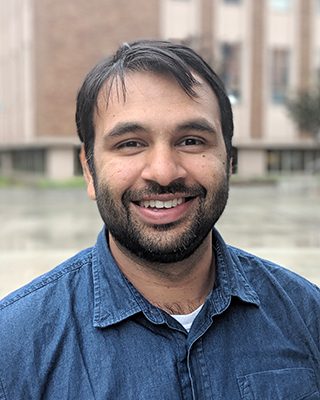
Dr. Anurag Purwar is an Associate Professor of Mechanical Engineering at Stony Brook University, directing the Computer-Aided Design and Innovation Lab and serving as PI for NSF I-Corps. He holds a Ph.D. from Stony Brook (2005) and a B.Tech. from IIT Kanpur (1995). His research merges rigid body kinematics with machine learning for mechanism and robot design, yielding 107+ peer-reviewed publications and patents licensed to industry. Key projects include the sit-to-stand walker assistive device (SAE Top 100 Award) and MotionGen software tools. Education: Ph.D., Stony Brook University (2005); B.Tech., IIT Kanpur (1995) Awards: A.T. Yang Award (2017), SAE Top 100 Award (2016), ASEE Distinguished Teaching Award (2021) Leadership: Program Chair (ASME 2014), Conference Co-Chair (IDETC 2016), NAI Senior Member Research focuses on machine learning-driven design of mechanisms, robotics, and assistive technologies. His labs develop algorithms for path synthesis, generative design, and kinematic analysis. He actively commercializes innovations through industry partnerships and has spun off startups like MotionGen.io.
Jun-Ki Choi is a Professor in the Department of Mechanical and Aerospace Engineering at the University of Dayton’s School of Engineering. He holds the O. Jack and Opal Anderson Faculty Fellowship in Engineering Innovation and serves as Director of the University of Dayton Industrial Training and Assessment Center (UD-ITAC), a U.S. Department of Energy-funded program providing energy efficiency assessments to small and mid-sized manufacturers. His research interests include: Sustainable Manufacturing Energy Efficiency Design for Environment Life Cycle Assessment Circular Economy Sustainable Energy Infrastructure Economic Systems Modeling Energy and Environmental Policy His recent publications focus on industrial energy efficiency, life cycle assessment, sustainable manufacturing, and the application of machine learning in energy systems. The research spans topics such as photovoltaic integration, desalination, refrigeration, compressed air systems, and building energy modeling, often combining techno-economic and environmental evaluations. Dr. Choi has received multiple awards for his work, including the U.S. Department of Energy Excellence in Applied Energy Engineering Research Award (2022), the ASHRAE Technical Paper Award (2017), and multiple recognitions as a Center of Excellence from the U.S. Department of Energy (2003, 2015). He has secured over $8 million in research funding as PI or Co-PI and has mentored numerous students through the UD-ITAC program, which has conducted over 1,000 energy assessments. He teaches courses such as Manufacturing Process, Heat Transfer, and Design for Environment at both undergraduate and graduate levels. Dr. Choi leads the UD-ITAC, a key research and outreach center focused on improving manufacturing competitiveness through energy savings, productivity improvements, and waste reduction. The center has received national acclaim for its impact and professionalism.
Steven Wu is an Associate Professor in the School of Computer Science at Carnegie Mellon University, with primary appointments in the Software and Societal Systems Department (S3D) and affiliated roles in the Machine Learning Department, Human-Computer Interaction Institute, CyLab, and Theory Group. Previously, he held positions at the University of Minnesota (Assistant Professor) and Microsoft Research-New York City (post-doctoral researcher). Ph.D. in Computer Science, University of Pennsylvania (co-advised by Michael Kearns and Aaron Roth) His research spans Machine Learning , Algorithms , Privacy , and Fairness , focusing on responsible AI foundations, interactive learning, causal inference, and economic applications. Recent work explores uncertainty quantification and privacy risks in synthetic data. He has received prestigious awards including the NSF CAREER Award and Penn's Rubinoff Award for his dissertation. His group mentors students across Ph.D. , postdoc, and visiting programs, with alumni now at institutions like UC Berkeley, Stanford, and Amazon. Key grants: NSF, Okawa Foundation, Open Philanthropy, Amazon, Google, J.P. Morgan, Meta, Mozilla, Apple, Cisco
Ben Lindley is an Assistant Professor of Nuclear Engineering and Engineering Physics at the University of Wisconsin-Madison since 2020. He leads research in advanced reactor design, reactor physics, and integrated energy systems with a focus on cost reduction, nuclear-solar co-generation, and multiphysics modeling. His work spans computational methods development, safety analysis, and fuel cycle optimization, supported by DOE grants and collaborations with Argonne National Laboratory. Education: PhD in Nuclear Engineering (Cambridge, 2014), MEng & BA in Mechanical Engineering (Cambridge, 2011) Affiliations: Joint faculty appointment at Argonne National Laboratory His research explores nuclear reactor design , flexible operation (load-following, thermal storage), and economic viability of advanced reactors. Recent publications highlight innovations in microreactors, molten salt systems, and fusion-fission hybrids, with methodological advances in reinforcement learning for reactor control and open architecture design . Key article trends include: Advanced reactor cost reduction Nuclear-solar synergy Accident-tolerant fuel analysis Fusion energy commercialization Uncertainty quantification High-fidelity computational modeling Scientific Awards : 2021 ICONE21 Best Paper Award 2011 Babcock Award Runner-Up IET Bill Kerss Scholarship ANS 40 Under 40 Cambridge Rex Moir Prize Ben leads the RETI Lab (reti.ep.wisc.edu), mentoring graduate students through courses like Nuclear Reactor Theory (NE405) and advising on advanced reactor projects with national laboratories.
Gerry Tsoukalas is an Associate Professor in the Information Systems Department at Boston University's Questrom School of Business . He is also a Visiting Professor at IMD Switzerland , Senior Fellow at the Wharton School , and Research Fellow at Cornell University's FinTech Initiative . PhD, Stanford University (2013) His research focuses on digital platforms , blockchain economics , and AI/ML applications in operations and finance. He co-founded the Crypto and Blockchain Economics Research Forum (CBER) , exploring topics like decentralized governance, tokenomics, and supply chain innovation. Recent publications examine blockchain scalability , privacy-preserving analytics , and tokenized financial systems . Awards include Dean’s Research Scholar and recognition by Thinkers50 Radar 2025 . He teaches business analytics at executive, graduate, and undergraduate levels . Affiliated with labs/teams: CBER Forum , Luohan Academy , and Harvard Business School research collaborations.
Marko Šarac is a Professor at Singidunum University in the Faculty of Informatics and Computer Science . He holds a Master's degree in Contemporary Information Technologies (2008) and a PhD in Advanced Protection Systems (2013) from the same institution. His research spans Cybersecurity, Artificial Intelligence, Blockchain, Internet of Things (IoT), Machine Learning, and Data Privacy . Education: Master: Contemporary Information Technologies, Singidunum University, 2008 PhD: Advanced Protection Systems, Singidunum University, 2013 Research Focus: SSL Traffic Security, Virtual Datacenters, Biometric Cryptography, and IoT Healthcare Systems Developed frameworks for Explainable AI in Metaverse Security , Blockchain-based IoT Security Gateways , and Machine Learning for Medical Diagnostics Notable Publications: 2025: CNN-enhanced attack detection for IoT-based Metaverse 2024: Modified Firefly Algorithm for medical dataset classification 2023: Space weather prediction using metaheuristics Projects: Co-author on 9+ books including Internet Marketing (2020) and Computer Network Security (2014) Contributed to 50+ peer-reviewed journals and conference papers on cybersecurity and AI Grants & Collaborations: Active in IEEE , ZINC , and Sinteza conference series Collaborated with researchers across Europe and Asia on IoT, Blockchain, and Cloud Security Contact: msarac@singidunum.ac.rs
Lalit Jain is an Assistant Professor at the Foster School of Business , University of Washington. His research bridges theoretical mathematics with practical machine learning systems, focusing on adaptive data collection under budget constraints, applied to marketing, cognitive psychology, and humor detection. Research Interests : Adaptive machine learning algorithms Bandit optimization and experimental design False discovery rate control Human-AI interaction Applications in marketing and cognitive science Advising : Justin Weltz (Neurips 2023) Zhaoqi (AISTATS) Romain (AISTATS) Zhihan (Amazon collaboration) Jennifer Brennan (ICML 2022 workshop) Projects : Co-developer of the New Yorker Caption Contest voting system Collaboration with Amazon on adaptive pricing systems
Timothy Sherwood is a Professor at the University of California, Santa Barbara (UCSB) in the Department of Computer Science , with affiliate status in Electrical and Computer Engineering . He serves as the Dean of the College of Creative Studies and leads the UCSB Computer Architecture Lab (ArchLab) . He co-founded the interdisciplinary SEEDS program and Cycuity , and has consulted for the UCSB Office of Research , including a tenure as Associate Vice Chancellor for Research .
Afsaneh Razi is an Assistant Professor at the Department of Information Science at Drexel University's College of Computing & Informatics (CCI), where she co-directs the DONUTS (Data Ontology Networks Users Textuality Safety) Collaboratory and directs the ETHOS (Ethical Technology Helping Our Society) Lab. Her research is positioned at the intersection of Human-Computer Interaction (HCI), Social Computing, AI/ML, Privacy, and Online Safety, with a focus on designing technologies that facilitate safer online interactions, especially for vulnerable populations. Education: PhD, Computer Science, University of Central Florida MS, Computer Science, University of Central Florida MS, Software Engineering, Islamic Azad University Central Tehran Branch BS, Computer Science, University of Tehran Dr. Razi's research focuses on the sociotechnical complexities of online harms, leveraging human-centered machine learning to understand and mitigate risks encountered by vulnerable users online. Her work spans Human-Computer Interaction with emphasis on youth populations, Social Computing examining online communities, AI/ML applications for safety, and Ethics in technology design. She is particularly interested in how AI can balance protection and privacy for young people on social media, and how to develop trauma-informed research practices when studying sensitive topics. Her recent publications consistently focus on youth online safety, examining sexual risk experiences, AI-induced harassment, and AI's role in peer support. The research employs mixed methods combining qualitative insights with machine learning approaches, with significant attention to Instagram and other social media platforms to understand how young people navigate online risks through human-centered AI solutions. Scientific Awards: Impact Recognition Award (2023) for 'Sliding into My DMs' paper Best Paper Honorable Mention at CHI'24 (two papers) Faculty Summer Research Award at Drexel University (2023) Science Center Health Equity Research Fellowship Award (2023) NSF CSGrad4US Fellowship for mentee Jessica Medina (2023) Dr. Razi actively mentors PhD students in the DONUTS Collaboratory, including Elham Aghakhani, Layla Bouzoubaa, Sanonda Datta Gupta, Matt Namvarpour, and Aria Pessianzade. She has secured multiple research grants, including Drexel's Faculty Summer Research Award to investigate AI's role in teens' online safety and the Science Center Health Equity Research Fellowship for studying social determinants of health for people with epilepsy. Her research is highly interdisciplinary, collaborating with experts across psychology, medicine, and computer science. Dr. Razi co-directs the DONUTS Collaboratory with Drs. Shadi Rezapour and John S. Seberger, which brings together faculty and PhD students to research online safety, ethics, and AI governance. She also directs the ETHOS Lab focused on ethical technology development. The DONUTS team includes multiple PhD students working on projects related to harm reduction, NLP, social computing, AI, and online safety. Dr. Razi is additionally involved in the MOSafely community, an open-source initiative leveraging evidence-based research and AI to help youth engage more safely online.
Dr Nataliia Sergiienko is a Senior Lecturer at the School of Electrical and Mechanical Engineering, University of Adelaide. Her research focuses on wave energy conversion, floating offshore wind turbines, and hybrid renewable energy systems, with a particular emphasis on power optimization, coastal erosion mitigation, and autonomous underwater vehicles (AUVs). Research Interests: Wave energy converter design and control Hybrid wind-wave energy systems Coastal protection using offshore wave farms Deep learning for marine energy forecasting Hydrodynamic optimization of floating structures Supervision & Collaboration: Dr Sergiienko co-supervises multiple Honours and PhD projects with colleagues like Prof Ben Cazzolato and Prof Maziar Arjomandi, focusing on floating wind turbines, distributed propulsion aircraft, and CubeSat technology.
Prof. Vana Kalogeraki is a Faculty Member at the Department of Informatics , Athens University of Economics and Business (AUEB) , and serves as the Dean of the School of Information Sciences and Technology and Director of the Computer Systems and Communications Laboratory . She has held academic positions at the University of California, Riverside and was a Research Scientist at Hewlett-Packard Labs . PhD: University of California, Santa Barbara M.S. & B.S.: University of Crete, Greece Her research focuses on Distributed and Real-Time Systems , Big Data Systems , Cloud Computing , Human-Centered Systems , and Crowdsourcing . She has published over 200 papers at top journals (IEEE TPDS, ACM TOS, etc.) and conferences (RTSS, DSN, ICDCS, VLDB, MDM), including co-authoring the OMG CORBA Dynamic Scheduling Standard . Her 2023-2025 publications address AI pipelines in serverless environments, edge computing for trauma detection via eye-tracking, and fairness in resource scheduling. She has received prestigious awards including an ERC Starting Grant , Best Paper Awards (DEBS 2017, IPDPS 2009), a Best Poster Award (EuroSys 2024), and multiple UC Research Awards . Her research is funded by the European Union (ARISTEIA, THALIS), NSF, and industry partners like SUN and Nokia. Advising Legacy : Supervised 10 PhD graduates (now at Google, Amazon, IBM, Apple) and over 60 MS/PhD committees Labs & Teams : Leads the Computer Systems and Communications Laboratory at AUEB, focusing on mobile human-centered systems and urban data analytics
Bilal Zafar serves as Professor and Chair of AI and Society at Ruhr University Bochum, leading research at the Research Center for Trustworthy Data Science and Security. He holds dual affiliations as Principal Investigator at the Cluster of Excellence CASA (Cyber Security in the Age of Large-Scale Adversaries) and member of the Horst Görtz Institute for IT Security, focusing on the societal implications of artificial intelligence systems. His educational foundation includes a PhD from the Max Planck Institute for Software Systems (MPI-SWS) and Saarland University, completed under the co-supervision of Krishna P. Gummadi and Manuel Gomez Rodriguez. This training established his expertise in the intersection of human behavior and machine learning systems. Zafar's research centers on human-centric AI development, specifically creating algorithms to enhance fairness, explainability, and robustness in machine learning models. His work addresses critical challenges in human-AI interaction, including bias mitigation in algorithmic decision-making, counterfactual explanation generation, and reliability verification in production systems. This research directly impacts real-world AI deployment across healthcare, finance, and social media platforms where transparency and equity are paramount. Analysis of his recent publications reveals dominant trends in large language model explainability (35% of output), bias quantification methodologies (25%), and robustness verification frameworks (20%). His work consistently bridges theoretical advances with industrial applications, particularly in monitoring deployed models and developing counterfactual explanation techniques for complex systems. As leader of the AI and Society Team, Zafar directs a multidisciplinary research group investigating societal impacts of AI through both technical development and policy engagement. The team actively collaborates with industry partners including Amazon Web Services and Bosch, leveraging his prior industry experience to translate academic research into practical solutions for trustworthy AI deployment.
Professor Damien Coyle is a leading academic at Ulster University , holding the title of Professor of Neurotechnology and serving as Director of the Intelligent Systems Research Centre (2017-2022) and Research Director in the School of Computing, Engineering and Intelligent Systems. He also leads the Cognitive Analytics Research Laboratory (CARL) and directs Ulster’s Spatial Computing and Neurotechnology Innovation Hub (SCANi-hub) . His research focuses on AI-driven brain-computer interface (BCI) development , translating electrophysiological signals into control signals for applications in rehabilitation, diagnostics, assistive communication, and entertainment. With over 190 publications and an h-index of 31, he pioneered wearable neurotechnology through his spinout company NeuroCONCISE Ltd (founded 2016). 2008 IEEE CIS Outstanding Doctoral Dissertation Award 2011 INNS Young Investigator of the Year 2018 IET Innovation Award Over £18m in external grants Co-investigator for Northern Ireland Functional Brain Mapping Facility As a IEEE Senior Member and founder of the International Brain-Computer Interface Society , he bridges academic research with industrial applications through projects like AI for Intelligent Neurotechnology and Smart Nano-Manufacturing Corridor .
Kevin Curran is a Professor of Cyber Security at Ulster University, serving as Executive Co-Director of the Legal Innovation Centre and group leader for the Cybersecurity & Web technologies Research Group. He joined the School of Computing and Intelligent Systems in 1999 and has established himself as a leading expert in cyber security with over 800 published works. His academic home is within the School of Computing, Engineering and Intelligent Systems at Ulster University's Magee Campus in Derry~Londonderry. Professor Curran's research interests span multiple domains within cyber security, with particular expertise in location positioning within indoor environments, Internet security, and the intersection of legal technology with cybersecurity. His recent work demonstrates a strategic expansion into AI-driven security solutions, blockchain applications, and IoT security frameworks. His research shows a clear evolution from foundational networking research to contemporary applications addressing legal technology challenges and emerging security threats in connected environments. His scholarly output reveals significant trends toward interdisciplinary research, particularly at the intersection of cyber security and legal technology. Recent publications focus on applying machine learning and AI techniques to legal document classification, blockchain security for autonomous vehicles, and generative AI applications in cyber defense. His work consistently addresses practical security challenges while maintaining strong theoretical foundations. Engineering and Technology Board Visiting Lectureship for Exceptional Engineers IEEE Technical Expert for Internet/Security matters since 2008 Member of the EPSRC Peer Review College Recipient of various patents in security technologies Founding Editor in Chief of the International Journal of Ambient Computing and Intelligence Professor Curran has successfully secured and managed numerous UK and European Framework projects and Technology Transfer Schemes throughout his career. He serves as Co-Investigator on several major research projects including the Baker McKenzie Research Project (2017-2026), LFR: Legal Futures Research (2016-2026), and the Ulster Centre for Legal Innovation (2016-2026). His research group actively collaborates with industry partners and legal professionals to address real-world cybersecurity challenges. The Cybersecurity & Web technologies Research Group under his leadership focuses on practical security solutions while maintaining strong theoretical foundations. As Executive Co-Director of the Legal Innovation Centre, Professor Curran bridges the gap between legal practice and technological innovation, particularly in the realm of cybersecurity applications for legal services. His team works on developing secure platforms for legal document processing, blockchain applications for contract management, and AI-driven tools for legal professionals while maintaining rigorous security standards.
Nicolas Ezequiel Faedo is a Fixed-term Researcher at the Department of Mechanical and Aerospace Engineering (DIMEAS) , Politecnico di Torino. He holds the scientific disciplinary sector IIND-02/A - Mechanics applied to machines under Area 0009 (Industrial and information engineering). Teaching: Course instructor for System identification and optimal control of wave energy conversion systems in PhD and Master's programs. Research: Focuses on wave energy conversion, control systems, and hybrid renewable energy systems. Principal investigator for the ECOWAVE project (2025-2028) under PNRR. Advising: Supervises PhD candidates Maria Luisa Celesti and Guglielmo Papini . Collaborates with the Mechatronics and servo systems research group. Publications: His recent work explores wave energy control algorithms, hybrid systems, and AI-based optimization. Trends include surrogate modeling, power absorption, and tidal/wind-wave integration.