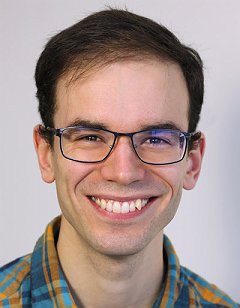
John Wickerson is a Senior Lecturer in the Department of Electrical and Electronic Engineering at Imperial College London. His research spans formal methods, concurrency, and hardware/software synthesis. Academic Rank: Senior Lecturer Affiliation: Imperial College London His research interests include concurrency semantics, weak memory models, transactional memory, GPU and FPGA programming, and high-level synthesis for hardware accelerators. These areas intersect formal verification, programming language design, and hardware-software interface optimization. The publications of John Wickerson reflect trends in formalizing memory models, improving hardware synthesis reliability, and testing concurrency frameworks. His work addresses challenges in quantum compiler validation, GPU workgroup progress, and weak memory persistency across Intel, ARM, and C++ architectures. He actively contributes to academic communities as a Publicity Co-Chair and Session Chair in conferences like POPL and as a Committee Member in SPLASH and PLDI. His GitHub repository activity and X (Twitter) presence further demonstrate his engagement in technical dissemination.
Dr. Iain McCurdy is an Assistant Professor in the Department of Music at Maynooth University. A composer originally from Belfast, his career includes international residencies at EMS (Stockholm), NK (Berlin), and ZKM (Karlsruhe). His work has been commissioned by the Arts Council of Northern Ireland, Sonic Arts Network, and Walter Fink Preis, and performed globally. His research explores: Electroacoustic composition and computer music Sensor technology integration in musical interfaces Hardware hacking for creative applications Visual reinforcement in instrumental composition He actively promotes open-source software in his teaching and creative practice. Dr. McCurdy's publication record includes co-editing 'The Csound Journal', focusing on computer music synthesis and programming. His scholarly output reflects consistent engagement with contemporary music technology and interdisciplinary approaches to composition. While not currently leading a formal lab, his work involves developing innovative human-computer interfaces for musical expression. He teaches across undergraduate and graduate programs in music technology at Maynooth University.
Clément QUINTON is an Associate Professor at the University of Lille, affiliated with both Inria and the CRIStAL laboratory (Centre de Recherche en Informatique, Signal et Automatique de Lille). He is an elected member of the laboratory council and maintains offices in both the Inria building (Room B312) and the M3 building (Room 224) at the Cité Scientifique campus. Dr. QUINTON is a member of the Spirals research team and holds the HDR (Habilitation à Diriger des Recherches), a French academic qualification that allows him to supervise PhD students. Dr. QUINTON's research spans several areas within computer science, with a primary focus on parallel computing, polyhedral models, and hardware acceleration. His work bridges theoretical computer science with practical applications in embedded systems and biomedical monitoring. He has made significant contributions to the fields of: Polyhedral compilation and loop optimization techniques High-level synthesis for FPGA-based hardware acceleration Systolic array design and parallel architectures Disruption-tolerant wireless sensor networks for biomedical applications Sustainable software engineering and cloud configuration Application of Large Language Models to software development Analysis of Dr. QUINTON's publication history reveals a consistent research trajectory that began with foundational work in parallel algorithms and systolic arrays, evolving toward more contemporary applications involving FPGA acceleration, polyhedral compilation, and biomedical sensor networks. His recent work shows increasing interest in sustainable computing, cloud architectures, and the application of Large Language Models to software engineering challenges. This evolution demonstrates his ability to adapt theoretical computer science concepts to address emerging technological challenges. Dr. QUINTON has supervised numerous PhD students whose research aligns with his expertise: Virginie Amand: Sustainable software services using large-scale models Alexandre Bonvoisin: Frugal software architectures for cloud-native microservices Tristan Coignion: Energy impact of Large Language Models for code Edouard Guegain: Software optimization through configuration (defended September 2023) Brell Péclard Sanwouo Chekam: Automatic detection and correction of side-channel vulnerabilities in cryptographic libraries Nada Zine: Complex and self-adaptive software systems Maxime Huyghe: Sustainable software services development based on Language Models (LLM) As a member of the Spirals research team at Inria and CRIStAL, Dr. QUINTON contributes to a collaborative environment focused on software engineering, system architecture, and sustainable computing. His work bridges theoretical computer science with practical applications in healthcare monitoring, cloud computing, and energy-efficient software development.