Thomas Dimopoulos is an Assistant Professor in Real Estate at Neapolis University Pafos Cyprus, coordinating the BSc in Real Estate Valuation and Development. He holds a PhD from Cyprus University of Technology and advanced degrees from Aristotle University of Thessaloniki and Oxford Brookes University. His professional roles include former chairman of RICS Cyprus, board member of the Cyprus Property Valuers Association, and European Board member of IVSC. Education: PhD, Civil Engineering & Geomatics (Cyprus UoT); M.Eng., Rural & Surveying Engineering (Aristotle UoThessaloniki); MSc, Real Estate (Oxford Brookes). Research focuses on property valuation methodologies, geospatial analysis, AI-driven mass appraisals, and sustainable design impact on real estate. His work emphasizes automated valuation models, GIS applications, and energy-efficient retrofitting. Recent articles explore urban accessibility, sustainability trends in tourism, and net-zero energy buildings. Professional affiliations include AXIA Chartered Surveyors (founded by him) and advisory roles in industry bodies. Active in Cyprus property policy, advocating data-driven valuation practices and fiscal decentralization through property taxation research.
Dr. George Gregoriou serves as Associate Professor at the Department of Engineering, School of Sciences and Engineering, University of Nicosia, where he also holds the position of Academic Vice President for Regulatory Affairs at the Rectorate and is a Member of the Senate. His educational background includes a BSc (Summa Cum Laude) in Electrical Engineering from the University of South Alabama (1986), and MSc and PhD degrees in Electrical Engineering from Drexel University (1992). His early career included positions as Research Assistant Professor at Drexel University (1992-1993) and Post-doctoral Research Associate at the University of North Carolina at Chapel Hill (1993-1995). Dr. Gregoriou's research spans multiple domains in engineering and healthcare technology, with recent focus on RFID systems for healthcare applications. His work bridges signal processing, medical imaging, and educational technology, demonstrating strong interdisciplinary capabilities. He has published extensively in IEEE journals and conferences, particularly in nuclear medicine imaging and wireless healthcare systems. His research publications show a clear evolution from foundational work in medical imaging and signal processing toward applied healthcare technology solutions, particularly RFID systems for hospital environments. Recent publications demonstrate practical implementations of wireless technologies in real healthcare settings with emphasis on system design, installation, and evaluation metrics. Senior Member, IEEE Senior Member, IEEE Computer Society Senior Member, IEEE Signal Processing Society Senior Member, IEEE Communication Society Senior Member, IEEE Engineering in Medicine and Biology Society Dr. Gregoriou has secured significant research funding as co-investigator on five research grants totaling over €5 million from the National Institutes of Health and Cyprus Research Promotion Foundation. He served as national delegate for COST B21 action on Physiological Modeling of MR Image Formation and has reviewed for prestigious IEEE conferences including the International Conference on Electronics, Circuits, and Systems. His work contributes to Sustainable Development Goal 3 (Good Health and Well-being) through healthcare technology innovations.
Stavros Zenios is a Professor of Administrative Science and Finance at the University of Cyprus (UCY), holding concurrent roles as a Senior Fellow at The Wharton School of Management (University of Pennsylvania) and Non-Resident Fellow at Bruegel think tank. He previously served as Assistant/Associate/Full Professor at the University of Pennsylvania and Visiting Professor at MIT, Vienna University, Haifa University, and the Athens University of Economics. His academic journey includes a PhD from Princeton University (Operations Research), where his thesis received an Honorary Distinction. He directed UCY’s Banking and Financial Studies Research Unit, designated a European Center of Excellence by the EU. Education: Bachelor’s in Mathematics, University of London Electrical Engineering, Higher Institute of Technology PhD in Operations Research, Princeton University Research Interests: Focuses on financial risk management, large-scale optimization, financial engineering, and service sector efficiency. His work bridges theoretical optimization with practical applications in finance and banking. Awards & Recognition: Marie Curie Fellowship (2000) Fellow of the Italian National Research Foundation PhD Thesis Honorary Distinction (Scientific Society of Operations Research) Leadership Roles: Rector of UCY (2002–2007, two terms) President of UNICA (Moscow Synod, 2007) Labs/Teams: Led UCY’s Banking and Financial Studies Research Unit, recognized as a European Center of Excellence.
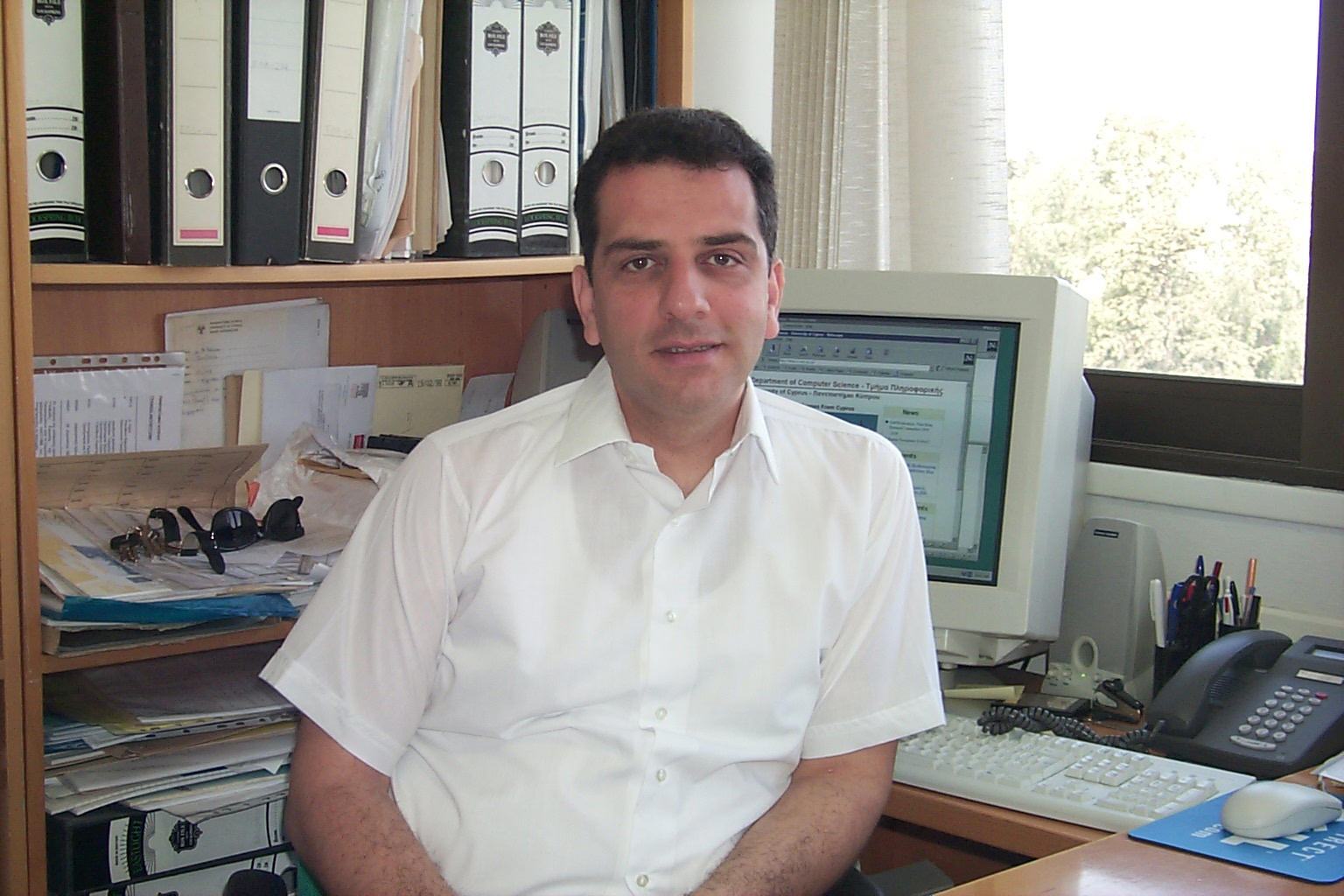
Yannis Dimopoulos is a Professor and Department Vice-Chair at the Department of Computer Science, University of Cyprus. He holds a B.Sc. and Ph.D. in Computer Science from the Athens University of Economics (1987 and 1992, respectively). Prior to his current role, he held research positions at the Max-Planck-Institut für Informatik in Germany and the University of Freiburg. His research focuses on Artificial Intelligence , particularly in Knowledge Representation and Reasoning , Planning , Logic Programming , Constraint Satisfaction , and Machine Learning . He has published extensively in top conferences and journals, including AAAI, IJCAI, and Artificial Intelligence. Dimopoulos's work integrates theoretical contributions with practical applications, such as argumentation frameworks, planning systems, and multi-agent negotiation. His publications reflect a strong emphasis on formal methods, computational logic, and AI reasoning. He has advised numerous students and contributed to the development of tools like plasp for Answer Set Programming-based planning. His research has been supported by grants and collaborations with international institutions.
Christos Panayiotou is a Professor in the Electrical and Computer Engineering Department at the University of Cyprus (UCY) and serves as the Deputy Director of the KIOS Research and Innovation Center of Excellence. He holds a B.Sc. and Ph.D. in Electrical and Computer Engineering from the University of Massachusetts Amherst (1994 and 1999), as well as an MBA from the Isenberg School of Management. Prior to joining UCY in 2002, he was a Research Associate at Boston University's Center for Information and System Engineering. His research focuses on modeling, control, optimization, and performance evaluation of discrete event and hybrid systems, with applications in intelligent transportation systems, cyber-physical systems, machine learning, wireless networks, and smart buildings. His work has secured over €45 million in funding from national/EU agencies, governments, and private entities. He has published over 290 papers and received the 2014 Best Paper Award in Building and Environment . Editorial Roles : Associate Editor for IEEE Transactions on Intelligent Transportation Systems, IEEE Control Systems Society, and others. Leadership : General Chair of EWGT2020, Co-Chair of ECC2018, and Chair of IEEE Computational Intelligence Society subcommittees. Key projects include UAV swarm coordination for maritime surveillance, digital twin architectures for smart buildings, and resilient traffic demand management systems. His grants emphasize cyber-physical systems, energy grids, and disaster response technologies.
Andreas Karageorghis is a Professor in the Department of Mathematics and Statistics at the University of Cyprus, affiliated with the School of Natural and Applied Sciences. His research focuses on numerical analysis, scientific computations, and boundary element methods, particularly employing the Method of Fundamental Solutions (MFS). He holds a DPhil from Oxford University, preceded by a BA and MA. His work emphasizes solving complex elliptic boundary value problems, inverse scattering, and geometric reconstruction. Notable contributions include advancements in MFS algorithms for biharmonic equations, axisymmetric systems, and polyharmonic problems. He has also explored hybrid meshless methods and RBF neural networks for nonlinear problems. Key applications span fluid mechanics (e.g., Brinkman equations), elasticity, and acoustic scattering. His research addresses challenges like void detection, shape identification, and steady-state heat conduction. Karageorghis has published extensively in top journals like SIAM and IMA Numerical Analysis, with over 40 years of continuous academic contribution. His methodological innovations include matrix decomposition algorithms, efficient Kansa-type MFS formulations, and non-iterative approaches for inverse problems. Ongoing work includes optimal parameter selection for RBF methods and extending MFS to higher-order PDE systems.
Antonis C. Kakas is a Professor in the Department of Computer Science at the University of Cyprus. His work spans computational logic, abduction, argumentation, and reasoning about actions and change. Education: B.Sc. in Mathematics, Imperial College London (1980) M.Sc. in Computer Science, Imperial College London (1987) Ph.D. in Theoretical Physics, Imperial College London (1984) Research focuses on Computational Logic , including Abductive Logic Programming , Argumentation , and Autonomous Agents . His projects involved EU-funded initiatives like Computing II, CompuCyprus, and SOCS. Key software developments include ACLP (Abductive Constraint Logic Programming), E-RES (reasoning about actions), and Gorgias (argumentation systems). Recent publications (2000-2005) explore integration of abduction with machine learning, agent deliberation, and answer set programming.
Sotiris Nikoletseas is a Full Professor and Founding Director of the Internet of Things Laboratory (IoT-Lab) at the Computer Engineering and Informatics Department of the University of Patras, Greece. He also serves as a Senior Researcher of the Algorithms Group at the Computer Technology Institute and Press "Diophantus" (CTI), Greece. His academic career includes Visiting Professor positions at the Universities of Geneva, Ottawa and Southern California (USC). Professor Nikoletseas's research spans several cutting-edge domains in computer science, with primary focus on algorithmic aspects of wireless sensor networks and the Internet of Things (IoT). His work extends to Artificial Intelligence of Things (AIoT), wireless energy transfer protocols, probabilistic algorithms and random graphs, and innovative applications of psychoanalysis driven computing to social networks and interactive media. His interdisciplinary approach bridges theoretical computer science with practical applications in networked systems. His publication record is exceptional, with over 300 publications in international journals and refereed conferences, three influential books, and 30 invited chapters in publications by major publishers. His most recent book, 'Wireless Power Transfer Algorithms, Technologies and Applications in Ad Hoc Communication Networks' (Springer, 2016), represents a significant contribution to the field. Best Paper award at the 18th International Conference on Distributed Computing and Networking (ICDCN), Hyderabad, India, 2017 Best Paper Award at the 6th IEEE International Conference on Distributed Computing in Sensor Networks (DCOSS), Santa Barbara, USA, 2010 Inclusion in the list of highly cited computer scientists based on Google Scholar h-index As an academic leader, Professor Nikoletseas has supervised over 50 diploma theses and numerous graduate students, including 7 PhD candidates who have completed their degrees under his guidance. His research has been supported by substantial external funding, including multiple European Union projects where he served as site leader or coordinator. His work with industry includes direct contracts with organizations like Pfizer through their Center for Digital Innovation. The IoT-Lab he founded at the University of Patras serves as a hub for research in algorithms and systems for the Internet of Things, fostering collaboration between academia and industry. His current research directions include AI-enhanced IoT applications, wireless power transfer systems, and innovative approaches to cybersecurity and environmental monitoring through advanced sensor networks.
Thanasis Hadzilacos is an Adjunct Professor at the Cyprus Institute focusing on climate change in the Eastern Mediterranean region. Previously, he served as Professor of Information Systems at the Open University of Cyprus (2007-2021) and Associate Professor at the Hellenic Open University. His Harvard education and PhD in Database Theory from the University of Patras inform his interdisciplinary approach. Research spans educational technology, human-robot interaction, and large-scale information systems. Core interests include: m-Learning and distance education platforms ICT integration in educational policy Climate change informatics Human-robot collaboration in agriculture Publications demonstrate sustained focus on pedagogical innovation through technology, with recent works exploring gamification in literacy development and adaptive learning systems. Earlier research pioneered geographic information systems and spatial modeling. Has advised education ministries in Greece, Cyprus, and Palestine while coordinating over 40 EU-funded R&D projects. Academic contributions include 100+ peer-reviewed publications and Council of Europe policy chapters on education technology.
Georgios Polykratis is a Researcher and PhD student at the Computation-based Science & Technology Research Center (CaSToRC) of the Cyprus Institute since October 2020. He holds a BSc in Physics from the National and Kapodistrian University of Athens, Greece, and a MSc in Theoretical Physics from École Normale Supérieure in Paris, France. His research focuses on quantum computing, quantum error mitigation, and lattice gauge theory simulations on quantum hardware. Key projects include implementing classical bit-flip correction for error reduction in quantum computations and exploring depolarizing noise effects in quantum circuits. He also contributes to detector simulation advancements in particle physics using MadAnalysis 5. Georgios has published extensively on quantum hardware implementation, error correction strategies, and computational methods. His work bridges theoretical physics with practical quantum computing challenges, aiming to enhance quantum algorithm reliability and scalability.
Christoforos Hadjicostis is Professor of Electrical and Computer Engineering at the University of Cyprus. He previously served as Chair of the department from 2008-2010 and held positions at the University of Illinois at Urbana-Champaign. He holds S.B. degrees in Electrical Engineering, Computer Science, and Mathematics, an M.Eng. in Electrical Engineering and Computer Science (1995), and a Ph.D. in Electrical Engineering and Computer Science (1999) from MIT. His research focuses on fault diagnosis and tolerance in distributed dynamic systems, error control coding, monitoring and control of discrete event systems, with applications in network security, anomaly detection, energy distribution, medical diagnosis, biosequencing, and genetic regulatory models. His publications primarily explore formal methods for system verification, distributed algorithms for multi-agent coordination, and privacy-preserving mechanisms in discrete event systems. Recent work emphasizes detectability, observability, and opacity enforcement in networked and cyber-physical systems.
Sina Hashemi is a Research Fellow at the Department of Electrical and Computer Engineering, University of Cyprus, with additional affiliation at the KIOS Research and Innovation Center of Excellence. He holds a PhD (2022) from the University of Tehran, specializing in power system stability and control. His work bridges academic research and practical solutions for modern power grids. Research Focus: Dr. Hashemi's expertise centers on enhancing power system resilience, stability, and reliability. Key areas include: Mitigation of cascading failures and cyberattack impacts Hybrid AC/DC grid planning and operation Voltage stability assessment and control optimization Reactive power management and blackout prevention His methodologies integrate machine learning, multi-objective optimization, and real-time monitoring frameworks. Publication Trends: Recent articles (2022–2024) emphasize cyber-physical security and resilience-oriented planning for modern grids, using optimization and AI-driven approaches. Earlier work (2010–2019) focused on voltage stability indices, neural network applications, and capacitor/UPFC placement. Affiliations: He contributes to the KIOS Research Center, which focuses on intelligent systems for critical infrastructure.
Ioannis Michos is an Assistant Professor at the Department of Computer Science and Engineering, European University, Cyprus. He holds a Ph.D. in Pure Mathematics (Algebra) from the University of Manchester (1999) with a thesis on 'Finite groups acting on free Lie algebras.' His academic career includes positions at Frederick University and the University of Ioannina. He is actively involved in research projects like GRATOS and PPW, focusing on permutations and combinatorics. Education Ph.D. in Pure Mathematics (Algebra), University of Manchester, 1999 M.Sc. in Pure Mathematics (Algebra), University of Manchester, 1994 B.Sc. in Mathematics, University of Ioannina, 1991 Research Interests : Discrete Mathematics, Theoretical Computer Science, Algebra, Combinatorics, and applications in graph theory and concurrent systems. His work spans free Lie algebras, permutation patterns, trace monoids, and kernel PCA methods in astrophysics. Awards Recognition at STACS’02 for work on trace monoids (2002) Onassis PhD Scholarship (1994–1997) NATO M.Sc. Scholarship (1992–1993) SERC Studentship in Manchester (1992–1995) Grants & Projects : Led projects on permutation patterns (PPW) and collaborated on ALAPEDES (TMR-funded). Current role as EUC Research Committee member and co-organizer of the EUC Colloquium.
Stelios Neophytou is an Associate Professor and Head of the Department of Engineering at the University of Nicosia. He holds a PhD in Computer Engineering from the University of Cyprus (2009) and a Bachelor's degree in Computer Engineering and Informatics from the University of Patras, Greece (2003). His research focuses on Electronic Design Automation, specifically developing algorithms for integrated circuit design verification and post-manufacturing testing. This includes methodologies for enhancing Automatic Test Pattern Generation (ATPG), test size compaction, and multiprocessing environments, alongside work on Built-In Self-Test architectures and graph-theoretic problems involving Binary Decision Diagrams. Dr. Neophytou has held academic roles such as Special Scientist and Teaching Assistant at the University of Cyprus (2003–2008) and Special Teaching Staff (2008). His expertise aligns with UN Sustainable Development Goals, particularly in advancing quality education and innovation. Notable contributions include research on IoT performance estimation frameworks, underwater sound classification using edge computing, and cross-national studies on automated vehicle acceptance. His work emphasizes scalability in testing processes, leveraging multicore systems and shared-memory architectures to improve efficiency. Recent studies explore real-time signal processing in IoT systems and agile edge classification for environmental monitoring. Dr. Neophytou maintains active collaborations in both technical and interdisciplinary research areas, contributing to both academic and practical advancements in engineering and computer science.
Prof. Irene Polycarpou serves as Rector of UCLan Cyprus and holds the academic title of Professor of Technology and Innovation in Education. She leads the School of Sciences while maintaining a prolific academic career spanning over 15 years in computer science education and research. Her qualifications include a PhD in Computer Science from Florida International University (2008), complemented by certifications such as the PECB CDPO and Higher Education Academy Fellowship. Education Background PhD in Computer Science, Florida International University, USA (2008) MSc Computer Science, Florida International University, USA (2004) BSc Computer Science, Florida International University, USA (2002) Associate of Computer Science, Higher Technical Institute, Cyprus (2000) Research Focus Her work centers on educational technologies, including interactive multimedia, e-learning systems, and STEM education. She explores how pedagogical strategies can enhance learning outcomes in computing education, particularly for K-12 students and underrepresented groups in STEM. Recent projects include designing coding workshops for high school students and analyzing virality factors in brand videos. Publications Trends Her publications span educational technology, computer science pedagogy, and interdisciplinary studies like cybersecurity curriculum development and music's role in advertising virality. Over 80% of her work post-2015 focuses on innovative teaching methodologies and their impact on student engagement and industry collaboration. Awards & Grants Member of €2.9M EU H2020 project SLICES-DS (2020–2022) Recipient of €299K for i-Sci Multi-Centre for Science and Technology (2016) Lead supervisor for 3 PhD/MSc students focusing on pedagogy and technology integration Leadership & Outreach As InSPIRE Center co-founder, she promotes interdisciplinary research and innovation. She advises Cyprus' Ministry of Education on digital technologies in education and serves on EU funding review panels. Her outreach includes organizing national coding competitions and mentoring women in computing through ACM-W Cyprus. Labs & Teams Leads the InSPIRE Center, focusing on interdisciplinary science promotion, and oversees research clusters in educational technology and STEM pedagogy at UCLan Cyprus.