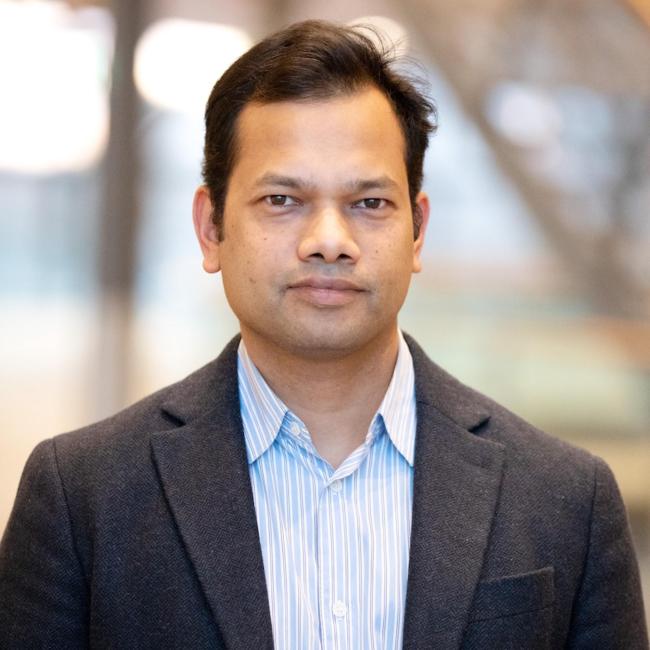
Jaime Campos is an Associate Professor in the Department of Informatics at Linnaeus University, Sweden. He coordinates the Information Systems Master's program and leads research projects bridging ICT with industrial maintenance and eHealth. His doctoral work contributed to the EU-funded DYNAMITE project on dynamic maintenance decisions, involving collaboration with Finland's Technical Research Center (VTT). His research focuses on digital transformation , decision support systems , and human-centric solutions across domains. Key interests include: Industrial applications of big data analytics IoT-enabled preventive maintenance eHealth technologies for elderly care Sustainable infrastructure management Recent publications emphasize Industry 4.0/5.0 transformation, AI in healthcare, predictive maintenance models, and gravel road maintenance optimization. His work consistently integrates emerging technologies like cloud computing, MLOps, and open-source frameworks to address real-world challenges. Campos directs projects including: FRONT-VL : IoT solutions for aging populations HUG : Sustainable gravel road maintenance Data-driven gravel road assessment (ongoing doctoral project)
Bodil Axelsson is Professor of Cultural Heritage at Linköping University, affiliated with the Department of Culture, Society, Design and Media (KSFM) within the Faculty of Philosophy. Her research focuses on how museums, associations and private individuals highlight, fixate and make visible what she calls 'meaningful past units' - the processes through which history and cultural heritage are shaped through storytelling, collecting and displaying. Her academic background includes a Master's in Communication from Linköping University (1999), a PhD in Communication (2003), Associate Professor of Culture and Media Design (2014), and Professor of Cultural Heritage (2021). She teaches in bachelor's and master's programs in Communication, Society and Media Production, and in doctoral education within Theme Culture and Society (Theme Q). Professor Axelsson's research examines the complex processes of cultural heritage formation, combining participant observation, interviews, and media and archive studies. Her current work investigates museums' digital teaching resources for schools, digitization of museum collections, internal museum processes for accessibility, and social media circulation of museum objects. Previous projects have addressed historical theater plays, popular history magazines, contemporary collecting practices, and artistic expression. Her recent publications reveal a consistent focus on digital transformations of cultural heritage, particularly examining how digitization alters context and meaning of cultural objects. Her work spans from Viking jewelry circulation on Pinterest to pandemic-era handwashing practices, demonstrating her interdisciplinary approach to understanding heritage in digital contexts. Cnattingius Prize from Östergötland Museum (2024) for outstanding research on cultural heritage and museums Professor Axelsson leads significant research projects including a 1.1 million SEK study on museums' digital teaching resources for schools (2022). She collaborates extensively with Östergötland Museum and researchers including Martin Fredriksson, Wiktoria Glad, Eva Hemmungs Wirtén, and David Ludvigsson. Her work critically examines the challenges of digitization, noting that while it makes heritage accessible, it also transforms museum knowledge when materials interact with algorithms and business models. She advocates for museums to avoid cultural polarization by engaging with diverse knowledge needs while maintaining their essential role as social institutions where people experience objects and documents directly.
Julia Velkova is an Associate Professor in Media and Communication Studies and a Lecturer in Technology and Social Change at Linköping University. She is affiliated with the Department of Tema, specifically the Department of Culture, Society, Design and Media and Theme Technology and Social Change. She is also a Pro Futura Scientia fellow (2023-2028), a prestigious five-year research program in the humanities and social sciences. Dr. Velkova's research focuses on the dismantling of communication infrastructure and the interaction between digitalization and energy. She leads several significant research projects including 'The dismantling of communications infrastructure in Sweden,' 'Megabytes vs Megawatts' which examines the environmental sustainability of data centers, and 'REIMAGINE ADM' which explores how public values intertwine with algorithmic systems. She is particularly interested in how aging and dismantling communication infrastructures challenge ideas about citizenship and the role of 'old' networks in society. Her recent publications show a strong focus on critical data studies, environmental impacts of digital infrastructure, and the societal implications of technological change. Her work bridges sociology, media studies, and environmental studies, with particular attention to the material aspects of digital technologies and their sustainability implications. Her scientific recognition includes: Pro Futura Scientia fellow (2023-2028) Dr. Velkova is actively engaged in public discourse, with media appearances in Dagens Nyheter, Swedish Radio, and other outlets where she discusses topics like Sweden's role as a 'low-cost country' for data centers and the environmental impacts of digitalization. She has also founded and co-chairs Temas DataLab, a forum for co-creation and experimentation with scientific practices and communication. She leads the research project studying the dismantling of the copper telephone network in Sweden, examining how different actors negotiate and implement infrastructure dismantling, what conflicts arise, and how these processes are experienced in everyday life. Her work aims to problematize assumptions about 'technological progress' and open new directions in infrastructure research.
Martin Jakobsson is an Associate Professor at KTH Royal Institute of Technology, working within the Division of Health Informatics and Logistics in the School of Engineering Sciences in Chemistry, Biotechnology and Health. He serves as a faculty member of Digital Futures and sits on the board of the KTH Center for Sports Engineering. His research focuses on robust network protocols and ICT solutions for wireless networks, WSNs, wearables, and Internet of Things applications in health, wellbeing, and sports domains. His work spans wireless sensor networks, machine learning applications in healthcare, and innovative technologies for sports performance analysis. Analysis of his recent publications (2018-2025) reveals a strong research trajectory in applying machine learning to physiological monitoring, particularly in intraoperative hypotension prediction, trauma care improvement, and wearable health monitoring systems. His work increasingly integrates drone technology for motion capture in sports performance analysis and explores LPWAN applications for health monitoring. Current projects include collaborations with Karolinska University Hospital on AI for hypotension prediction, trauma care improvement, and lifestyle intervention apps VINNOVA-sponsored projects focusing on signal processing and machine learning for surgical patients Development of the 'My Digital Drone Twin' system for sports performance analysis LPWAN applications for wearable sensor systems, including smart shoe technology As an educator, he teaches multiple courses including Communication Systems, Mobile Communications and Wireless Networks, and Network Security, demonstrating his commitment to training the next generation of engineers in wireless technologies and network security.
Lina Eklund serves as an Associate Professor and Senior Lecturer in Human-Computer Interaction at Uppsala University's Department of Informatics and Media, where she leads the Human-Computer Interaction research unit. Her academic journey includes a doctorate in Sociology from Stockholm University (2013), followed by postdoctoral positions at Stockholm University and UC Berkeley (2014-2015), with an exchange scholarship at Concordia University's game studies lab. Her research critically examines technology's role in intimate life spheres, focusing on user agency within technological structures. Current projects include Intimate AI: Knowledge from the Machine , Controlling the Uncontrollable (studying reproductive health apps' impact on pregnancy experiences), and leading the media use component in the interdisciplinary UPIC project on youth mental health. Her work spans digital gaming's transition to cultural heritage, family technology use, and ethical AI implementation. Eklund's publication trends reveal strong interdisciplinary focus across Human-Computer Interaction, Sociology, and Cultural Heritage. Recent work critically examines AI ethics through intimate contexts (reproductive health apps, emotional AI interfaces), while maintaining her foundational research on gaming culture and family technology dynamics. Her scholarship consistently bridges macro-level sociological frameworks with micro-level user experiences, particularly regarding gendered technology use and cultural heritage digitization. Eklund actively leads major research initiatives including the UPIC interdisciplinary project and serves as principal investigator for multiple grant-funded studies examining technology's societal impacts. Her work demonstrates significant real-world engagement through collaborations with cultural institutions and healthcare researchers. Her laboratory work centers on interdisciplinary collaboration, particularly through the Human-Computer Interaction unit she leads at Uppsala. Projects frequently involve cross-institutional teams spanning museum studies (collaborating with cultural heritage institutions), game development studios, and healthcare organizations, creating hybrid research environments that blend academic inquiry with practical implementation.
Andreas Fhager is an Associate Professor in Biomedical Electromagnetics at Chalmers University of Technology, where he leads the research group of the same name. His work focuses on developing microwave-based imaging diagnostics for breast cancer, stroke, and other biomedical applications, encompassing system design, signal processing, electromagnetic modeling, and optimization. He co-founded Medfield Diagnostics AB to commercialize microwave diagnostic equipment, demonstrating strong translational research capabilities. His research centers on biomedical electromagnetics with emphasis on microwave imaging for medical diagnostics. Key areas include breast cancer detection through tomographic systems, stroke diagnosis using ultra-wideband technology, and traumatic injury monitoring via wearable devices. He develops advanced electromagnetic models, optimization algorithms, and signal processing techniques to improve diagnostic accuracy while reducing hardware complexity. His work bridges theoretical innovation with practical clinical applications, particularly targeting prehospital care settings where rapid diagnosis is critical. Analysis of his recent publications (2021-2025) reveals three dominant trends: hardware simplification (reducing transmission channels, frequency points, and system components), noise/multipath mitigation (using lossy gels, dielectric antennas, and asymmetry detection), and clinical translation (wearable abdominal injury monitors, stroke triage tools, and muscle rupture diagnostics). His research increasingly focuses on real-world implementation, with studies using porcine models and phantom testing to validate systems for emergency medical applications. No scientific awards were mentioned in the provided text. Fhager co-founded Medfield Diagnostics AB, indicating active engagement in research commercialization and likely related grant acquisition. While specific grants aren't detailed, his leadership of a research group and extensive publication record suggest successful funding from sources like the Swedish Research Council or EU programs. He teaches Electromagnetic Field Theory, Medical Signals and Systems, and Diagnostic Imaging, contributing to academic training in biomedical engineering. His entrepreneurial activity demonstrates effective translation of academic research into medical technology solutions. He leads the Biomedical Electromagnetics research group at Chalmers University of Technology, which develops end-to-end microwave diagnostic systems from electromagnetic modeling to prototype validation. The group's work includes antenna design (e.g., dielectric rod antennas), computational methods (e.g., discrete dipole approximation), and clinical testing (e.g., porcine models for abdominal injuries). Current projects focus on wearable prehospital diagnostics and stroke triage tools, with future directions likely expanding into point-of-care applications and integration with AI-driven analysis.
Alexander Bock is an Assistant Professor at Linköping University's Media and Information Technology (MIT) department within the Department of Science and Technology (ITN). His primary research focuses on scientific visualization, sonification, and immersive technologies, particularly through the OpenSpace software framework. He leads efforts to contextualize complex scientific data (e.g., astrophysics, biology) for public engagement and education. Bock's team develops open-source tools like OpenSpace, which visualize planetary data and NASA missions, emphasizing STEM outreach. Key projects include Birdsongification (sonification for biology visualization) and Parallel Chords (multidimensional data analytics). He organizes major conferences such as Eurographics and Eurovis, which have attracted global participation. His work bridges academia and informal science institutions, enhancing science communication through interactive platforms. Research interests span audiovisual analytics, data-driven modeling, and interdisciplinary collaborations. Bock's publications address visualization techniques, plasma physics simulations, and software frameworks for space weather and molecular biology. His team's OpenSpace project has been adopted worldwide in planetariums and educational settings. Labs/Teams: OpenSpace Development Team, C-research (Visualization Center C collaboration).
Niklas Rönnberg is an Associate Professor and Senior Lecturer in Sound Technology at Linköping University's Department of Science and Technology (ITN), part of the Institute of Technology. His research focuses on sonification as a complementary modality in interdisciplinary applications, including information visualization, interaction design, and cognitive psychology. He teaches courses in sound technology, research methodology, and digital media production for Media Technology, AI and Engineering, and Graphic Design & Communication programs. His academic journey includes a Master's in Communication Science and a PhD in Technical Audiology (2014). He has led projects like 'Sound of Art,' where sonification transformed Nordic artworks into musical experiences. His work explores how musical elements enhance data understanding and interaction in fields like process control and decision support. Rönnberg actively promotes sonification's societal impact through conferences like the International Conference on Auditory Display. Research affiliations include Media and Information Technology (MIT) and Visualization and Interaction Design (VID) groups. He has contributed to over 30 peer-reviewed publications, focusing on sonification's role in urban planning, AI education, and multimodal interfaces. His current interests emphasize making sonification accessible beyond academia, particularly in public spaces and creative industries.
Robin Teigland is a Professor of Strategy and Management of Digitalization at Chalmers University of Technology, part of the Entrepreneurship and Strategy Division within the Department of Technology Management and Economics. She holds a PhD from the Stockholm School of Economics (SSE) and has held prior roles as a Professor of Business Administration at SSE. Her research focuses on the intersection of strategy, technology, innovation, and entrepreneurship, with emphasis on digital innovation networks, disruptive technologies (e.g., AI, blockchain), and circular economy initiatives. She currently leads projects such as SuRF-LSAM (microfactories for circular economy) and chairs the Mistra-funded C2B2 program. Robin is also an impact entrepreneur, developing blue circular economies through startups like Circular Ocean LDA and Ekbacken Studios AB. Education: B.A. in Economics, Stanford University MBA, Wharton School MA in International Studies, University of Pennsylvania PhD in Business Administration, Stockholm School of Economics Research Interests: Her work explores digital transformation, circular economy transitions, and the societal impacts of technologies like blockchain and AI. Key areas include: Open source communities and entrepreneurial ecosystems Disruptive technologies' role in labor markets and firm structures Circular economy microfactories and ocean-based sustainability Professional Roles: Fellow of the Royal Swedish Academy of Engineering Sciences (IVA) Member of Sweden's Productivity Commission Former board member of Luftfartsverket AB and Akademiska Hus AB Awards & Recognition: Ranked among Sweden’s top 100 public speakers (2019) Listed as one of Sweden’s most influential women in technology by Veckans Affärer Projects & Grants: Robin directs initiatives funded by Vinnova, Formas, Mistra, and others, including the Ocean Data Factory and 4boards.ai. Her work bridges academia, industry, and public sectors to address challenges like sustainable manufacturing and ocean data governance. Impact Entrepreneurship: Beyond academia, she co-founded startups focused on circular economy solutions in Portugal and Sweden, leveraging her diverse background in venture capital, consulting, and international business.
Per Stenstrom is a Professor of Computer Engineering at Chalmers University of Technology, Sweden since 1995. His research focuses on computer architecture, particularly high-performance memory systems and energy-efficient computing. He has authored/co-authored four textbooks, over 200 publications, 20 patents, and supervised approximately 25 PhD students. Awarded ACM Fellow and IEEE Fellow. Member of Academia Europaea and the Royal Swedish Academy of Engineering Sciences. Co-founder of the HiPEAC Network of Excellence. Served as Editor or Associate Editor for journals like ACM Transactions on Architecture and Code Optimization and IEEE Transactions on Computers . Program Chair for major conferences including ISCA, HPCA, IPDPS, and ACM International Conference on Supercomputing. His research innovations include cache compression techniques, memory optimization strategies, and energy-aware resource management in multicore systems. Ongoing work emphasizes secure and scalable cache partitioning, hybrid memory systems, and defense mechanisms against microarchitectural attacks.
Nutapong Somjit holds dual academic roles as an Associate Professor in the School of Electronic and Electrical Engineering at the University of Leeds and an adjunct faculty member in the Micro and Nanosystems Department at KTH Royal Institute of Technology, Sweden. His career includes a research leadership position at TU Dresden and a Doctoral Research Award from IEEE in 2012. Specializing in high-frequency components and sustainable microsystems, his work emphasizes innovative fabrication techniques and MEMS integration. He has received over a dozen awards, including the 2009 EuMIC Best Paper Award and editorial roles in IET Electronics Letters. Education: MSc (Dresden University of Technology, 2005), PhD (KTH, 2012) Awards: 6 major honors including IEEE fellowships and chair positions at international conferences Research focuses on next-gen RF systems, with 15+ peer-reviewed articles since 2006. Key innovations include 3D-printed antennas, cost-effective MEMS phase shifters, and high-aspect-ratio TSV fabrication using magnetic assembly techniques. His work bridges microfabrication scalability with practical high-frequency applications. Grants: Not explicitly stated in provided text Labs: Leads research teams at both Leeds and KTH focusing on millimeter-wave and nanoscale systems
Jeannette Bohg is a Professor of Robotics and Computer Science at Stanford University, directing the Interactive Perception and Robot Learning Lab. Her work focuses on perception, learning, and real-time methods for autonomous robotic manipulation and grasping, emphasizing cross-embodiment learning. She previously led the Autonomous Motion Department at MPI for Intelligent Systems (2012–2017) and completed her PhD at KTH in Stockholm, with earlier studies at Chalmers and TU Dresden. Notable awards include the 2019 IEEE Early Career Award and the 2020 Robotics: Science and Systems Early Career Award. Education: PhD in Robotics, Perception and Learning (RPL), KTH Royal Institute of Technology, Stockholm (2012) Masters in Art and Technology, Chalmers University, Gothenburg Diploma in Computer Science, TU Dresden Research interests span robotic grasping, equivariant policies, and scalable data-driven approaches. Key projects include the DROID dataset for cross-embodiment learning and development of the Tidybot mobile manipulator platform. Her lab explores principles of human sensorimotor coordination to enhance robotic autonomy, integrating machine learning and computer vision. Recent work emphasizes leveraging human demonstrations and vision-language models for generalizable manipulation skills, alongside tactile sensing and sim-to-real transfer techniques.
Johan Netz is an Assistant Professor at Karlstad University, focusing on innovation management, idea screening methodologies, and the impact of emerging technologies like AI on organizational structures. His work bridges academic research with practical applications in service innovation and agile methodologies. Primary research interests include optimizing idea evaluation processes, understanding expert decision-making patterns, and analyzing how technological advancements reshape innovation ecosystems. He frequently collaborates with colleagues such as Alexandre Sukhov, Peter Magnusson, and Filip Högberg. Recent work explores AI's disruptive potential in service ecosystems and the balance between organizational stability and change in agile environments. Despite prolific publishing since 2012, no awards or grants are explicitly mentioned in the provided text. Notable contributions include frameworks for improving idea screening through holistic approaches and leveraging frontline employees for innovation input. His research often emphasizes practical tools and methodologies for service innovation and decision-making optimization.
Mohammad Rajiullah is a Senior Lecturer in Computer Science at Karlstad University, Sweden. His research focuses on low latency networking, 5G/6G systems, satellite internet integration, and IoT optimization. He leads major EU initiatives including the MAGDALENA (6G-SANDBOX) project (Principal Investigator) evaluating LEO satellite-5G integration, and the XR health training use case in the 6G-PATH project for immersive medical education. Currently PI of the EU IMAGINE-B5G SIMONE project developing AR/VR platforms over 5G/6G. Active in national projects like DRIVE (8-year initiative for latency-sensitive mobile services) and international collaborations such as the 5G-DiGITs curriculum development. His work spans over 50 peer-reviewed publications, with recent focus on Starlink performance analysis, NB-IoT optimization, and 5G non-standalone network evaluations. He maintains the CARL-W testbed for hybrid 5G/satellite testing. Teaching includes core courses in Operating Systems, Computer Networking, and IoT. His research emphasizes cross-disciplinary projects involving academia-industry partnerships across Europe and Asia. He has contributed to EU deliverables like 6G-SANDBOX D6.3 and NEAT D3.1 , showcasing leadership in collaborative network research.
Professor Gabriel Skantze is a faculty member at KTH Royal Institute of Technology in Stockholm, Sweden, affiliated with the Department of Speech Music and Hearing within the School of Computer Science and Communication. His research focuses on conversational systems, human-robot interaction (HRI), and multimodal dialogue technologies. He co-founded Furhat Robotics in 2014 and currently holds a part-time role as Chief Scientist there, while maintaining his full-time academic position. Skantze earned his MSc in Cognitive Science from Linköping University and his PhD in Speech Communication from KTH in 2007. His work integrates interdisciplinary approaches from linguistics, phonetics, and artificial intelligence to develop socially intelligent robots capable of natural face-to-face interaction with humans. Research interests include turn-taking prediction, feedback modeling in HRI, and visual grounding in dialogue. He has supervised numerous PhD students, including ongoing advisees such as Nikita Torgashov and Bram Willemsen, and past students like Carol Figueroa and Chinmaya Mishra. His awards include Best Paper recognitions at HRI 2025 and SIGDIAL 2022. Skantze serves as President Emeritus of SIGdial (ACL) and on editorial boards for journals like Transactions on Human-Robot Interaction . Key projects explore robots as hosts on autonomous buses, virtual patients for medical training, and language learning companions. Funded by grants, his work bridges theoretical research with practical applications in healthcare, education, and robotics. Collaborations with Furhat Robotics and academic institutions worldwide highlight his commitment to advancing socially aware AI systems.