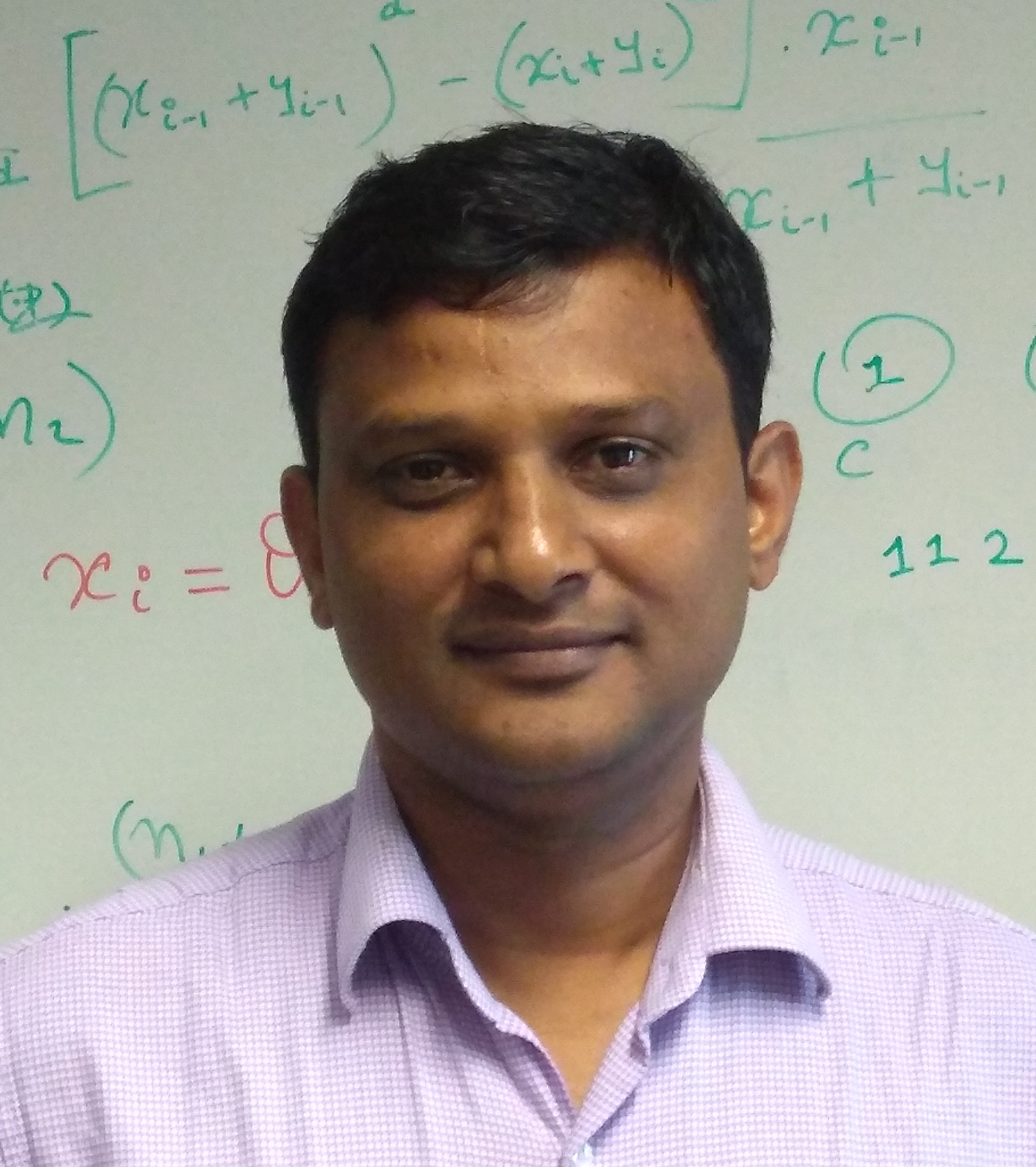
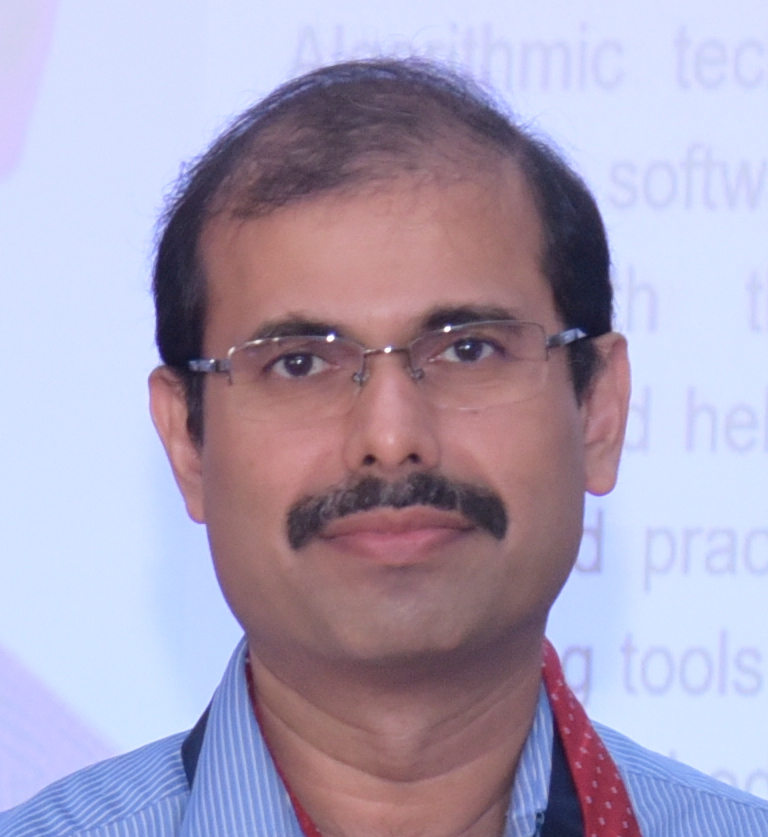
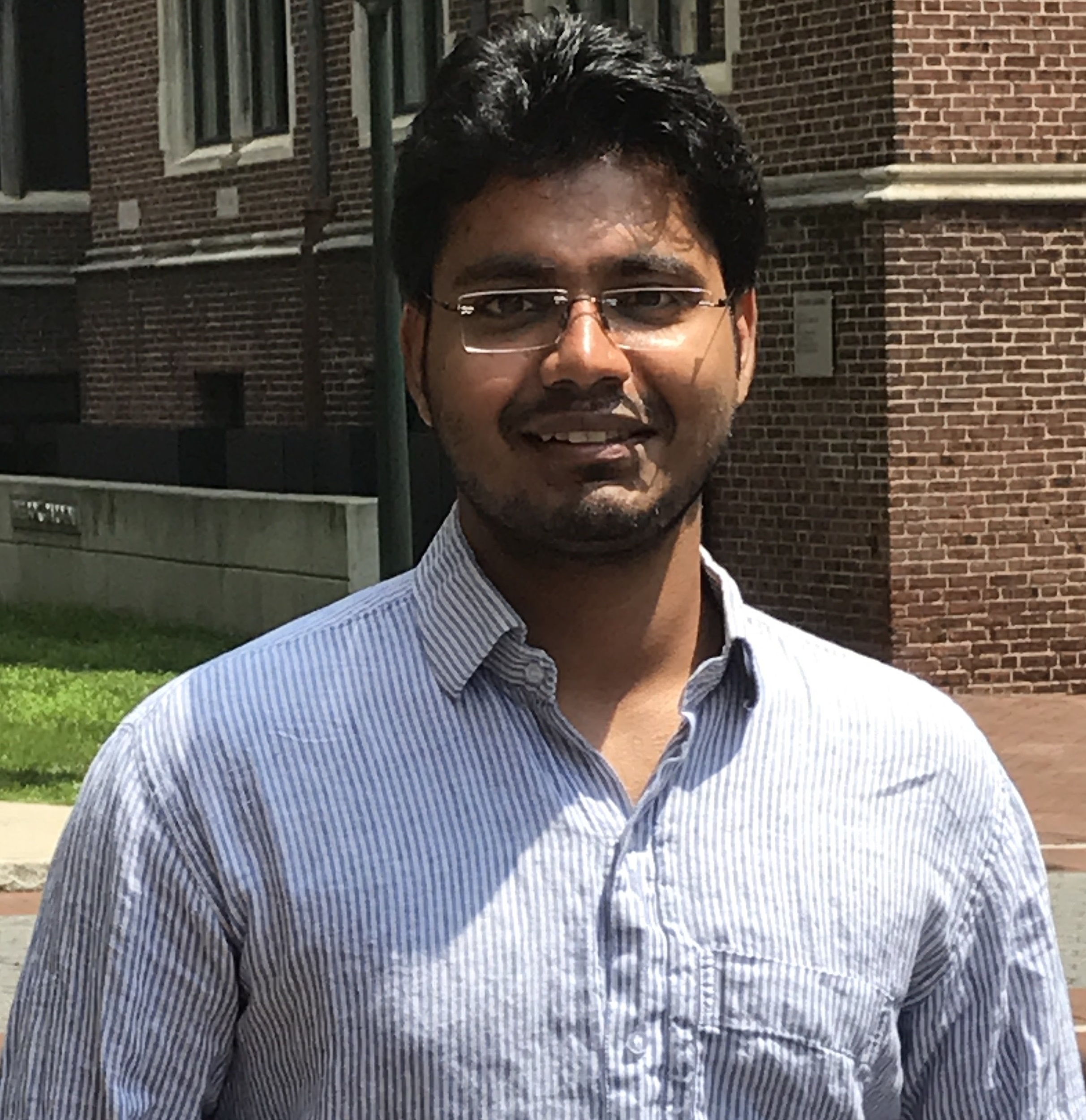
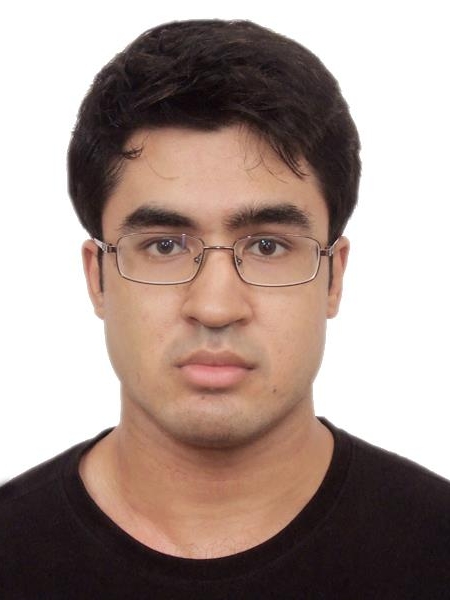
Dr. Balaraman Ravindran is a Professor and Head of the Department of Data Science and Artificial Intelligence (DSAI) at IIT Madras. He also leads the Robert Bosch Centre for Data Science & Artificial Intelligence (RBCDSAI) and the Centre for Responsible AI (CeRAI). His research focuses on reinforcement learning, geometric deep learning, and ethical AI deployment. Education includes a PhD from the University of Massachusetts Amherst (2004) and MSc from the Indian Institute of Science, Bangalore (1996). He holds prestigious fellowships from AAAI and INAE, and is an ACM Distinguished Member. Key contributions include work on class imbalance learning (e.g., TODUS algorithm) and applications in healthcare, transportation, and social networks. He has advised over 20 students and secured grants from Google, TCS Research, and others. Labs/Teams: Heads RBCDSAI and CeRAI, collaborates with TCS Research and Google.
Shivaram Kalyanakrishnan is an Associate Professor at the Department of Computer Science and Engineering , Indian Institute of Technology Bombay , specialising in Artificial Intelligence and Machine Learning . His research spans sequential decision making , multiagent learning , multi-armed bandits , and humanoid robotics , with applications in robot soccer , computer games , and online advertising . He teaches advanced courses like CS 747: Foundations of Intelligent and Learning Agents and CS 748: Advances in Intelligent and Learning Agents , focusing on end-to-end system design and theoretical analysis. His scientific awards include the Best Student Paper Award at RoboCup International Symposium 2006 and nomination for Best Student Paper Award at AAMAS 2007 . His work on reinforcement learning and policy iteration has been published in leading venues such as IJCAI , ICML , and COLT , with recent contributions to railway scheduling and bandit algorithms. While no explicit list of advisees is provided, his research projects and publications suggest mentorship of students in collaborative efforts. Contact : shivaram@cse.iitb.ac.in .
Ajit Rajwade is a Professor at the Department of Computer Science and Engineering , Indian Institute of Technology Bombay. His research spans Artificial Intelligence , Compressed Sensing , and Medical Imaging , with affiliations to the Centre for Machine Intelligence and Data Science and the Koita Centre for Digital Health . Education : PhD in Computer and Information Science and Engineering, University of Florida (2010) MSc in Computer Science, McGill University (2004) BTech in Computer Engineering, University of Pune (2002) His research interests focus on intelligent data acquisition, particularly in neural network analysis , graph signal processing , and medical imaging . He develops compressed sensing algorithms for inverse problems like tomography and MRI reconstruction , alongside applying group testing to pandemic response. Scientific awards include the Prof. S. P. Sukhatme Award (2024) and Departmental Teaching Excellence (2019). His publications demonstrate expertise in image restoration , noise modeling , and epidemiological algorithms . He has advised PhD students like Sabyasachi Ghosh and Jerin Geo James , with a focus on computationally efficient methods in medical imaging and machine learning .
Sharat Chandran is a Professor in the Department of Computer Science and Engineering at the Indian Institute of Technology Bombay (IIT Bombay), where he has been actively engaged in teaching and research for several decades. His office is located in Room KR102 (also known as A202) in the Rekhi Building on the IIT Campus in Mumbai, India. His primary research interests span two major areas in computing: Computer Graphics and Computer Vision . He has extensively worked in these fields with his students and research staff, producing various publications, talks, and research projects over the years. His current teaching focus includes Math for Visual Computing (CS 740), a course designed for postgraduate students new to the IIT system who may have some apprehension about mathematics. Professor Chandran has supervised numerous PhD students whose work covers diverse topics including 3D modeling, efficient computing with tomographic measurements, vision for drones, cancer prognosis, hierarchical visibility, projector-camera systems, arterial pulse analysis, and optimization algorithms for motion factorization. His teaching portfolio is extensive, having offered courses such as Basic Freshman Programming, Software Systems, Parallel Programming Paradigms, Graphics I & II, Multimedia Systems, Computer Vision, Digital Image Processing, Algorithms, and Spatial Data Structures. He has held multiple administrative and service roles at departmental, institutional, and external levels. Departmental roles include PhD Faculty Advisor, Awards Committee Chair, Faculty Search Chair, and Web Team Chair. At the institutional level, he served as Founding PMRF Coordinator, Head of the Application Software Centre, and IIT Research Fellowship Initiative Coordinator. Externally, he has coordinated the DST India Digital Heritage Project and served as Program Co-Chair for conferences like Mysore Park Vision Conference and ICVGIP. Professor Chandran is actively involved in campus community activities including Sanskriti @ IITB, Taekwando @ IITB, and serves as Secretary for Kendriya Vidyalaya PTA. His office hours are from 12:30 PM to 1:00 PM on Monday, Tuesday, and Thursday, and he emphasizes using Piazza rather than email for student communications.
Antony Franklin is an Associate Professor and Head of the Department of Computer Science and Engineering at the Indian Institute of Technology Hyderabad (IITH), India. He leads the Networked Wireless Systems (NeWS) Lab and is actively involved in 5G research, wireless networks, and cybersecurity. He earned his Ph.D. from IIT Madras in 2010. Education: Ph.D. in Computer Science and Engineering, IIT Madras, 2010 Research Interests: His research spans wireless networks , 5G systems , mobile edge computing , low-latency transport protocols , and cybersecurity . He focuses on next-generation mobile systems, especially 5G, aiming to meet the demands of ultra-low latency, high data rates, and quality of experience for services like IoT, autonomous driving, and VR. He has been involved in developing testbeds and prototypes to validate real-world performance of 5G technologies, including network slicing, LTE-WiFi integration, and edge computing. Scientific Awards: Best Academic Demo Award, IEEE COMSNETS 2018 Second Best Paper Award, IEEE ANTS 2017 Grants & Projects: Network Slice Life-cycle Management for 5G Mobile Networks – SPARC, MHRD (2019–2021) DNS/IPv6 for IoT Security – NASSCOM (2018–2019) CCRAN: Energy Efficiency in Cloud RAN – Intel India (2018–2021) End-to-End 5G Test-Bed – DoT, GoI (2018–2021) M2SMART Smart Cities – SATREPS (2018–2023) Ultra-Reliable Low Latency Protocols – STINT, Sweden (2017–2018) Low Latency 5G Protocols – SERB ECR (2016–2019) Lab & Team: He leads the NeWS Lab (Networked Wireless Systems) at IITH, which focuses on 5G, wireless networks, and IoT systems. The lab is actively involved in developing real-world testbeds and publishing in top-tier conferences and journals.
Manjesh Kumar Hanawal is an Associate Professor at the Industrial Engineering and Operations Research (IEOR) center of IIT Bombay , India. His academic journey includes a Ph.D. from University of Avignon/INRIA (2013), M.Sc (Engg) from IISc Bangalore (2009), and B.E. from NIT Bhopal (2004). Pre-Ph.D. work: Scientist-B at DRDO's CAIR Postdoctoral: Boston University (2013-2015) Appointed as first Professor-In-Charge of TCA2I center Research focuses on Machine Learning algorithms for limited feedback environments, Communication Networks resource allocation, and Cybersecurity threat detection. Publications span top venues like IEEE Transactions, NeurIPS, INFOCOM, and AISTATS. Recent work trends include: Bandit algorithms for distributed learning in heterogeneous networks Contextual information integration in sequential selection Energy efficiency optimization in wireless sensor networks Net neutrality violation detection frameworks Anti-jamming countermeasures in cognitive networks Scientific recognition includes the SERB Early Career Research Award (2019-2022) for machine learning applications in wireless networks. Advisees include Ph.D. awardee Arun Verma and Best Masters Thesis Awardee Sayan Chatterjee.
Supratik Chakraborty serves as the Bajaj Group Chair Professor in the Department of Computer Science and Engineering at Indian Institute of Technology Bombay. He maintains dual affiliations with the Centre for Formal Design and Verification of Software and the Centre for Liberal Education at IIT Bombay, demonstrating his cross-disciplinary engagement. Professor Chakraborty's research spans formal methods with focus on formal verification, rigorous analysis of system models, and automated synthesis of systems from specifications. His work bridges theoretical foundations with practical applications, particularly in developing mathematically provable guarantees for increasingly complex hardware, software, and intelligent systems. Current research interests include constrained counting and sampling, scalable formal verification of software and hardware systems, automated synthesis of programs and circuits, and applications of automata, logic and finite model theory to practical verification challenges. His publication trajectory shows a significant evolution from traditional hardware and software verification toward addressing verification challenges in machine learning and AI systems. Recent work increasingly focuses on interpretability of black-box models, verification of neural networks, and synthesis techniques applicable to intelligent systems. The research demonstrates strong interdisciplinary connections between formal methods, programming languages, and artificial intelligence. IIT Bombay Excellence in Thesis (CSE) Award 2011 (for Bhargav Gulavani's thesis) IIT Bombay Excellence in Thesis (CSE) Award 2017 (for Abhisekh Sankaran's thesis) Best Paper in Algorithms and Architecture track at IEEE International Conference on Computer Design: VLSI in Computers and Processors, 1998 Professor Chakraborty has successfully supervised 11 doctoral students, with research spanning formal verification techniques, Boolean functional synthesis, constrained counting, and applications to hardware and software systems. His students have gone on to positions at major institutions including Microsoft Research, TCS Research, Georgia Tech, and BARC, reflecting the strong industry and academic impact of his mentorship. Current research directions show increasing emphasis on verification challenges posed by machine learning systems and AI. His research group at IIT Bombay, while not explicitly named in the materials, appears to focus on formal methods with strong connections to the Centre for Formal Design and Verification of Software. The group maintains active collaborations with international researchers including Moshe Y. Vardi at Rice University, and has made significant contributions to verification tools like VeriAbs that bridge theoretical advances with practical applications.
Arpit Agarwal is an Assistant Professor in the Department of Computer Science & Engineering at the Indian Institute of Technology, Bombay. He previously held postdoctoral positions at FAIR Labs (Meta) working with Max Nickel and at the Data Science Institute at Columbia University hosted by Prof. Yash Kanoria and Prof. Tim Roughgarden. He completed his PhD from the Department of Computer & Information Science at the University of Pennsylvania under the guidance of Prof. Shivani Agarwal. His research focuses on the intersection of human behavior and machine learning systems, with particular interest in learning from implicit, strategic, and heterogeneous human feedback. His work spans multiple dimensions of human-AI interaction including understanding long-term dynamics between humans and AI systems, designing responsible AI, and studying misalignment between user preferences and system objectives. His research methodology often combines theoretical machine learning with practical applications in recommendation systems and social AI. His recent publications reveal a strong focus on bandit algorithms, preference learning, and recommendation systems, with increasing attention to responsible AI design and human-centered considerations. His work demonstrates expertise in theoretical machine learning with applications to real-world problems, particularly in understanding how humans interact with and are influenced by AI systems over time. Dr. Agarwal teaches advanced courses including CS767 Theoretical Machine Learning (Autumn 2025) and CS6103 Human-Centered AI: From Learning Models to Responsible Systems (Spring 2025), which covers topics such as AI alignment, learning from pairwise comparisons, crowdsourcing, human-in-the-loop decision making, recommendation systems, interpretability, privacy, fairness, causality, and AI governance.
Kumar Vaibhav Srivastava is a Professor in the Department of Electrical Engineering at the Indian Institute of Technology Kanpur (IIT Kanpur). His research focuses on electromagnetic theory, meta-materials, and antenna design, with significant contributions to the field of computational electromagnetics and microwave engineering. Dr. Srivastava received his B.Tech from Kamla Nehru Institute of Technology, Sultanpur U.P. in 2002, followed by an M.Tech from IIT Kanpur in 2004. He completed his PhD at IIT Kanpur in 2008 with a thesis titled "Studies on Inhomogeneous Dielectric Resonators for Improved Mode Separation in MIC Environment using Efficient FDTD Algorithm and its Application to Band-pass Filter" under the supervision of Prof. Animesh Biswas. His research interests span a wide range of topics in electromagnetics, with particular expertise in Meta-Materials , Microwave Antennas , Microwave Absorbers , Microwave Cloaking , and the Finite-Difference Time-Domain (FD-TD) Technique . Dr. Srivastava's work has significant applications in wireless communications, radar systems, and electromagnetic compatibility. His innovative approaches to meta-material absorbers and antenna design have garnered attention in both academic and industrial circles. Dr. Srivastava's recent publications demonstrate a strong focus on advancing meta-material absorber technology and antenna design. His work shows consistent innovation in bandwidth enhancement techniques, polarization independence, and compact antenna designs for ultra-wideband applications. His research bridges theoretical electromagnetic principles with practical engineering solutions. Cadence Gold Medal-2005 for Best M.Tech. Thesis Best Teaching Assistantship Award (2005-06) Appreciation Letter from GE Global Research Centre Young Research Fellowship (Class of 1979) Best Paper Award at ATMS Conference (2013) IEI Young Engineer Award 2014 Dr. Srivastava has supervised numerous research projects and students in the field of electromagnetics and antenna design. His work with industry partners, including GE Global Research Centre, demonstrates his ability to translate theoretical research into practical applications. He maintains active collaborations with researchers both within IIT Kanpur and internationally. Based in the Advanced Centre for Electronic Systems (ACES) at IIT Kanpur, Dr. Srivastava works within a vibrant research ecosystem that supports cutting-edge work in electronic systems and electromagnetic applications. His laboratory focuses on computational electromagnetic simulations and experimental validation of novel meta-material structures and antenna designs.
Roop Aparajita Subhra Purushottam is an Associate Professor in the Department of Computer Science and Engineering at the Indian Institute of Technology Kanpur. His research focuses on machine learning foundations and applications, particularly in extreme classification, optimization techniques, robust learning, and educational technology. He has developed scalable algorithms for web-scale applications and innovative teaching tools for programming education. His research interests span: Design and analysis of machine learning algorithms Statistical learning theory and online optimization Non-convex optimization for large-scale problems Robust learning against adversarial corruptions Applications in information retrieval, education, and environmental monitoring Recent publications demonstrate a strong focus on extreme classification techniques, efficient deep learning architectures, and educational technologies. His work consistently appears in top-tier conferences including KDD, ICML, NeurIPS, and CVPR, with innovations in scaling machine learning systems to handle millions of labels and users. Significant Awards: Gopal Das Bhandari Distinguished Teacher Award (2024) PK Kelkar Faculty Fellowship (2024-2027) Microsoft Bing Ads Greatness Award (2021) Computer Society of India Faculty Award (2018) Multiple best paper awards and nominations at major conferences He leads several research grants and consults for industry partners including Microsoft Research and Tower Research. His team develops open-source tools like Prutor for programming education and DEFRAG for efficient feature agglomeration in extreme classification. He has advised numerous PhD and Master's students who have received prestigious awards for their research contributions.
Angshuman Karmakar is an Assistant Professor in the Department of Computer Science and Engineering at the Indian Institute of Technology Kanpur, India. His research focuses primarily on Post-Quantum Cryptography (PQC) and Computation On Encrypted Data (COED), which are critical areas in modern cryptography and computer security. Dr. Karmakar received his Ph.D. from Katholieke Universiteit Leuven (KU Leuven), Belgium, where he worked under Prof. Ingrid Verbauwhede in the COSIC research group. He was awarded the prestigious Erasmus Mundus fellowship for his doctoral studies and the FWO (Fonds voor Wetenschappelijk Onderzoek – Vlaanderen) fellowship for his post-doctoral research at KU Leuven. His research spans theoretical development of cryptographic schemes, implementation algorithms, side-channel and fault attack analysis, and countermeasure development. Dr. Karmakar has established extensive international collaborations with researchers and engineers worldwide to address complex challenges in cryptography and security. Recent publications demonstrate a strong focus on practical post-quantum cryptographic implementations with particular attention to hardware and software efficiency, side-channel resistance, and novel attack methodologies. His work bridges theoretical cryptography with real-world implementation challenges across diverse platforms from IoT devices to high-performance computing systems. Erasmus Mundus fellowship for doctoral studies at KU Leuven FWO fellowship for post-doctoral study at KU Leuven Google India Research Award for work on practical transition to post-quantum cryptography Dr. Karmakar is actively seeking graduate students and postdoctoral researchers to collaborate on cutting-edge research in cryptography and computer security. His work has significant implications for securing future communication systems against quantum computing threats, with applications spanning blockchain technologies, IoT security, and general-purpose computing systems.
Rajesh Ranjan is an Assistant Professor in the Department of Aerospace Engineering at the Indian Institute of Technology Kanpur. His academic career spans multiple prestigious institutions including Ohio State University and Jawaharlal Nehru Centre for Advanced Scientific Research. Dr. Ranjan completed his PhD (2016) from Jawaharlal Nehru Centre for Advanced Scientific Research, Bengaluru, ME (2007) from Indian Institute of Science, Bengaluru, and BE (2005) from Bihar Institute of Technology, Sindri where he achieved First Rank with Roll of Honor. His educational background laid the foundation for his expertise in fluid dynamics and computational methods. His research focuses on fundamental and applied aspects of fluid dynamics with specialization in turbomachinery flows, applied aerodynamics, stability and flow control, transition and relaminarization phenomena, and high performance computing applications. Dr. Ranjan employs a multidisciplinary approach combining theoretical analysis, advanced computational techniques, and experimental validation to address complex fluid flow problems in aerospace engineering. His work has significant implications for improving efficiency in turbomachinery design and understanding fundamental flow physics in complex geometries. Dr. Ranjan's publication record reveals a strong trajectory in computational fluid dynamics with recent work spanning traditional aerospace applications like turbomachinery and aircraft aerodynamics while also demonstrating adaptability through interdisciplinary research such as his data-driven approach to modeling the COVID-19 pandemic. His publications consistently demonstrate rigorous methodology and innovative approaches to complex fluid flow problems. All India Rank-3, Graduate Aptitude Test in Engineering (GATE), India (2005) Roll of Honor (First Rank), B.E., BIT, Sindri, India (2001-2005) Outstanding Performance Award (thrice), TATA CRL, Pune, India (2008-10) ICAM International Travel Award, Institute for Complex Adaptive Matter (2013) International Travel Support Award, DST, Govt. of India (2014) Best Poster Award, JNCASR In-house Symposium, Bengaluru, India (2015) Dr. Ranjan has mentored multiple students through research projects at IIT Kanpur and previously at Ohio State University. His research has been supported by institutional funds and travel awards from national agencies including the Department of Science and Technology, Government of India. He maintains active collaborations with researchers in India and internationally to advance computational fluid dynamics methodologies and their application to real-world engineering problems.
Shashank Vatedka is an Assistant Professor in the Department of Electrical Engineering at the Indian Institute of Technology Hyderabad . His research focuses on information theory , coding theory , and their applications to data compression , statistical inference , and security . He holds a PhD from IISc, Bengaluru and has postdoctoral experience at Institut Polytechnique de Paris and The Chinese University of Hong Kong . Education : PhD and MSc (Engg) in Electrical Communication Engineering, IISc, Bengaluru (2011-17) Academic Positions : Assistant Professor, IIT Hyderabad (2019-present) Postdoctoral Fellow, Telecom Paris (2018-19) Research Assistant/Postdoctoral Fellow, Institute of Network Coding, CUHK (2016-18) His research spans three main areas: distributed inference (federated learning, wireless sensor networks), compression with locality constraints (local decoding, low-complexity algorithms), and communication in adversarial environments (jamming, list decoding). Recent work includes distributed mean estimation with limited communication and adversarial channel coding with partial information. He has received several honors including the Seshagiri Kaikini Medal for best PhD thesis at IISc in 2017, Best Paper Awards at NCC 2023 and Stanford Compression Workshop 2021, and the TCS Research Fellowship (2014-17). He serves as a Faculty Placement Coordinator at IIT Hyderabad and organizes international conference tracks. His research group advises students across PhD, MTech, BTech , and internships , with alumni pursuing advanced degrees at institutions like UCSD , Columbia University , and TU Delft . Collaborations include theoretical work with colleagues like Yihan Zhang and Sidharth Jaggi .
Dr. Shatarupa Thakurta Roy is an Associate Professor in the Department of Humanities and Social Sciences at the Indian Institute of Technology Kanpur (IIT Kanpur). She teaches courses in Art Appreciation, Design Theory, Visual Communication, and History of Art, and collaborates with IIT Kanpur's Design Programme. She holds a Ph.D. in Design from IIT Guwahati (2014), an M.F.A. (1999), and a B.F.A. (1997) from Kala Bhavana, Visva Bharati Santiniketan. Her research explores Visual Culture , Indian Folk and Minor Art , Graphic Design , and Design Theory , with fieldwork focusing on narrative folk paintings across Eastern India. She emphasizes cultural sustainability, visual storytelling, and interdisciplinary design methodologies. Her publications (2011–2022) span art theory, data visualization, HCI, and cultural preservation, reflecting trends in cross-disciplinary innovation , social impact design , and digital heritage conservation . She frequently integrates cognitive psychology, new materialism, and postcolonial perspectives. Awards & Honors: Best Paper Award, NaCoMM 2011 National Scholarship Scheme, Government of India (1997–1998) Mentorship Award for 'Toycathon 2021' (designing educational board game 'CheMystery') Advising & Grants: She has supervised 15+ Ph.D. and 35+ M.Des. theses. Funded projects include an MHRD grant (2016) for assistive interfaces for dyslexic children and a Doordarshan collaboration (2022) on sustainable farming documentaries. Administration: She has served as Warden, DPGC Convener, and lab in-charge at IIT Kanpur. She also edits academic journals and chairs conferences on art and design.
R.K. Shyamasundar is a Professor at the Indian Institute of Technology Bombay , with a focus on Real-Time and Reactive Programming, Logic Programming, Pi-Calculus, and Parallel Programs. Research spans formal verification, concurrency, and distributed systems. Key contributions include RT-CDL semantics, Esterel language extensions, and hybrid system controller synthesis. Scientific awards include JC Bose National Fellow, Fellowships at Indian Academy of Sciences and Indian National Science Academy, and Senior Membership in IEEE. His work involves collaborations with institutions like TCS Group and researchers such as Basant Rajan, N. Raja, and Deepak Kapur.