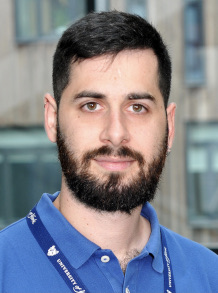
Ioannis Stefanakos is a Research Associate at the Department of Computer Science, University of York, affiliated with the High Integrity Systems research group. His work focuses on formal verification of autonomous systems, safety-critical robotics, and software performance analysis. Current projects include assurance frameworks for drones, adaptive reinforcement learning in healthcare robotics, and probabilistic modeling of software performance. Recent research emphasizes interdisciplinary applications in UAV systems, medical decision support systems, and collaborative manufacturing robots. No academic awards are listed, though his work has been published in top-tier conferences. Advising and grants details are not explicitly stated, but his involvement in doctoral forum papers suggests potential supervision roles in software systems research.
Dr. Martin O'Mullane serves as a Research Fellow in the Department of Physics at the University of Strathclyde's Faculty of Science, specializing in atomic processes for magnetic fusion plasmas. His work directly supports international fusion facilities including JET, ITER, MAST-Upgrade, and Wendelstein 7-X through critical contributions to plasma diagnostics and atomic data modeling. Research focuses on tungsten impurity behavior in fusion environments, electron-impact collision physics, and advanced spectroscopic techniques. Key methodologies include X-ray crystal spectrometry , Rydberg transition analysis , and optical emission diagnostics for impurity transport studies. His atomic data calculations enable accurate modeling of plasma conditions in tokamaks and stellarators, addressing critical challenges for ITER and future DEMO reactors. Recent publications (2024-2025) demonstrate expertise across fusion diagnostics, spanning tungsten ion collision strengths, JET campaign spectrometer configurations, and W7-X impurity transport studies. Work integrates atomic physics , computational modeling , and experimental validation to advance diagnostic capabilities for core plasma conditions and edge-exhaust integration. Secured major funding as Principal Investigator for the UK APAP Network (2021-2025) and multiple CASE awards, including industrial collaborations with the Atomic Weapons Establishment supporting PhD research. Supervised Daljeet Gahle's doctoral work through Top-up CASE funding (2016-2021) and Industrial Case Accounts (2015-2024). Active in international fusion collaborations, co-authoring MAST-Upgrade physics results and developing diagnostic frameworks for ITER core spectroscopy. Current work addresses tungsten transport modeling, spectrometer calibration for deuterium-tritium campaigns, and low-temperature plasma diagnostic techniques applicable to fusion boundary conditions.
Mauro Vallati is a Full Professor of Artificial Intelligence at the Department of Computer Science, School of Computing and Engineering, University of Huddersfield. He is also the Director of the Centre for Autonomous and Intelligent Systems and holds leadership roles in several AI-focused research centres, including the Centre for Planning, Autonomy and Representation of Knowledge and the Centre of Artificial Intelligence for Mental Health. Additionally, he is a member of the Sustainable Living Research Centre. Vallati is currently accepting PhD students and is an active researcher with over 200 publications. His research expertise lies in Artificial Intelligence, with a strong focus on Automated Planning and Argumentation. He applies these techniques to real-world problems, particularly in Urban Traffic and Mobility, which is the central theme of his UKRI Future Leaders Fellowship. He also explores innovative applications of AI in Medicine and Computational Creativity. His work aligns with UN Sustainable Development Goals, especially in sustainable cities and communities. The recent articles highlight a consistent trend in applying AI and planning techniques to urban mobility challenges, including traffic signal optimization, autonomous vehicle routing, and passenger demand prediction. There is also a strong theoretical foundation in argumentation, plan robustness, and macro-actions. The research spans both practical implementations and algorithmic advancements, with increasing emphasis on sustainability and real-world impact. Scientific Awards and Recognitions: UKRI Future Leaders Fellow ACM Senior Member ACM Distinguished Speaker on AI for the UK Vallati has secured significant research funding through projects such as AI4ME, AI for Autonomic Urban Traffic Control, MIREL, and SimplifAI. He supervises PhD students and early-career researchers, contributing to the development of the next generation of AI scientists. His leadership in organizing key academic events, such as the UK Planning and Scheduling Special Interest Group workshop, underscores his active role in the international AI community. He leads and contributes to multiple research centres, including the Centre for Autonomous and Intelligent Systems, where he drives innovation in AI applications for traffic, mental health, and sustainability. His interdisciplinary collaborations span engineering, computer science, and environmental research, particularly evident in projects involving textile waste recycling and legal text mining.
Professor Alireza Maheri is a Personal Chair in the School of Engineering at the University of Aberdeen, where he has been a faculty member since 2016. He previously served as a Senior Lecturer at Northumbria University and held a research position at the University of Bristol. His academic journey includes a BSc from Shiraz University, an MSc from Amirkabir University of Technology, and a PhD from UWE Bristol, all in Mechanical Engineering. BSc in Mechanical Engineering, Shiraz University MSc in Mechanical Engineering - Energy Conversion, Amirkabir University of Technology PhD in Mechanical Engineering - Design and Simulation of Adaptive Aero-structures, UWE Bristol His research focuses on renewable and sustainable energy systems, with key interests in wind energy, hybrid renewable energy systems (HRES), multidisciplinary design optimization, offshore wind farm decommissioning, and smart energy systems. He leads several high-impact research projects funded by EU-InterReg, Net Zero Technology Centre, and Innovate UK, among others. His work integrates advanced computational methods with real-world energy challenges, particularly in off-grid and island communities. The 15 most recent publications reflect a strong trend in optimization of hybrid energy systems, decommissioning cost modeling, decision support platforms, and algorithmic development for renewable integration. His research spans both technical innovation—such as ant colony algorithms and metaheuristic assessments—and practical implementation, including hydrogen production and load planning for machinery. Professor Maheri has received recognition through research grants, including a project funded by the Royal Aeronautical Society. He has also secured substantial funding from national and international bodies, demonstrating sustained excellence and impact. Net Zero Technology Centre: 'Data for Net Zero (D4NZ)', £992k, 2022–2025, CoI EU-InterReg: 'DecomTools', £240k, 2018–2023, PI National Decommissioning Centre PhD Studentship: 'DSS for Oil & Gas Decommissioning', £72k, 2019–2022, PI Scottish Funding Council SPRe-Industrial Collaboration: £78k, 2019–2023, PI Carnegie Trust PhD Scholarship: 'Wind Turbine Smart Blades', £60k, 2019–2022, Principal Supervisor He supervises a wide range of PhD students on topics including smart blades, hydrogen systems, energy management, and decommissioning. He is also actively involved in teaching, particularly as Course Coordinator for Energy Systems Integration (EG554T and EG554U). His leadership extends to editorial roles in journals such as Energies and Renewable Energy , and he has chaired multiple international conferences. He serves on research proposal review panels for EPSRC, Royal Society, and DAAD, and has acted as an external examiner for MSc programs at Cranfield University. Professor Maheri leads the Applied Dynamics and Structures Research Group and is affiliated with the Centre for Energy Transition. He collaborates with institutions and industries across the UK, Europe, China, Mauritius, and Jordan, fostering international research partnerships in sustainable energy and engineering design.
Mark Walters is a Reader in Pure Mathematics at the School of Mathematical Sciences , Queen Mary University of London. He is affiliated with the Centre for Combinatorics, Algebra and Number Theory , where his work focuses on probabilistic and combinatorial methods in mathematical sciences. His research interests span Combinatorics , Probability , and Random Geometric Graphs , with a particular emphasis on Percolation , Euclidean Ramsey Theory , and applications to Sensor Networks . Publications highlight collaborations with leading researchers including Paul Balister, Béla Bollobás, Imre Leader, and J. Robert Johnson. Mark's submitted and published work includes studies on Constructible Graphs , Optimal Resistor Networks , and geometric problems like Subtended Angles . His recent articles focus on network theory, probabilistic combinatorics, and Ramsey-type problems, reflecting interdisciplinary applications in computer science and engineering.
Ye He serves as a Lecturer (Chinese Language Teacher) at the Confucius Institute within the Language Centre of Queen Mary University of London's School of Languages, Linguistics and Film. Her primary role involves instructing Chinese language courses across undergraduate and postgraduate programs, with an office located in Arts Two 2.16. Her research profile spans two distinct domains: Chinese language pedagogy and advanced mathematical representation theory. In language education, she focuses on second-language acquisition methodologies and curriculum development for Chinese instruction. Concurrently, her mathematical research centers on symmetric groups, Hecke algebras, and modular representation theory, with emphasis on decomposition numbers, block structures, and combinatorial aspects of group representations. Analysis of her 15 most recent publications (2019–2025) reveals consistent contributions to algebraic combinatorics, particularly in characterizing irreducible representations under prime characteristics, ribbon block structures, and Fock space comparisons. These works demonstrate rigorous theoretical frameworks applicable to both pure mathematics and computational algebra. No scientific awards or fellowships were documented in the provided materials. Information regarding student supervision, research grants, or collaborative funding initiatives was not specified. Her sole documented scholarly presentation occurred at the QMUL Language Centre conference. No laboratory facilities, research teams, or institutional partnerships beyond her Confucius Institute affiliation were referenced in the source materials.
Dr. Tom Beesley is a Senior Lecturer in the Department of Psychology at Lancaster University, specializing in human learning processes and cognitive psychology. His research focuses on how humans process and learn about relationships between environmental stimuli, with particular emphasis on associative learning mechanisms and their interaction with attentional processing. His research interests include: Associative learning and attentional processing interactions Computational modeling of learning processes Comparisons between effortful reflection and rapid stimulus processing The role of intention in learning Conscious awareness requirements in learning Uncertainty processing in cognitive systems Dr. Beesley's recent publications demonstrate a consistent focus on stimulus representation accuracy, contextual learning, and uncertainty-driven attentional mechanisms. His work frequently employs eye-tracking and EEG methodologies to examine automatic and controlled cognitive processes. Current research projects include: "Known Unknowns and Unknown Unknowns: Coping with Different States of Uncertainty in a Changing World" (ESRC-funded) "Can psychopathy inform the cognitive mechanics of social learning?" (ARC Discovery Project) "Automatic and controlled processes in learned biases of attention" (ARC Discovery Project) "How does uncertainty guide attention in human learning" (ARC Discovery Project) Dr. Beesley supervises PhD students including Lara Easdale and Adrian Walker, and collaborates with researchers across multiple institutions including the University of Nottingham, UNSW Australia, UCL, and King's College London.
Jonathan E Cooper holds the RAEng Airbus Sir George White Professorship in Aerospace Engineering at the University of Bristol's School of Civil, Aerospace and Design Engineering, with an international reputation spanning 30 years in aeroelasticity, structural dynamics, and sustainable aircraft design. His work directly addresses Net Zero Aviation through industry collaborations focused on fuel-burn reduction and next-generation wing technologies. His research centers on novel loads control systems, structural/control system nonlinearities, high-aspect-ratio wings with folding wingtips, uncertainty quantification, and multidisciplinary design optimization. Key initiatives include developing efficient prediction methods for aeroservoelastic behavior and structural performance certification, emphasizing practical industry applications. Analysis of his 2021-2025 publications reveals dominant themes in folding wingtip dynamics, gust load alleviation, landing gear design optimization, and nonlinear aeroelastic modeling. His work increasingly integrates data-driven methods with traditional aerospace engineering to address complex fluid-structure interactions in flexible aircraft configurations. Honors include: Fellow of the American Institute of Aeronautics and Astronautics (2018) Fellow of the Royal Academy of Engineering (2019) Journal of Sound and Vibration Doak Award (2019) Fellow of the Royal Aeronautical Society Professor Cooper supervises 16 research students and leads major projects including 'Development of Advanced Wing Solutions 2' (2024-2026) and 'ONEHeart' (2023-2025), funded by Airbus and EU programs. His work is conducted within the Fluid and Aerodynamics Dynamics and Control research group, focusing on experimental validation and computational modeling. He actively contributes to national aerospace strategy through the Aerospace Technology Institute (2015-2019) and Royal Aeronautical Society (Chair 2015-2018), bridging academic research with industrial implementation in sustainable aviation.
Professor Prashant Kumar serves as Chair Professor at the University of Surrey, holding dual leadership roles as Founding Director of the Global Centre for Clean Air Research (GCARE) and Associate Dean (International) for the Faculty of Engineering and Physical Sciences. His expertise spans air quality management, green infrastructure development, and nature-based solutions for urban pollution and climate mitigation, with research focused on translating scientific findings into practical tools for cities worldwide. His educational foundation includes a PhD in Engineering from the University of Cambridge and a Masters in Environmental Engineering & Management from the Indian Institute of Technology Delhi. This training underpins his multidisciplinary approach bridging environmental science, public health, and urban planning. Research priorities center on nature-based solutions for urban challenges, particularly through GCARE's development of public engagement tools like HedgeDate (hedge effectiveness assessment), Heat-Cool (urban cooling strategies), and GeoIKP (knowledge platform). Current work integrates social-ecological-technological systems to address thermal resilience and pollution exposure in megacities, with strong emphasis on vulnerable populations and real-world applicability. His recent 2025 publications reveal concentrated focus on urban air quality monitoring (especially low-cost sensors), green infrastructure effectiveness, and climate-health interconnections. Key themes include biomass burning impacts, children's pollution exposure, and smart city monitoring systems, demonstrating consistent application of modeling and field measurements to solve pressing urban environmental problems. Professor Kumar has secured approximately £10.5 million in individual research funding from a total portfolio exceeding £30 million. He actively serves on editorial boards for multiple environmental journals and reviews for over a dozen international funding agencies, while advising governmental bodies on air quality policy. His leadership extends to major initiatives including RECLAIM and OPERANDUM projects. As GCARE Director, he leads a globally connected research group developing nature-based solutions for pollution and heat mitigation. The team collaborates with city planners and communities worldwide, notably through OPERANDUM's development of real-time monitoring tools and public engagement platforms that translate complex science into actionable community guidance.
Dr. Benedict Allbrooke is a Senior Research Fellow in Physics and Astronomy at the University of Sussex, within the School of Mathematical and Physical Sciences. He has been an active member of the ATLAS collaboration since 2015, contributing significantly to the experiment's trigger systems and physics analysis programs. His research focuses on experimental particle physics, with particular expertise in trigger system development, Higgs boson physics, and Standard Model validation. Dr. Allbrooke has played key roles in the ATLAS Hardware Track Trigger upgrade project and currently serves as the ATLAS Trigger Configuration and Database co-ordinator, managing critical infrastructure for data acquisition and analysis. Analysis of his recent publication record reveals a strong emphasis on Higgs boson properties, top quark physics, and searches for physics beyond the Standard Model. His work spans precision measurements of Standard Model processes and innovative searches for new phenomena, often requiring sophisticated trigger strategies to capture rare events. Dr. Allbrooke supervises PhD students and leads software development efforts for trigger configuration tools, providing opportunities for students to engage with cutting-edge high-energy physics research and international collaboration within the ATLAS experiment.
Dr. Danni Novakovic serves as a part-time Senior Lecturer Practitioner at Anglia Ruskin University within the Faculty of Science and Engineering, specializing in Computing and Information Science. She joined ARU in 2019 after holding leadership roles including Head of School of Computer Science at the University of Bedfordshire and Head of Computing at the University of West London, with an academic career spanning since 1994. Her educational background comprises: PhD in Mathematics PgCert in Teaching and Learning in Higher Education BSc in Computer Science and Mathematics Research focuses on cryptography-combinatorics intersections for security applications, formal methods, and computational theory. Recent expansions include computer music generation via genetic algorithms and self-configuring security frameworks for mobile devices, reflecting an evolution from theoretical mathematics to applied interdisciplinary security solutions. Publication trends demonstrate foundational work in permutation mathematics (1995-2000), system dynamics for institutional management (2009-2010), and contemporary security applications including EEG biometrics and smartphone anomaly detection (2014-2018), showcasing consistent contributions to cryptographic theory and practical security engineering. Professional recognition includes: Fellow of the British Computer Society Fellow of Higher Education Academy She actively supervises postgraduate research across mathematics, cryptography, and cybersecurity domains while contributing to academic leadership through program committee roles at major conferences including IEEE CIT and WEBIST, alongside extensive curriculum development and quality assurance experience.