Professor Ivo Sachs is a distinguished theoretical physicist at the Ludwig-Maximilians-Universität München (LMU), where he holds a position at the Arnold Sommerfeld Center for Theoretical Physics with a Chair on Cosmology. His research spans multiple areas of theoretical physics with a particular focus on string theory, quantum field theory, and cosmological applications. He maintains an active research program with numerous recent publications in prestigious journals. Professor Sachs' research interests center around fundamental theoretical physics, with significant contributions to string field theory, cosmological perturbation theory, and the mathematical structures underlying quantum gravity. His work often bridges abstract mathematical concepts with physical applications, particularly in understanding the early universe and quantum aspects of gravity. He has developed innovative approaches to studying cosmological correlators, spinning particles, and the relationship between quantum field theory and gravitational physics. Analysis of his recent publications reveals a strong focus on the intersection of cosmology and string theory, with particular attention to mathematical structures in quantum gravity. His work demonstrates consistent exploration of how quantum field theory techniques can be applied to cosmological problems, especially regarding correlation functions in the early universe. He frequently collaborates with researchers across Europe, indicating an active international research network. Martín Enríquez Rojo (PhD, 2022): Asymptotic symmetries in FLRW and deformations of gravitational symmetry algebras
Alexis Kouvidakis is a Professor at the Department of Mathematics and Applied Mathematics within the School of Sciences and Engineering at the University of Crete . His research focuses on Algebraic Geometry , particularly in areas such as divisors, moduli spaces, Hodge theory, and the geometry of cubic hypersurfaces. He has published extensively on symmetric products of curves, Hurwitz spaces, and Fano surfaces, with recent work exploring effective divisors on projectivized Hodge bundles and geometric properties of cubic fourfolds. His email address is kouvid@uoc.gr . The trends in his publications reflect a deep engagement with geometric structures in algebraic varieties. His work spans topics like Modular Forms in Hodge bundles, Monodromy in cubic threefolds, and Divisorial Loci in Hurwitz spaces. He has also contributed to applied mathematics through research in Medical Physics , including dosimetry modeling for ophthalmic brachytherapy.
Theodoulos Garefalakis is a Professor at the University of Crete , affiliated with the School of Theoretical Mathematics and the Department of Applied Mathematics . His research spans foundational and applied mathematics, focusing on finite fields and algorithmic number theory. Education: PhD, University of Toronto (2000) Research Interests include: Finite Field Theory (algebraic structures, arithmetic algorithms) Algorithmic Number Theory (computational methods, integer factorization) Cryptography (security protocols, encryption schemes) Coding Theory (error-correcting codes, data transmission)
Praveen Agarwal is a Professor of Mathematics at the Department of Mathematics, International College of Engineering, located near Kanota, Agra Road, Jaipur-303012, Rajasthan, India. He also maintains a significant affiliation with the Lepage Research Institute in Slovakia. His academic profile demonstrates a strong international presence with collaborations spanning multiple continents. Dr. Agarwal's research expertise centers on Special functions , Fractional calculus , and Mathematical Physics . His work in fractional calculus represents cutting-edge contributions to this specialized mathematical field, developing theoretical frameworks with applications across diverse scientific disciplines. His research in special functions has led to numerous extensions and generalizations of classical mathematical constructs, creating innovative tools for solving complex differential equations. In mathematical physics, he applies rigorous analytical techniques to model physical phenomena, particularly those involving wave propagation, diffusion processes, and energy systems. Analysis of Dr. Agarwal's extensive publication record reveals a sophisticated approach to fractional-order differential equations with applications spanning viscoelastic wave behavior, neural networks, energy storage systems, and biomedical engineering. He frequently develops novel mathematical methods, including specialized integral transforms and polynomial-based solution techniques, to address complex nonlinear systems. His research consistently bridges pure mathematical theory with practical engineering applications, particularly in areas requiring precise modeling of memory effects and non-local phenomena. The interdisciplinary nature of his work is evident in publications addressing both theoretical mathematics and practical engineering challenges. Dr. Agarwal maintains active research collaborations with prestigious institutions worldwide, including The Union of Czech Mathematicians and Physicists, University of Prešov in Prešov, Eötvös Loránd University, Italian Society for General Relativity and Gravitation, Transilvania University of Brasov, VŠB-TU Ostrava, and Lodz University of Technology. These international partnerships reflect the global recognition of his contributions to mathematical sciences and demonstrate his ability to work across disciplinary boundaries to solve complex problems.
Heather Miller is a tenure-track Assistant Professor in the Software and Societal Systems Department within Carnegie Mellon University's School of Computer Science. Her academic journey includes prior roles as an Assistant Clinical Professor at Northeastern University's College of Computer and Information Science and as Executive Director of the Scala Center at EPFL. Miller's research centers on distributed and concurrent computation through the lens of programming languages, with particular emphasis on data-centric systems, big data processing, and edge computing. A defining theme throughout her work is composability - enabling construction of complex distributed systems through composition of components that are correct by construction. Her projects span distributable closures, flexible serialization techniques, futures and promises for asynchronous programming, and deterministic concurrent dataflow models. Her recent publications demonstrate strong trends in applying programming language theory to practical distributed systems challenges, with increasing focus on WebAssembly instrumentation, microservice resilience, and language model pipelines. This evolution reflects her commitment to bridging theoretical foundations with real-world system requirements. Dahl-Nygaard Junior Prize (2023) Mentorship forms a significant component of Miller's academic work. She actively supervises multiple PhD, MS, and undergraduate researchers at CMU, including Christopher Meiklejohn, Matthew Weidner, Huairui Qui, Ria Pradeep, and Luke Dramko. Her service contributions span numerous top-tier conferences including PLDI, SPLASH, ECOOP, and ICSE where she has served as committee member, chair, and keynote speaker. Miller co-founded the Curry On conference to foster industry-academia dialogue, hosting successful editions in Prague, Rome, Barcelona, Amsterdam, and London. She leads research groups focused on distributed programming models and maintains strong industry connections through Two Sigma, where she holds an affiliation. Her work consistently emphasizes practical open-source implementations, primarily within the Scala ecosystem where she's been a core contributor since 2011.
Volker Mehrmann is a full professor at the Technical University of Berlin in the Institute of Mathematics , Faculty II - Mathematics and Natural Sciences. He has held academic positions at Chemnitz University of Technology and RWTH Aachen University . His roles include leadership in research centers: Spokesperson for the DFG Research Center Matheon (2008-2016), President of the European Mathematical Society (2017-2022), and committee member of the Cluster of Excellence MATH+. PhD: Bielefeld University (1982) Habilitation: Bielefeld University (1987) His research interests span Numerical Linear Algebra , Differential-Algebraic Equations (DAEs) , Control Theory , and Industrial Mathematics . Recent work focuses on port-Hamiltonian systems and model order reduction for multi-physics applications. Key scientific contributions include: ERC Advanced Grant (2011-2016) on multi-physics systems Hans Schneider Prize (2019) SIAM Fellow (2011) and AMS Fellow (2022) He serves as editor-in-chief of Linear Algebra and Its Applications and contributes to numerous editorial boards. His leadership roles include presidency in the European Mathematical Society and GAMM .
Rainer Sinn is a University Professor (on leave) at Leipzig University, specializing in Applied Algebra within mathematics. His research centers on real algebraic geometry, convex optimization, and sums of squares, with significant contributions to spectrahedra, amplituhedra, and nonnegativity certificates. His primary research interests include real algebraic geometry (focusing on nonnegative polynomials and quadratic forms), convex algebraic geometry (studying convex hulls of algebraic varieties), and combinatorial applications in optimization. He explores geometric structures like amplituhedra in theoretical physics and investigates algebraic solutions to optimization problems. Recent publications (2022-2025) demonstrate a cohesive focus on algebraic approaches to optimization, with recurring themes in nonnegativity certificates, tropical geometry, and combinatorial aspects of algebraic varieties. His German-language works also address the philosophy and public understanding of mathematics, highlighting interdisciplinary impact. No scientific awards were documented in the provided sources. Details regarding academic advising, research grants, laboratories, or collaborative teams were not specified in the available information.
Benjamin Lucien Kaminski is a Professor at Saarland University and a Lecturer at University College London . He specializes in quantitative aspects of formal program verification , with a focus on probabilistic and quantum programs , incorrectness logic , and non-classical computation models . His research includes semantics , probabilistic program verification , expected runtimes , and explainable verification . He leads the Examination Board for B.Sc. Computer Science (English) and actively mentors PhD, Master’s, and Bachelor’s students in logic and verification. 2025 : A Taxonomy of Hoare-Like Logics (POPL), Partial Incorrectness Logic (TPSA) 2024 : Quantitative Weakest Hyper Pre (OOPSLA), Caesar: A Verifier for Probabilistic Programs (Dafny), Hoare-Like Triples (Incorrectness-track) 2023 : A Deductive Verification Infrastructure (OOPSLA), Lower Bounds (OOPSLA), A Calculus for Amortized Expected Runtimes (POPL) He has received notable awards including the Ackermann Award (2020), Best Paper at LOPSTR 2020 , and EATCS Best Paper Award at ETAPS 2016 . He has also served on program committees for leading conferences like CAV , POPL , and LICS , and reviewed for prestigious journals such as Journal of the ACM and TOCL .
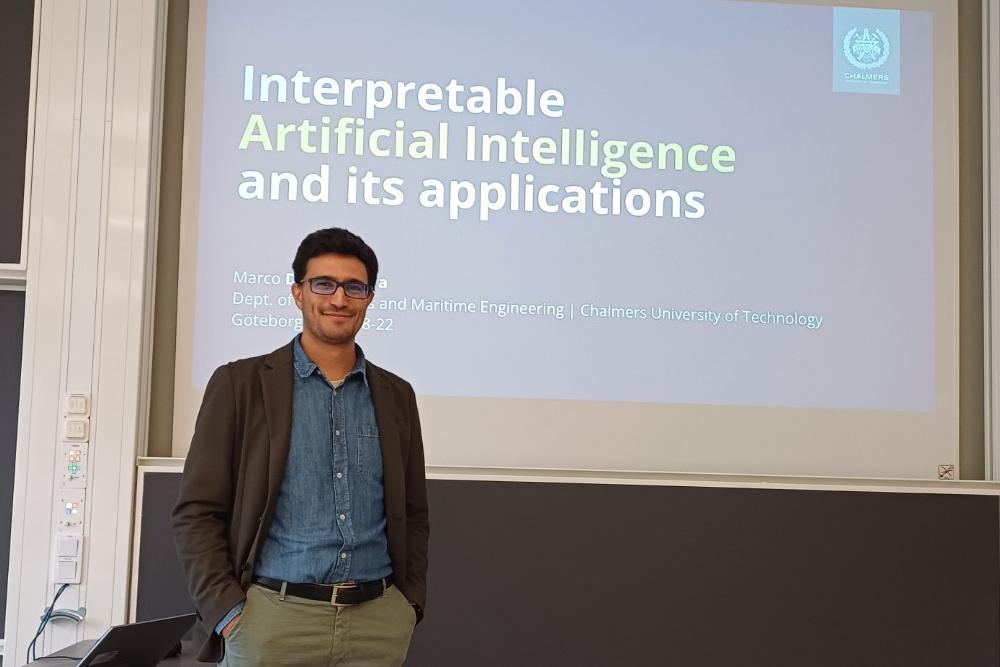
Marco L. Della Vedova is a Senior Lecturer in Applied Artificial Intelligence at Chalmers University of Technology, Sweden. He works in the Vehicle Engineering and Autonomous Systems division within the Department of Mechanics and Maritime Sciences, as part of Prof. Mattias Wahde's research group. Since 2025, he has served as Director of the Data Science and AI master's programme (MPDSC) at Chalmers, where he teaches courses including Introduction to Artificial Intelligence and Digitalization in Sports. Dr. Della Vedova earned his academic foundation at the University of Pavia, Italy, where he completed his BSc (2006), MSc (2009), and PhD (2013) in Computer Engineering. His doctoral research focused on "Real-Time Physical Systems and Electric Load Scheduling" under Prof. Tullio Facchinetti. During his PhD studies, he spent a year at U.C. Berkeley hosted by Prof. Francesco Borrelli at the Model Based Predictive and Distributed Control Lab. His research spans multiple AI domains with a strong emphasis on interpretability. Dr. Della Vedova develops interpretable methods for conversational AI, naturalness evaluation of forests using canopy height models, and geospatial applications. His work bridges theoretical AI with practical societal benefits, particularly in environmental monitoring, transportation systems, and orienteering. He has previously contributed to cloud computing, hate speech detection, and cyber-physical energy systems, demonstrating his interdisciplinary approach to AI research. Dr. Della Vedova's publication record reveals a consistent trajectory of impactful research across multiple domains of artificial intelligence. His recent work shows a strong focus on interpretability in AI systems, with significant contributions to natural language processing, geospatial analysis, and causal inference. The research demonstrates both theoretical depth and practical applications, particularly in environmental monitoring and social media analysis. His methodology often combines traditional machine learning approaches with novel interpretability techniques, creating bridges between complex AI systems and human understanding. Dr. Della Vedova has received several prestigious recognitions for his work: Best PhD thesis award from the Order of the Engineers of Bergamo (2013) Italian champion of Il Cervellone (2012) Top Italian performer in IEEEXtreme 6.0 programming competition (148th overall globally, 2012) Premio Arturo Schena award from Fondazione Credito Valtellinese (2010) With over 50 students supervised through bachelor's and master's theses, Dr. Della Vedova has established himself as a dedicated mentor in the AI community. His current PhD students include Minerva Suvanto working on interpretable NLP and Vivien Lacorre developing AI for railway infrastructure inspection. His supervision spans diverse topics from forest naturalness evaluation to hate speech detection and transportation optimization. Beyond formal supervision, he actively contributes to educational initiatives including serving as Director of Chalmers' Data Science and AI master's program and developing innovative teaching methods that connect theoretical concepts with real-world applications. Dr. Della Vedova is deeply embedded in both academic and professional communities. He leads the Applied Artificial Intelligence research group at Chalmers while maintaining strong connections with European research networks through projects like the ERASMUS+ EUrienteering initiative. His interdisciplinary approach is reflected in collaborations across computer science, environmental science, and social sciences. Notably, he applies his AI expertise to orienteering both as a researcher developing localization methods and as a licensed Event Advisor for the International Orienteering Federation, demonstrating how his professional and personal interests converge in innovative ways.
Tamar Ziegler is a Professor of Mathematics at the Einstein Institute of Mathematics, Hebrew University, holding the Henry and Manya Noskwith Chair in Mathematics since 2018. She currently serves as Chair of the Einstein Institute (2020-present) and has held visiting positions at prestigious institutions including IAS Princeton (2022-2023 Distinguished Visiting Professor), MSRI (2017 Simons Professor), and Stanford University (2012-2013). Her academic journey began with a B.Sc. summa cum laude (1995), M.Sc. (1998), and Ph.D. (2003) in mathematics from Hebrew University under advisor Hillel Furstenberg. Her career progression shows steady advancement from Zassenhaus Assistant Professor at Ohio State University (2002-2005), through positions at Technion (rising from Senior Lecturer to Professor), to her current role at Hebrew University since 2013. Ziegler's research spans number theory, ergodic theory, and combinatorics, with particular focus on additive combinatorics, higher order Fourier analysis, and connections between dynamical systems and number theory. Her work frequently involves collaborations with leading mathematicians including Terence Tao, Ben Green, and David Kazhdan. Analysis of her publication record reveals consistent contributions to fundamental mathematical problems, particularly in establishing polynomial patterns in primes, inverse conjectures for Gowers norms, and connections between ergodic theory and combinatorial number theory. Her research demonstrates a progression from foundational work on characteristic factors to increasingly sophisticated applications in prime number theory. 2025-2030 ERC Advanced grant 2024 Rothschild Prize in Mathematics 2024 9th European Congress in Mathematics, Plenary Speaker 2023 AIM Alexanderson Award 2021 Elected to Academia Europaea 2016 Rector's Prize for Excellence in Research and Teaching 2016-2021 ERC Consolidator grant 2015 Michael Bruno Memorial Award Ziegler has received continuous research funding through prestigious grants including multiple ERC awards and fellowships. Her leadership role as Chair of the Einstein Institute demonstrates significant institutional responsibility. While specific advising information isn't provided in the sources, her Erdős number is 2 (via Hillel Furstenberg) and she has collaborated with many prominent mathematicians throughout her career. As Chair of the Einstein Institute of Mathematics, Ziegler leads one of Israel's premier mathematical research centers, overseeing research programs and academic activities that connect ergodic theory, number theory, and combinatorics with other mathematical disciplines.
Val Tannen is a Professor at the University of Pennsylvania, specializing in database systems, provenance analysis, and programming languages. His research focuses on data management, query languages, and systems like DBSP and ORCHESTRA. Collaborations include work with co-authors such as Zachary Ives, Susan Davidson, and Todd Green. Key research interests include provenance for databases, incremental view maintenance, and data integration. His work bridges theoretical foundations and practical applications in systems like DBSP for stream processing and ORCHESTRA for collaborative data sharing. Publications span provenance frameworks, query optimization, and distributed systems. While no awards are explicitly listed, his contributions to database theory and systems are widely recognized.
Judit Gervain is a Full Professor at the Department of Developmental and Social Psychology at the University of Padua, Italy, and a CNRS Senior Research Scientist (Directeur de Recherche) at the Integartive Neuroscience and Cognition Center (CNRS & Université Paris Descartes), Paris, France. Her research focuses on early speech perception, language acquisition in monolingual and bilingual infants, and the neural mechanisms underlying language learning. She pioneered studies on newborn speech perception using near-infrared spectroscopy (NIRS), revealing prenatal influences on perceptual abilities and the emergence of grammatical structures in preverbal infants. Education: PhD in Cognitive Neuroscience (2002, SISSA, Trieste), postdoctoral research at the University of British Columbia (2007–2009), and CNRS researcher since 2009. She has authored over 100 peer-reviewed articles in journals like Science Advances , Nature Communications , and Developmental Science . Research Interests: Infant language processing, bilingualism, neuroimaging techniques (fNIRS), and comparing infant learning trajectories to artificial intelligence systems. Her work bridges developmental psychology, neuroscience, and computational linguistics, emphasizing the role of innate biases and environmental input in language acquisition. Her recent studies explore how infants’ learning mechanisms differ from Large Language Models (LLMs), focusing on input requirements, critical periods, and the role of multimodal integration. She also investigates the impact of prenatal auditory experience on neonatal speech perception and the neural foundations of linguistic structure detection. Labs/Teams: Affiliated with the CNRS’s Integartive Neuroscience and Cognition Center and the University of Padua’s developmental psychology group. Serves as associate editor for Developmental Science and Neurophotonics .
Davi De Castro Silva is a Researcher at the University of Cambridge, affiliated with the Department of Computer Science and Technology and the Centre for Quantum Information and Foundations. His current work is advised by Tom Gur and Sergii Strelchuk. Previously, he was a postdoc at CWI (Amsterdam) in QuSoft, advised by Jop Briët, and completed his PhD in Applied Mathematics at the University of Cologne under Frank Vallentin and Fernando de Oliveira Filho. He holds a Master's from IMPA (Brazil) under Roberto Imbuzeiro Oliveira and a BSc/MSc from École Polytechnique (France). His research focuses on theoretical computer science, quantum computing, and combinatorics, with recent emphasis on quantum speedups' structural foundations, such as symmetry's role. Key areas include additive combinatorics (e.g., higher-order Fourier analysis), computational complexity (lower bounds), combinatorial optimization (semidefinite programming), and quantum information theory. Notable contributions include studies on quasirandomness in additive groups, quantum algorithms' limitations, and tensor analysis. His work bridges combinatorial methods with quantum computing, exploring algorithmic efficiency and structural properties. He has published in journals like Discrete Analysis , Combinatorica , and Forum of Mathematics, Sigma , with preprints addressing quantum computation symmetry, Goldreich-Levin algorithms, and hypergraph quasirandomness. His research highlights interdisciplinary approaches to foundational questions in computing and mathematics.
Søren Eilers is a Professor at the Department of Mathematical Sciences, University of Copenhagen, affiliated with both the QA (Analysis & Quantum) and AG (Algebra & Geometry) sections. He holds editorial roles at Journal of Mathematical Analysis and Applications and contributed to Springer's Operator Algebra and Dynamics proceedings. Education : M.S. (1993), PhD (1995) in Mathematics from the University of Copenhagen. Positions : Assistant Professor (1996–1999), Associate Professor (1999–2008), Professor (2008–present). Research Interests : Focus on operator algebras, particularly C*-algebras associated with discrete structures. Active in symbolic dynamics, K-theory, and experimental mathematics. His work bridges algebraic structures and dynamical systems, with notable contributions to the classification of graph C*-algebras and the LEGO counting problem. Recent efforts emphasize computer-aided methods in mathematical research. Key Contributions : Pioneered geometric classification of graph C*-algebras, explored flow equivalence of shift spaces, and authored Introduction to Experimental Mathematics (2017). His research has been supported by grants such as the Villum Fonden's Experimental Mathematics initiative (2012–2016). Teaching & Mentorship : Supervised 28 PhD theses and numerous projects in analysis, discrete mathematics, and experimental mathematics. Taught courses in functional analysis, dynamical systems, and experimental methods. Scientific Leadership : Organized major programs like the 2016 Mittag-Leffler Institute's classification of operator algebras. Served as President of the Danish Mathematical Society (2006–2008) and led NordForsk's Operator Algebras and Dynamics network (2009–2012). International Collaboration : Extensive visiting appointments at institutions like MSRI (Berkeley), Fields Institute (Toronto), and Institut Mittag-Leffler (Stockholm). Maintains global research networks in operator algebras and dynamics.
Dudley Stark is a Reader in Mathematics and Probability at the School of Mathematical Sciences, Queen Mary University of London. He holds a BA in Mathematics and BS in Physics from the University of Rochester, an MA in Mathematics from UCLA, and a PhD in Mathematics from the University of Southern California. Prior to his current role, he held postdoctoral positions at the University of Zurich, University of Melbourne, and Hewlett Packard Laboratories in Bristol, and was a visiting scholar at Green-Templeton College (University of Oxford) and on secondment to the University of Bristol. His research focuses on probabilistic and enumerative combinatorics, random combinatorial objects (e.g., permutations and graphs), Poisson approximation, generating functions, and asymptotic expansions. He teaches courses such as Bayesian Statistical Methods and Advanced Derivatives Pricing and Risk Management. His work spans over 30 years, with contributions to stochastic processes, graph theory, and combinatorial probability. His research has been published in top journals like Stochastic Processes and Their Applications , Discrete Mathematics , and Advances in Applied Mathematics . Stark collaborates with institutions globally and contributes to the Centre for Combinatorics, Algebra and Number Theory. His expertise includes random graph theory, asymptotic enumeration, and applications of probabilistic methods in combinatorial structures.