Alexander Müller-Hermes is an Associate Professor at the Department of Mathematics, University of Oslo. His research focuses on quantum information theory with emphasis on mathematical questions in quantum Shannon theory and entanglement. He also explores functional analysis and convex geometry inspired by quantum phenomena. Before joining UiO, he held a Marie Skłodowska-Curie fellowship at University Claude Bernard Lyon 1 and was a postdoc at the Centre for Mathematics in Quantum Theory (QMATH), University of Copenhagen. He earned his PhD in Mathematics from Technical University Munich in 2015. Teaching includes advanced courses like Quantum Information Theory (MAT4430) and Linear Algebra (MAT1120). His research interests span quantum communication, entanglement theory, operator algebras, and functional analysis, with over 20 peer-reviewed publications since 2014. His work on fault-tolerant quantum coding and entanglement monotones has advanced theoretical foundations in quantum information. He collaborates with the Operator Algebras research group at UiO and is part of the QOMBINE project on quantum computation and many-body theory.
Lilya Budaghyan is a Professor at the Department of Informatics, University of Bergen, Norway, leading the Boolean functions research team at the Selmer Center. She holds a PhD from the University of Magdeburg (2005) and a habilitation from Paris 8 University (2013). Her research focuses on Boolean functions, particularly APN (Almost Perfect Nonlinear) functions and their cryptographic applications, with contributions to hardware implementations, equivalence relations, and cryptographic protocol design. She has authored the book *Construction and Analysis of Cryptographic Functions* and received awards including the TMS Starting Grant (2016) and Emil Artin Junior Prize (2011). Her work includes projects like the EU-funded BoolTI (2021–2025) and collaborations across institutions in Armenia, Germany, Italy, and France. Key research themes include constructing APN functions, analyzing their properties, and optimizing their hardware implementations for secure systems. Her recent publications emphasize hardware architectures for APN permutations, equivalence between cryptographic functions, and theoretical advancements in algebraic coding and finite fields. She serves as an editor for journals in cryptography and has organized international workshops such as WCC 2013.
Magne Haveraaen is a Professor in the Department of Informatics at the University of Bergen, where he leads the Bergen Language Design Laboratory (BLDL). He is actively engaged in research on programming theory, formal methods, language design, and high-integrity systems. His work centers on algebraic specifications, generic programming, domain engineering, and the design of the Magnolia programming language. He has been a long-standing instructor of key courses such as INF220 (Program Specification) and INF222 (Programming Languages), and contributes to national and international academic forums. University: University of Bergen School: Faculty of Mathematics and Natural Sciences Department: Department of Informatics Academic Rank: Professor Email: magne.haveraaen@uib.no His research interests include programming language design, formal specifications, generic and mouldable programming, multicore and GPU computing, and algebraic methods in software development. He emphasizes correctness, reuse, and high-integrity software through theoretical and practical innovations. He has contributed extensively to the literature on algebraic reasoning, array programming, and domain-specific abstractions. The recent publications highlight a consistent focus on algebraic semantics, language design (especially Magnolia), array programming, and formal verification. Themes across these works include correctness by design, specification-driven development, and adapting programming models for modern architectures. His involvement in workshops like ARRAY, WGP, and CALCO underscores his leadership in programming language theory. No scientific awards are listed in the provided texts. He advises students and welcomes collaboration in programming theory, language design, and formal methods. He has led funded projects such as MoSIS and SHIP and is involved in the High Integrity Systems Forum. He organizes and participates in key conferences including NWPT, GPCE, and SCAM. He leads the Bergen Language Design Laboratory (BLDL), which focuses on experimental language design, and contributes to the SAGA initiative on scientific computing with algebraic abstractions. His work integrates theory with practical tooling and language implementation.
Øyvind Ytrehus is a Professor at the Department of Informatics, Faculty of Mathematics and Natural Sciences, University of Bergen (UiB), Norway. He is actively engaged in research and academic supervision, with a focus on coding theory and its applications in communication systems. Research Interests: His primary research areas include Coding Theory , Error-Correcting Codes , Information Theory , Network Coding , Cryptography , and RFID Communication . His work bridges theoretical foundations with practical implementations in wireless and networked systems. The recent publications (2024–2008) reflect a consistent trajectory in coding for communication security, RFID systems, and iterative decoding. Key trends include the use of formally unimodular lattices for secrecy gain, LDPC and turbo codes for erasure channels, and network coding for multicast and delay optimization. His work frequently intersects with physical-layer security and energy-efficient communication. Scientific Contributions: Co-edited special issues on coding theory and applications. Authored foundational work on convolutional codes, stopping sets, and generalized Hamming weights. Contributed to RFID and inductively coupled channel modeling. Advising and Grants: He has supervised several PhD candidates, including Bjørn Møller Greve, Christian W. Otterstad, and Mohsen Toorani. While specific grants are not listed, his extensive publication record and editorial roles suggest active grant involvement in coding and communication research. Labs and Teams: While no specific lab name is mentioned, his collaborations with researchers at Simula UiB, University of Valladolid, and Lancaster University indicate participation in interdisciplinary research networks focused on coding and communication systems.
Professor Talal Rahman is a faculty member at the Western Norway University of Applied Sciences, where he works in the Department of Computer Science, Electrical Engineering and Mathematical Sciences. His office is located at Bergen KRONSTAD D305, and he can be reached at phone number +47 55 58 72 46. Professor Rahman's research spans several key areas in computational mathematics and scientific computing. His primary research interests include: Scientific Computing Numerical Analysis Numerical Methods for Partial Differential Equations Preconditioning Finite Element with Domain Decomposition Methods Variational Image Processing Artificial Intelligence and Machine Learning applications Professor Rahman's extensive publication record demonstrates a strong focus on domain decomposition methods, particularly Schwarz methods and their applications to multiscale problems. His recent work shows an increasing integration of machine learning techniques with traditional numerical methods, as evidenced by publications on neural network applications for environmental modeling and capelin migration patterns. His research also extends to biomedical applications, including computational analysis of biodegradable materials and bone tissue engineering scaffolds. He has made significant contributions to the development of adaptive preconditioners and parallel algorithms for solving complex numerical problems, with his work on the TV-Stokes model for image processing representing an important contribution to the field of variational image processing. Professor Rahman has supervised numerous research projects and students, though specific student names are not provided in the available information. His research appears to be supported by grants related to computational science and engineering, though specific grant details are not mentioned in the provided text. Based on his research areas, Professor Rahman likely collaborates with various research groups focused on computational science, with potential connections to biomedical engineering labs and environmental research teams studying the Barents Sea ecosystem.
Duy Ho is a Research Fellow in the Department of Mathematics and Statistics at UiT The Arctic University of Norway. He holds a PhD in Mathematics from McGill University and MS from Lomonosov Moscow State University. His research explores geometric structures and combinatorial methods with applications in coding theory and cryptography. Ho's current work focuses on developing coding theory applications using theoretical foundations from finite geometry. Recent projects investigate hull-variation problems in rank metric codes, quasi-cyclic codes, and linear complementary dual codes. His geometric research examines ovoids in projective spaces, hyperovals, and toroidal circle planes. Publications demonstrate strong connections between combinatorial structures and cryptographic applications, including work on bent functions derived from geometric constructions. Ho's research aims to advance mathematical foundations for secure communication systems.
Ermes Franch is a Postdoctoral Fellow at the Department of Informatics, University of Bergen, Norway. He is actively engaged in research in coding theory and cryptography, contributing to both theoretical developments and cryptanalytic investigations. Research Interests: His work primarily focuses on coding theory , especially low-rank parity-check codes, and their applications in cryptography . He investigates algebraic constructions of error-correcting codes, decoding algorithms, and the security of post-quantum cryptographic schemes such as Integer-RLWE. His research lies at the intersection of information theory, algebra, and computer security. Publication Trends: His recent publications show a consistent focus on generalizations and algorithmic improvements in rank-metric coding, with increasing contributions to high-impact IEEE journals. The work demonstrates a trajectory toward both theoretical depth and practical relevance in secure communications. Scientific Funding and Projects: Associated with the project Sequences and Their Applications funded by the Research Council of Norway (Reference: 311646). Advising and Grants: While no formal students are listed, his collaborative publications with senior researchers like Chunlei Li and Philippe Gaborit suggest active participation in a research group. His work is supported by national research grants, indicating recognition of his contributions in the field. Labs and Research Teams: He is affiliated with the Department of Informatics at the University of Bergen, contributing to research in sequences, coding, and cryptography, likely as part of a larger research group focused on theoretical informatics and security.
Rakhi Pratihar is a Postdoctoral Research Fellow at Inria Saclay Centre, France, affiliated with the GRACE research team. Her work bridges combinatorics, algebraic coding theory, and topological structures, focusing on rank metric codes, q-matroids, and shellable simplicial complexes. Research interests include: Decoding algorithms for rank metric codes and their cryptographic applications Generalizations of shellable q-complexes and matroid-like structures Topological and algebraic invariants (e.g., Betti numbers, Euler characteristic) of coding-theoretic objects Her publications span topics like Reed-Muller codes, Gabidulin codes, and Schur squares of Twisted Generalized Reed-Solomon codes, often exploring connections between coding theory and algebraic topology. She employs computational tools like SageMath for algebraic implementations. Rakhi collaborates with researchers such as Alain Couvreur, Sudhir R. Ghorpade, and Trygve Johnsen. Her work has been supported by institutions linked to Inria and the Simons Foundation.
Assoc. Prof. Constanza Riera is affiliated with the Department of Computing, Mathematics, and Physics at the University of South-East Norway. Her research focuses on cryptography, finite fields, Boolean functions, quantum computing, algebraic combinatorics, and coding theory. She has published extensively on topics including differential spectra, cryptographic function design, quantum states, and algebraic structures. Her work bridges theoretical mathematics with applications in cryptography and information security. Recent articles explore properties of APN functions, c-differentials, quantum state characterization, and combinatorial designs rooted in finite fields. Notable contributions include advancements in c-differential uniformity and the application of Dillon's switching method to construct secure functions. Riera's research also delves into quantum computing, analyzing graph-based quantum states and their algebraic properties. Her interdisciplinary approach addresses both foundational mathematical problems and practical cryptographic challenges.
Mohit Pal is a Postdoctoral Fellow at the Department of Informatics, University of Bergen, Norway. He is affiliated with the Faculty of Mathematics and Natural Sciences and conducts research under the mentorship of Prof. Lilya Budaghyan. He holds a Ph.D. in Mathematics from the Indian Institute of Technology Jammu, where he was supervised by Dr. Sartaj Ul Hasan. Education: B.Sc. in Mathematics, University of Allahabad (2011–2014) M.Sc. in Mathematics, Indian Institute of Technology Kharagpur (2014–2016) Ph.D. in Mathematics, Indian Institute of Technology Jammu (2018–2021) Visiting Student, Indian Institute of Technology Delhi (2018–2019) Visiting Student, Indian Statistical Institute Delhi (2022) His research lies at the intersection of cryptography and finite fields, focusing on boomerang uniformity, differential uniformity, APN and PN functions, permutation polynomials, and arithmetization-oriented cryptographic primitives . His work contributes to the theoretical foundations of symmetric cryptography and algebraic design of secure functions. He has published in leading journals such as Designs, Codes and Cryptography , IEEE Transactions on Information Theory , and Advances in Mathematics of Communications . His recent publications explore connections between generalized differential properties and cryptographic robustness, particularly in odd characteristic fields. Scientific Awards and Recognition: Reviewer for top-tier journals including IEEE Transactions on Information Theory , Designs, Codes and Cryptography , and Applicable Algebra in Engineering, Communication and Computing . Active participant in major international workshops such as Asiacrypt, Boolean Functions and Their Applications (BFA), and SETA. Erdős Number: 3 (via Sartaj Ul Hasan and Pantelimon Stănică). He has advised no students to date but has contributed to research mentoring through collaboration. He taught INF-143A: Applied Cryptography at the University of Bergen in 2024, instructing 84 students at undergraduate and master’s levels. His research has been supported through postdoctoral funding at the University of Bergen and prior project fellowships at IIT Jammu and Harish-Chandra Research Institute. He is currently engaged in advancing the theory of arithmetization-friendly cryptographic functions, with implications for zero-knowledge proofs and secure computation. Laboratories and Research Teams: Mohit Pal is part of the cryptography research group at the Department of Informatics, University of Bergen, collaborating closely with Prof. Lilya Budaghyan and Dr. Chunlei Li. His work integrates into broader efforts on algebraic methods in modern cryptography, particularly in the context of post-quantum and efficient cryptographic design.
Benjamin Adric Dunn is an Associate Professor in (Neural) Data Science at NTNU's Department of Mathematical Sciences. Formerly, he held positions as a PhD researcher and postdoc at NTNU's Kavli Institute for Systems Neuroscience, with prior education including an MS in Computational Engineering from Purdue University and a BS in Applied Mathematics from the University of Connecticut. His career also includes industrial experience as a Computational Methods Engineer at Pratt & Whitney, UTC. His research focuses on integrating mathematical and computational approaches to understand neural systems, particularly spatial cognition, grid cells, and topological data analysis in neuroscience. Key contributions include work on toroidal representations in grid cells, posture coding in neocortex, and cohomological feature extraction from neural data. Publications emphasize multidisciplinary methods bridging algebraic topology, statistical physics, and neuroscience. Teaching includes courses like TMA4255 (Applied Statistics) and TMA4285 (Time Series). Outreach activities highlight engagement in scientific communication, including media interviews about posture-coding neurons and grid cell research.
Trygve Johnsen is a Professor of Pure Mathematics at the Department of Mathematics and Statistics, UiT The Arctic University of Norway. His research bridges algebraic geometry with error-correcting codes , focusing on matroid theory, coding theory, and combinatorial structures. He is affiliated with the research group Applied and Computational Algebra and the Albatros project on mathematical aspects of information transmission. Education: PhD in Mathematics (University of Oslo, 1984) Research Interests: Algebraic Geometry, Coding Theory, Matroid Theory, Combinatorics, Algebraic Methods in Coding His recent work explores symmetric determinantal varieties, q-matroid analogues, and generalized weight spectra of codes. Scientific contributions include foundational studies on Grassmannians, Stanley-Reisner rings, and Betti numbers in coding theory. Doctoral Students: Supervised 5 PhD candidates including Andreas L. Knutsen and Jan Roksvold.
Volker Stolz is an Associate Professor in the Department of Informatics at the University of Oslo, Faculty of Mathematics and Natural Sciences. He is affiliated with the Reliable Systems research group, where his work centers on improving software reliability through formal methods, model transformation, and UML-based modeling. Institution: University of Oslo School: Faculty of Mathematics and Natural Sciences Department: Department of Informatics Research Group: Reliable Systems Contact: stolz@ifi.uio.no | +47 22852438 | Room GA06 9461 His research spans formal verification, concurrency, model-based testing, and programming language semantics. He has made significant contributions to deadlock detection, refactoring equivalence, runtime verification in distributed systems, and data race analysis, often using formal models such as Petri nets and active object languages. The recent publications highlight a consistent focus on software correctness , modular analysis , and automated verification techniques. Trends include the use of behavioral effects, abstract execution, and field calculus for distributed monitoring. His work frequently appears in top-tier venues like Theoretical Computer Science , Lecture Notes in Computer Science , and Journal of Logical and Algebraic Methods in Programming , indicating strong theoretical and practical impact. He collaborates extensively with researchers such as Violet Ka I Pun, Rui Wang, Lars Michael Kristensen, and Martin Steffen, reflecting an active and collaborative research profile. No scientific awards are mentioned in the provided text. There is no information available about student advising or research grants. Volker Stolz is involved in research projects related to model-based testing, formal methods, and reliable software systems, particularly through the Reliable Systems group. His work often involves building theoretical foundations and practical tools for verifying and improving software behavior in distributed and concurrent environments.
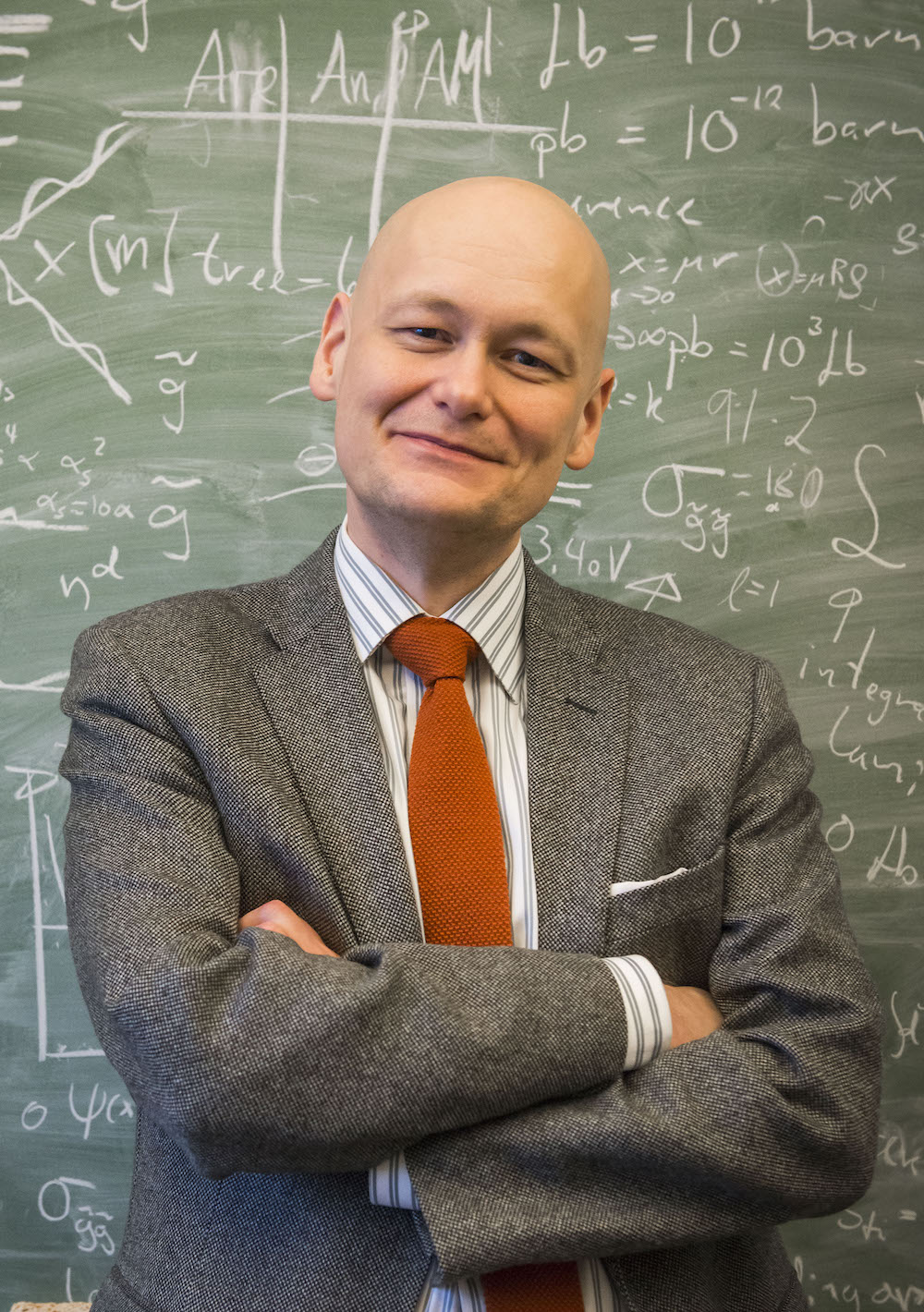
Are Raklev is a Professor at the University of Oslo's Department of Physics. His research focuses on theoretical and computational physics, particularly dark matter, particle physics at CERN's LHC, and applications of machine learning. He holds leadership roles in the GAMBIT Collaboration and its Collider Working Group. Education: PhD (University of Bergen, 2007), Postdoc (University of Cambridge, 2009), and Associate Professor at the University of Oslo (2010-2013) before becoming a full Professor in 2013. His teaching includes classical mechanics and electrodynamics (FYS3120) and supersymmetry (FYS5190/9190). Research Interests: Dark matter detection, Higgs boson studies, software for computational physics, and machine learning techniques like Gaussian processes. He leads projects like GAMBIT (a global inference tool) and PLUMBIN' (to address computational bottlenecks in high-energy physics). Recent publications span superconducting magnet design for colliders, quantum computing error correction, and nuclear isotope production. His work bridges theoretical insights with experimental applications at CERN and other facilities.
Oleksandr Kholosha is an Associate Professor at the Department of Informatics, University of Bergen. His research focuses on cryptography, coding theory, and discrete mathematics with an emphasis on bent functions, finite fields, and sequence design. He has collaborated extensively with experts like Tor Helleseth and Lilya Budaghyan. His work spans cryptographic primitives (stream ciphers like Pomaranch), algebraic aspects of bent functions, and analysis of pseudorandom sequences. Notable contributions include studies on Niho bent functions, correlation properties of m-sequences, and cryptanalysis techniques. Key achievements include over 30 peer-reviewed publications in top venues such as IEEE Transactions on Information Theory and Lecture Notes in Computer Science. His research addresses theoretical foundations and practical applications in information security.