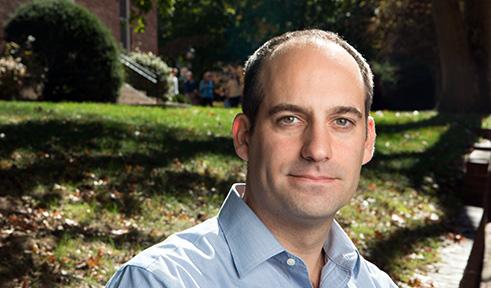
Joseph GingerichView profile
Associate Professor
Joseph Gingerich is an Associate Professor in the Department of Sociology and Anthropology at Ohio University’s College of Arts and Sciences. He is also a Research Associate at the Smithsonian Institution’s National Museum of Natural History and a National Geographic Explorer-Grantee. His research spans North America and East Africa, focusing on early human adaptations during the Late Pleistocene and Early Holocene. His educational background includes a Ph.D. from the University of Wyoming and a B.A. from Temple University. His research expertise lies in hunter-gatherer societies, stone tool technology, spatial analysis, and human-environmental interactions, particularly in the context of the colonization of the Americas. Ph.D., University of Wyoming B.A., Temple University Gingerich’s research interests center on the behavioral and technological adaptations of early human populations. He employs GIS, 3D morphometrics, and lithic refitting to analyze artifact distributions and reconstruct past mobility and social patterns. His work investigates how climatic and environmental changes influenced human settlement and subsistence strategies during the Paleoindian period. The trends in his recent publications reflect a strong focus on the Eastern Fluted Point Tradition, Clovis archaeology, and the use of advanced analytical techniques such as 3D modeling and spatial statistics. His work spans zooarchaeology, geoarchaeology, and technological analysis, emphasizing interdisciplinary approaches to understanding early human behavior in North America and Africa. His research has been supported by major funding bodies including the National Science Foundation, National Geographic Society, and the Virginia Department of Historic Resources. He collaborates with prominent researchers such as Rick Potts from the Smithsonian’s Human Origins Program, particularly on the Olorgesailie project in Kenya. National Science Foundation National Geographic Society Smithsonian Institution Virginia Department of Historic Resources Gingerich teaches courses such as World Archaeology, North American Prehistory, GIS for Anthropologists, and the Ohio Archaeological Field School. He has mentored students through field and laboratory research, though specific advisees are not listed. His editorial work includes major volumes on the Eastern Fluted Point Tradition, highlighting his leadership in the field. He is actively involved in research teams at the Olorgesailie Basin in Kenya and conducts fieldwork in the Roanoke River Valley and Southeastern Ohio. These projects integrate geoarchaeological, lithic, and spatial analyses to explore early human innovation and adaptation.