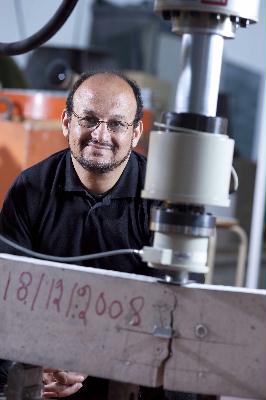
Dr. Qian Shunzhi is an Associate Professor and Program Director for the Bachelor of Engineering (Civil) at NTU's School of Civil and Environmental Engineering. He holds a PhD from the University of Michigan (2007), with prior faculty experience at Southeast University (2009-2013) and postdoctoral research at TU Delft (2007-2009). His research focuses on advanced construction materials like Engineered Cementitious Composites (ECC), self-healing concrete, and 3D-printable concrete, alongside life cycle assessment of infrastructure. Key interests include sustainable materials, CO2 sequestration, and material durability. Education: Bachelor's: Southeast University (Nanjing, 1998) Master's: Chinese Ministry of Transport Highway Research Institute (Beijing, 2001) PhD: University of Michigan (Ann Arbor, 2007) Research Interests: Novel cementitious composites for infrastructure resilience Recycled materials in construction 3D printing applications in concrete Material lifecycle analysis Notable contributions include bacterial encapsulation for self-healing, graphene-enhanced antibacterial surfaces, and CO2 sequestration via reactive materials. His work bridges material science, sustainability, and advanced manufacturing techniques.
Kamal H. Khayat serves as the Jones Professor of Civil Engineering at Missouri University of Science and Technology and directs the Center for Infrastructure Engineering Studies (CIES), focusing on advancing concrete technology for sustainable infrastructure development. His research spans high-performance concrete (HPC), ultra-high-performance concrete (UHPC), self-consolidating concrete (SCC), and concrete rheology, with specialized expertise in 3D printing applications, fiber reinforcement systems, and shrinkage mitigation techniques. He investigates innovative materials like superabsorbent polymers and alternative binders to enhance durability and sustainability in concrete infrastructure. Analysis of his recent publications reveals dominant trends in digital fabrication of concrete, particularly 3D printing optimization and rheological modeling for structural build-up. His work increasingly integrates machine learning for material property prediction while emphasizing eco-friendly formulations using recycled aggregates and carbon-mineralization techniques. As Director of CIES, Khayat leads multidisciplinary research initiatives in infrastructure materials engineering, overseeing projects related to concrete rehabilitation, sustainable construction methods, and advanced material characterization techniques for civil infrastructure systems.
Dr. Ali Kashani is a Senior Lecturer at the University of New South Wales (UNSW) within the School of Civil and Environmental Engineering. His research focuses on sustainable and low-carbon concrete materials, robot-aided construction (particularly 3D printing), and Circular Economy-aligned applications. Leadership in cementitious materials innovation Expertise in 3D printing for construction Advocate for waste valorisation and carbon capture Dr. Kashani has secured approximately $7 million in research funding and holds a patent in lightweight concrete foam. His work spans 70+ publications with 9,000+ citations, including media coverage in the Sydney Morning Herald and The Fifth Estate. He actively contributes to professional organizations such as MECLA, RILEM, and ASTM. Recent research trends include AI and optimization algorithms for sustainable concrete mix design, chloride diffusion modeling, and 3D printing performance analysis. His publications often address waste material integration, durability assessment, and eco-friendly construction practices. Scientific Awards: National and NSW Awards for 'Excellence in Concrete' (Technology and Innovation) from the Concrete Institute of Australia Churchill Fellowship for Digital Construction and 3D Printing sponsored by AVJennings Dr. Kashani serves as Co-Chair of the cement and concrete working group at MECLA and contributes to RILEM and ASTM committees. His email is ali.kashani@unsw.edu.au , and his office is located in the Civil Engineering Building (H20), Level 2, Room CE204, UNSW.
Gonzalo Barluenga Badiola is a Professor at the Department of Architecture within the School of Architecture at the University of Alcalá. His research focuses on advanced construction materials, including 3D-printable mortars, self-healing concrete, phase change materials (PCM), and nanomaterials for sustainable architecture. He leads the 'Promarq' research group, specializing in architectural projects and building materials. He holds a Ph.D. from the Universidad Politécnica de Madrid (2002), with a thesis on joint systems in facade construction. His research interests emphasize material innovation for energy efficiency, structural health monitoring, and environmental adaptation. Key areas include bio-based composites, thermal/acoustic mortar properties, and the integration of nanotechnology into construction materials. Recent work explores post-fire self-healing mechanisms, PCM-enhanced mortars, and additive manufacturing applications. His publications (2023–2025) highlight advancements in 3D-printed cement-lime mortars, nano-modified self-compacting concretes, and fiber-reinforced composites. He investigates rheological properties of materials at early stages and their structural performance. No scientific awards are explicitly mentioned, but his work is widely cited in sustainable construction and materials science. Grants and collaborations are inferred from his research output, though specific funding details are not provided here. His lab, 'Promarq,' likely focuses on experimental and numerical analysis of building materials. No student advising records are listed in the provided data.
Mehdi Mehrali serves as a Senior Researcher in the Department of Civil and Mechanical Engineering at the Technical University of Denmark (DTU), Denmark. His research spans advanced materials engineering with focus on sustainable construction and biomedical applications. Research Focus: Dr. Mehrali's work centers on geopolymer engineering , hydrogel development , and nanomaterial reinforcement for 3D-printed construction. His fingerprint reveals expertise in biomaterials (39%), graphene (45%), and phase change materials (27%), contributing to UN Sustainable Development Goals through sustainable infrastructure solutions. Publication Trends: Recent work demonstrates convergence of civil engineering with AI-driven material design (e.g., machine learning for geopolymer extrusion) and biomedical applications (e.g., antibacterial hydrogels). His 2025 publications show strong emphasis on multifunctional composites with self-sensing capabilities and robotic integration. Awards & Recognition: 6 similar researcher profiles identified in global networks 5 Mendeley readers for recent work Featured in 3 X (Twitter) discussions Supervision & Grants: Actively supervises three PhD candidates on 3D-printed construction materials while collaborating on major projects including COOLBATTERY (€2.1M) and RESTORATIVE grid-scale energy storage. His research attracts significant downloads (321 for hydrogel review) and citations (30+). Laboratory Focus: Leads research in Materials and Surface Engineering at DTU's Produktionstorvet facility, specializing in printable geopolymers, hydrogel robotics, and cement-based smart materials for sustainable construction.
Dr. Sumanta Das is an Associate Professor and Graduate Director in the Department of Civil and Environmental Engineering at the University of Rhode Island. His research focuses on sustainable infrastructure materials, with particular expertise in cementitious materials, composite structures, and advanced computational modeling techniques. He directs a vibrant research group that bridges experimental mechanics with computational modeling and machine learning approaches to address challenges in infrastructure durability and performance. Dr. Das received his educational training from prestigious institutions: Ph.D. in Materials and Structures from Arizona State University (2015) M.Tech. in Structural Engineering from Indian Institute of Technology, Kanpur (2012) B.E. in Civil Engineering from Jadavpur University (2010) His research interests center around developing sustainable and durable infrastructure materials through innovative design approaches. Dr. Das investigates microstructure-property relationships in cementitious systems, with special focus on materials containing microencapsulated phase change materials for freeze-thaw durability, fiber-reinforced composites, and smart cementitious materials with self-sensing capabilities. His work integrates advanced experimental techniques like nanoindentation with computational modeling approaches including finite element analysis, molecular dynamics simulations, and machine learning algorithms to predict material behavior and optimize performance. Dr. Das's recent publications demonstrate a clear trajectory toward integrating machine learning with traditional materials science approaches. His research group has made significant contributions to understanding the behavior of cementitious composites under extreme conditions, developing multifunctional composites with embedded sensing capabilities, and creating computational frameworks that bridge multiple scales from molecular to structural levels. The work shows increasing sophistication in combining experimental validation with predictive modeling. Dr. Das has successfully secured numerous research grants as PI or Co-PI from diverse funding sources including the Office of Naval Research, Department of Defense, US Department of Transportation, and industry partners like Goetz Composites. His research portfolio spans infrastructure durability, composite materials for marine applications, and smart sensing technologies for structural health monitoring. As an educator and mentor, Dr. Das has supervised multiple doctoral and master's students who have completed theses on topics including: Multiscale simulation and machine learning-assisted performance prediction for cementitious composites Performance-based multiscale tuning of inclusion-modified and 3D printed composites Enhancing freeze-thaw durability of cementitious composites through innovative materials design Underwater explosion response of composite structures Implosion pulse mitigation using additively manufactured filler profiles
Dr. Aliakbar Gholampour is a Senior Lecturer in Civil and Structural Engineering at the College of Science and Engineering, Flinders University. He earned his PhD in Structural Engineering from the University of Adelaide in 2019 and served as a Postdoctoral Research Fellow at the University of Melbourne until July 2020. He currently serves as Sustainable Construction Materials and Technologies Lead at Flinders University. Dr. Gholampour's educational background includes: PhD in Structural Engineering, University of Adelaide (2019) MSc in Structural Engineering BSc in Civil Engineering (Honours) His research focuses on sustainable infrastructure development through innovative materials and technologies. Dr. Gholampour specializes in recycling waste materials, industrial by-products, and fibers to develop sustainable construction materials. His work encompasses cementitious composites containing nanomaterials, smart multifunctional construction materials, 3D printable concrete, and advanced modeling of fiber-reinforced concrete. In structural engineering, he investigates the behavior, performance, and design of civil infrastructure with emphasis on resilience, sustainability, and management of deteriorating assets. Analysis of his recent publications reveals a strong focus on sustainable construction materials, particularly in recycling waste streams (foundry sand, plastic, glass, lead slag) for concrete production. His work integrates advanced computational methods including machine learning for material property prediction. The research trends show increasing emphasis on life cycle assessment, carbon reduction technologies, and the development of high-performance sustainable concrete alternatives using industrial by-products and recycled materials. Dr. Gholampour's scientific recognition includes: World's top 2% scientist by Stanford University and Elsevier (2021-2023) Emerging Research Leader Award, Flinders University (2023) Vice-Chancellor's Award for Early Career Researchers, Flinders University (2022) Finalist, SA Climate Leaders Awards (2024) Dean's Commendation for Doctoral Thesis Excellence, University of Adelaide (2019) His research is supported by significant grants including the International Clean Innovation Researcher Networks for Decarbonising the Building Industry (2023-2027), multiple Research Investment Funds from Flinders University, and the CRC-P grant for Recycling Waste Plastics. Dr. Gholampour serves as Special Issue Editor for multiple journals including Materials, Fibers, and Frontiers in Built Environment, and as Associate Editor for Frontiers in Built Environment Journal. He is a Steering Committee Member of the International Researcher Network for Decarbonising the Building Industry and a member of the Concrete Institute of Australia.
Budapest University of Technology and EconomicsHungary
Dr. Katalin KOPECSKÓ is Associate Professor in the Department of Engineering Geology and Geotechnics , Faculty of Civil Engineering, Budapest University of Technology and Economics (BME) . She lectures on construction-materials chemistry, durability and advanced concrete technologies, and maintains an active research portfolio spanning radioactive-waste solidification, geopolymer binders, supplementary cementitious materials and fibre-reinforced cementitious composites. Education & Academic Career Long-standing faculty member at BME Faculty of Civil Engineering (exact degrees not specified in text). Regular instructor for master-level courses: Alkali Activated Materials in Civil Engineering , Chemistry of Construction Materials , Durability of Construction Materials , Structure–Property Relations of Concrete . Holds weekly consultation hours on Thursdays 12–14 in building K, basement level, room 10/5. Research Focus Her research integrates materials science , geotechnical engineering and nuclear-waste management . Recent investigations include: Development of alkali-activated recipes for borate-rich liquid radioactive waste using limestone-portland blends. Application of semi-adiabatic calorimetry to identify optimal cement types for radioactive waste cementation. Enhancement of 3D-printing performance of concrete via metakaolin and silica fume. Long-term geotechnical and hydraulic impacts of municipal solid-waste leachate on soils. Durability of natural-fibre and nanocellulose-reinforced geopolymer mortars. Corrosion behaviour of vitrified high-level waste glass under simulated repository conditions. Across 2022-2025 she has published more than 40 peer-reviewed articles, reflecting a clear shift toward sustainable construction materials , nuclear environmental safety and advanced testing methodologies . Laboratory & Collaborative Environment Dr. KOPECSKÓ operates within BME’s well-equipped Engineering Geology and Geotechnics laboratories, where calorimetry facilities, geopolymer synthesis rigs and microstructural analysis tools support her projects. Close collaboration exists with the Vásárhelyi Pál Doctoral School and the national nuclear-waste management programme at Paks NPP, evidenced by joint publications on cemented-waste testing laboratories. Grants & Awards While specific grant numbers are not listed, her sustained output in high-impact journals and participation in national projects (e.g., NVKP_16-1-2016-0019 “Increasing the Chemical Resistance of Concrete”) indicate continuous external funding. Contact Office: Building K, basement, room 10/5, Budapest University of Technology and Economics. E-mail: kopecsko.katalin@emk.bme.hu Phone: +36 1 463 2238
State University of New York at BuffaloUnited States
Pinar Okumus serves as Associate Professor in the Department of Civil, Structural and Environmental Engineering at the University at Buffalo's School of Engineering and Applied Sciences. Her research focuses on advancing infrastructure resiliency through low-damage seismic systems, prefabricated concrete structures, and high-performance materials for rapid construction and repair of bridges and buildings. Her academic credentials include: PhD in Civil Engineering, University of Wisconsin, Madison (2012) MS in Civil Engineering, University of Wisconsin, Madison (2008) BS in Civil Engineering, Middle East Technical University (2006) Dr. Okumus' research integrates nonlinear structural analysis, material-scale testing, and in-situ monitoring to develop rapidly deployable infrastructure solutions. Her work emphasizes practical applications of pre-tensioned, post-tensioned, and reinforced concrete components for extreme event resilience, with particular focus on coastal infrastructure vulnerability and seismic retrofitting. The Dr. Okumus Research Group employs advanced methodologies including machine learning for structural assessment and optical fiber technologies for long-term monitoring. Recent publications (2023-2025) reveal strong thematic trends in corrosion effects on coastal infrastructure, 3D-printable cementitious composites for rapid repair, and tessellated structural-architectural systems. Her work increasingly incorporates machine learning for shear strength prediction and crack pattern analysis while maintaining core expertise in post-tensioned systems and seismic retrofit solutions. Research funding is secured through competitive grants from the National Science Foundation and Federal Highway Administration, supporting experimental validation of novel concepts like self-centering shear walls and ultrahigh-performance concrete retrofits. The group actively collaborates with transportation agencies to translate laboratory findings into field applications for bridge and building systems. The Dr. Okumus Research Group operates as an interdisciplinary team investigating structures that enable rapid reoccupation after extreme events. Current projects focus on modular systems with interlocking components, optical sensing integration for tendon force monitoring, and material innovations for climate-resilient infrastructure, maintaining strong connections with industry partners for practical implementation.
Professor Chengqing Wu is a distinguished academic in the School of Civil and Environmental Engineering at the University of Technology, Sydney (UTS). He serves as Professor of Structural Engineering with a research focus on blast-induced phenomena and advanced concrete technologies. His expertise spans structural response to blast loading, mitigation of blast effects, and the development of ultra-high performance concrete systems. Professor at University of Technology, Sydney Former Chair of Australian Chapter of International Association of Protective Structures (2013-2017) Associate Editor of ASCE Journal of Performance of Constructed Facilities Editorial Board Member of International Journal of Protective Structures Professor Wu's research interests center on structural engineering with emphasis on blast resistance, ultra-high performance concrete, geopolymer concrete, and structural response to extreme loading conditions. His work bridges theoretical analysis with practical applications, particularly in protective structures and extreme environment construction. His research group has made significant contributions to understanding material behavior under blast, impact, and extreme thermal conditions, with applications ranging from terrestrial infrastructure to potential lunar construction. Analysis of Professor Wu's recent publications reveals a strong focus on advanced concrete technologies for extreme environments. His research spans 3D-printed concrete, lunar and Martian construction materials, cryogenic performance of concrete, and blast-resistant structural systems. A notable trend is the increasing application of computational methods and machine learning techniques to predict structural response to explosions, alongside traditional experimental approaches. His work demonstrates a progression from fundamental material characterization to complex structural system analysis, with growing emphasis on sustainable construction and extraterrestrial applications. Author/co-author of over 200 international journal papers Editor of four conference proceedings Editor of two ASCE special issues Editor of two International Journal of Protective Structures special issues Professor Wu has successfully attracted over 4 million dollars in research funding from diverse sources including the Australian Research Council (ARC), Defence Science and Technology Organization (DSTO), and industry partners. His current projects include Eco-friendly Ultra-High Performance Rubberised Concrete, Decarbonised Infrastructure, Structural protective design on large capacity flywheel energy storage system, and Gas Explosion Resistance of Non-Cement Based High Performance Concrete. He actively supervises undergraduate honors students, coursework master's students, and research higher degree candidates, with several scholarships available for prospective postgraduates and research associates. Professor Wu leads research in protective infrastructure technology through the Joint Research Centre for Protective Infrastructure Technology and Environmental Green Bioprocess with Tianjin Chenjian University. His team operates the National Drop Weight Impact Testing Facility and contributes to the National Facility for Physical Blast Simulation. Current research directions include sustainable concrete technologies for extreme environments, blast-resistant structural systems, and innovative applications of concrete in space exploration contexts.
Ji Ma is an Assistant Professor in the Department of Materials Science and Engineering at the University of Virginia. His research focuses on additive manufacturing of metallic alloys, microstructure control, and multifunctional materials design. He explores novel material properties through 3D printing techniques, including spatially tailored properties, 3D concrete printing, and medical implant applications. His work addresses challenges in porosity, residual stress, and corrosion resistance in additively manufactured materials. Education: Ph.D. Mechanical Engineering, Texas A&M University (2012) B.S. Civil Engineering, Texas A&M University (2008) Research Interests include: Additive Manufacturing Multifunctional Materials Tailored Materials Orthopaedic Implants His projects span metallic alloys, multi-material printing, and bio-inspired materials for healthcare and construction. Grants and Collaborations: Virginia Innovation Partnership grant for commercializing 3D-printed wrist replacement technology Lead of $4.3M DARPA project to develop corrosion-resistant materials for naval systems Cross-disciplinary work with architecture and environmental sciences on sustainable 3D-printed soil structures Labs/Teams: Directs the Advanced Additive Manufacturing and Materials Group, focusing on innovation in material design, process optimization, and application-driven solutions for industry and healthcare.
Kemal Celik is an Assistant Professor of Civil Engineering at New York University Abu Dhabi (NYUAD) and holds a Global Network Assistant Professor appointment at New York University Tandon School of Engineering. He directs the AMBER Lab , focusing on sustainable construction materials and building energy efficiency. PhD in Civil and Environmental Engineering from University of California, Berkeley (2015) MS and BS in Civil Engineering from Istanbul University His research spans multi-scale material characterization, 3D printing of cementitious composites, carbonation processes for CO2 sequestration, and hybrid simulation methods for daylighting optimization. Current trends include lunar regolith simulants for space construction and low-carbon cement technologies. Scientific Awards: Outstanding Graduate Student Instructor Award, UC Berkeley (2013-14) Outstanding Paper Award, SCMT3 Conference, Kyoto (2013) UC Berkeley Conference Grant Ministry of National Education of Turkey Scholarship TUBITAK Fellowship
Ahmed LOUKILI is a Professor in the Mechanics, Materials and Civil Engineering Department at Ecole Centrale de Nantes, France. He is affiliated with the Research Institute in Civil and Mechanical Engineering (GeM), where he leads a research team focused on concrete. His work spans concrete technology, structural engineering, and materials science, with a particular emphasis on sustainable construction practices. Professor LOUKILI earned his Bachelor of Civil Engineering from the University of Bordeaux 1 in 1991, followed by a Master of Civil Engineering from Ecole Centrale de Nantes in 1992. He completed his Doctorate Degree (PhD) at Ecole Centrale de Nantes in November 1996 with a thesis on "Delayed deformation of the Ultrahigh-Performance Concrete." In December 2005, he obtained his Habilitation degree from the University of Nantes, enabling him to direct research. His research interests focus on the mix design and mechanical behavior of concrete, durability of cement-based materials, green concrete, and size effects in concrete. Professor LOUKILI has made significant contributions to understanding the early-age behavior of new cementitious materials and the durability mechanics of concrete structures. His work combines experimental approaches with advanced modeling techniques to address critical challenges in concrete technology. Analysis of Professor LOUKILI's recent publications reveals a strong focus on sustainable concrete technologies, including low-carbon cementitious materials, alternative binders like calcined clay and geopolymers, and the application of artificial intelligence for concrete optimization. His research increasingly integrates multi-scale characterization techniques such as nanoindentation and SEM imaging to understand the fundamental mechanisms governing concrete behavior. There's also a growing emphasis on 3D concrete printing and the development of methodologies for eco-design of concrete structures. Professor LOUKILI is a RILEM Senior Member and serves on the TC 195-DTD committee, which develops recommendations for test methods for autogenous deformation and thermal dilation of early-age concrete. He is also a member of the American Concrete Institute (ACI) and regularly reviews for numerous civil engineering journals. Since 2002, he has been a member of the scientific council at Ecole Centrale de Nantes. As Head of the concrete research team in Nantes, Professor LOUKILI has supervised numerous research projects focused on concrete technology and durability. His work has resulted in over 40 refereed papers and book chapters, with recent research expanding into areas like AI applications for concrete optimization and advanced characterization of low-carbon cementitious materials. He teaches courses in concrete technology, reinforced concrete, durability of concrete, and structural engineering. Professor LOUKILI's research is conducted through the Research Institute in Civil and Mechanical Engineering (GeM), where he leads a team investigating fundamental aspects of concrete behavior. His laboratory work combines experimental testing with advanced analytical techniques to address practical challenges in concrete technology and sustainable construction.
Derk H. Bos is a postdoctoral researcher in the Department of the Built Environment at Eindhoven University of Technology (TU/e), specialising in 3D concrete printing and quality control engineering. He completed his MSc cum laude in 2019 and defended his PhD dissertation in October 2024, both at TU/e. Education MSc in Structural Engineering and Design, Eindhoven University of Technology (cum laude, 2019) PhD in Concrete Structures, Eindhoven University of Technology (2024) Research Interests Derk’s research integrates additive manufacturing, materials science, and process engineering to advance 3D concrete printing. He develops parametric mortar design methodologies, rheological models for mixing and pumping, and novel in-line quality-control tests. His work addresses the challenges of ensuring structural integrity and process reliability in large-scale digital construction. Key focus areas include: – Rheology and yield stress optimisation of printable cementitious composites – Real-time monitoring techniques such as dye-tracer and gravity-induced compression tests – Multi-scale quality assessment from material to structural level Scientific Awards Digital Concrete Conference – Best Paper Award (2022) Service & Collaboration Since 2019, Bos chairs the PhD Network Civil Engineering, fostering early-career researcher engagement. He co-organised the Second RILEM International Conference on Concrete and Digital Fabrication in 2020, strengthening international collaboration in digital construction. Labs & Teams He is embedded within the Concrete Structures chair of the Unit Structural Engineering and Design, working closely with the TU/e 3D Concrete Printing research group led by Prof. Theo Salet and Dr. Rob Wolfs.
Roshan Jayathilakage is a Research Fellow at RMIT University's School of Engineering, specializing in sustainable concrete technologies. His work focuses on low-carbon concrete mix designs using calcined clays and industrial waste, alongside synchrotron-based material analysis and 3D concrete printing. He holds a Ph.D. in Civil Engineering from Swinburne University, with postdoctoral experience at the University of New South Wales, where he researched rubber and glass-reinforced concretes for noise walls. His expertise spans structural engineering, geotechnical design, and advanced material characterization, supported by industry collaborations for sustainable infrastructure solutions. Education: Ph.D. in Civil Engineering (Swinburne University of Technology), Postdoctoral Research at UNSW Sydney. Research interests include: sustainable construction materials, rheology of concrete, acoustic performance evaluation, numerical simulations (FEM/DEM/CFD/FDM), and waste integration in construction. He has published in top-tier journals and received the 2024 ICSBE Best Paper Award. His teaching includes Concrete Structures 2 and capstone project supervision. Current projects involve rheological formulations of calcined clay concrete and synchrotron analysis of low-carbon concretes. He actively mentors HDR students and contributes to academic communities through volunteer work and teaching.