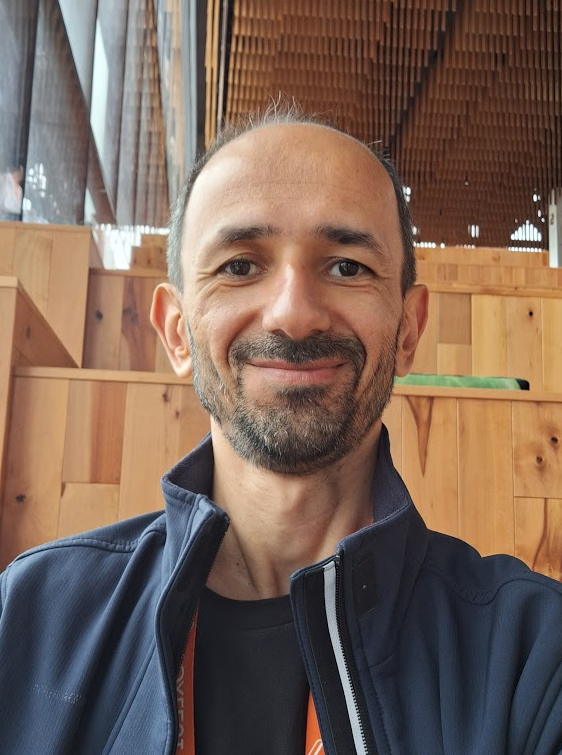
Adrian Munteanu is a Professor in the Department of Electronics and Computer Science at Free University of Brussels (Vrije Universiteit Brussel). He has been actively contributing to research in image processing, deep learning, and signal processing since 1995, with over 414 research outputs and an h-index of 29. His work spans diverse fields such as video compression, autonomous vehicle pose estimation, greenhouse gas emissions prediction, and real-time distributed video coding.
Sinan KALKAN is a full professor at the Department of Computer Engineering , Middle East Technical University (METU) , Ankara, Turkey. He actively contributes to interdisciplinary research at the intersection of Computer Vision, Machine Learning , and Robotics , with a focus on imbalanced learning, bias/fairness, and detection/segmentation tasks. As a member of multiple research centers ( METU Robotics and AI Center , METU Image Processing Lab , COVIG Lab (Denmark) , and BCCN Center (Germany) ), he drives collaborative innovation across Turkey, Denmark, and Germany. Research Interests include: Computer Vision (Object Detection, Segmentation, Recognition) Machine/Deep Learning (Imbalance Problems, Bias and Fairness) Robotics (Human-Robot Interaction, Context Modeling) Recent Article Trends show expertise in: Unified loss functions for detection/classification Uncertainty-aware neural architectures Fairness in affective computing Imbalance mitigation strategies Energy modeling under climate change Transformer-based time-series forecasting Scientific Awards : Best Paper Award, IEEE Transactions on Cognitive and Developmental Systems (2016) Labs and Teams : METU Robotics and AI Center METU Image Analysis Center METU Image Processing Laboratory METU Balance METU Energy Cambridge University AFAR
Professor Yusuf Sahillioğlu is a faculty member in the Computer Engineering Department at Middle East Technical University (METU), Faculty of Engineering, specializing in computer graphics and geometric processing. His academic journey includes a BS from Bilkent University, MS from University of Florida, and PhD from Koç University, followed by postdoctoral work at Koç University and University of Pennsylvania. His research focuses on 3D shape correspondence , deformation algorithms , deep learning for 3D data , and geometry processing . Key contributions include novel methods for isometric shape matching, topologically-stable correspondence, and real-time secondary animation. His recent work integrates deep learning with traditional geometric approaches for mesh segmentation, point cloud classification, and 3D scene extrapolation. His 15 most recent publications (2021-2025) reveal a strong trend toward real-time geometric algorithms (e.g., spring-decomposed skinning), kernel computation for mesh processing, and deep generative models for 2D-to-3D conversion. The research consistently bridges theoretical geometry with practical applications in animation, reconstruction, and medical imaging. Award highlights include: METU Academic Performance Award (2018) METU Young Scientist Awards (2015-2017) TÜBİTAK 1001 Grants (2016, 2020, 2024) for 3D content analysis, shape matching, and reconstruction TÜBİTAK 3501 Career Grant (2015) for virtual medicine applications He teaches core courses including Data Structures, Operating Systems, Computer Graphics, and Advanced Digital Geometry Processing. His lab focuses on geometric algorithms with applications in medical imaging, animation, and 3D printing, maintaining strong industry and international collaborations through projects like TÜBİTAK-funded initiatives.
Anastasia Angelopoulou is a Senior Lecturer (equivalent to Associate Professor) at the School of Computer Science and Engineering, University of Westminster , since 2005. She co-leads the Health and Social Care Modelling research group , focusing on AI systems for real-time healthcare and sustainable cities. A Fellow of the UK Higher Education Academy (FHEA) and certified STEM Ambassador, she bridges academia and industry with 5+ years of experience in image processing and software development across the UK and Greece. Research Interests: Computer Vision, Sign Language Recognition, Brain-Computer Interfaces, and Machine Learning for healthcare and sustainable systems. Grants: £65,173 from Dunhill Medical Trust for AI-based dementia diagnosis in deaf populations; NVIDIA GPU grant for depth map research; Heritage Lottery Fund grants for storytelling and health projects. Publications: 50+ works in Tier-1 journals (e.g., Neural Networks , Neurocomputing ) and top conferences (ICCV, ECCV, IJCNN). Awards: Elsevier Outstanding Review Status (2016); Westminster Teaching Excellence Team Award (2017). Her work emphasizes ethical AI, self-learning algorithms, and multimodal systems for diverse applications including clinical investigation and cultural heritage.
Professor Peter M. Atkinson is Distinguished Professor of Spatial Data Science at Lancaster University and Executive Dean of the Faculty of Science and Technology since 2015. He also served as Executive Dean of the Faculty of Health and Medicine (2018–2019) and is currently Visiting Professor at the University of Southampton and the Chinese Academy of Sciences in Beijing. Education and Career: Head of School (Geography), University of Southampton (2007–2012) Director of REF Strategy, University of Southampton (2012–2014) Visiting Fellow, Green-Templeton College, Oxford University (2012–2014) Belle van Zuylen Chair, Utrecht University (2015–2016) Research Interests: Professor Atkinson is an interdisciplinary scientist whose work integrates spatial data science , geostatistics , machine learning , and Earth observation to address complex environmental and societal challenges. His research spans: Disease transmission systems (e.g., COVID-19, malaria) Climate change impacts on vegetation and land cover Natural hazard risk assessment (e.g., floods, landslides, asteroid impacts) Spatiotemporal sampling and change-of-support problems Scientific Contributions: With over 300 peer-reviewed journal articles , 9 books , and 50 book chapters , Professor Atkinson has made foundational contributions to geospatial science. His work is widely cited, with an H-index of 78 (Google Scholar) and 57 (Web of Science). Awards and Recognition: Peter Burrough Medal, International Spatial Accuracy Research Association (2016) Distinguished Lecturer, International Association of Mathematical Geosciences (2020) Editor-in-Chief, Science of Remote Sensing Associate Editor, Environmetrics PhD Supervision and Grants: Professor Atkinson has supervised approximately 60 PhD students and led numerous large-scale research grants. He is currently supervising students in Earth Science, Geospatial Data Science, and STOR-i Centre for Doctoral Training. Research Groups and Labs: Centre of Excellence in Environmental Data Science Lancaster Intelligent, Robotic and Autonomous Systems Centre (LIRA) STOR-i Centre for Doctoral Training DSI – Environment Geospatial Data Science
Laura Ruotsalainen is a Professor of Spatiotemporal Data Analysis for Sustainability Science at the Department of Computer Science, University of Helsinki . She leads the Spatiotemporal Data Analysis group and is affiliated with the Helsinki Institute of Sustainability Science (HELSUS) and Helsinki Institute of Urban and Regional Studies (Urbaria) . Her research focuses on machine learning, computer vision, and sensor fusion for sustainable smart cities, particularly in urban mobility and GNSS security. Professor in Spatiotemporal Data Analysis for Sustainability Science Research Group: SDA (Spatiotemporal Data Analysis) Key Collaborations: Finnish Center for AI (FCAI), Konecranes Oyj, MATINE Her recent publications span spatiotemporal analysis, GNSS jammer localization, urban traffic simulation, and deep learning applications in navigation. Projects include AI-based optimization tools for sustainable urban planning (Research Council of Finland) and 5G-assisted Galileo-GPS receivers with inertial and visual enhancements.
Cees Snoek is a researcher at the University of Amsterdam specializing in AI foundation models, multimodal learning, and video analysis. His work focuses on advancing self-supervised learning, generalized category discovery, and multimodal interaction. Research Highlights: Developing revolutionary self-coding models for test-time category discovery Creating methods for generalized multimodal learning with unseen modality combinations Pioneering Bayesian approaches to improve prompt learning in vision-language models Innovating end-to-end graph refinement for object detection Advancing motion-focused video representations through tubelet-contrastive learning His recent work at NeurIPS 2023 and ICCV 2023 demonstrates leadership in solving fundamental challenges in category delineation, multimodal generalization, and 3D point cloud processing. All publications emphasize practical implementation with theoretical foundations. Scientific Awards: Recipient of the Netherlands Prize for ICT research (2012), recognizing innovative contributions to semantic video search technology
Yi Ding is a tenure-track Assistant Professor of Computer Science at Georgia State University. He leads a research group focusing on multimodal machine learning and human-computer interaction, particularly in understanding human behavior through technology. His work emphasizes applications in healthcare, education, and community benefits. Before academia, he had extensive industry experience as an engineer and researcher. Education B.S. in Computer Science and Mathematics, University of Massachusetts Amherst (2011) M.S. in Computer Science, University of California Santa Barbara (2021) Ph.D. in Computer Science, University of California Santa Barbara (2022) Research Interests Dr. Ding explores how technologies can interpret human behavior and social signals to improve health, education, and community systems. His work addresses challenges in multimodal data fusion, label noise robustness, and ethical AI design. Key areas include: Multimodal machine learning frameworks Human-centric AI ethics Data augmentation strategies for noisy labels Gesture-based interfaces Bio-signal authentication systems Professional Activity His research bridges academia and industry, with contributions to VR/AR systems, health monitoring technologies, and adaptive user interfaces. He collaborates with interdisciplinary teams to address real-world challenges through innovative machine learning approaches.
Dr. Xiaojun Qi is a Professor and Department Head of Computer Science at Utah State University (USU), where he has been since 2002. He holds a Ph.D. in Computer Science from Louisiana State University. His research focuses on Image Processing, Machine Learning, Computer Vision, and Deep Learning, with notable contributions to medical imaging, object detection, and multimedia security. Qi leads the Computer Science department and oversees research projects funded by grants from organizations like UDOT and GRCO. He has advised numerous graduate and undergraduate students across projects such as fake face detection, facial expression recognition, and LiDAR-based traffic sign detection. His work integrates computational geometry and AI to address challenges in vision systems and biomedical applications. Education: Ph.D., Computer Science (Louisiana State University); M.S., Systems Science (Louisiana State University); M.S., Computer Science (Shenyang Institute of Automation, Chinese Academy of Sciences); B.S., Computer Science and Engineering (Donghua University). Research Interests: Image Processing, Machine Learning, Deep Learning, Computer Vision, Medical Imaging, Object Detection, Digital Watermarking, and Data Mining. He has organized numerous conferences and served on technical committees for VISAPP, CompIMAGE, and DEXA. Grants include UDOC (Traffic Sign Detection), GRCO (Medical Image Segmentation), and NSF REU (Computer Vision). His lab focuses on interdisciplinary projects such as vision-based navigation, steganalysis, and bio-inspired algorithms.
Qingshan Liu is a faculty member at the Nanjing University of Information Science & Technology, School of Information and Control. His research focuses on computer vision, pattern recognition, remote sensing, and artificial intelligence, with specialized applications in satellite imagery analysis, LiDAR processing, and spatiotemporal modeling. Dr. Liu has contributed significantly to neural network architectures for video analysis, 3D segmentation, and domain adaptation techniques. His recent work demonstrates strong engagement with deep learning approaches for environmental monitoring and geospatial analysis, including precipitation nowcasting systems, change detection in remote sensing data, and crowd counting methodologies. Publications show consistent innovation in transformer networks, generative adversarial models, and multimodal learning frameworks applied to real-world problems in urban computing and autonomous systems.
Dr. Peter Feldens is a researcher at the Leibniz Institute for Baltic Sea Research (IOW), specializing in Marine Geology and Marine Geophysics. His work focuses on sediment dynamics, submarine landslides, and acoustic remote sensing techniques. He leads the Marine Geology section and contributes to the Marine Geophysics work group. His research integrates advanced technologies like AI-driven sonar analysis and deep learning to study boulder distribution, seafloor morphology, and human impacts on marine environments. Key research areas include glacial sediment processes, fjord dynamics, submarine landslide mechanics, and habitat mapping. He has extensively published on topics ranging from Andaman Sea sedimentation to Baltic Sea benthic ecosystems. Feldens collaborates internationally on projects like the STB interdisciplinary initiative and ECOMAP environmental assessments. His technical expertise spans multibeam backscatter analysis, parametric echosounding, and high-resolution seismic imaging. Notable contributions include developing methods for detecting boulders and coral reefs using sonar data and quantifying trawling impacts on seafloor morphology.
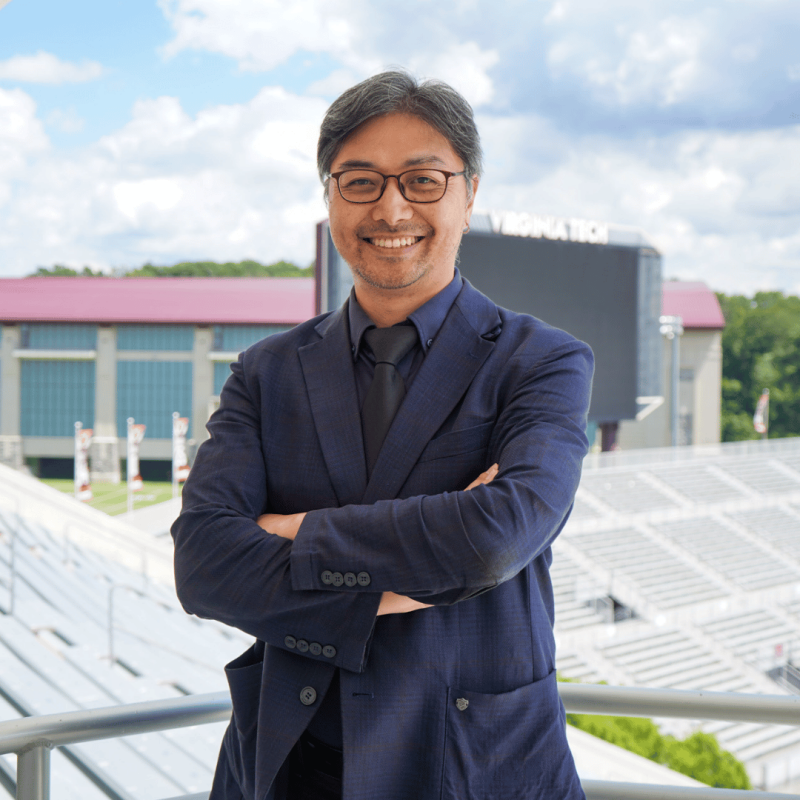
Myounghoon "Philart" Jeon is a Professor in the Department of Industrial and Systems Engineering at Virginia Tech. He leads the Mind Music Machine (tri-M) Lab, focusing on interactive technologies for artistic and creative experiences. His research spans Human-Computer Interaction, Human-Robot Interaction, and Affective Computing, with applications in automotive interfaces, assistive technologies, and extended reality (XR). Education: PhD in Engineering Psychology and Human-Computer Interaction from Georgia Tech, M.S. in Engineering Psychology (Georgia Tech), and B.S. in Psychology from Yonsei University. Research emphasizes interdisciplinary approaches combining psychology, neuroergonomics, and computational modeling. Key areas include sonification, emotion-aware design, and inclusive technologies. He has authored numerous publications in top journals like International Journal of Human-Computer Interaction and IEEE Transactions on Visualization and Computer Graphics. Lab Focus: tri-M Lab explores AI-driven art, automotive UX, assistive robotics, and XR applications. Grants & Awards: Includes Earl Alluisi Early Career Award and multiple best paper awards. Active in diversity initiatives through HFES COAG and BIPOC Affinity Group. Editorial Roles: Associate Editor for International Journal of Human-Computer Studies and Presence: VR & Teleop. His work bridges technical innovation with human-centric values, addressing challenges in automated vehicles, creative collaboration, and ethical AI/robotics education.
Nasim Dadashi Serej is a Lecturer in Artificial Intelligence at the School of Computing and Engineering, University of West London. Her expertise lies in applying AI to healthcare challenges, particularly in medical data analysis, collaborating closely with clinicians and healthcare organizations. Her research focuses on machine learning, deep learning, computer vision, and medical image-guided interventions. Her research interests include advanced AI techniques such as 3D scene analysis, natural language processing, stochastic search methods, and combinatorial optimization. She actively contributes to the development of software solutions for medical applications like image-guided navigation, medical image/video processing, and dataset collection. Nasim teaches across multiple programs, including BSc and MSc courses in Artificial Intelligence, Data Science, and related fields. Her recent publications span AI-driven healthcare innovations, from seizure detection to cardiovascular imaging analysis and pandemic forecasting. She emphasizes collaboration with clinical partners to ensure practical, real-world impact. Her work bridges theoretical AI advancements with clinical practice, aiming to improve diagnostic accuracy and patient outcomes through technology.
Professor Hyo-sang Shin is a Lecturer at Cranfield University, specializing in Guidance, Navigation, and Control within the Autonomous and Intelligent Systems Group. He holds an MSc in Aerospace Engineering from KAIST and a PhD in cooperative missile guidance from Cranfield University. His expertise includes Aeronautical Systems, Autonomous Systems, and Vehicle Health Management. Research focuses on cooperative guidance/control for multiple vehicles, coordinated health monitoring, and information-driven sensing. He collaborates with industry partners like Leonardo, Airbus, and Lockheed Martin. Key awards include Silver and Most Popular Team awards from the 2004 Korea Robot Aircraft Competition. Publications emphasize advanced control algorithms, UAV trajectory optimization, and sensor fusion techniques. Over 150 peer-reviewed articles span journals like IEEE Transactions on Aerospace and Electronic Systems and International Journal of Robust and Nonlinear Control. Labs/Teams: Active contributor to the Centre for Autonomous and Cyberphysical Systems at Cranfield, leading projects on UAV swarms, autonomous systems, and hypersonic vehicle control.
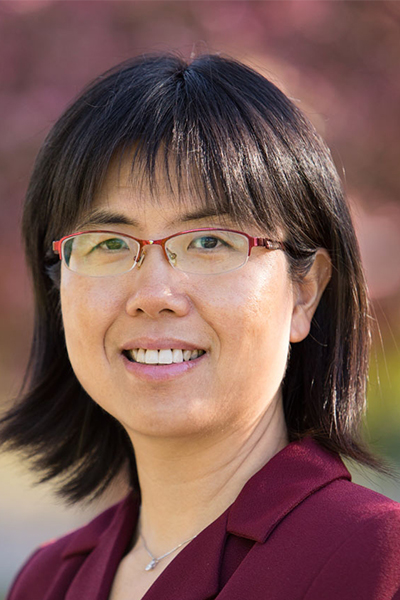
Linwei Wang is the Bruce B Bates Endowed Professor in the Department of Computing and Information Sciences at Rochester Institute of Technology (RIT). She leads the Computational Biomedicine Laboratory (CBL), focusing on integrating domain knowledge with machine learning to address critical medical challenges, particularly in cardiac electrophysiology and arrhythmia treatment. Her research bridges physics-based models with data-driven inference, emphasizing personalized healthcare solutions. Education: PhD in Computing and Information Science from RIT (2009), MPhil from Hong Kong University of Science and Technology (2007), and BE in Optic-Electronic Information Engineering from Zhejiang University (2005). Research interests include Electrocardiographic Imaging (ECGi), uncertainty quantification in cardiac models, and machine learning for medical data. Key projects involve noninvasive imaging of ventricular tachycardia, improving ECGi accessibility through camera-based systems, and developing hybrid models for personalized cardiac simulations. Scientific awards include the NSF CAREER Award (2014) and PECASE (2019). Her lab collaborates with institutions like NIH, Siemens Healthineers, and the University of Pennsylvania. Current teaching includes CISC-820 (Quantitative Foundations) and CISC-862 (Computational Modeling). Grants: NIH R01HL145590 (2019-2024) and NSF awards. Advises numerous PhD students in machine learning and biomedical applications. Lab activities include developing AI tools for real-time clinical guidance and risk prediction in heart failure.