
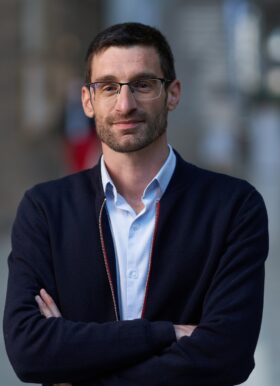
About
Thomas Papouin is an Assistant Professor of Neuroscience in the School of Medicine at Washington University in St. Louis, where he leads the Papouin Lab. His research focuses on astrocytes, a type of glial cell that comprises 80-90% of non-neuronal cells in the brain, and their role in brain function and information processing.
Dr. Papouin received his PhD in Neuroscience and Pharmacology from the University of Bordeaux, France (2007-2011), following an MSc in Integrative Biology and Physiology (specialized in Neuroscience) from Ecole Normale Supérieure, Institut Pasteur, and Université Pierre et Marie Curie, Paris (2005-2007), and a BS in Biology from the same institutions (2004-2005).
His research explores how astrocytes contribute to information processing in the brain at molecular, circuit, and behavioral levels. Rather than studying astrocytes in isolation, his lab investigates their position in brain circuitry and their role in brain computation from the perspective of brain states. His lab coined the term 'contextual guidance' to describe how astrocytes shape underlying neuronal networks via gliotransmitter release according to ongoing brain states. His work has important implications for understanding neurological disorders including schizophrenia, depression, and cognitive disorders associated with sleep loss.
Analysis of his recent publications reveals a strong focus on astrocyte-neuron interactions, with particular attention to how neuromodulators affect astrocyte activity and how this influences synaptic properties and cognitive functions. His research combines molecular, cellular, and systems neuroscience approaches to understand the fundamental mechanisms by which astrocytes contribute to brain function.
Dr. Papouin has received numerous prestigious awards including a NARSAD Young Investigator Grant (2020-2022), McDonnell Center for Cellular and Molecular Neurobiology small grant award (2020), Whitehall Foundation Research Grant (2020-2023), and a Human Frontier Science Program long-term Fellowship (2013-2016).
His lab develops innovative methodologies for studying astrocyte activity, as evidenced by the STARDUST pipeline for analyzing astrocyte calcium dynamics. His work bridges basic neuroscience with clinical applications, particularly in understanding how astrocyte dysfunction contributes to neurological and neuropsychiatric disorders.
Find Thomas Papouin elsewhere
Related Searches
You Might Also Like
 Thomas PapouinReed College · Assistant Professor
- KKeith MuraiMcGill University · Professor
 Christian HennebergerRhenish Friedrich Wilhelm University of Bonn · Professor
 Jiakun ChenUniversity of North Carolina at Chapel Hill · Assistant Professor
 Rogier MinVrije University Amsterdam · Research Fellow
 Mark BeenhakkerUniversity of Virginia · Associate Professor