

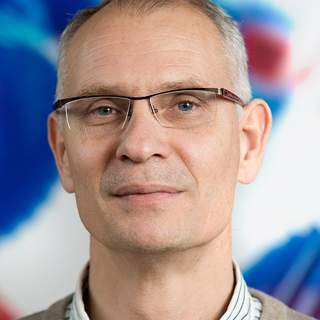
Stéphane Mery
Researcher · Self-organized π-conjugated organic materials
Fritz Haber Institute of the Max Planck SocietyAbout
Stéphane Mery has been a permanent CNRS Researcher at the Institut de Physique et Chimie des Matériaux de Strasbourg (IPCMS, University of Strasbourg-CNRS) since 1992. After completing his PhD (1990, University of Bordeaux) and a post-doctoral fellowship at the Naval Research Laboratory (Washington DC, 1990–1992), he obtained his Habilitation à diriger des recherches (HDR) in 2001. His activities revolve around the molecular design, synthesis and self-assembly of π-conjugated organic semiconductors.
Education
- PhD in Chemistry and Physics, 1990 – University of Bordeaux, France (supervisors: Prof. F. Hardouin & Dr. M. Mauzac)
- Habilitation à diriger des recherches (HDR), 2001 – Accredited to supervise doctoral research
Research Focus
Dr. Mery’s research integrates synthetic organic chemistry, supramolecular chemistry and materials science to create self-organized π-conjugated materials. By decorating chromophores with flexible alkyl or siloxane chains, he stabilizes mesomorphic organizations that combine fluidity with long-range order—ideal for solution-processable optoelectronics. A recent thrust is the development of π-functional molecular liquids: room-temperature solvent-free fluids whose fluidity and electronic properties are simultaneously tuned for electroluminescent devices.
Core expertise spans:
- Self-organized organic systems (liquid-crystalline, mesomorphic)
- Siloxane-containing organic semiconductors
- π-Conjugated molecules and polymers for OLEDs, OPVs and OFETs
- Structure–morphology–property relationships
Publication Landscape
Over the past five years his group has published extensively on (i) side-chain engineering of conjugated polymers to control crystallinity, doping and thermoelectric performance, (ii) halogenation effects on backbone conformation, (iii) solvent-free melt-processing of large crystalline domains, and (iv) hybrid organic/inorganic photoactive systems. The work repeatedly combines advanced structural probes (solid-state NMR, GIWAXS, AFM-KPFM) with device studies (OPV, OLED, OFET) to close the design–function loop.
Laboratory & Team
He is a member of the “Functional Molecular Materials” team at IPCMS, where he supervises synthetic and device-oriented projects in close collaboration with physicists, spectroscopists and theoreticians.
Find Stéphane Mery elsewhere
Related Searches
You Might Also Like
 Anthony D'ALEOFritz Haber Institute of the Max Planck Society · Researcher
 Bertrand DonnioFritz Haber Institute of the Max Planck Society · Researcher
 Matteo MauroFritz Haber Institute of the Max Planck Society · Associate Professor
 Hakan UstaBatman University · Professor
 Pierre RABUFritz Haber Institute of the Max Planck Society · Researcher
 Peter BobbertUniversity of Twente · Professor