
_edited.jpg)
About
Mo R. Ebrahimkhani, MD is an Associate Professor with tenure in the Department of Pathology at the University of Pittsburgh School of Medicine. He is also a member of the Pittsburgh Liver Research Center, McGowan Institute for Regenerative Medicine, and Pittsburgh Department of Bioengineering. His research integrates synthetic biology, systems biology, and stem cell engineering to advance regenerative medicine through programming stem cell morphogenesis and developing novel multicellular systems.
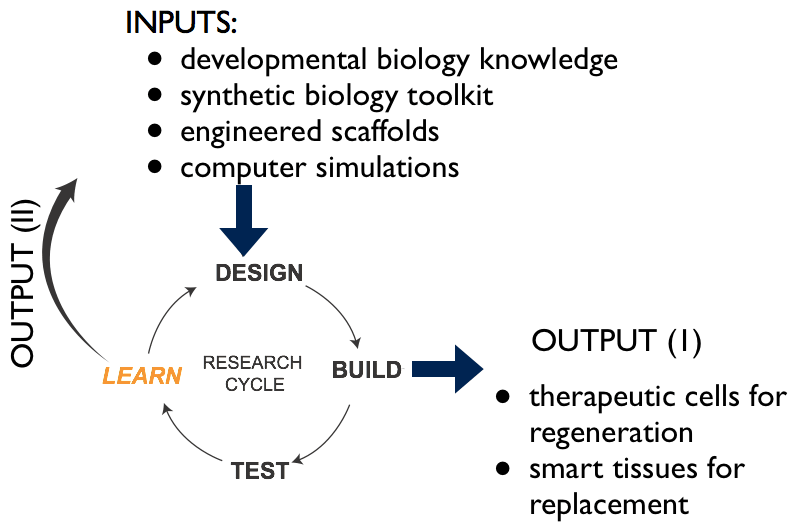
Dr. Ebrahimkhani's research focuses on five key areas: Human Organoids and Synthetic Niches, Modeling Embryogenesis, Tissue Ecology, Systems Biology of Multicellular Systems, and In-vivo Regenerative Technologies. His lab pioneered Designer Liver Organoids (DesLOs) that mimic native liver tissue for regenerative therapy and disease modeling. Recent work includes modeling post-implantation human development to yolk sac blood emergence (Nature, 2024) and developing genetically engineered endothelial niches for vascularized kidney organoids.
- Synthetic developmental biology: Build and control multicellular systems
- Programming morphogenesis through systems and synthetic biology
- Genetically engineering self-organization of human pluripotent stem cells
- CRISPR-based epigenetic tools for in vivo tissue homeostasis
- Tissue ecology and multicellular computation
Dr. Ebrahimkhani has received significant recognition for his work including NIH RO1 grants, the Mayo Clinic accelerated regenerative medicine award, and the New Investigator Award from Arizona Biomedical Research Council. His research on modeling human development was highlighted in major media outlets including the New York Times.
The lab actively trains graduate and undergraduate students in interdisciplinary approaches to regenerative medicine. Current projects include developing mature human liver organoids, modeling embryogenesis, studying tissue ecology, and developing CRISPR-based regenerative technologies. The lab maintains strong collaborations with computational biologists at Carnegie Mellon University and clinicians at UPMC.
Dr. Ebrahimkhani leads the Laboratory for Synthetic Biology and Regenerative Medicine, which combines wet-lab experimentation with computational modeling to understand and engineer multicellular systems. The lab's work has significant implications for regenerative therapies, disease modeling, and drug discovery.
Find Mo R. Ebrahimkhani elsewhere
Related Searches
You Might Also Like
 Leonardo MorsutUniversity of Southern California · Assistant Professor
- GGeraldine MitchellAustralian Catholic University · Associate Clinical Professor
 Parashurama NateshState University of New York at Buffalo · Assistant Professor
- KKeisuke IshiharaUniversity of Pittsburgh · Assistant Professor
 Anna-Katerina HadjantonakisMemorial Sloan Kettering Cancer Center · Professor
 Gat RaunerTufts University · Academic