
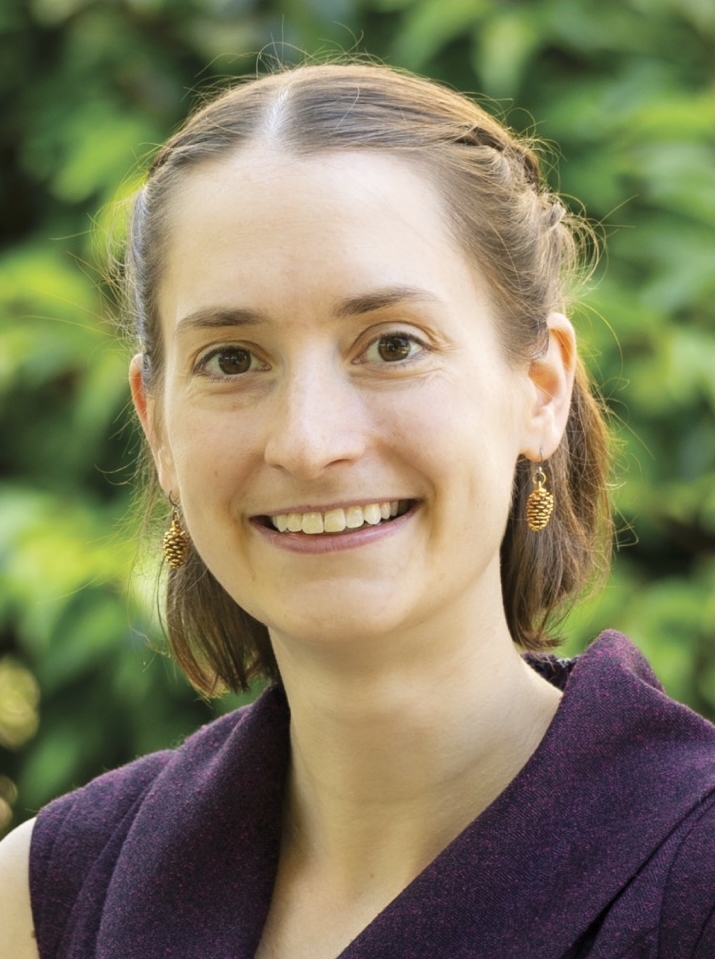
About
Marysa Laguë is an Assistant Professor in the Department of Geography within the Faculty of Arts at the University of British Columbia. She is a climate scientist specializing in understanding how terrestrial processes impact the atmosphere and surface climate across scales from individual plants to entire planets. Her research focuses on how changes in the land surface modify energy and water fluxes between the land and atmosphere, and how these changes subsequently affect atmospheric dynamics and climate both locally and remotely. Dr. Laguë serves as a member of the Graduate and Postdoctoral Studies program at UBC.
Dr. Laguë earned her PhD in Atmospheric Sciences and MSc degrees in both Atmospheric Sciences and Applied Mathematics from the University of Washington. Her educational background provides her with strong theoretical and modeling expertise that informs her comprehensive research approach.
Her research can be broadly categorized into three interconnected areas: understanding land-atmosphere interactions in the modern climate system, exploring fundamental physical connections between terrestrial and planetary processes using idealized models, and climate model development. She studies how changes in vegetation impact cloud formation, temperatures, water vapor, and atmospheric circulation in ways that can feed back on surface climate. On the idealized side, she investigates how continental configurations fundamentally alter global-scale climate patterns. Her work often involves developing and using numerical models of varying complexity to quantify land's role in the coupled Earth System. She is particularly interested in understanding where the atmosphere cares about changes in the land surface, and what particular properties of the land surface it is that the atmosphere cares about.
Dr. Laguë's recent publications demonstrate a consistent focus on land-atmosphere interactions, with particular emphasis on how terrestrial evaporation, surface albedo, and vegetation properties influence climate dynamics. Her research spans from local-scale processes to planetary-scale phenomena, including studies of exoplanet climates. She frequently employs both complex Earth system models like the Community Earth System Model and idealized modeling frameworks to isolate specific mechanisms. A recurring theme across her work is the development and application of the Simple Land Interface Model (SLIM), which allows researchers to test how individual land-surface properties modify energy and water fluxes to the atmosphere.
Dr. Laguë is actively involved in mentoring graduate students and is interested in supervising Master's students, Doctoral students, and Postdoctoral Fellows. She supports interdisciplinary research collaborations and is open to supervising students interested in public scholarship through the Public Scholars Initiative. She also encourages experiential learning opportunities like internships for her graduate students and emphasizes the importance of interdisciplinary research approaches.
She is the lead scientific developer of the Simple Land Interface Model (SLIM), an idealized land surface model that couples with the Community Earth System Model. This tool allows researchers to isolate the effects of individual land surface properties on the Earth system. Her work has significant implications for understanding climate change impacts, land management strategies, and even the potential habitability of exoplanets. Her research methodology includes using climate models, Earth system models, numerical Earth system models, Python, Jupyter, the Coupled Model Intercomparison Project (CMIP), and Fortran programming for climate model development.
Find Marysa Laguë elsewhere
Related Searches
You Might Also Like
- MMarysa LagueUniversity of Utah · Adjunct Assistant Professor
 Yeliz YilmazUniversity of Oslo · Researcher
- RRahel BuriETH Zurich · Researcher
- AAlexander WinklerMax Planck Institute for Biogeochemistry · Researcher
 James KastingPennsylvania State University · Professor
 Alejandro N. FloresBoise State University · Professor