
About
Francesco Ambrogi is an Assistant Professor in the Department of Mechanical and Materials Engineering at Queen's University, where he leads the Fluids, Energy, and Bio-inspired Unsteady Simulations (FEBUS) lab. His research focuses on computational and theoretical studies of turbulent boundary layers under pressure gradients, with applications in unsteady aerodynamics (turbine blades, rotor blades) and biomimicry (swimming/flying animals) for flow control.
Dr. Ambrogi received his PhD in Mechanical Engineering from Queen's University in 2024, following a MASc in Energy and Nuclear Engineering from the University of Bologna, Italy (2019), and a BAsc in Mechanical Engineering from the University of Modena and Reggio Emilia, Italy (2015). He previously served as an Adjunct Assistant Professor at Queen's University in 2024 and completed a Postdoctoral Research Fellowship at the University of Waterloo in Mechanical and Mechatronics Engineering.
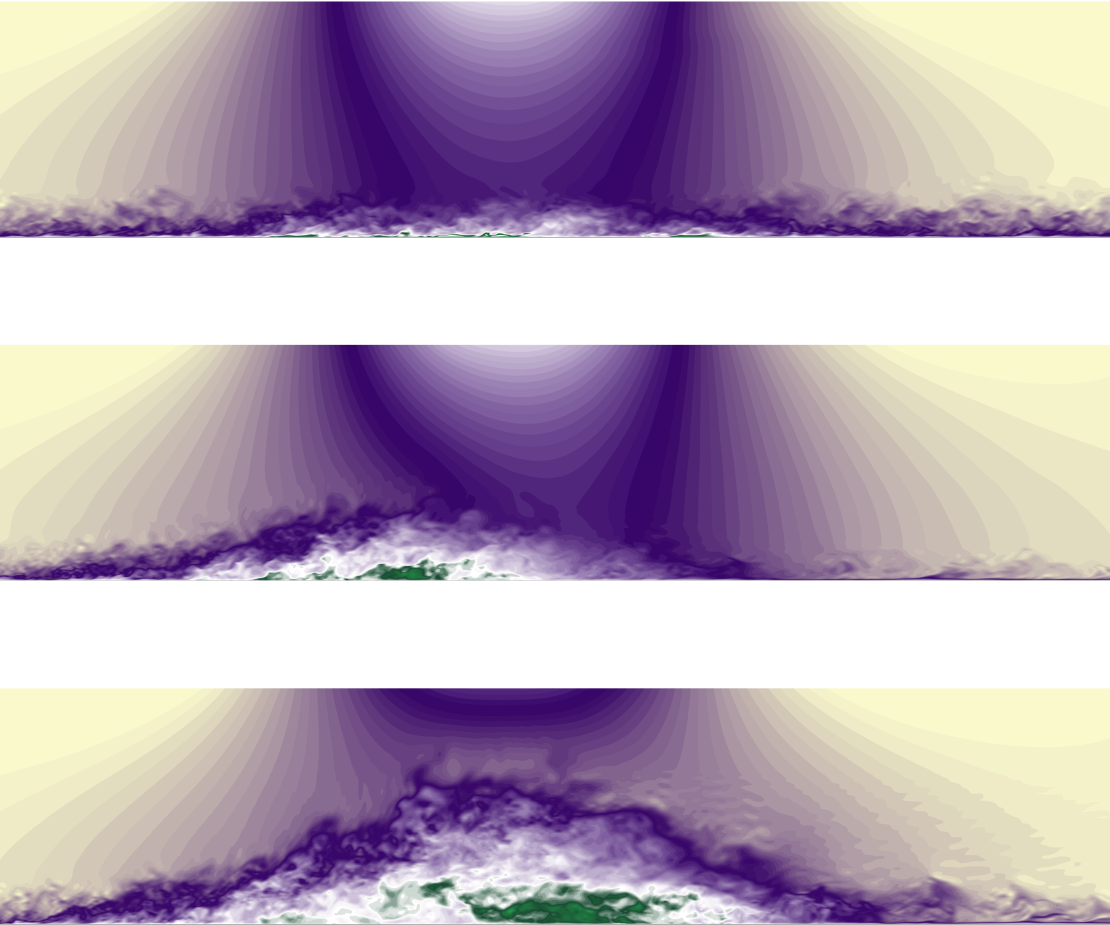
His research program centers on advancing the understanding of turbulent boundary layer physics under unsteady pressure gradients. Dr. Ambrogi's team leverages modern computational tools, particularly large-eddy simulations, to investigate separated turbulent boundary layers and large-scale coherent structures. These structures are pivotal for the transport of mass, momentum, energy, and contaminants in turbulent flows. His work has significant implications for engineering applications such as turbulent mixing, heat diffusion, and contaminant transport in the atmosphere, with direct relevance to turbine blades, rotor blades, and biomimetic systems for flow control.
Dr. Ambrogi's recent publications demonstrate a consistent research trajectory focused on unsteady boundary layer separation phenomena, showing increasing sophistication in handling complex unsteady flow physics. His work combines rigorous computational methods with practical applications in aerodynamics and flow control, particularly examining how time-varying freestream conditions affect boundary layer separation and how turbulent kinetic energy is advected in these complex flows.
Dr. Ambrogi has secured funding through the Natural Sciences and Engineering Research Council of Canada (NSERC-CRNSG) under the Discovery Grant Program, with computational support provided by the Digital Research Alliance of Canada. His educational initiatives include ARC4CFD, an open-source course designed to bridge the gap between small-scale CFD simulations and large-scale computations on high-performance computing systems.
As director of the FEBUS lab at Queen's University, Dr. Ambrogi leads research that combines fundamental fluid dynamics with practical engineering applications. The lab's work spans from theoretical investigations of flow separation mechanisms to the development of computational tools for practical engineering problems in aerospace and bio-inspired systems.
Find Francesco Ambrogi elsewhere
Related Searches
You Might Also Like
- DDan HenningsonKTH Royal Institute of Technology · Professor
- AArdeshir HanifiKTH Royal Institute of Technology · Researcher
- HHrvoje KozmarUniversity of Zagreb · Professor
 Yendrew YauwenasUniversity of New South Wales · Researcher
 Parviz MoinStanford University · Professor
 Feng GaoUniversity of Surrey · Academic