
About
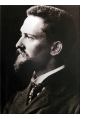
Felix Hausdorff (1868–1942) was a preeminent German mathematician and philosopher, renowned for foundational contributions to topology, set theory, and measure theory. He held academic positions at the University of Leipzig, University of Bonn, and University of Greifswald, culminating in a full professorship at Bonn from 1921 until 1935. His seminal work Grundzüge der Mengenlehre (1914) established topology as a distinct mathematical discipline.
Education: Born in Breslau, he studied and later habilitated at the University of Leipzig. He transitioned from an associate professor (1901–1910 in Leipzig) to full professorships in Greifswald (1913) and Bonn. His academic career was interrupted by Nazi persecution, leading to his tragic suicide in 1942.
Research Interests: Hausdorff’s work spanned topology, set theory (e.g., Hausdorff dimension), measure theory (Hausdorff measure), functional analysis (moment problems), and algebra (Baker-Campbell-Hausdorff formula). He also contributed to probability theory and insurance mathematics. Under the pseudonym Paul Mongré, he authored philosophical essays, poetry, and the acclaimed play Der Arzt seiner Ehre.
Publications: Over 70 works, including foundational papers on ordered sets, descriptive set theory, and topological spaces. His posthumous manuscripts and correspondence are preserved in the Hausdorff Edition project at the University of Bonn.
Find Felix Hausdorff elsewhere
Related Searches
You Might Also Like
- MMarkus PrimRhenish Friedrich Wilhelm University of Bonn · Researcher
- TThomas BeckerRhenish Friedrich Wilhelm University of Bonn · Professor
- NNorbert LangerRhenish Friedrich Wilhelm University of Bonn · Professor
- RRayk BehrendtRhenish Friedrich Wilhelm University of Bonn · Professor
 Markus WagnerRhenish Friedrich Wilhelm University of Bonn · Professor
- MMarion RoehmerRhenish Friedrich Wilhelm University of Bonn · Researcher