
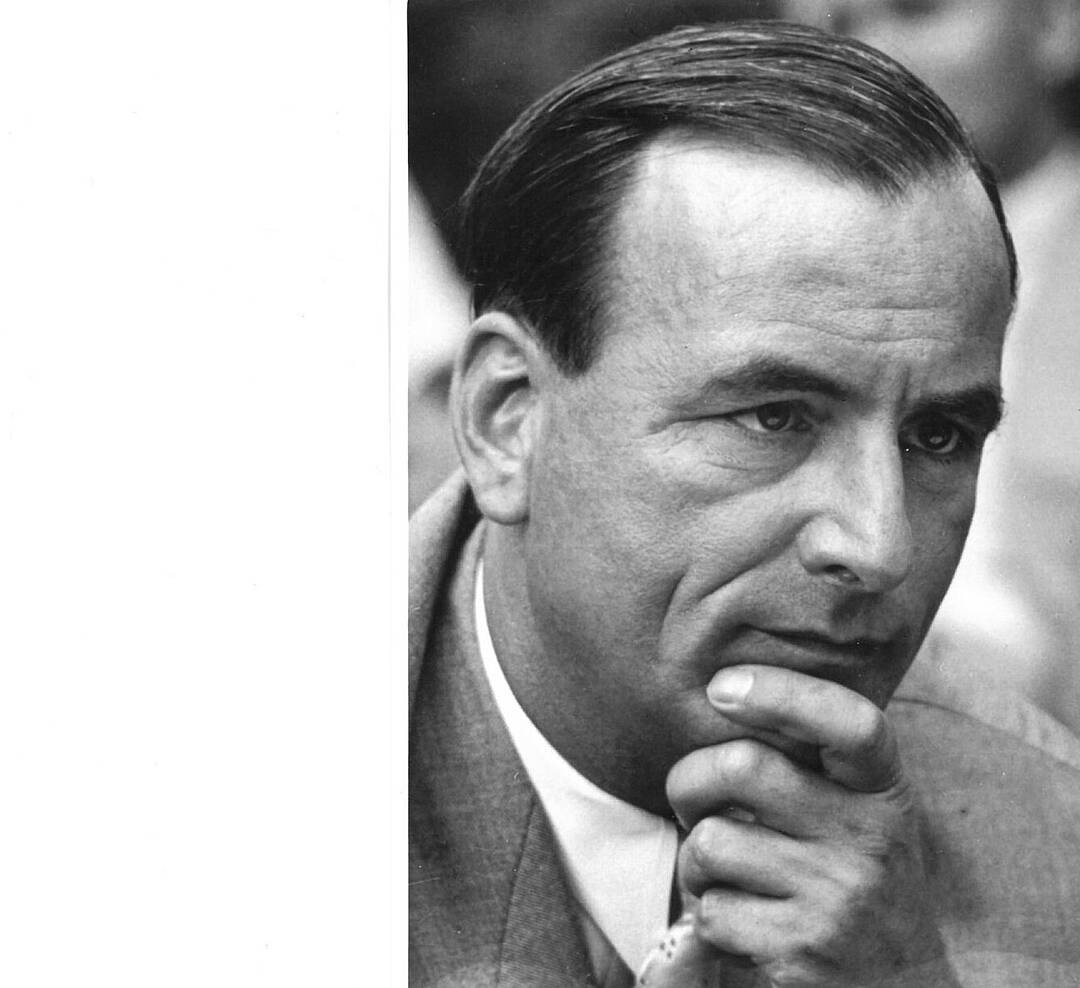
About
Ernst Ruska was an adjunct professor at Technische Universität Berlin (awarded 1959) and a pioneering physicist whose foundational work in electron microscopy revolutionized scientific imaging. His academic journey began at Technische Hochschule zu Berlin (now TU Berlin), where he developed the theoretical framework for electron optics under Professor Adolf Matthias. Key contributions include inventing magnetic lenses and constructing the first high-resolution electron microscope (1933). He shared the 1986 Nobel Prize in Physics with Gerd Binning and Heinrich Rohrer.
Education: Studied electrical engineering at TU Berlin (1928–1933), completed his PhD in 1933, and earned habilitation in 1944. Post-academia, he led electron microscopy development at Siemens (1937–1955), co-founded the Siemens electron microscope production line, and later directed the Institute of Electron Optics at the Fritz Haber Institute (1945–1974).
- Key Achievements: Invented the electron microscope, enabling magnification beyond light microscopy limits (12,000x in 1933)
- Legacy: Pioneered industrial applications of electron optics and collaborated with his microbiologist brother Helmut Ruska to refine microscopy techniques
His research bridged engineering and physics, focusing on optimizing electron beam control, resolving material structures at atomic scales, and advancing semiconductor and materials science through imaging innovations.
Find Ernst Ruska elsewhere
Related Searches
You Might Also Like
 Ralph ErnstorferLeibniz Institute of Agricultural Development in Transition Economies · Professor
- AAlexander Viktorovich KarpovTechnical University of Berlin (TU Berlin) · Assistant Professor
 Iwan RudiartoTechnical University of Berlin (TU Berlin) · Professor
 Tim PolzehlTechnical University of Berlin (TU Berlin) · Researcher
- EEdith ElkindTechnical University of Berlin (TU Berlin) · Professor
 Tim Christian ReseTechnical University of Berlin (TU Berlin) · Researcher