

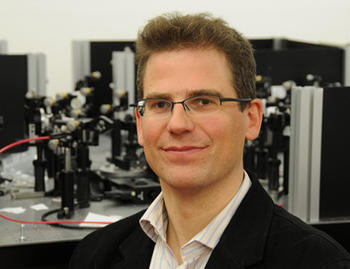
Daniel Schick
Researcher · Ultrafast Magnetism
Max Born Institute for Nonlinear Optics and Short Pulse SpectroscopyAbout
Dr. Daniel Schick is a Leibniz Junior Research Group Leader at the Max Born Institute for Nonlinear Optics and Short Pulse Spectroscopy in Berlin, Germany. His research focuses on ultrafast magnetism, spin dynamics, and coherent phonon interactions in nanoscale systems. He leads the group Complex Spin Structures in Time and Space, contributing to projects 3.2 and 3.3 on solids, nanostructures, and transient structures. His work integrates resonant magnetic scattering, XMCD spectroscopy, and ultrafast X-ray techniques to explore antiferromagnetic systems and spin-phonon coupling.
Education:
- Ph.D. in Physics (2013), University of Potsdam
- Diploma in Physics (2009), University of Rostock
- Erasmus exchange (2006), Umeå University
Research Interests:
Dr. Schick investigates ultrafast magnetization dynamics using extreme ultraviolet (XUV) and soft X-ray spectroscopy. Key areas include the interplay between spin and phonon dynamics in antiferromagnetic materials, element-specific probing of magnetic moments, and time-resolved X-ray scattering for studying transient structures. His experimental tools include laser-driven plasma sources and tabletop setups for picosecond time resolution.
Articles Trends (2022–2025):
Recent work emphasizes ultrafast magnetism in nanoscale systems, with breakthroughs in observing spin reorientation in multiferroics and quantifying ultrafast spin dynamics. Studies on multi-THz phonons and all-optical switching highlight advancements in coherent control of magnetic and structural phases. The use of resonant four-wave mixing and XUV transient gratings expands capabilities for nanoscale spin wave imaging.
Grants & Advising:
No specific grants are listed, but his role as a junior group leader implies ongoing funding. No student advisees are documented here.
Labs/Teams:
Maintains the Electron and Spin Dynamics group (B1) at the Max Born Institute, collaborating with synchrotron facilities (e.g., BESSY II) and international institutions like ICFO (Barcelona). Key tools include picosecond laser-driven X-ray sources and advanced time-resolved setups.
Find Daniel Schick elsewhere
Related Searches
You Might Also Like
 Stefan EisebittMax Born Institute for Nonlinear Optics and Short Pulse Spectroscopy · Professor
- CChristian Stefan StrueberMax Born Institute for Nonlinear Optics and Short Pulse Spectroscopy · Researcher
 Matias BargheerLeibniz Institute of Agricultural Development in Transition Economies · Professor
 Holger StielMax Born Institute for Nonlinear Optics and Short Pulse Spectroscopy · Researcher
 Martin HenneckeMax Born Institute for Nonlinear Optics and Short Pulse Spectroscopy · Researcher
 Urs StaubPaul Scherrer Institute · Researcher