About
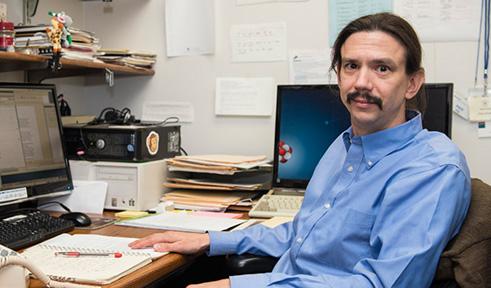
Brian Quinn is a Professor of Physics at Carnegie Mellon University's Mellon College of Science, where he has served on the faculty since 1988, achieving indefinite tenure in 1996 and full professorship in 2001. His research focuses on the intersection of nuclear and particle physics through quark interaction studies.
Education
- Ph.D. in Physics, Massachusetts Institute of Technology (1984)
- B.Sc. in Physics, McGill University, Canada (1978)
Research Focus
Professor Quinn's work explores non-perturbative quantum chromodynamics through precision experiments at Jefferson Laboratory. His research program investigates hadron structure, strangeness content of nucleons, parity violation effects, and neutron radius measurements using electron and photon beams. Key contributions include leadership in the G0 and HAPPEX-III parity violation experiments and development of advanced instrumentation for nucleon form factor studies.
Publication Trends
His 2006-2016 publications reveal a consistent focus on precision measurements at Jefferson Lab, particularly through parity-violating electron scattering. Major themes include determination of strange quark contributions to the proton, neutron radius measurements in lead-208, and high-precision nucleon form factor studies. Instrumentation development for polarimetry and calorimetry constitutes approximately 40% of his recent work, reflecting his dual expertise in physics analysis and detector design.
Scientific Awards
- No specific awards mentioned in source material
Advising and Research Leadership
Professor Quinn has advised graduate students including Megan Friend (thesis on Compton polarimetry for HAPPEX-III). His research is conducted through major Jefferson Lab collaborations including G0, HAPPEX, MOLLER, and nucleon form factor experiments. He led CMU's design and prototyping of the hadron calorimeter for high-precision form factor measurements, securing significant experimental resources through these collaborations.
Research Group
He leads the Carnegie Mellon Quark Interaction group, which has contributed to diverse experiments using anti-protons, kaons, pions, photons, and electrons. The group specializes in detector development, data acquisition systems, and complex data analysis, with CMU graduate students consistently taking leadership roles in experimental execution and interpretation.